Automatic Bagging Machine & Palletizing Systems Manufacturer

Category: Articles

  • How a Russian Salt Producer Turned a ppline Bulk Bagging Area Into a Clean Flow From Filling to Palletizing

    How a Russian Salt Producer Turned a ppline Bulk Bagging Area Into a Clean Flow From Filling to Palletizing

    For a Russian salt producer, the problem was not only bagging speed. The real bottleneck was the distance between the filling point, the transfer conveyor, and the pallet zone. The ppline bulk bagging line answers that problem by keeping the flow visible, guided, and physically separated from the traffic around it.
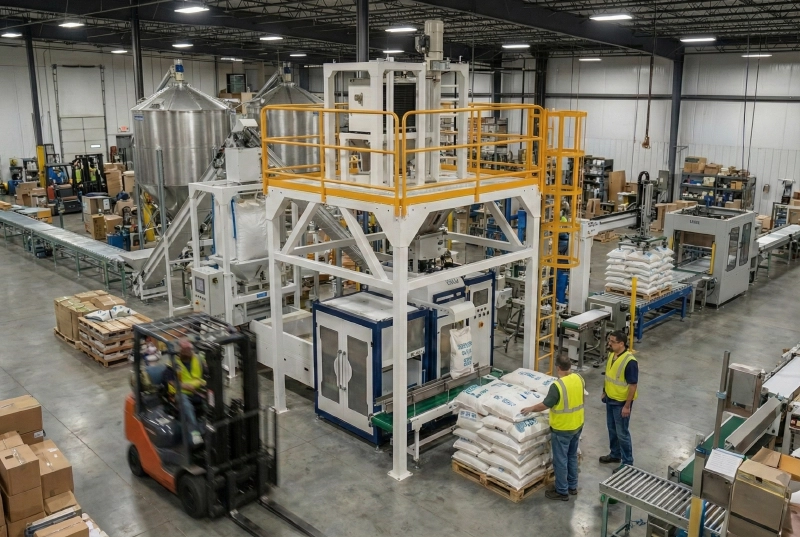
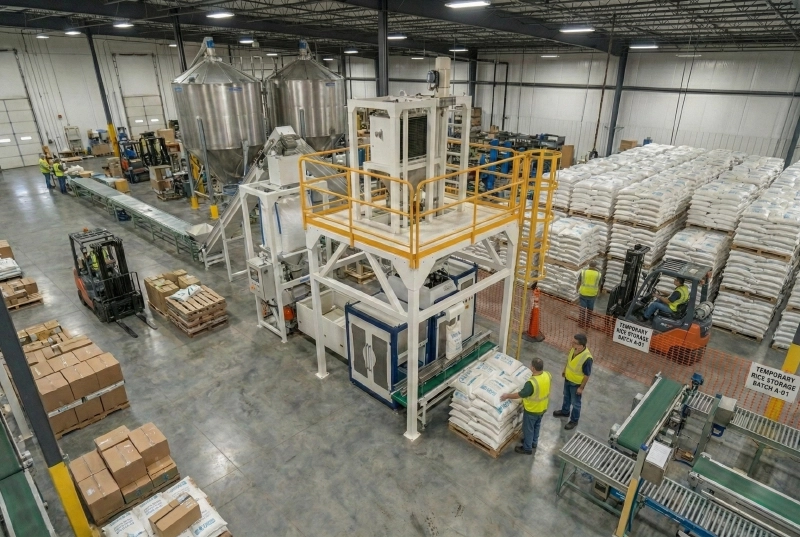
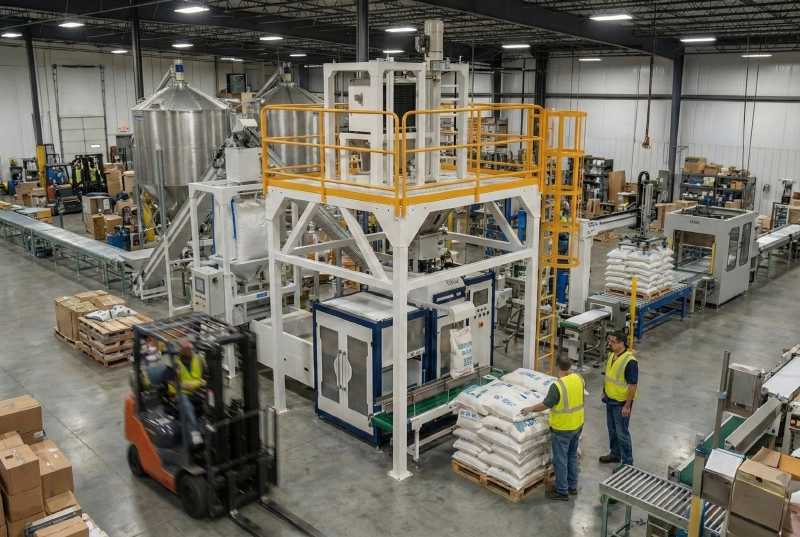
    High-angle view of a ppline bulk bagging line with QZK-1200 packaging station, forklift logistics, and pallet flow
    The old issue:

    When bulk sacks move through a loosely arranged area, operators start compensating for the layout. Bags get re-aligned by hand, forklifts cut through the same corridor, and the last meters before palletizing become a stop-and-go zone. Output looks fine on paper, but the line loses rhythm on the floor.

    Why the ppline layout fits this exact scenario

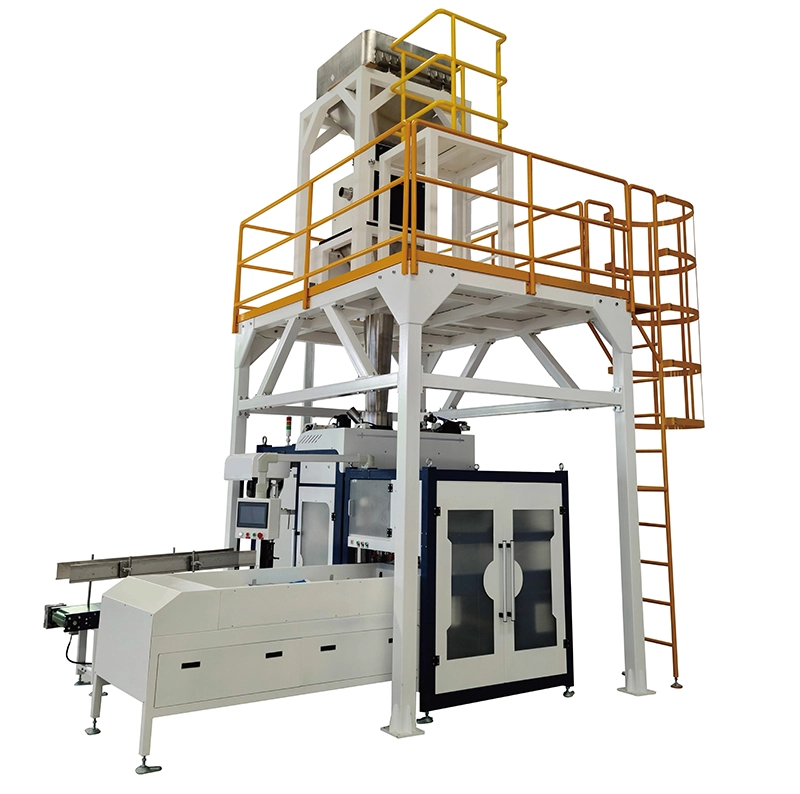
    The ppline line is built around a steel tower, a guided discharge path, and a transfer zone that is easy to read from the operator side. In the field photos, the QZK-1200 station sits high enough to keep the packaging area clear, while the conveyor route carries sacks away without forcing extra turns or manual lifts. That matters for bulk products because every extra turn creates a chance for bag swing, label damage, or product spill.

    For the salt producer, this meant the packaging point could stay focused on filling, while the downstream flow handled the bag transfer and the pallet rhythm as one connected sequence. The machine area becomes easier to supervise, but it also becomes easier to maintain because the access path is not buried under the product flow.
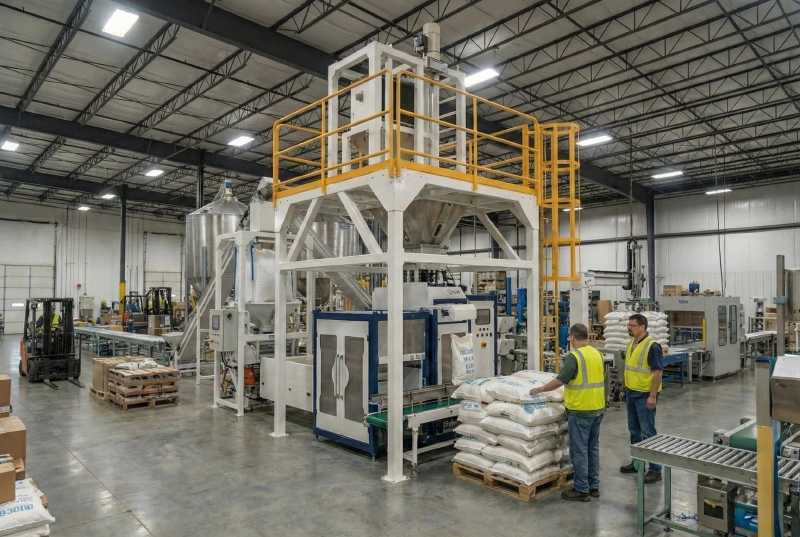
    Operating ppline bagging station with steel safety cage ladder, conveyor, and operators stacking sacks

    BPM Engineering Insight: On a bulk bagging line, the fastest way to create more throughput is often not a faster filling head. It is a cleaner handoff between the filling point, the guided outfeed, and the palletizing zone. Once the handoff is stable, the line stops wasting time on correction moves.

    What the structure is doing at each step

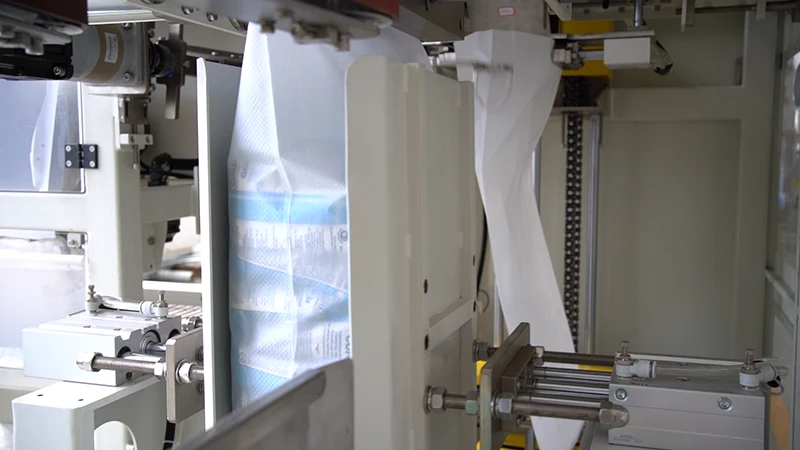
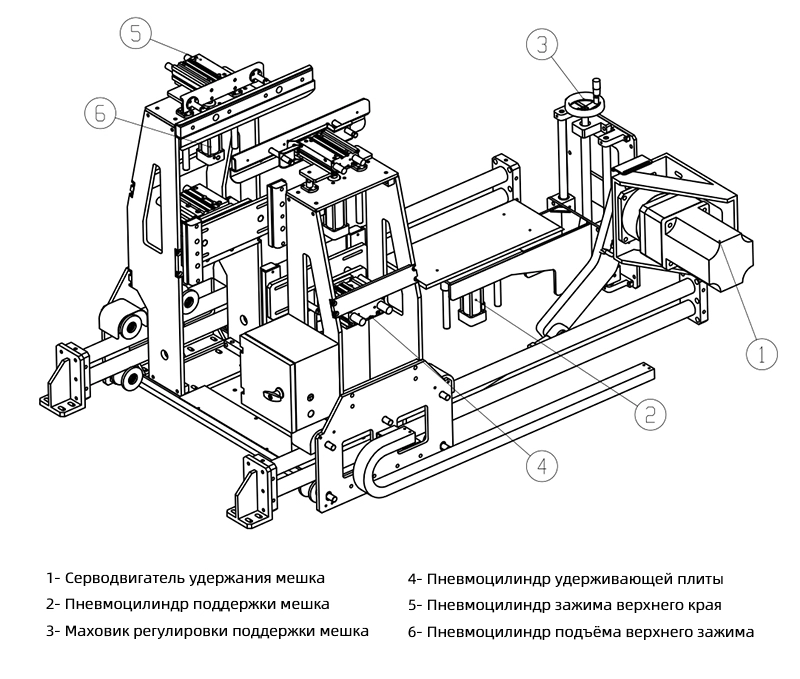
    The structure evidence is visible in the image set. The CAD view shows a modular arrangement with an accumulation belt, a bag gripper, and a discharge conveyor. The close-up assembly view shows the clamping and bottom support logic that keeps the sack aligned before it leaves the station. The operational photo confirms the same idea in real production: the sack is not wandering through the line; it is being guided through it.

    This is why the line suits bulk products rather than only one narrow material. Salt, grain, and other free-flowing materials all punish unstable transfer points. If the bag orientation changes too early, the rest of the process starts fighting gravity, not using it.
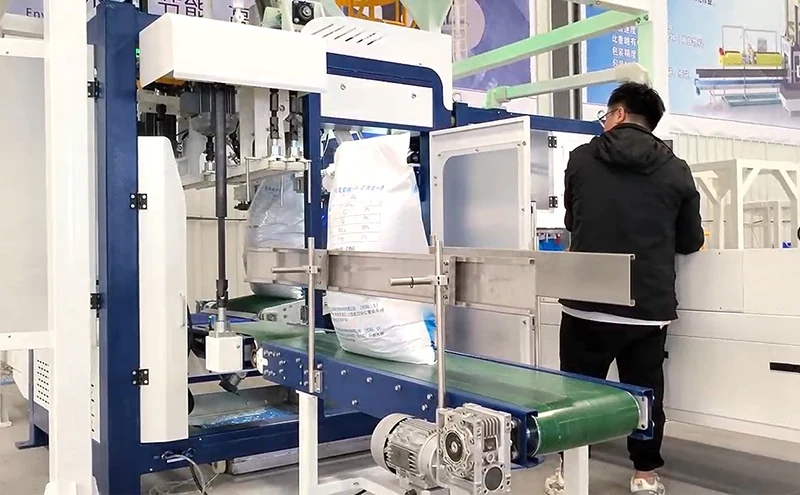
    Bag transfer conveyor with steel frame and guide rails carrying sacks toward palletizing
    Old problemppline responseResult on the floor
    Bag swing and re-handling after fillingGuided outfeed conveyor with a fixed transfer pathCleaner movement from the filling point to the pallet zone
    Cross-traffic around the machineElevated steel tower and separated operating laneLess interference from people, forklifts, and moving sacks
    Unstable bag alignment before dischargeBag clamping and bottom support assemblyMore consistent sack position and fewer correction steps

    What the CAD views prove before the machine is even running

    The technical drawings are not decoration. They show how the line is built to keep the bag path predictable. The modular layout puts the accumulation belt, bag gripper, and discharge conveyor in a straight logic chain, which is exactly what a bulk products line needs when the goal is stable transfer instead of random handovers. The bag clamp and bottom support detail adds another layer of control right where sacks normally begin to deform.
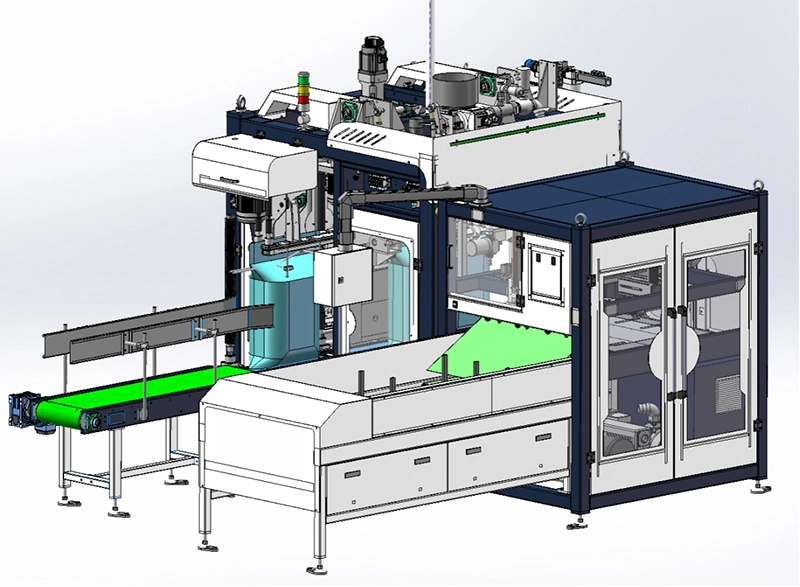
    3D CAD view of a modular ppline bulk bagging line with accumulation belt, bag gripper, and discharge conveyor
    Technical CAD detail of bag clamping and bottom support assembly for the ppline bulk bagging line

    For a salt producer, that detail translates into less guesswork during daily operation. The operator can see where the bag enters, how it is held, how it exits, and where it should land next. That visibility reduces hesitation, and reducing hesitation is often what keeps a line from becoming a bottleneck.

    FAQ

    Why does the transfer zone matter so much on a bulk bagging line?

    Because the transfer zone is where the process either becomes continuous or turns into a series of corrections. If that area is guided well, the downstream pallet work stays predictable.

    Why is the elevated tower useful for a salt producer?

    It keeps the machine structure above the traffic path, improves access for maintenance, and helps separate packaging motion from forklift movement and manual sorting.

    If you need a bulk bagging layout that keeps filling, transfer, and palletizing in one clean flow, ask for a ppline line review before the next bottleneck shows up on the floor.
    Request a layout review

  • Why a Salt Producer Should Treat Bag Orientation and Labeling as One Flow

    Why a Salt Producer Should Treat Bag Orientation and Labeling as One Flow

    For a southern Russian salt producer, the hard part was never the filling step alone. The real problem was what happened after the bag left the sealer: the bag needed to stay stable, readable, and ready for palletizing without a second round of manual handling. That is exactly the zone where bpmpack ppline earns its place.

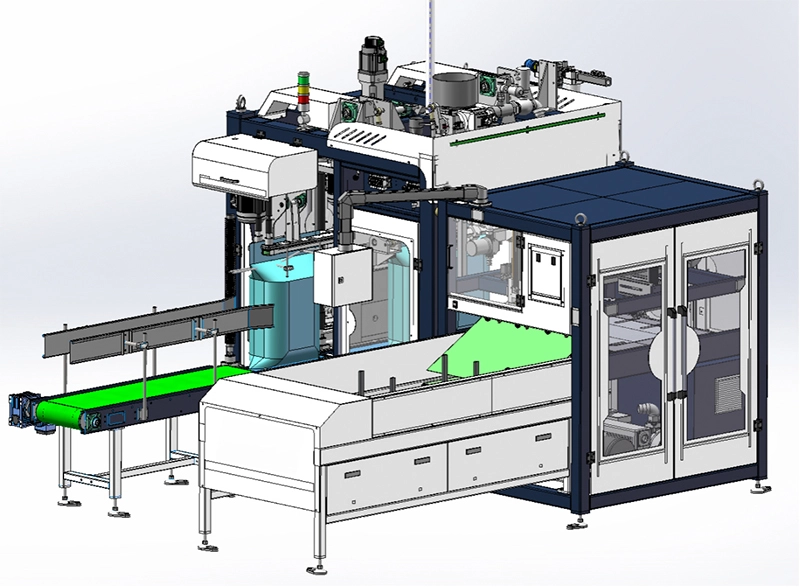
    Isometric product photo of QZK-1200 bagging machine showing swing-arm HMI touchscreen panel, outfeed belt conveyor, and platform.
    The bottleneck is usually downstream, not inside the filler.

    On dense mineral products like salt, the bag may leave the sewing or sealing head correctly but still arrive at the palletizer with a poor orientation, a shifted label, or a shape that needs to be corrected by hand. Once that happens, line speed drops, bag quality becomes inconsistent, and the whole packaging room starts depending on operators to fix what the machine should have controlled.

    The first meter after sealing decides whether the line stays stable

    ppline is built around a simple idea: pre-made heavy bags should not be treated as isolated stations. The bagging machine, outfeed conveyor, turner, inspection point, and palletizing handoff all belong to the same flow. In project examples, the line family covers common heavy-bag ranges such as 5-50 kg and 7-30 kg, with speeds from around 700 bags/hour up to 900+ bags/hour depending on the configuration and material behavior.

    That is why the outfeed section matters so much. If the bag leaves the unit with the wrong posture, the next station has to fight the bag instead of moving it. A clean transfer zone keeps the bag body supported, keeps the printing and label face in the expected position, and makes it easier for the downstream conveyor to send the bag into the palletizing rhythm without interruption.

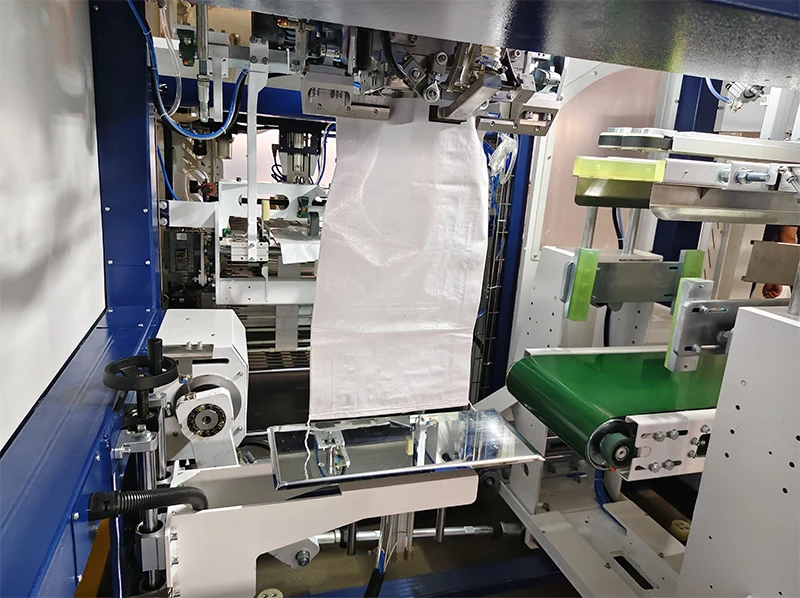
    Close-up internal photo of bagging unit with vacuum suction cups, robotic placing arm, green conveyor, and white woven bag.

    BPM Engineering Insight: On salt projects, the value of automation is not only in filling accuracy. It is in keeping the bag geometry, label position, and downstream transfer behavior consistent enough that the palletizer can run at a fixed pace without manual correction. That is what turns a packaging machine into a line.

    Labeling only works when the bag path is controlled

    A labeler can look impressive on paper and still underperform if the bag is drifting, rotating, or stretching after sealing. For that reason, ppline treats bag orientation and labeling as one control problem. The bag path must be predictable so the label hits the same surface every time, and the bag must reach the inspection point in a posture that the operator can trust.

    This matters even more when the customer wants the line to handle multiple bag types, such as woven bags, kraft paper bags, or composite bags. The packaging room then needs one common downstream logic instead of a separate manual workaround for each bag format. The product brief for ppline is clear on this point: the family is meant to connect packaging, checking, transfer, and palletizing preparation in one line discussion, not as disconnected add-ons.

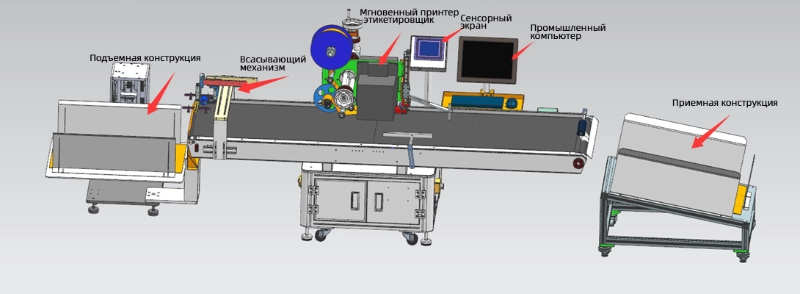
    3D CAD rendering of automatic conveyor labeling system with vacuum applicator, touchscreen and industrial PC.

    Why the frame, control cabinet, and service access still matter in a salt plant

    Salt is unforgiving to weak design choices. Dust, abrasion, and a busy transport area quickly expose machines that are difficult to service or too open to the environment. In a real project, the structure has to support maintenance access, safe walkways, and a stable interface for the operator panel. Depending on the configuration, ppline uses a carbon-steel painted structure with 304 stainless steel on contact parts, plus familiar controls such as PLC and HMI-based operation.

    The benefit is not abstract. It means faster start-up, fewer complaints about access, and less time spent chasing alignment issues. When the operator can see the bag path, understand the alarm, and reach the adjustment points without breaking the line flow, the packaging room becomes easier to run every shift.

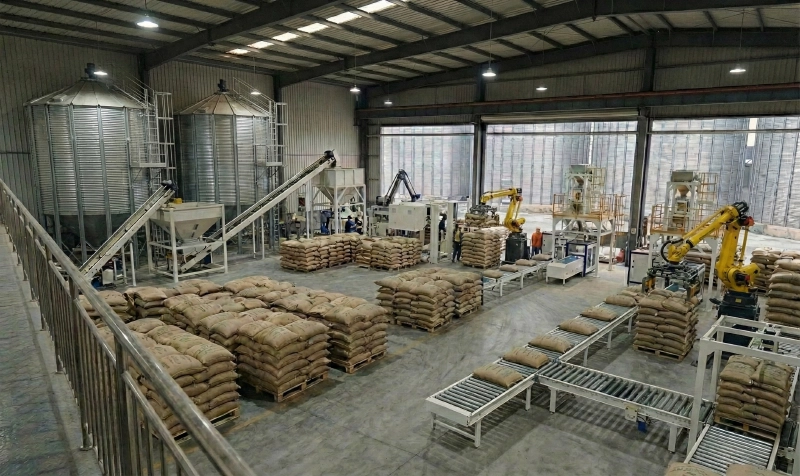
    Detailed 3D render of dual bagging lines with two yellow robotic palletizing arms, roller conveyors, and twin metal storage silos.

    When the line reaches palletizing, the bag must already be “ready”

    That is the logic behind a good secondary packaging line. The output bag should already be oriented, read, and spaced correctly so the palletizer is not forced to rework the product. In the best projects, the downstream conveyor, inspection point, and robot handoff are planned together from day one. This is especially important when the customer wants higher throughput or a compact plant layout where every meter of floor space has to do useful work.

    For a salt producer, that coordination can eliminate one of the most common hidden costs: the labor required to straighten, flip, and re-stack bags before they reach the pallet. Once that manual loop disappears, line rhythm becomes easier to predict, and the shipment area stops acting like a bottleneck.

    Decision pointWhat ppline solves
    Bag posture after sealingControlled outfeed and transfer logic keep the bag stable before the next station takes over.
    Label placement and readabilityThe bag path is coordinated with labeling so the same face is presented consistently.
    Palletizer handoffThe bag arrives in a predictable orientation, which reduces manual correction and keeps throughput steady.

    Frequently asked questions for salt packaging projects

    Can ppline handle salt bags?
    Yes. Salt is a typical mineral-granular application for this line family, provided the bag size, sealing method, and downstream arrangement are defined correctly in the project brief.

    What should be fixed before asking for a quotation?
    Bag weight range, target output, bag material, label position, available floor space, and whether the line ends at a conveyor, a checkweigher, or a robotic palletizer. The more precise the inputs, the easier it is to choose the right downstream modules.

    If your packaging room still depends on manual bag straightening between sealing and palletizing, the problem is usually not the filler alone. It is the missing line logic after it.

    Request Storage Advice

  • Why the Bag Clamp Station Decides the Rhythm of a Salt Packaging Line

    Why the Bag Clamp Station Decides the Rhythm of a Salt Packaging Line

    At a southern Russian salt producer, the problem was not the filling head alone. The line only became unstable when the bag clamp station, the transfer conveyor, and the palletizing crew stopped speaking the same mechanical language. Once the bag mouth starts to move, every downstream action has to compensate for a mistake that should have been prevented earlier.

    Pain point: If the sack is not held flat and centered before discharge, the operator corrects the bag, the conveyor absorbs the wobble, and the palletizing zone loses rhythm.

    The QZK-1200 line is built to reduce that chain reaction. Its job is not only to move product, but to keep the transition zone calm enough that the next step can happen without extra handling.

    High-angle operational photo of QZK-1200 bagging plant featuring twin stainless steel storage silos, conveyors, and active forklifts
    High-angle view of the QZK-1200 packaging plant, showing how upstream storage, bagging, and outbound logistics stay linked in one working system.

    The bag clamp station is where rhythm is protected

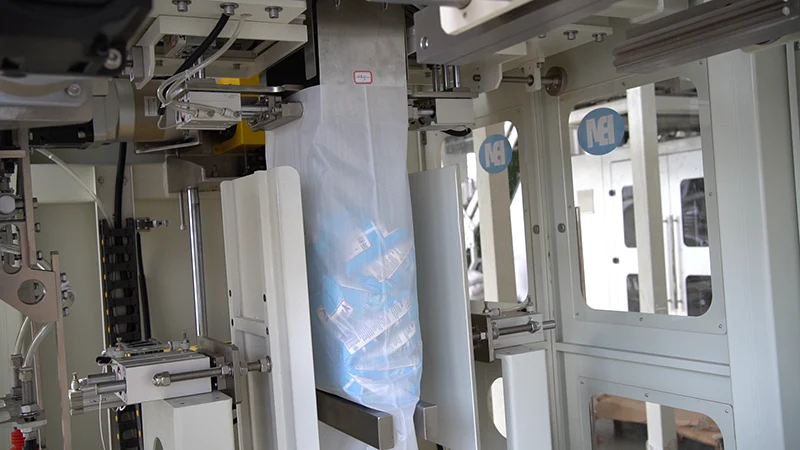
    The most important thing about a bag clamp station is not how dramatic it looks from the outside. It is whether the bag arrives in a repeatable position, is held securely, and leaves the machine with a predictable orientation. The close-up internal image of the bagging unit makes that visible: vacuum suction cups, a robotic placing arm, a green conveyor, and the woven bag all work together in a narrow window where mistakes are expensive.

    Close-up internal photo of bagging unit with vacuum suction cups, robotic placing arm, green conveyor, and white woven bag
    Bag alignment and transfer detail. This is the point where a stable grasp matters more than brute force or raw line speed.
    StationWhat it controlsWhy it matters on a salt line
    Bag clamp / mouth alignmentBag position before dischargeReduces skew, wrinkling, and manual correction
    Vacuum pickup and placingHow the sack enters the transfer zoneKeeps the bag centered and repeatable
    Enclosed frame and access ladderOperator access and service safetySpeeds checks without exposing the line to disorder
    Outbound conveyorTransfer from machine to logistics areaPrevents congestion before palletizing

    Why alignment matters more than raw speed

    Many line owners ask for more throughput first, but speed only helps when the transfer zone is stable. If the bag leaves the machine crooked, the faster conveyor simply moves the problem downstream. In the running line photo, the operators, forklifts, and transport path are all visible at the same time. That is exactly the reality most plants face: the machine is never isolated from the rest of the warehouse.

    High-angle perspective photo of running QZK-1200 packaging line with active forklift logistics and high-visibility operators
    Operational coordination matters. The packaging line, human handling, and forklift movement must stay synchronized or the rhythm breaks.

    For a salt producer, that synchronization is especially important because salt packaging usually runs in a high-usage environment: frequent output, repetitive bag handling, and constant pallet movement. The line cannot depend on improvised corrections every few minutes. It needs a frame, a transfer path, and a discharge point that keep performing the same way on every shift.

    What the machine architecture tells you

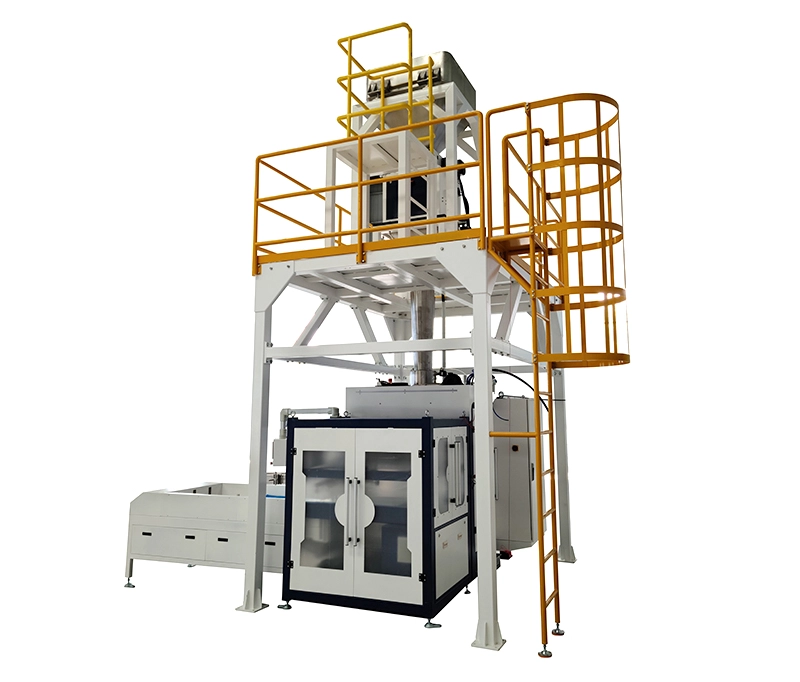
    The front view of the QZK-1200 shows the elements that make this possible: an elevated steel framework, a safety cage ladder, and an enclosed cabinet. These are not decorative features. They create access, keep the machine protected, and support a more disciplined workflow around the bagging tower. When maintenance is easier to reach and the operator path is clear, restart time goes down and the entire line recovers faster after interruption.

    Front view product photo of QZK-1200 automatic bagging machine with elevated steel framework, safety cage ladder, and enclosed cabinet
    Structural clarity helps plant teams understand the machine quickly: platform, access, enclosure, and discharge path are all visible in one frame.

    Expert note: If a salt line is losing time between filling and palletizing, the first question should not be “Can we run faster?” It should be “Is the bag being held, centered, and transferred cleanly enough to let the next station do its job?” That is where the QZK-1200 architecture earns its value.

    What to specify before you plan an upgrade

    • Bag handling stability: define how the sack is held at the mouth, not just the target output rate.
    • Transfer visibility: make sure the operator can see the discharge path and react quickly when a bag drifts.
    • Maintenance access: prioritize access to the frame, cabinet, and service points so downtime stays short.
    • Logistics handoff: design the conveyor and forklift zone together, because pallet removal is part of the line rhythm.

    That is the lesson from this southern Russian salt project: the last meters matter. A line becomes reliable when the bag clamp station, the transfer conveyor, and the warehouse flow are built as one system, not as three separate jobs.

    Request a line review for your bagging and transfer zone

  • What a Siberian Salt Plant Solved at the Last Meter of Secondary Packaging

    What a Siberian Salt Plant Solved at the Last Meter of Secondary Packaging

    For salt producers, the most expensive problems are often not in the filler itself. They show up at the last meter: when the bag leaves the primary packer, loses shape, picks up air, and reaches the sewing head too loosely to build a dense, stable pallet. That is where a well-built secondary packaging line changes the economics of the whole plant.

    Dosing hoppers of packaging line with automated bucket elevator conveyor in background
    The hidden problem is not speed.

    If the bags arrive uneven, inflated, or contaminated with fine salt dust, the line can still be fast and still fail. The result is weak bag geometry, unstable stack height, and a pallet that wastes space long before it reaches the truck.

    1. The transfer zone decides whether the line stays clean or starts leaking value

    On a modern salt line, the transfer zone is not a passive bridge between primary filling and secondary packing. It is the place where bag flow is buffered, aligned, checked, and prepared for compression. If the upstream buffer runs dry, the whole line begins to stutter. If the buffer runs too loose, bags float with trapped air and the downstream seam takes unnecessary stress.

    That is why the upstream hardware matters so much. In a salt plant, the dosing area must stay stable even under corrosive and dusty conditions. With 316L contact surfaces, a protected control cabinet, and a layout that keeps the feed pool full, the line stops behaving like a chain of separate machines and starts acting like one coordinated system.

    Upper auger dosing systems and structural columns of four VFFS machines

    BPM Engineering Insight: The gain is never just “more bags per minute.” The real gain comes from reducing giveaway, keeping the transfer zone stable, and protecting the line from chloride-driven wear. That is how a plant moves from short-term throughput thinking to a real 18-20 month payback model.

    2. Why compression before sewing changes the pallet, not just the seam

    When a woven secondary sack is filled, it is usually still too soft. Air pockets make the bag look full, but they reduce stack density. The bag may survive the sewing step, yet the pallet becomes taller, looser, and more likely to shift during transport. In salt logistics, that is where the hidden cost lives: the plant pays to move air instead of product.

    Compression before sewing solves this in a mechanical way. Side clamping, controlled push plates, and a guided discharge path force the bag body into a flatter shape before the needle head closes the top. The seam is easier to keep consistent, but the bigger win is downstream: better pallet geometry, higher cube utilization, and fewer complaints about bag slippage in storage or transit.

    Loaded secondary woven PP sack compressed by pneumatic side clamping plates

    3. The sewing head only performs well when the upstream flow is already disciplined

    Many buyers look at the sewing head as the last decisive component. In reality, it is the final proof that the whole upstream layout is working. If the bag is overinflated, misaligned, or arriving with irregular tension, the sewing head cannot “fix” the process. It can only close what the line has already prepared.

    That is why a salt plant needs a full system view. The target is not a neat stitch alone. The target is a stable 20 kg to 50 kg secondary pack that can run at production speed, stay within control tolerance, and maintain the shape required for safe stacking. On the BPMPack side, that means the line is designed around flow discipline, not isolated machine promises.

    Industrial Newlong sewing machine head stitching the opening of filled woven sack
    What the plant needsWhat the line provides
    Stable transfer after primary fillingBuffered flow, full feed pool, and a controlled handoff into the secondary unit
    Resistance to salt corrosion316L contact parts, protected electrical enclosure, and corrosion-aware construction
    Dense pallets and lower freight wasteCompressed bag geometry, better stacking, and a practical path toward 1.2 t pallets instead of loose 750 kg loads

    Frequently asked questions from salt plants

    Why not just increase the filler speed and leave the rest unchanged?

    Because speed only helps when the upstream and downstream motions are already synchronized. If the bag is still soft at the sewing head, more speed only multiplies the same instability. The better approach is to keep the transfer zone full, compress the bag body, and let the sewing head close a prepared package.

    Can a cheaper 304 machine survive a salt environment?

    Not for long in a chloride-rich plant. Salt attacks weak points first: seams, crevices, and unprotected surfaces. That is why a serious salt line uses 316L contact materials, proper passivation, and a protected cabinet design. The objective is not just to run today; it is to keep the line productive year after year.

    If your salt line still loses control between primary filling and palletizing, BPM can review the layout, bag format, and target pallet density with your team.

    Request a Line Review

  • Why Compression Before the Sewing Head Matters on a Siberian Salt Line

    Why Compression Before the Sewing Head Matters on a Siberian Salt Line

    Why Compression Before the Sewing Head Matters on a Siberian Salt Line

    On a high-humidity salt line, the bag that reaches the sewing head is already deciding the quality of the pallet. If the sack still carries trapped air, if the mouth is not square, or if the transfer is too soft, the seam becomes a rescue job instead of a controlled process. That is exactly where BIBPU helps a Siberian salt producer turn an unstable final meter into a repeatable packaging step.

    Refined salt packets falling into secondary woven PP bag held by pneumatic clamps
    What usually goes wrong at the end of the line

    A filled woven sack may look finished, but if it arrives bulged, loose, or off-center, the sewing head has to fight the bag instead of closing it. That creates crooked stitches, poor mouth alignment, unstable stack geometry, and more manual correction just before dispatch.

    The real job is not closing the bag. It is preparing the bag for closing.

    BIBPU is built around that idea. The line does not treat compression, deaeration, and transfer as optional extras. It uses them as the control points that shape a soft, air-filled bag into a transport-ready unit. In the Siberian salt case, that matters because humidity, salt dust, and chloride exposure make ordinary handling surfaces wear faster and make the bag body more difficult to stabilize.

    The flow starts upstream and stays controlled all the way to the sewing station. The woven bag is supported, its top section is flattened, and the excess air is pushed out before the final stitch. Once that happens, the mouth of the bag stays more consistent, the seam line is cleaner, and downstream palletizing stops inheriting the problem created at the closing station.

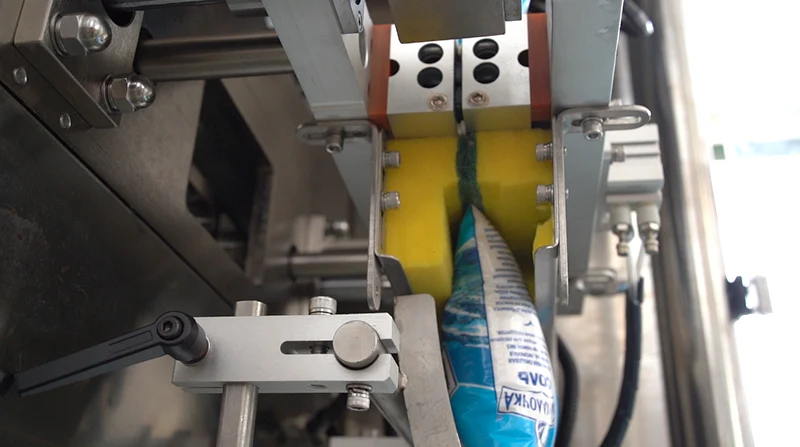
    Soft polyurethane foam guide mechanism on VFFS machine to flatten salt bags

    BPM Engineering Insight: On salt lines, the seam head is not the place to discover shape problems. When BIBPU uses compression and foam-guided deaeration first, the final sewing step becomes predictable instead of corrective. That is the difference between a line that looks busy and a line that actually holds output.

    Why salt makes the last meter harder than it looks

    Salt is abrasive, hygroscopic, and harsh on contact surfaces. If the environment is damp, the outer bag can soften while the product inside still resists the shape you want. If the transfer path is not rigid enough, the bag swells at the wrong point and the mouth wanders before sewing. BIBPU addresses that with stainless contact parts, protected transfer paths, and a compression sequence that keeps the bag body compact instead of puffy.

    This is also why a confluence or transfer section matters. When bags merge into one stable path, the line is less dependent on operator reaction time. The machine keeps the bag on the same centerline long enough for the next action to happen cleanly, whether that action is compression, alignment, or stitching.

    Multi-lane conveyor confluence section with green belt and stainless steel brackets
    Line problemHow BIBPU responds
    Bulging sack mouth before sewingPneumatic compression and foam-guided deaeration reduce trapped air and keep the mouth square.
    High humidity and salt corrosion316L / UNS S31603 contact surfaces and protected structural parts are used where salt exposure is constant.
    Unstable bag flow before palletizingGuided transfer and confluence sections hold the bag on centerline so the sewing and downstream handling stay consistent.

    The sewing head works best when the bag is already under control

    That is why the open sealing and closing components matter. The final closure is only strong when the bag has been conditioned before it reaches the head. A clean approach angle, a flatter top section, and a controlled mouth position let the seam do its real job: sealing, not correcting shape.

    The same logic applies to the full line. If the packaging system can keep a salt bag compact, aligned, and easy to close, the result is not just a neater stitch. It is a more stable pallet, fewer manual interventions, and a line that behaves better under real plant conditions.

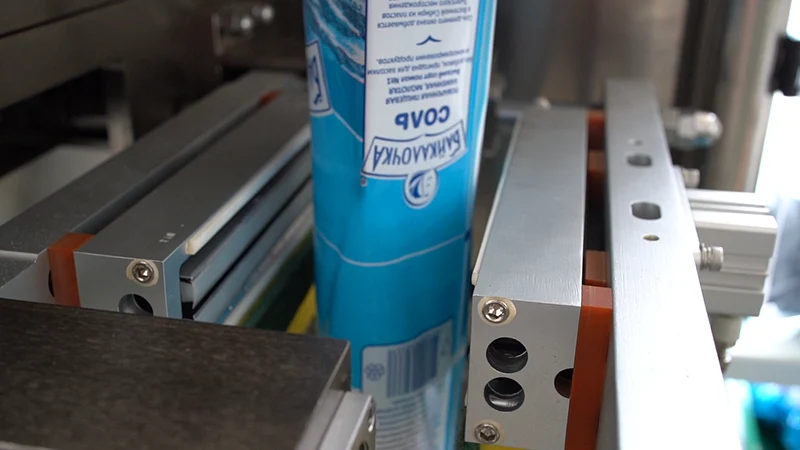
    Open Teflon-coated horizontal sealing jaws of VFFS machine with salt bag

    What a salt producer should expect from a serious end-of-line package

    For a producer working in a corrosive, high-output environment, the target is not simply to close sacks faster. The target is to keep the bag shape stable enough that sewing, handling, and stacking all happen with the same repeatable geometry. That is where BIBPU stands out: it is designed as a packaging control chain, not just a closing machine.

    If the line keeps the bag flat, the seam steady, and the transfer stable, the whole packaging zone becomes easier to run. That is the real value of compression before the sewing head.

    FAQ

    Can a standard bag closer handle salt sacks on its own?

    It can close them, but it cannot reliably correct a bulging or off-center bag. Without compression and deaeration, the stitch area becomes inconsistent and pallet quality suffers.

    Why not let operators fix the bag manually?

    Manual correction slows the line, creates shift-to-shift variation, and does not scale when output rises. A controlled mechanical sequence is more stable and easier to repeat.

    If your salt line still fights bulging sacks, crooked seams, or unstable pallet geometry, BIBPU can be configured around your bag size, humidity level, and output target.

    Request a packaging line review

  • How a Siberian Salt Producer Stabilizes the Transfer Zone Before Palletizing

    How a Siberian Salt Producer Stabilizes the Transfer Zone Before Palletizing

    How a Siberian Salt Producer Stabilizes the Transfer Zone Before Palletizing

    In salt plants, the most expensive problems rarely start at the filler. They show up one step later: film that sticks, bags that bulge, transfer points that skew, and a palletizing zone that keeps waiting for operators to fix what the machine should have controlled in the first place.

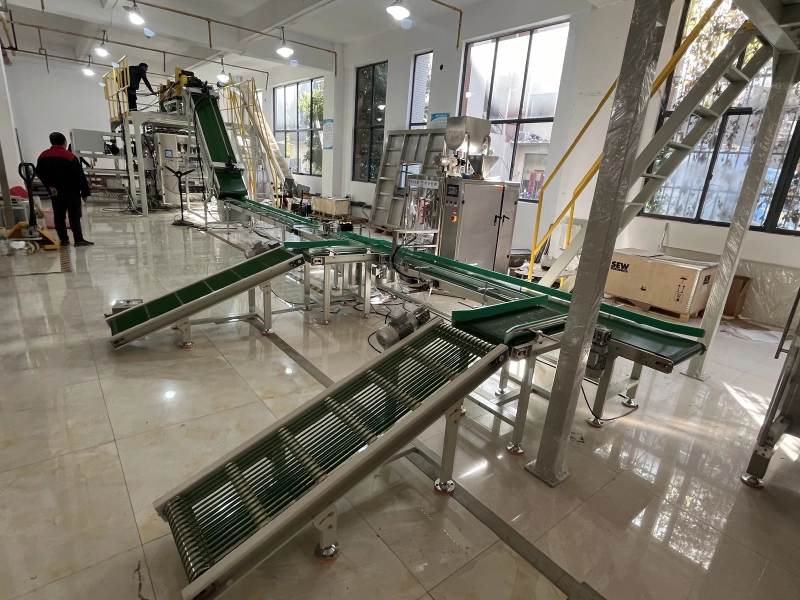
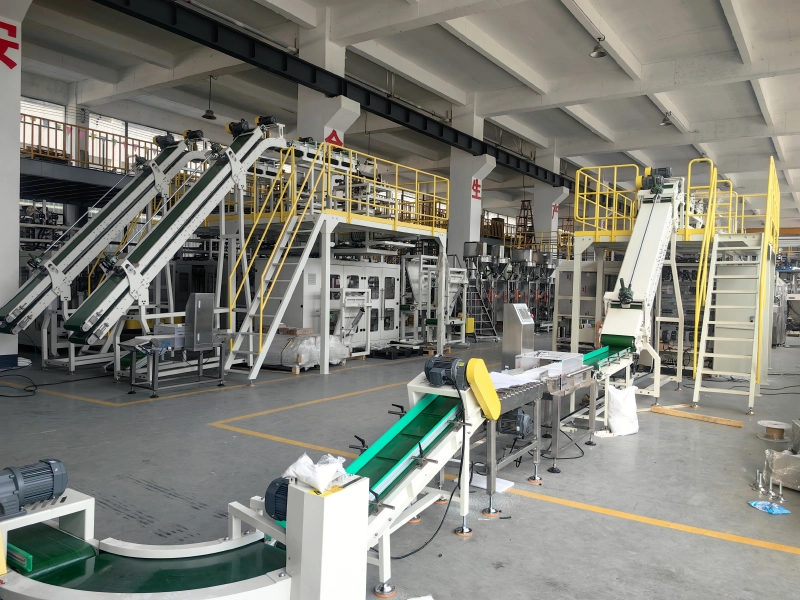
    Automated packaging workshop with inclined belt conveyors, steel platform, and multi-station control cabinets
    Why this matters for a Siberian salt producer:

    Salt is abrasive, moisture-sensitive, and unforgiving when the transfer rhythm breaks. If the bag arrives uneven, the next unit cannot correct the error for free. The result is rework, slower pallet formation, and a line that looks busy while output stays flat.

    1) The transfer zone has to do more than move bags

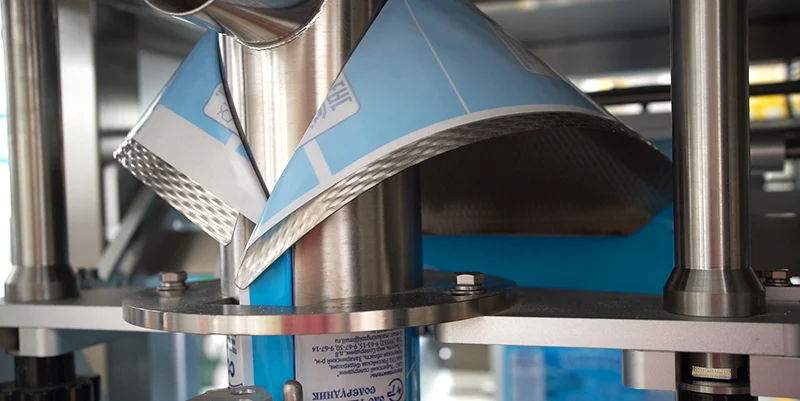
    For secondary packaging, the transfer zone must keep the film centered, protect the bag shape, and hand off each unit without introducing twist. That is why the forming shoulder and film path matter so much. On this kind of line, the dimpled stainless forming shoulder is not a cosmetic detail. It is a practical anti-stick surface that helps reduce web drag when salt-room humidity starts working against the film.

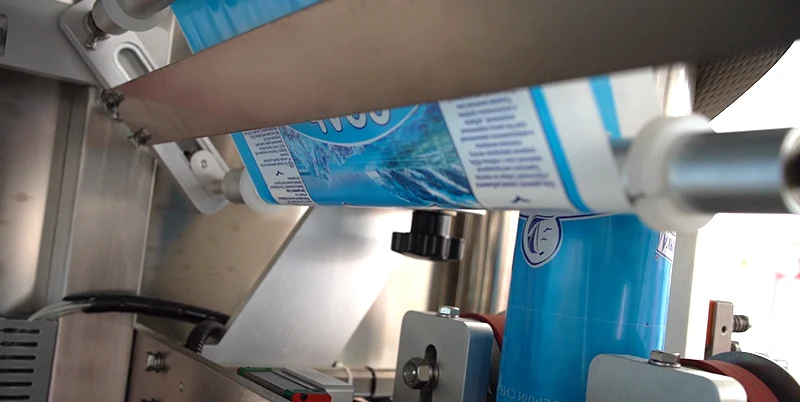
    At the same time, the guide rollers need to keep the web tracking stable so the bag does not wander into the sealing area. When the transfer is steady, the palletizing section receives bags that are already better aligned, easier to group, and less likely to collapse during stacking.

    Dimpled stainless steel forming shoulder of VFFS machine to reduce film sticking
    Aluminum film guide rollers and manual alignment collar on VFFS machine

    BPM Engineering Insight: For salt applications, the machine cannot rely on “operator correction” as a normal operating method. The line needs mechanical alignment, stable film tracking, and corrosion-aware construction. In the BIBPU family, material-contact components are specified for chloride-heavy environments, and the electrical side stays separated from the wet workflow so the transfer zone remains predictable instead of fragile.

    2) Control quality is part of packaging quality

    A stable line is not only about steel and rollers. The operator interface also decides whether a plant can keep pace across shifts. A clear cabinet, fast access to controls, and a readable HMI reduce setup mistakes when the team is dealing with different bag formats, changing throughput targets, or repeated start-stop cycles.

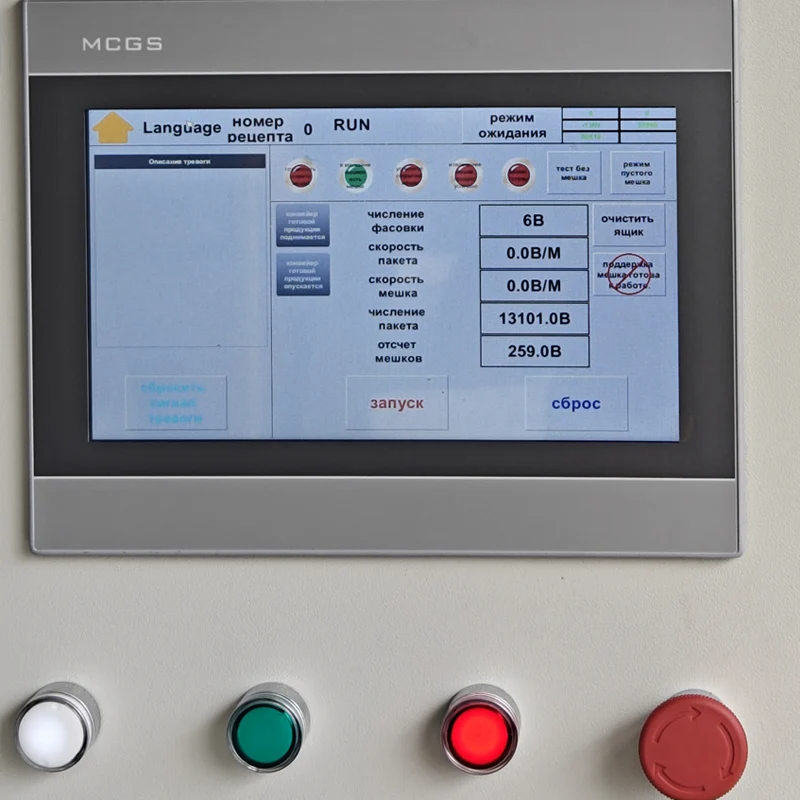
    That is where the cabinet and the screen become part of the process story. A protected electrical enclosure, touch HMI, and a screen that can show packaging parameters in the operator’s working language all reduce the chance of a slow restart after a stop. For a salt producer, that is the difference between a line that recovers in minutes and a line that drifts for the rest of the shift.

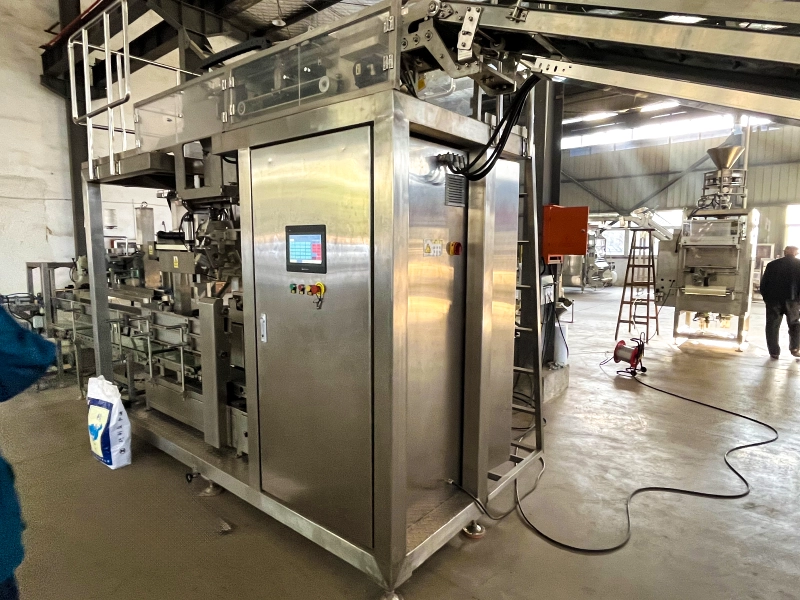
    Stainless steel electrical control cabinet with Siemens touch HMI and tower light
    MCGS industrial touch screen interface displaying Russian language packaging control parameters
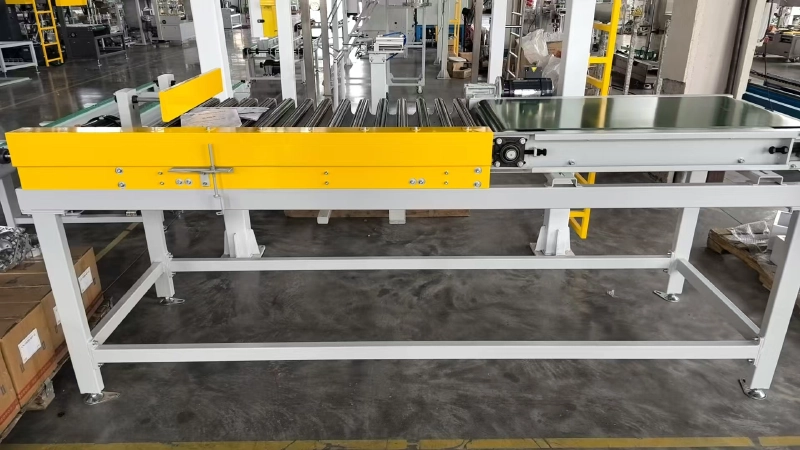
    Steel frame flat belt conveyor with yellow safety steel sheet guards
    Observed line problemWhat BIBPU-style equipment does to contain it
    Film sticks or drags in humid salt-room conditionsDimpled forming shoulder and controlled film path reduce contact resistance and help the web stay stable.
    Bags arrive skewed at transfer pointsGuide rollers and aligned conveyors keep the bag centered before the next process step.
    Operators lose time after start-stop interruptionsProtected cabinet layout and readable HMI shorten reset time and make setpoints easier to verify.
    Corrosive atmosphere attacks exposed hardwareSalt-facing components are built for harsh environments, with corrosion-aware material selection on contact surfaces.

    3) The best salt line does not feel busy; it feels controlled

    In a well-designed packaging area, the transfer zone, the control cabinet, and the conveyor layout all work together. The workshop image tells the same story: steel platform access, grouped control cabinets, and a layout that keeps the machine line readable for maintenance teams. That matters because line stability is not a single machine feature. It is the sum of alignment, guard design, operator clarity, and the way each bag is handed to the next unit.

    For a Siberian salt producer, the practical goal is simple: keep the bags moving, keep the geometry consistent, and keep the palletizing section from becoming a manual rescue station. Once the line does that, the factory gets more than higher throughput. It gets lower fatigue on operators, fewer corrections at the end of the line, and a packaging workflow that behaves like a system instead of a collection of separate machines.

    FAQ

    Can this kind of line handle only salt?

    No. Salt is a strong reference case because it exposes moisture, corrosion, and flow-control weaknesses quickly, but the same transfer and control logic also supports other granular bulk products. The exact setup depends on product flow, bag format, and target output.

    Why not solve transfer problems with more manual inspection?

    Manual checks are useful for QA, but they do not fix unstable mechanics. If the film path, guide rollers, conveyor handoff, and operator interface are built correctly, the line needs fewer interventions and spends more time producing saleable bags.

    If your salt plant is losing time at the handoff between filling, sealing, grouping, and palletizing, BPM can help you map the weak point and choose the right BIBPU configuration for the job.

    Request a Packaging Line Review

  • The Missing Step in Salt Dispatch: Secondary Packaging That Keeps Pouches Together

    The Missing Step in Salt Dispatch: Secondary Packaging That Keeps Pouches Together

    For a major salt producer in Siberia, the real risk is not the seal on a single pouch. The risk is what happens after the pouch leaves the filler: scuffs, dust, bag drift, unstable stacks, and extra hand touches before dispatch.

    That is why the final step matters. A bag-in-bag system turns loose finished pouches into a transport unit that can be moved, stored, and loaded with less damage. In practice, it gives the warehouse team a package that behaves like one unit instead of many loose items.

    Refined salt packets falling into secondary woven PP bag held by pneumatic clamps

    The secondary bag is the dispatch layer

    The first question is simple: how many times should a finished pouch be touched before it reaches the truck? The answer should be as close to zero as possible. In a salt plant, every extra touch adds risk. A secondary woven PP bag creates a stable outer layer that protects the smaller packs from rubbing, shifting, and being crushed during handling.

    This is especially important when the product goes through short storage, cross-docking, or mixed pallet routes. The outer bag is not decoration. It is the transport layer that keeps the units together and makes the next logistics step easier.

    Top opening of filled woven bag clamped by dual belt feeders to sewing head

    Keep the mouth flat before sewing

    One weak point in secondary packaging is the bag mouth. If it is not aligned, the sewing station slows down, the seam becomes uneven, and operators start correcting the bag by hand. That is where the dual belt feeder and the sewing head matter. They keep the mouth flat, steady, and ready for a clean closure.

    For a salt producer, the value is not only speed. It is repeatability. When the top opening is controlled, the finished unit looks better, holds better, and moves better through the warehouse. The line stops depending on operator skill alone.

    Real industrial photo of a stainless steel BIBPU secondary packaging line with conveyors and buffering bin

    Use the line as a controlled buffer

    Salt production rarely runs as a perfectly smooth stream. One part of the day the upstream section moves fast, and another part slows down because of maintenance, changeover, or material variation. A secondary packaging line works best when it absorbs that variation instead of amplifying it.

    That is why the stainless steel line, conveyor transfers, and buffering area are important together. The machine is not just a wrapping station. It is a small logistics system that keeps product moving without forcing the plant to stop and restart every few minutes. In corrosive or dusty environments, the stainless construction also helps the equipment stay practical for long-term use.

    Dosing hoppers of packaging line with automated bucket elevator conveyor in background

    Stable output starts upstream

    Even a strong dispatch cell cannot fix an unstable upstream flow. If the feed is inconsistent, the whole line feels it. A steady supply to the hoppers and conveyor sections keeps the cycle balanced and prevents avoidable empty runs. For a salt plant, that means fewer interruptions, less manual correction, and a cleaner transition from production to dispatch.

    The important point is this: the warehouse problem usually begins before the warehouse. When the upstream stream is steady, the secondary packaging stage can do its job properly. It can group, hold, sew, and release each unit with the same pattern every time.

    For plants that still send finished pouches out one by one, the missing step is often not more labor. It is a dedicated secondary packaging layer built for the material, the line speed, and the route to the warehouse. Once that layer is in place, the whole dispatch flow becomes calmer, cleaner, and easier to scale.

  • How a Siberian Salt Producer Builds Stable Dispatch Units from Finished Salt Pouches

    How a Siberian Salt Producer Builds Stable Dispatch Units from Finished Salt Pouches

    For a Siberian salt producer, the expensive part is not filling the pouch. It is what happens after the pouch leaves the bagger: corners get knocked, air remains inside the shipment unit, and stacked loads start shifting before they reach the warehouse rack or the truck bed.

    This BIBPU secondary packaging line is built for that gap. It takes finished salt pouches, places them into a woven PP overbag, compresses the load into a flatter shape, and then closes the mouth with a heavy-duty sewing head. The goal is simple: make the dispatch unit behave like a unit, not like a pile of loose bags.

    "Real
    Compact stainless-steel line layout with transfer sections, buffer space, and operator access.

    Why the handoff is the real bottleneck

    Salt plants usually focus on the primary pouch first, but the damage often begins later. Once the packs leave the filling area, they need a controlled route into the secondary unit. If the transfer is too abrupt, the edges deform, the load becomes uneven, and the stack loses discipline before it ever reaches dispatch.

    That is why the line needs more than a single machine body. The image above shows a compact layout with integrated conveyors and a buffering zone. This is where the system absorbs pace differences between upstream packing and downstream handling. A stable handoff is what keeps the flow continuous instead of forcing operators to stop and re-stack bags by hand.

    "Stainless
    Enclosed frame, transfer conveyor, and service aisle keep the line practical for daily operation.

    Operators need a screen they can read without guessing

    Every packaging line becomes harder to run when the interface is unclear. For a salt plant, that means longer startup checks, more time spent on recipe changes, and more chances for a wrong setting to slip through during a shift handover. The control system on this line solves that with a straightforward HMI layout and Russian-language operation text.

    The MCGS screen in the image below shows labels such as запуск, сброс, and скорость. That matters because the crew can check status, reset the line, and adjust speed without decoding a foreign interface. In a production environment, clarity is not cosmetic. It is what reduces misread settings and keeps the machine moving at the same pace as the warehouse.

    "MCGS
    Localized HMI helps operators change speed and reset the line without hesitation.

    The overbag stage must protect the pouch geometry

    Once the finished pouches move into the woven PP sack, the machine cannot simply dump them in. The transfer has to stay controlled, because the load still needs to fit a transportable shape. In the close-up below, the clamping jaws hold the sack open while the smaller packs move in from above. That keeps the entry neat and reduces the chance of a crushed corner or a twisted face panel.

    This is the stage that turns individual retail or bulk pouches into a shipment unit. It is also where the line shows whether it was designed for real logistics or only for production footage. If the fill is messy here, the rest of the process has to work harder to recover the shape.

    "Refined
    Pneumatic clamping keeps the woven overbag open while the finished pouches drop in cleanly.

    Compression comes before sewing, not after complaints at the dock

    After filling, the sack still needs to be flattened before it is closed. Otherwise the unit carries trapped air, bulges at the sides, and becomes harder to stack. The side compression station solves that by pressing the loaded sack into a tighter profile before the mouth is sent to the sewing head.

    The image below shows the side clamping plates compressing the filled sack. The 150 mm stroke is enough to bring the bag into a more stable shape without overworking the material. For dispatch teams, that means cleaner stacking, less wobble on the pallet, and fewer adjustments when the truck is loaded.

    "Loaded
    Side compression flattens the load so it can be stacked and moved with less deformation.

    A proper sewn closure protects the whole load

    The final closure is not just a finishing step. It is the point where the dispatch unit either holds together or starts to unravel in handling. A heavy-duty sewing head gives the line the closing strength it needs for woven sacks that will be lifted, moved, and re-stacked many times before delivery.

    Here the Newlong DS-9C head stitches the opening with a strong double-line chain seam, while the cutting and sensing components keep the process controlled. For a salt producer, that means the overbag is not only closed; it is closed in a way that supports the rest of the logistics chain.

    "Industrial
    Heavy-duty sewing gives the final overbag the closure strength needed for warehouse and truck handling.

    For a salt plant, secondary packaging is not an extra layer of paperwork or an afterthought on the floor. It is the stage that decides whether finished pouches reach dispatch as a flat, stable, easy-to-handle unit. When the transfer, compression, and closure steps work together, the line stops creating loose bags and starts producing shipment units that are ready for the warehouse, the truck, and the customer.