
Powder packaging equipment
Mipline Powder Packaging Line for Cleaner Bag Handoff Before Sewing
For dairy powder, flour, starch, and other dry powders packed in 25 kg kraft paper or woven bags, the last transfer before sewing can determine whether the finished bag arrives square, stable, and ready for a consistent closure. Mipline combines an automatic powder bagging machine, guided conveyors, bag clamping, and roller transfer sections to reduce manual bag straightening between filling and sewing.
Why the final meter creates trouble for powder bags
A filled industrial bag is not a rigid container. After dosing, its center of gravity can shift, the mouth can arrive skewed, and the bag body can twist or collapse while moving toward the sewing head. In a manual arrangement, operators often pull the bag straight at the last meter. That intervention may keep one bag moving, but it makes alignment dependent on operator timing and creates an unstable handoff to the sewing or sealing station.
For a milk powder packaging machine or flour bagging line, the practical requirement is more specific than simply “convey the bag.” The line must control the bag from filling through transfer: support the base, guide the sides, keep the mouth accessible, and present the bag in a repeatable orientation before sewing.
Mipline matches the process, not just the filling step
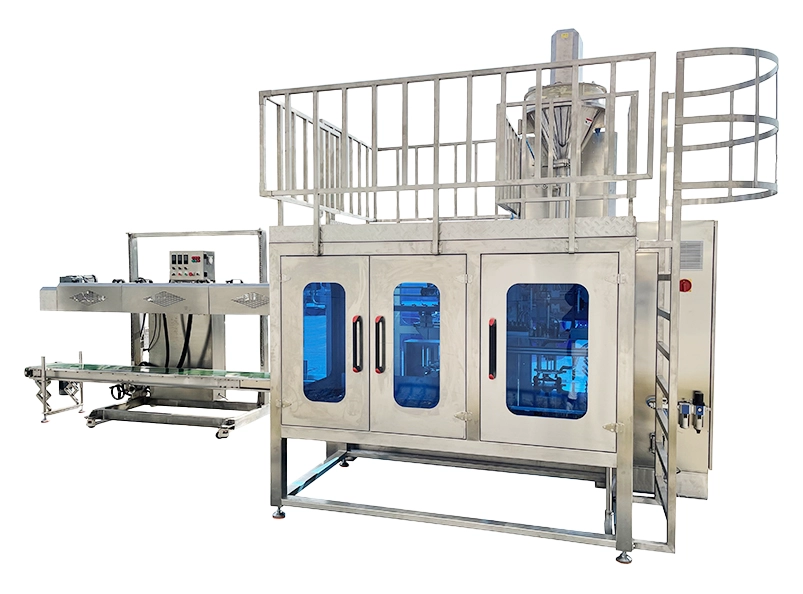
Mipline is configured as an automatic powder packaging and bagging line for dry powders in industrial bags, especially 25 kg formats. The enclosed stainless steel bagging station provides a defined location for bag handling, while the bag magazine conveyor and upstream feeding devices keep empty bags available for the automatic cycle. Blue inspection windows make the operating area visible without removing the guarding, and the top access platform supports practical maintenance access.
This matters when a dairy powder plant needs a cleaner transfer between filling, conveying, and sewing. Instead of treating the sewing head as an isolated machine, the line uses the upstream bag handoff as part of the packaging result.
Roller transfer supports a squarer bag before sewing
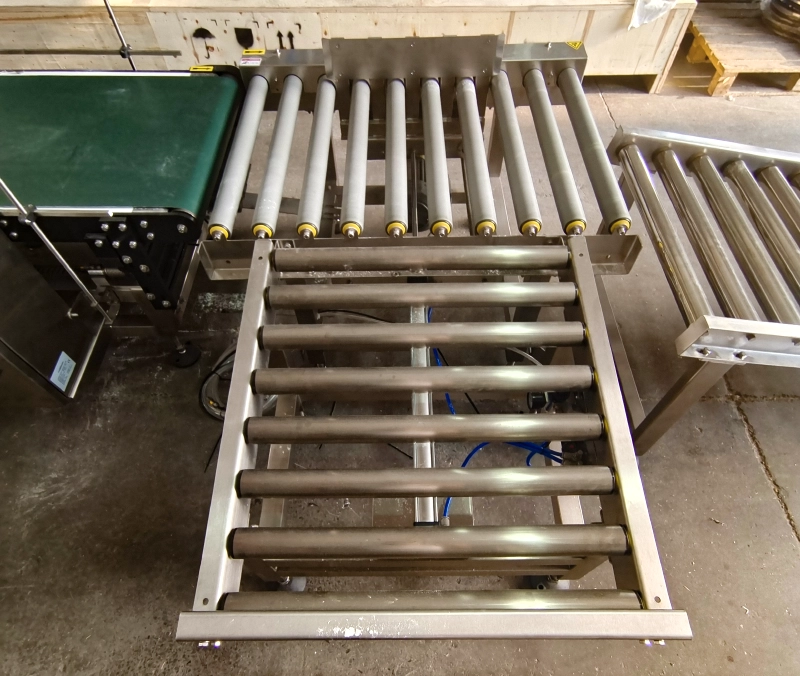
The roller conveyor transfer section uses multiple support points to carry the filled bag through a line transition. The visible angled roller arrangement is suited to a controlled change of direction or elevation, while the welded frame and adjustable feet provide a stable base for line integration. Supporting the bag over a broader contact area helps reduce sudden folding or dragging as it leaves the filling area.
For the operator, the benefit is a more predictable bag handoff before sewing: less time spent catching a collapsing bag, fewer corrections at the conveyor edge, and a better chance of keeping 25 kg bags square as they approach the closure process.
Guided conveying reduces manual straightening
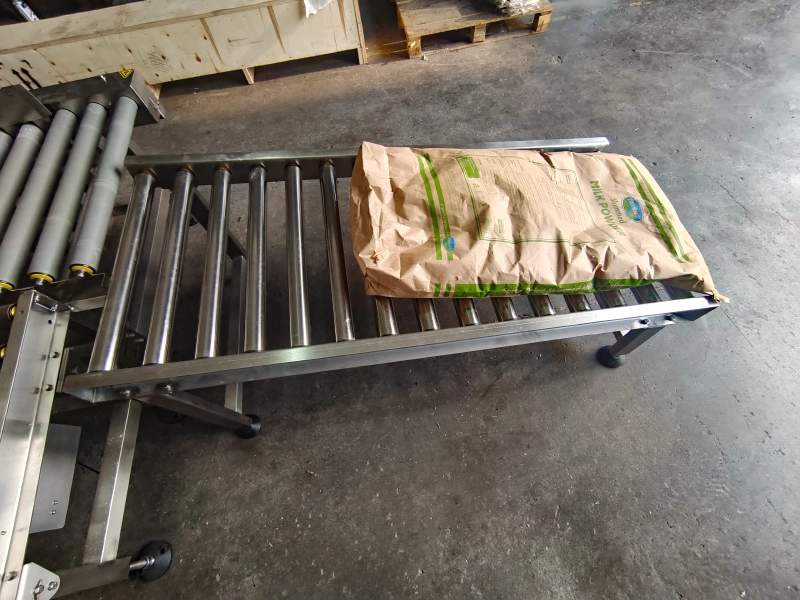
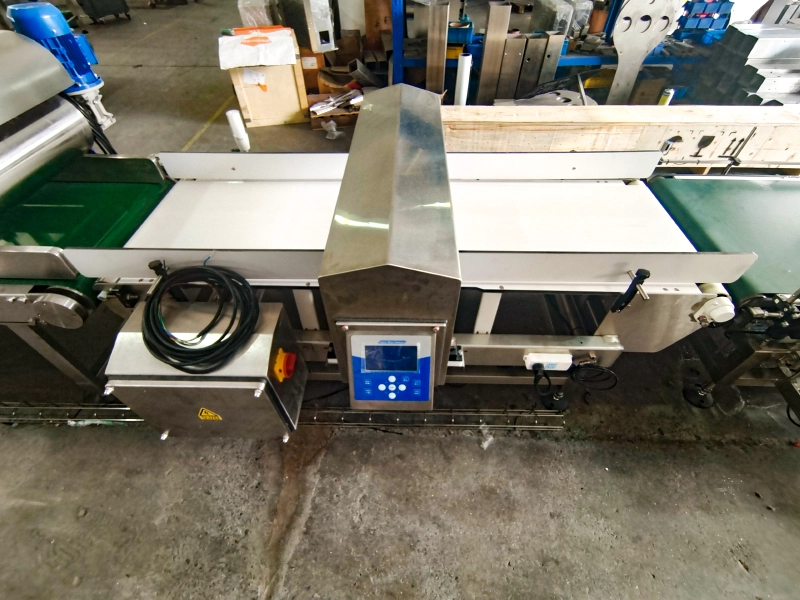
The line’s conveying modules address the point where many conventional layouts lose control. A roller conveyor can support and transfer the bag, while a twin-belt section can hold the bag between guided surfaces during a handoff. Adjustable side guides help maintain the travel path without relying on a person to repeatedly push the bag back into position.
Bag clamping and guided movement work together: the clamp establishes a repeatable reference at the handling station, and the conveyor sections carry that orientation forward. This arrangement is useful for automatic bagging machine applications where the sewing head becomes unstable when the bag mouth arrives skewed.
Enclosed construction supports a cleaner production area
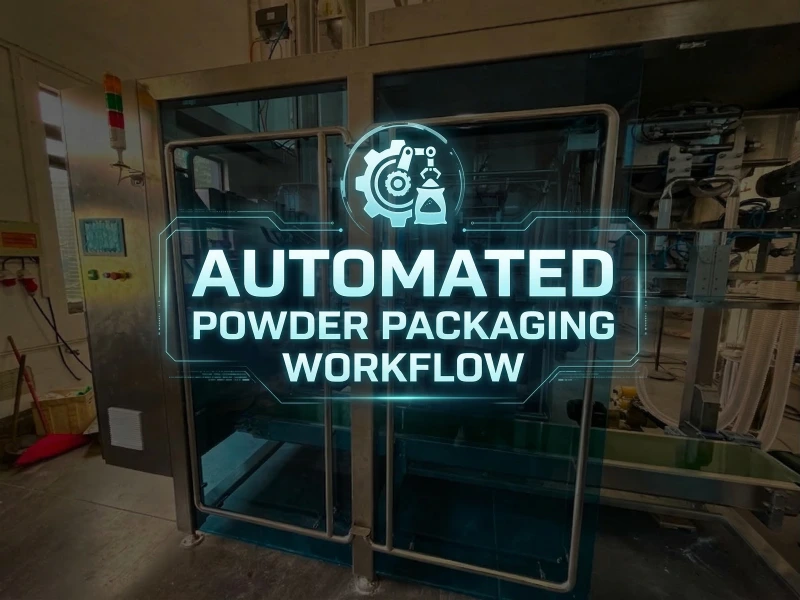
Powder handling also places demands on the machine environment. Mipline’s stainless steel enclosure, safety doors, inspection access, conveyor interfaces, and integrated control equipment create a more organized powder packaging line around the bagging operation. The enclosed station separates the handling mechanism from the surrounding production area while allowing visual checks during operation.
For food powder applications, this structure gives the project team a clearer basis for maintenance planning and line-side cleaning. Final material choices, dosing range, bag dimensions, sewing equipment, and capacity should be confirmed against the actual powder and plant layout, but the visible design establishes the core principle: control the bag continuously instead of correcting it only at the sewing head.
Result: a more stable powder filling and bag sewing line
When the customer’s problem is a twisted or collapsing bag before closure, the solution is not another manual adjustment point. It is a coordinated handoff: automatic bag supply, clamping, supported roller transfer, guided belt conveying, and a protected stainless steel bagging station. Mipline applies those elements to 25 kg powder packaging so operators can reduce manual bag straightening, improve bag alignment, and send a cleaner, more stable bag toward sewing or sealing.
If your application involves milk powder, flour, starch, or another dry powder, share the powder characteristics, bag format, target output, and sewing interface. BPM can then define the appropriate automatic powder packing machine and conveyor handoff around the complete line.
 English
 Русский