
10 kg Powder Bagging Line: Stable Bag Transfer Before Sewing
A dairy powder, flour or starch plant that scales down from 25 kg sacks to 10 kg bags keeps the same dosing logic but loses margin in the last metre. This 10 kg powder bagging line clamps the bag mouth before dosing, holds both bag faces through belt and roller transfer, and hands a square bag to the sewing head instead of a twisted one.
Where a 10 kg Bag Goes Wrong on an Existing Line
A 10 kg paper or paper-plastic bag is shorter and stiffer than a 25 kg sack, so it behaves differently at every station. It leaves the filling spout aerated and slightly inflated, it takes the shape of whatever carries it, and it tips easily once the center of gravity sits low. On a line that was originally laid out for heavier sacks, the bag is never clamped during dosing, so the mouth drifts open, powder lands on the sealing area, and the bag lands on the belt skewed.
By the time the bag reaches the last metre, two operators are usually standing there: one pulls the mouth straight, one holds the bag while the sewing head engages. Nothing in that arrangement appears on a capacity calculation, yet it decides the real output of a 10 kg powder bagging line. When one of those operators steps away, the sewing head receives a leaning bag, the seam runs crooked, and the bag is either reworked or downgraded.
Adding a straightening table and a second person at the sewing head hides the problem without removing it. The bag is still filled without a clamp, still arrives dusty, and still depends on a human hand at the exact point where the line should be most repeatable.
Clamp-Held Filling and Guided Transfer Before the Sewing Head
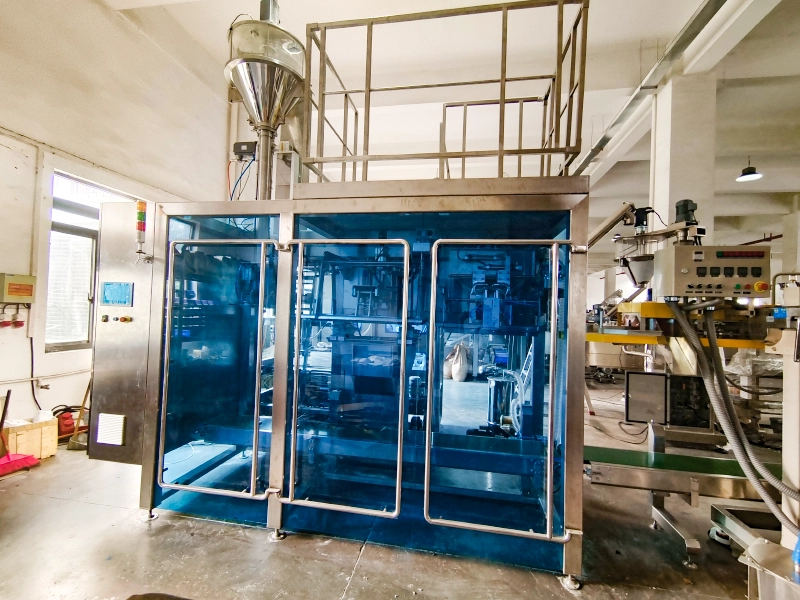
Mipline treats bag supply, opening, clamping, filling, closure and transfer as one process rather than a row of independent machines. A flat bag magazine feeds the stack, a vacuum pickup opens the mouth, and a clamp holds the bag through the entire dose. The filling head rises with the fill level, so the drop height stays short at the start and at the finish, and a three-stage screw covers fast, medium and slow final dosing. On a 10 kg powder bagging line that staged dosing matters more than on a heavy sack, because a 200 g overshoot is two percent of the target weight.
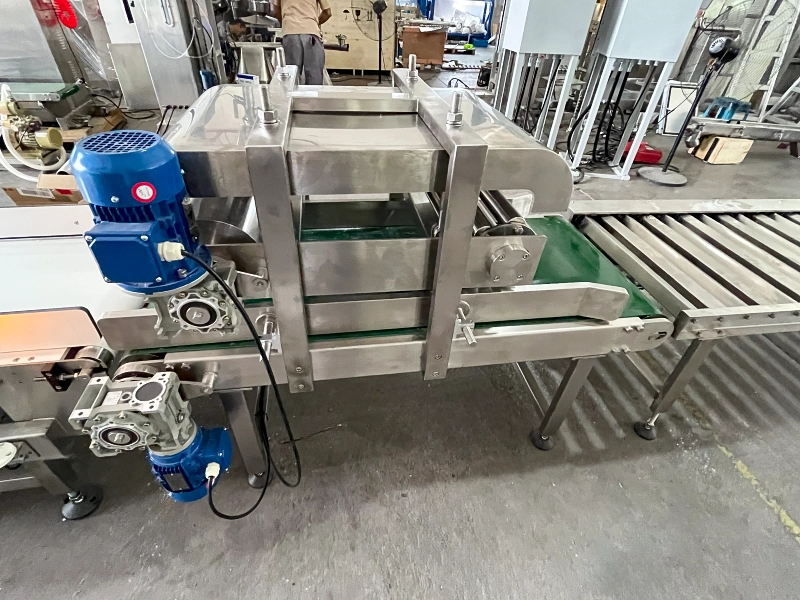
After dosing, the bag is released into a guided handoff: a twin-belt transfer with adjustable side guides squares both faces, a roller section carries the bag to settling and shaping, then metal detection and checkweighing run before the sewing head. The station itself is enclosed stainless steel with blue inspection windows, guarding, an HMI panel and an emergency stop, so the clamp, the seam area and the transfer path can be checked without opening the line. That visibility is what makes a 10 kg powder bagging line auditable rather than dependent on operator memory.
Field note: On a 10 kg target, a stated filling accuracy of ±0.2% equals roughly ±20 g per bag. Treat that as the reference figure for a defined configuration, not a promise for any powder: bulk density, flowability and moisture move the number. The checkweigher is where drift is caught and rejected before dispatch.
What to Fix Before Ordering a 10 kg Powder Bagging Line
Every item a buyer brings to the table changes the machine, and each one already has a defined answer inside the Mipline configuration. Bag construction and dimensions select the magazine, the clamp stroke and the guides, because kraft paper, paper-plastic composite and coated woven bags do not fold the same way. Bulk density, flowability and aeration set the screw stages, the lifting fill speed and the de-aeration step. Closure method selects the module stack: dust removal, trimming, inner heat sealing, pressing, sewing and hot-melt paper tape are combined per bag type instead of being assumed. Target speed and palletizing layout determine conveyor lengths, settling time and roller discharge height.
The bag weight range is the first number to confirm: a reference DS25K configuration covers 5 to 25 kg, so a 10 kg powder bagging line sits inside a proven envelope rather than at the edge of it. Inspection follows the same logic. A metal detector with a 600 × 230 mm aperture and a checkweigher rated for the finished bag are placed after closure and shaping, with a reject path that removes the bag instead of stopping the line. Confirm the detector and its product effect against your actual powder, and keep checkweigher accuracy to the datasheet of the selected unit.
| Параметр | Reference configuration (confirm per project) |
|---|---|
| Bag weight range | 5–25 kg, so 10 kg bags fall inside the range |
| Stated filling accuracy | ≤ ±0.2% of target weight |
| Stated throughput | 1–3 bags/min, material and configuration dependent |
| Power supply | 380/220 V, 50–60 Hz, 5 kW |
| Air supply | 6 kg/cm² |
| Product contact / body | SUS304 stainless steel, enclosed station with inspection windows |
| Ambient guidance | 0–40 °C, 10–70% RH |
Size the Line Around Your 10 kg Bag
Send the bag dimensions, bag material, powder bulk density, target weight and required bags per minute. We will come back with the station layout, the clamp and screw configuration, the closure modules and the inspection points for a 10 kg powder bagging line matched to that powder, so the bag reaches the sewing head square without an operator holding it.
Request a bagging line proposal English
 Русский