
Flour Bagging Line: A Pasta Factory Walk-Through
A pasta factory buys flour by the tonne and sells it back as dry shapes, so a 25 kg bag has to weigh right and reach the sewing head straight. This walk-through follows one flour bagging line from bag pickup to the last roller before the pallet.
What the Packing Hall Sees Every Shift
In a pasta plant the packing hall sits between the mill holding silos and the pallet stack: semolina and wheat flour arrive in bulk, are packed into 25 kg kraft paper or paper-plastic composite bags, then closed by sewing or heat sealing. The material that fed the press a few hundred metres away is the same material inside the bag, so the bag is judged on three things only — weight, shape, and how clean the mouth looks when it reaches the closing head.
The older layout handles that work by hand. Two or three operators per shift pull flat bags from a stack, hold them open over a spout, steady them while the screw runs, then straighten each bag on the way to the sewing machine. A flour bagging line built that way does run, but it depends on people standing in the right place at the right second, and on a 25 kg bag being manhandled at the exact point where it is least stable.
Not at the dosing screw. The bag twists when the clamp releases, the mouth arrives dusty and skewed, and the sewing head pulls a curve into the seam. The last two metres decide whether the pallet is square.
Why the Bag Changes Shape After It Is Full
Flour holds air. A free-fall fill drops the whole 25 kg through the mouth in one pass, so the powder hits the base, aerates, and pushes dust back up into the mouth area — exactly where the closure has to work. A tracked bottom-up fill keeps the filling head close to the rising material level, so the drop is short, the dust stays inside the bag, and the fill happens from the base upward instead of ballooning the faces.
That is why a flour bagging line is designed as a chain of controlled handoffs rather than a filler with a conveyor bolted on. The bag is lifted from the magazine, opened and clamped before the first gram falls, held at the mouth through the fill, then released onto a surface that keeps both faces under control. Every handoff removes one place where an operator used to correct a bag by hand.
On the floor: the cheapest fix is rarely more speed. It is deleting the moment when a full bag is unsupported between two machines.
Inside the Mipline Flour Bagging Line
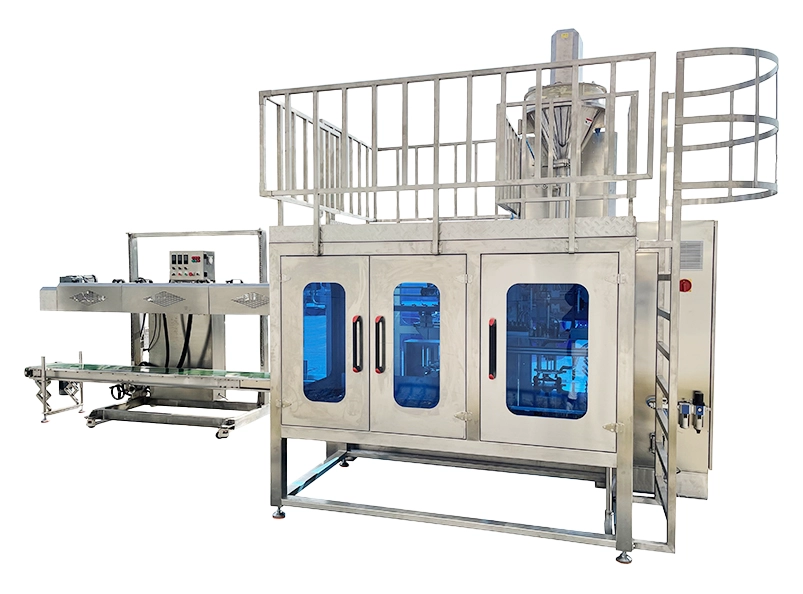
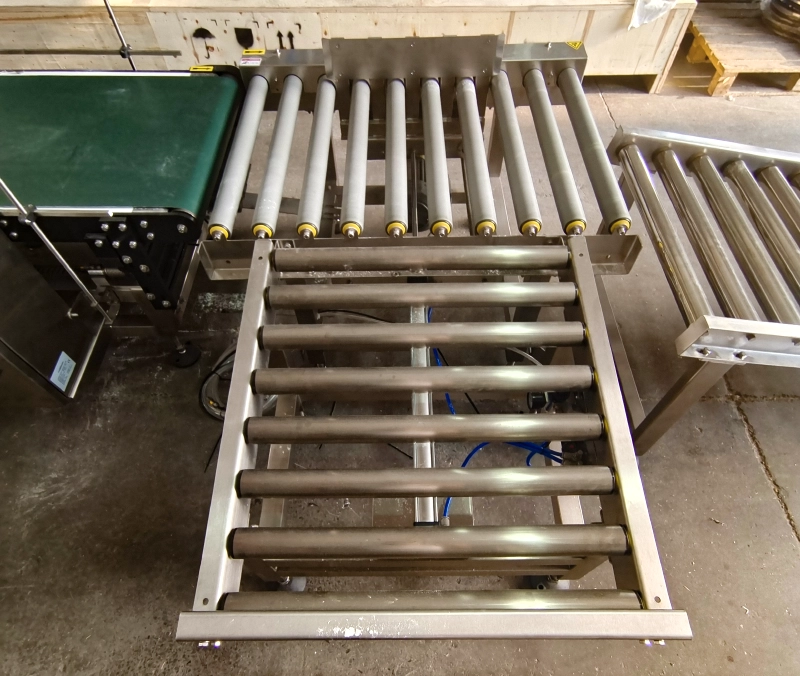
The bagging station is enclosed in stainless steel, with blue inspection windows in the front doors and a bag magazine conveyor feeding the pickup, so the operator can watch the clamp and the filling head without opening a guard. Green belts and stainless roller sections carry the filled bag away, and a twin-belt transfer with adjustable side guides holds both faces on the approach to the sewing head. The line runs from a touch-screen HMI with an emergency stop, and the transfer path is open enough to clear a jammed bag without tools.
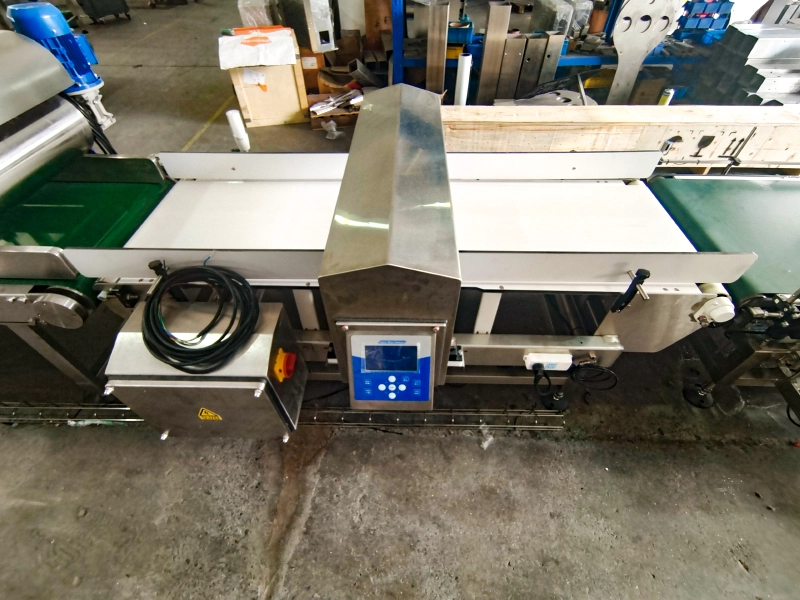
Configuration follows the material. On a 25 kg flour bagging line, one reference build is stated at 1.5–2 bags per minute with filling accuracy around ±0.1–0.2%, while other references in the range run 1–3 bags per minute on 5–25 kg bags at ≤±0.2%. The body is SUS304, main power is 5 kW, and where vacuum extraction is fitted the stated vacuum rate is 63 m³/h. Those figures move with bulk density, bag construction, closure method, and how much settling the bag needs before palletizing, so they are quoted per project. The same rule applies at the end of the line: detector aperture and checkweight tolerance have to be matched to the flour and the bag, not copied from a catalogue.
| Station | What happens | Visible on the machine |
|---|---|---|
| Bag magazine and pickup | Flat kraft or composite bags are lifted and opened | Bag magazine conveyor, vacuum pickup, guarded frame |
| Clamp and hold | The mouth is fixed before the first gram falls | Bag clamp inside the stainless station, blue inspection windows |
| Bottom-up filling | Three-stage screw feed with the head tracking the fill level | Lifting fill head, weighing control, HMI |
| Air and dust control | Extraction or de-aeration before closure | Vacuum line, sealed station |
| Closure | Dust removal, trimming, heat sealing, sewing and paper tape where configured | Closure handoff path, paper-tape unit |
| Settling and shaping | The aerated bag is flattened and squared on the move | Twin-belt transfer with adjustable side guides |
| Inspection and reject | Metal detection and checkweight on the finished bag | Detector aperture, checkweigher, reject path |
| Discharge | Roller sections toward palletizing | Stainless roller conveyor, leveling feet |
Planning a Line Like This for Your Plant?
Send the flour type, bag size and construction, target bags per minute, the closure method you use, and where the packing hall sits in your building. We will reply with a flour bagging line layout, the stainless configuration, and the inspection points that fit your site. For background, compare these notes on 25 kg powder bag transfer before sewing and on clamp filling to sewing handoff.
Request a line proposal English
 Русский