
Flour Bagging Line: Clamp Filling to Sewing Handoff
A flour bagging line loses more output in the last metre than at the filler. Flour keeps air when it drops into a 25 kg kraft bag, the bag reaches the sewing head soft and slightly turned, and an operator steps in to straighten it by hand. Mipline answers that with a clamp-held filling station, a twin-belt transfer section with adjustable guides, a short settling run and a roller conveyor that presents the bag mouth square to sewing or sealing.
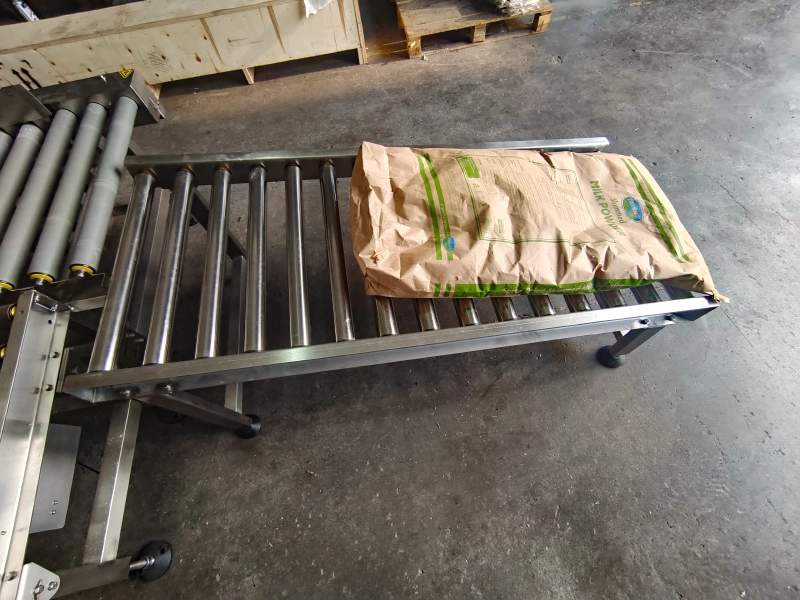
Where a 25 kg flour bag actually goes wrong
Walk the dispatch floor of a flour mill and the sequence looks simple: empty bag, filling spout, conveyor, sewing head, pallet. What the layout drawing hides is the second of hesitation after the bag leaves the spout. Flour is not a plastic pellet. It holds entrained air, it settles after filling, and the column inside the bag shifts whenever the bag changes direction. On a line built only from a filler and an open belt conveyor, that shift lands on the operator. Someone stands at the end of the transfer, grabs the bag mouth, walks it straight and feeds it into the sewing head. When two bags arrive together, the queue stops. When the bag arrives skewed, the seam wanders.
Plants that run this way usually buy a second filler when orders grow, then find the bottleneck did not move. The filler is measurable and therefore blamed; the handoff between filling and closure is invisible, so it stays manual. That is the gap a purpose-built flour bagging line is meant to close, and the first question is not capacity but how the bag is held after the weight is inside it.
Between the filling spout and the sewing head there are roughly three seconds in which a 25 kg flour bag can twist, slump or shed a corner. No weighing accuracy earlier in the line recovers a bag that reaches the sewing head out of square, and no operator works that station all shift without fatigue affecting the seam.
Why Mipline suits flour, not just free-flowing powders
Mipline was built around the physical behaviour of dry, air-retaining powders packed in industrial bags: dairy powder, flour, starch, gypsum-type fillers. The bag is taken from a magazine conveyor and clamped at the mouth, so the filler fills a bag that is already squared and supported instead of a bag an operator is holding open by hand. Filling runs bottom-up, which keeps the product column rising rather than falling, so the bag does not balloon at the shoulders and blow dust back through the spout.
The transfer section is where this Mipline arrangement differs from a generic conveyor handoff. A twin-belt section with adjustable side guides carries the filled bag on both faces, holding the rectangle square, and hands it to a roller section before the sewing head. Between those stages there is a short settling run: the bag pauses long enough for air to leave the flour column, so the sewing head closes a firm bag mouth rather than a slack one. Operators still watch the line, but no longer hold it straight; the guides and the clamp alignment do that work, which is the difference between a two-person dispatch station and a one-person inspection station.
What to check on the bag, not the brochure. Dust extraction at the spout, bag-mouth support during filling and settling time before closure decide whether a flour bag sews square far more than any nominal output figure. Ask for a trial on your own kraft or coated woven bag, filled to your declared 25 kg weight, and watch the last metre rather than the first.
What the structure on site proves
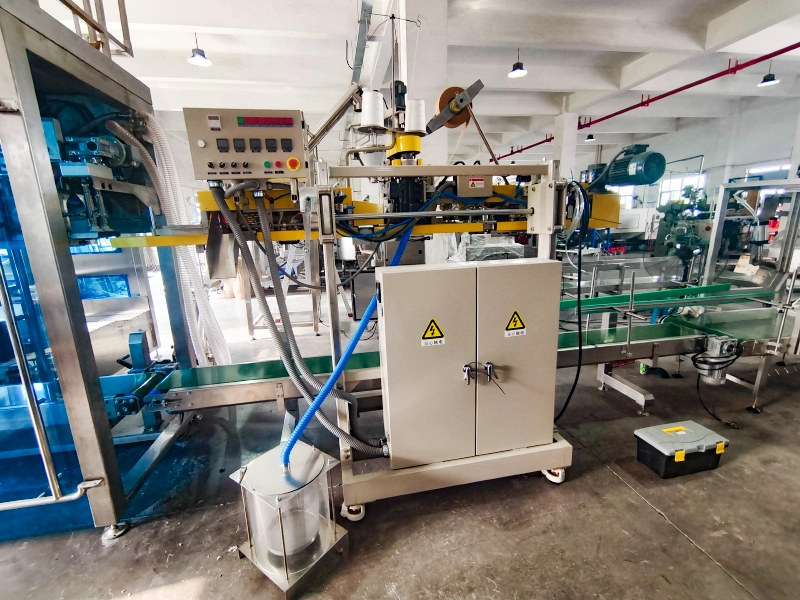
On an installed flour bagging line the evidence is visible without opening a manual. The bagging station is an enclosed stainless steel frame with blue inspection windows in the door panels, so the clamp, bag mouth and spout can be watched while the door stays shut. A bag magazine conveyor feeds the pickup station on the infeed side. A top access platform with guard rails sits over the station for maintenance of the spout and clamp. Pneumatic lines run to the pickup and clamp cylinders, and the control cabinet stands next to the station rather than in a separate room, which keeps a fault visible at the point where it happens.
Downstream, the line reads as transfer hardware: green belt sections mated to stainless roller sections, each with adjustable side guides and leveling feet, joined by welded frames that keep the pass height consistent from the bagging station to the sewing head. That consistency is what stops a bag from dropping, bouncing and turning between stations. Anyone specifying a second line for a flour mill, bakery supply plant or starch processor can check the same visible points and stop asking the wrong question about filling speed.
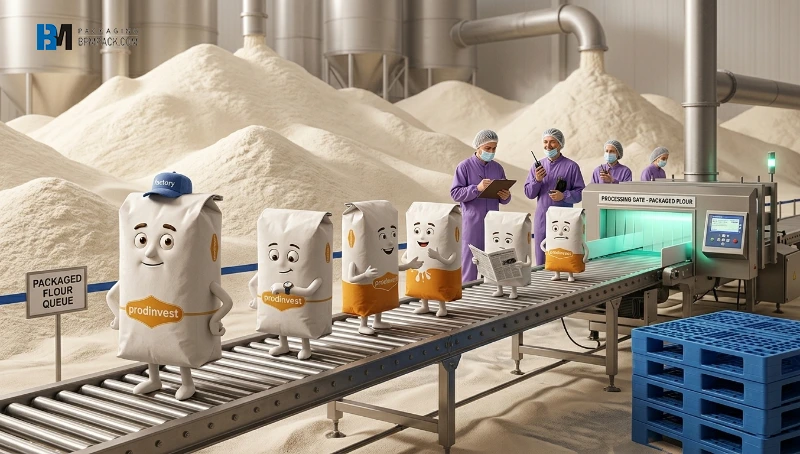
| Line stage | What the station controls | Failure it removes |
|---|---|---|
| Bag magazine and pickup | Bag taken from the magazine conveyor and squared before it is opened | Double picks, crushed bag mouths, bags opened by hand |
| Clamp-held filling | Bag mouth clamped under the spout, product delivered bottom-up | Ballooning shoulders, dust blowback, corner splits |
| Settling run | Short pause after filling so air leaves the flour column | Slack bag folding under the sewing head |
| Guided transfer | Twin-belt section with adjustable guides, then roller conveyor | Twisted bags and manual straightening at the last metre |
| Inspection | In-line weight check, with metal detection where the plant specifies it | Off-weight bags reaching the pallet |
| Closure handoff | Bag mouth presented square to sewing or sealing | Wandering seams, open seams, reject pile at the head |
The result on the floor is a dispatch station that one operator can supervise instead of two operators feeding. Seam quality stops depending on who is standing at the head, bags reach the pallet square enough to stack, and flour dust stays inside the enclosed station instead of settling on the frame and the floor. For a mill weighing the cost of the last metre against the cost of a rebuild, that is the part worth measuring first — and the related layouts for clean bag handoff before sewing and milk powder bag mouth control show the same logic on other powders.
Specify the handoff, then the output
Send one empty bag and one filled bag from your own production, with the declared weight and the sewing or sealing method you already use. We will quote a Mipline flour bagging line around that bag format rather than around a catalogue figure.
Send your bag sample English
 Русский