
Protein Powder Packaging Line: Keeping 25 kg Bags Square Before Sewing
A sports-nutrition plant packing bulk whey into 25 kg kraft bags rarely loses output at the filler. It loses it in the last metre, where a soft, aerated bag has to reach the sewing head straight. This walk-through follows a protein powder packaging line from clamp-held filling through guided transfer and in-line weight check, and shows which hardware keeps the bag square.
Where protein powder costs you the last metre
Protein blends do not behave like salt or sugar in the same bag format. Whey concentrate, isolate, collagen and plant-protein blends are light for their volume, they hold air after dosing, and they are hygroscopic enough to cake on any surface that stays damp. A 25 kg kraft bag filled with that material is not a rigid block. It is a soft column with a mouth that wants to close on itself.
In a manual layout the sequence is always the same. One operator holds the bag mouth under the spout, a second carries the filled bag to the sewing head, and a third straightens the mouth at the last metre. When the pace rises, the mouth arrives at an angle, the sewing head drags the paper instead of guiding it, the seam wanders, and the rejected bag is cut open and reworked. The real cost is not the rework. It is that the throughput of the line is set by the slowest pair of hands in that metre.
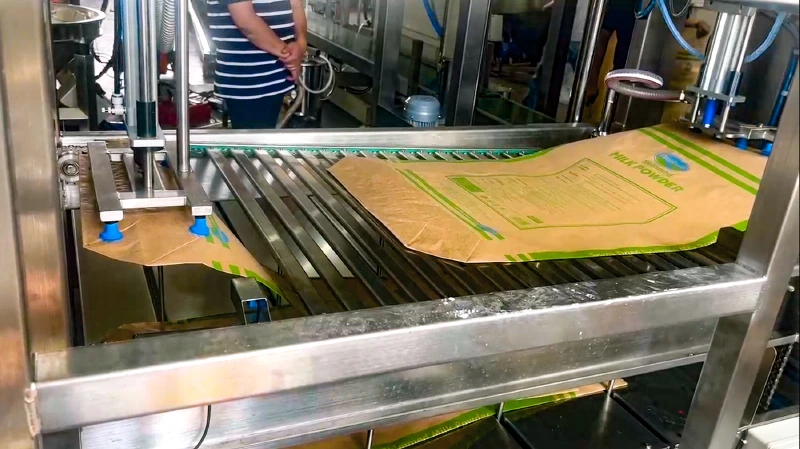
Every 25 kg bag that has to be straightened by hand on the belt is a bag the machine did not control — and on a night shift, that hand is also the most expensive component of the line.
Holding the bag instead of chasing it
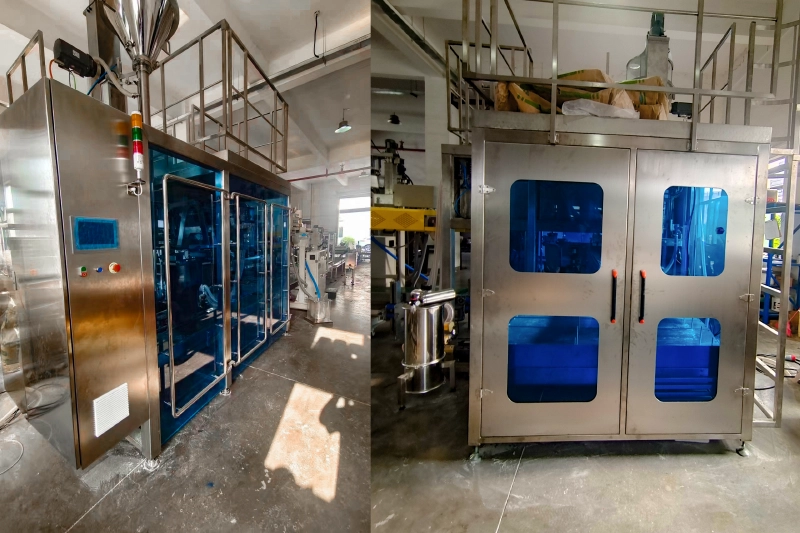
On a Mipline powder packaging line the bag is the fixture, not the payload. Kraft paper or coated woven bags are lifted from a bag magazine conveyor and presented to an enclosed stainless steel bagging station, where the clamp takes the mouth and holds it square for the whole filling cycle. Because the mouth is fixed, filling runs from the base upward: the powder builds a column from the bottom instead of dropping into an empty bag and ballooning the paper outward.
The enclosure is doing real work. Full-height stainless panels and hinged doors with blue inspection windows keep the operator out of the bag path while still allowing a visual check of the mouth, the clamp and the seam line. A top access platform and guardrail put maintenance above the machine instead of inside it, and the control cabinet stands outside the dusty zone. For a protein plant that matters twice: fine powder that escapes the bag does not migrate into the drive area, and the operators can confirm bag position without leaning into the frame.
Transfer, settling and the sewing handoff
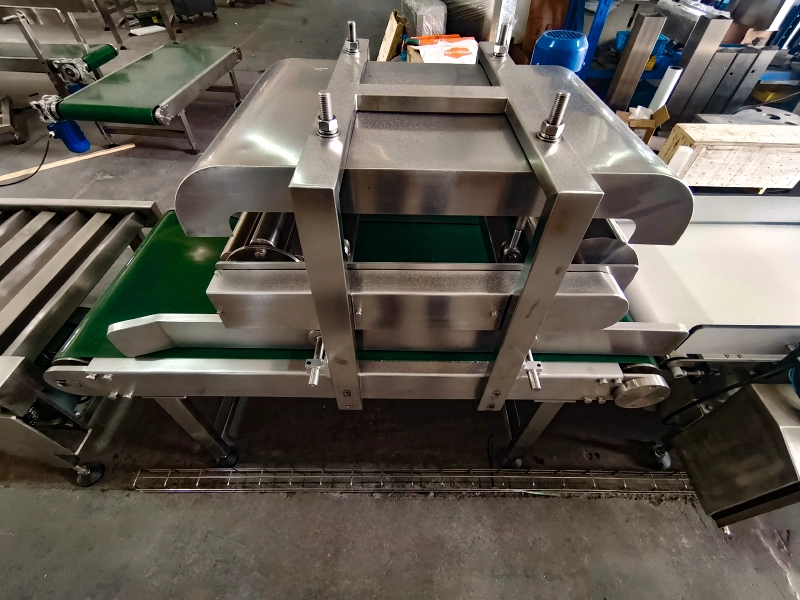
Between filling and closing, the bag has to be carried rather than handed over. On this powder packaging line the transfer runs on a twin-belt conveyor with adjustable side guides, feeding roller conveyor modules at both ends, so the bag body is supported on both flanks while it moves. The guides are set to the bag width, which stops the column from rotating, and the roller sections carry the load between driven belts so a 25 kg bag crosses a gap instead of slumping into it.
Then come the two steps most manual layouts skip. The bag is weighed in line on a conveyor weighing platform, so an underfilled bag is caught before the mouth closes rather than after palletising. And it is given settling length — a few metres of guided conveyor — so the aerated protein column comes down before the seam is made. A bag sewn while the powder is still airborne looks full on the belt and looks soft on the pallet a shift later.
What each station does to the bag
The table maps the hardware you can see on this powder packaging line to the job it performs on the bag. It is the part worth arguing about in a technical review, because it is where a quotation stops being a list of machines and becomes a sequence.
| Station | Job on the bag | Visible hardware |
|---|---|---|
| Bag pickup | Kraft bag lifted from the magazine, mouth opened and squared before filling | Roller conveyor with vacuum grippers, bag magazine conveyor |
| Clamp filling | Mouth held at a fixed height while powder builds from the base upward | Enclosed stainless bagging station with blue inspection windows |
| Settling | Aerated column allowed to come down before closure | Guided belt length between filling and closing |
| Transfer | Bag carried on both flanks with no rotation between modules | Twin-belt transfer conveyor with adjustable side guides |
| Weight check | Bag weighed without leaving the conveyor | Conveyor weighing platform with adjustable support frame |
| Sewing handoff | Mouth arrives aligned, at the height the sewing head expects | Guided handoff before the sewing head |
The result on the dispatch floor
On a powder packaging line the change that shows up first is not top speed, it is the number of bags that reach the pallet untouched. When the mouth is clamped, the transfer is guided and the weight is checked before closing, three things stop at once: manual straightening disappears from the job description, the sewing head stops chasing a moving seam, and the pallet stack stops leaning because every bag lands square.
Format change is where the same hardware has to earn its keep. Going from a 20 kg to a 25 kg protein format is done at the side guides and the clamp, not by rebuilding the line, and the inspection windows let an operator confirm the bag is seated correctly after the change instead of running a scrap bag to find out. The same handoff logic is written up for a flour bagging line and for a milk powder packaging line, because the failure mode is shared: the bag, not the filler, decides the seam.
What we ask for first: send the bag, the fill weight and a note on how the powder behaves in a hopper. Two bags of the same size run differently if one is laminated and the other is plain kraft, and the guides, clamp height and settling length are all set from that sample.
Send your bag and your fill weight
Tell us the bag format, the protein type (whey concentrate, isolate or blend) and the target bags per minute. You get a layout proposal with the clamp, transfer and closure stations drawn around your bag, plus a straight answer on where a powder packaging line for your format differs from a dairy or flour line.
Запросить аудит линии English
 Русский