
Flour Bagging Line: Clean Bag Handoff Before Sewing
A Mipline flour bagging line fills 25 kg kraft paper and coated woven bags from the bottom up, then hands each bag to the sewing or sealing head through guided roller and twin-belt transfer. The aim is a square, clean-topped bag at the closing station instead of an operator pulling it straight at the last meter.
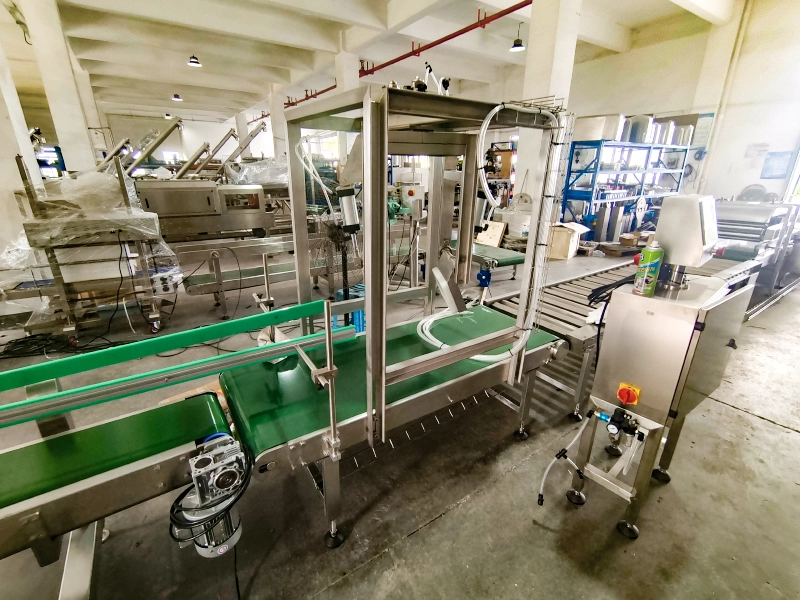
Where Flour Bagging Lines Lose Their Rhythm
Flour, starch and milk powder are light, aerated and quick to escape, which is why most flour bagging lines fail in two places: the fill point and the last meter before sewing. In a plant that still fills by free fall, the product drops from a fixed height into an open bag. The air pushed out of that bag carries fines upward and coats the inside of the bag mouth, the spout area and the floor around the station. The bag then reaches the closing head with a dusty, uneven top edge, and the stitch line or heat seal is laid over a contaminated surface.
Manual handling compounds the problem. Operators open bags by hand, hold them under the spout through the whole fill, then lift and straighten a 25 kg bag before it reaches the sewing head. A twisted bag, a collapsed gusset or a skewed mouth passes the closing station out of square, and the bag is re-sewn, downgraded or opened again. Weight is rarely the issue at that stage. Bag geometry and bag-mouth condition are.
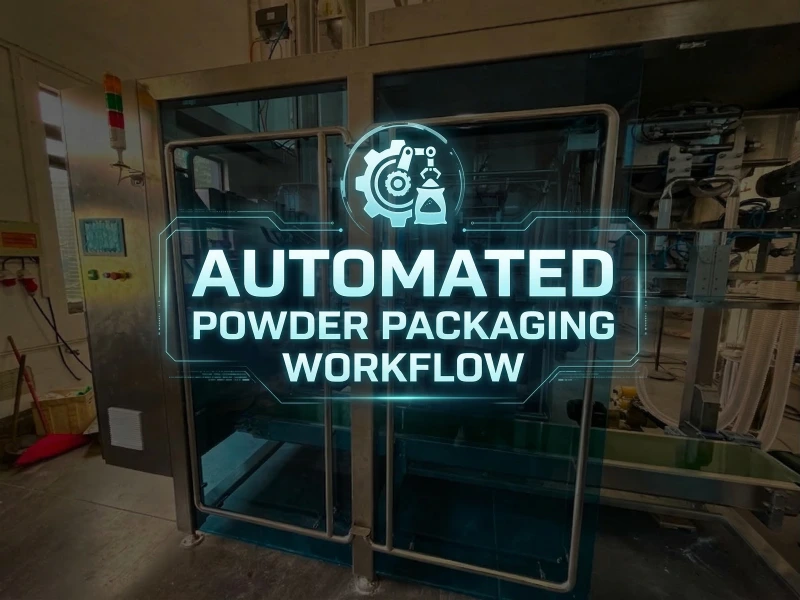
If the bag mouth is dusty, folded or skewed when it arrives at the sewing head, no amount of care at the sewing head fixes it. The failure is created upstream, in the transfer between the filling station and the closer.
Filling, Transfer and Closure as One Process
On a Mipline powder packaging line, the filling station, the transfer conveyors and the closing head are configured as one process rather than three machines that happen to stand next to each other. Bags come from a magazine, are picked up by vacuum, opened and clamped before any product is released. Filling is bottom-up: a lifting platform raises the bag so the spout stays close to the rising product surface, and a three-stage screw feeder runs fast, then medium, then slow for final dosing. Because the fill point tracks the material level instead of sitting at a fixed height, free-fall distance stays short and less air is driven through the powder.
After filling, the line does not simply drop the bag onto a flat belt. Roller conveyor sections and a twin-belt transfer conveyor with adjustable side guides keep the bag supported and square on its way to the closing station, and settling and shaping sections give the product time to de-aerate before inspection. On a flour bagging line this handoff is part of the machine design, not an accessory bought later. It is the same principle used on a milk powder packaging line, where a dusty bag mouth and a skewed stitch line cause the same downtime.
Practical note: On powder lines, most “sewing problems” are transfer problems. Stabilise the bag before the closer and the sewing head becomes a boring, repeatable station — which is exactly what a shift team wants.
Specifying a Flour Bagging Line Around Your Bag and Powder
Bagging lines are often quoted on throughput alone, and that is where mismatch starts. A line should be specified against the bag itself: kraft paper or paper-plastic composite, open-mouth or valve, bag length and gusset, and whether closure is sewn, heat sealed or wrapped with hot-melt paper tape. The powder matters as much as the machine. Bulk density, flowability, moisture, aeration after bulk transport and dust behaviour decide the feeder type, the spout design, and whether vacuum extraction or de-aeration is needed before closure. Rejection strategy belongs in the same conversation, because a bag that fails metal detection or checkweighing needs a defined path out of the line — the same discipline described in final bag inspection for powder bagging lines.
For each item above, the reference configuration answers with hardware rather than a promise. Sealed and clamped bag handling replaces hand opening and hand holding. Bottom-up lifting fill with three-stage screw feeding targets a short free-fall distance and cleaner bag mouth. Enclosed SUS304 stations with blue inspection windows keep the filling area contained and observable. Guided roller and twin-belt transfer keeps the bag square into closure, and settling, shaping, metal detection, checkweighting, reject and roller discharge cover the finished bag instead of stopping at the fill.
| Item | Reference configuration |
|---|---|
| Nominal bag weight | 25 kg industrial bags; other weights and bag formats on project review |
| Bag types | Kraft paper, paper-plastic composite, coated woven bags |
| Filling method | Bottom-up tracked lifting fill with three-stage screw feed (fast, medium, final dosing) |
| Reference capacity | 1.5–2 bags/min on the reference configuration; material, bag and closure dependent |
| Reference accuracy | Stated up to ±0.1–0.2% for that configuration; confirm against your own powder on test |
| Управление | PLC with HMI, alarm and log functions |
| Конструкция | SUS304 stainless steel, enclosed stations with blue inspection windows and guarding |
| Vacuum extraction | 63 m³/h on the reference configuration; de-aeration optional before closure |
| Power and air | 5 kW main power, 5.5 m³/h air consumption on the reference configuration |
| Transfer | Roller conveyor and twin-belt transfer with adjustable side guides; 3,000 mm settling conveyor at 15 m/min; 1,500 mm shaping section |
| Final bag check | Metal detection with 600 × 230 mm aperture window (reference values: Fe ≥ 1.2 mm, NF ≥ 2.0 mm, SUS304 ≥ 2.5 mm), checkweighing, reject and roller discharge |
Match the Line to Your Bag, Not to a Brochure
Send us your bag dimensions, powder type, target weight and closure method, and we will review which flour bagging line configuration fits your floor — including extraction, inspection and reject handling.
Запросить аудит линии English
 Русский