
25 kg Powder Bagging Line: Bag Transfer Before Sewing
In most flour, starch and dry dairy plants the filler is not the bottleneck — the last metre is. A 25 kg powder bagging line earns its place at the handoff between clamping, transfer and sewing, where a bag that arrives skewed still has to be closed cleanly.
Where a 25 kg Powder Bagging Line Loses Its Rhythm
A powder plant usually starts from a filler that already hits weight and a sewing head that already sews. Between the two sits a stretch of conveyor that nobody engineered as a process step. The bag leaves the filling spout with a full body and an open mouth, lands on a belt, settles unevenly, and is free to rotate a few degrees on the way to closure. That is enough. By the time the bag reaches the sewing head, the mouth is no longer square to the head.
The usual fix is labour. An operator stands at the last metre, straightens each bag by hand, flattens the mouth and feeds it into the sewing infeed. That is a 25 kg lift repeated all shift, and it makes closure quality depend on how tired the person is. A 25 kg powder bagging line should remove that correction step instead of staffing it.
A bag that leaves the filler at 25 kg still has to arrive at the sewing head square, with the mouth flat and the body supported. A twisted bag does not fail at the filler — it fails at closure, and the plant pays for it in rejected seams, dust and rework.
What Holds the Bag Square Between Filling and Closure
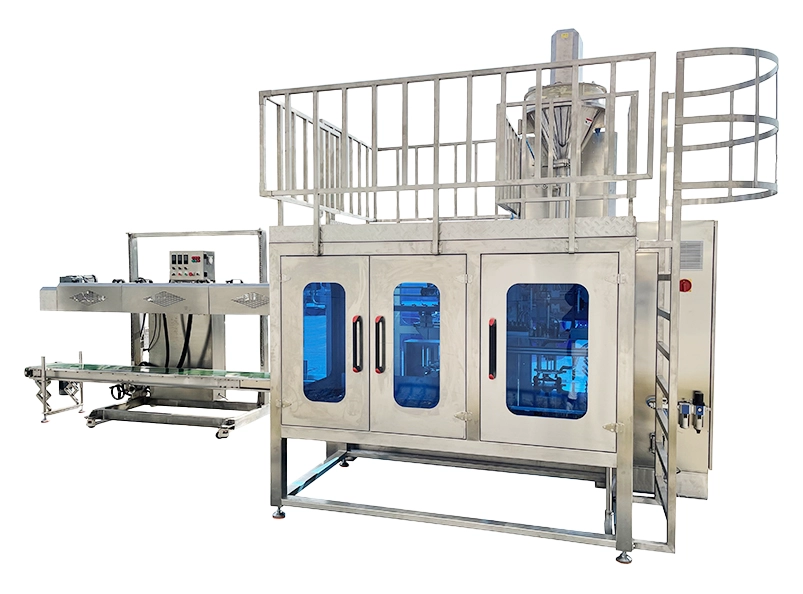
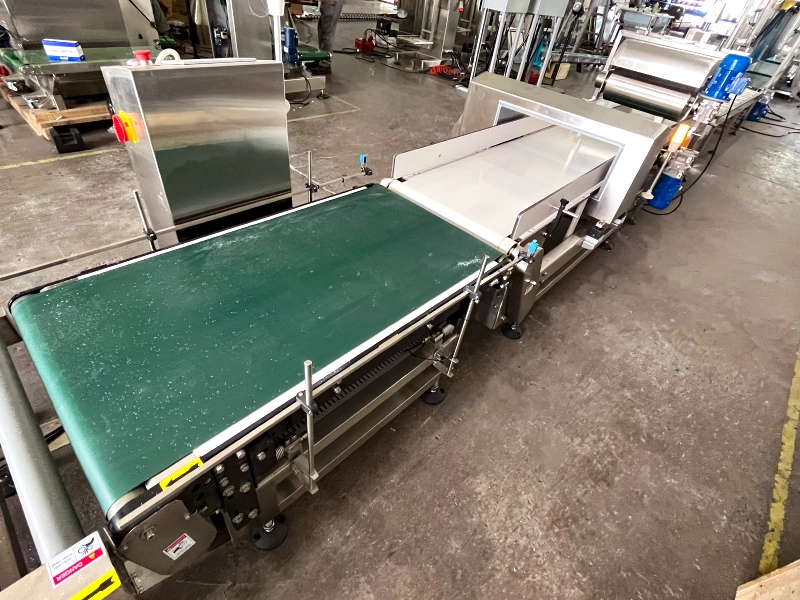
On a Mipline 25 kg powder bagging line the bag is never free to fall. The bag magazine conveyor feeds the next kraft paper or woven bag to the clamp; the clamp holds the mouth open through filling, so the body hangs straight instead of ballooning sideways; and the filled bag is lowered onto a guided transfer rather than dropped. From there twin-belt and roller conveyor sections carry it with side guides set to the bag width — which is what stops the rotation that later shows up as a skewed mouth at the sewing head.
The structure is stainless steel throughout: welded frames, adjustable feet for levelling to the existing floor, blue inspection windows over the clamp and guide area, and a top access platform for the clamp and hopper. Because the guides are adjustable, moving from a gusseted kraft bag to a flat woven bag is a setting change on the transfer, not a rebuild of the line.
Field note — most bag-straightening habits on a flour line are compensating for a transfer section that was never aligned to the bag. Fix the clamp path and the guides, and the manual correction disappears — without asking the operator to work faster.
Specifying a 25 kg Powder Bagging Line Without Guessing
Buyers open a specification with throughput and close it with price. The questions that decide whether the line actually runs sit between the two — and each one has a structural answer.
| Specification question | Why it decides closure quality | Structure that answers it |
|---|---|---|
| Which bag must the line clamp? | Paper and woven bags behave differently when filled | Bag magazine conveyor and clamp set to the bag, not to the powder |
| How does the bag leave the filling spout? | Free fall folds the bag body on landing | Clamp-held filling, then the bag is lowered onto the transfer |
| Can the bag rotate on the way to closure? | A few degrees of rotation skew the mouth at the sewing head | Twin-belt and roller transfer sections with adjustable side guides |
| Is skew corrected or prevented? | Correction depends on an operator standing at the last metre | Guides and conveyor speed set so the bag arrives square |
| Can maintenance reach the clamp and guides? | Guides drift out of setting if nobody can see or touch them | Blue inspection windows, removable guarding, top access platform |
| Does the frame stay level and cleanable? | Uneven floor and dust build-up both move the bag path | Stainless steel welded frame with adjustable feet |
Read the last column as one continuous path. The clamp sets the mouth; the transfer with adjustable guides keeps the body from rotating; the twin-belt and roller sections hold the bag level until the sewing head takes it. On a 25 kg powder bagging line that continuity is what replaces the operator at the last metre, and it is also what makes the line easier to clean, because every section is stainless with open frames that shed dust instead of trapping it. The result on the dispatch floor is a bag that reaches the pallet square, with a seam that repeats from the first bag of the shift to the last.
Send the bag, not just the powder
The useful starting point for a 25 kg powder bagging line quote is the bag itself: material — kraft paper or woven — filled dimensions, gusset, and the height of the sewing head it has to meet. With those, the clamp, the guides and the transfer length can be set as one continuous path from filling spout to closure.
Talk to a Mipline engineer English
 Русский