
Automatic Bagging Machine for Powder: From Bag Magazine to Clamp
The first metre of a powder line decides the last one. On a Mipline automatic bagging machine for powder, a bag magazine conveyor, a clamp-held fill station and a guided handoff keep 25 kg kraft and woven bags flat, square and dust-tight from pickup to the sewing head, so operators stop straightening bags by hand at line speed.
Where a 25 kg powder bag stops being square
A dairy, flour or starch plant rarely loses output at the filler. It loses it at the front of the line, where the bags are still flat. In a manual layout an operator pulls one bag from a pallet stack, opens the mouth by hand and holds it under the spout while the powder falls in. The mouth wrinkles against the spout, the clamp closes on a fold, and the filled bag leaves the station already leaning. By the time it reaches the sewing head, the bag has twisted, the bag mouth is skewed and someone has to straighten it before the needle arrives.
A Mipline automatic bagging machine for powder removes that hand-off from the cycle. Bags sit in a magazine conveyor next to the fill station, are taken one at a time, opened and presented to the clamp in the same position on every cycle. Because the bag is held and not balanced by an operator, the mouth stays square while the powder goes in, and the bag leaves the clamp already in line with the transfer conveyor behind it.
Filled bags arrive at the sewing head twisted, with a skewed mouth. Powder sits on the outside of the bag, and the operator steps in on the last metre to straighten what the machine should have delivered straight.
Why the failure starts at the magazine, not the filler
Most plants try to correct this downstream: a guide bar bolted to the conveyor, a second operator at the last metre, a slower sewing speed. Those measures treat the symptom. If the bag was already rotated when the clamp released it, no guide bar will bring the bag mouth back onto a straight line. The correction has to happen where the bag is picked up and where it is held during filling.
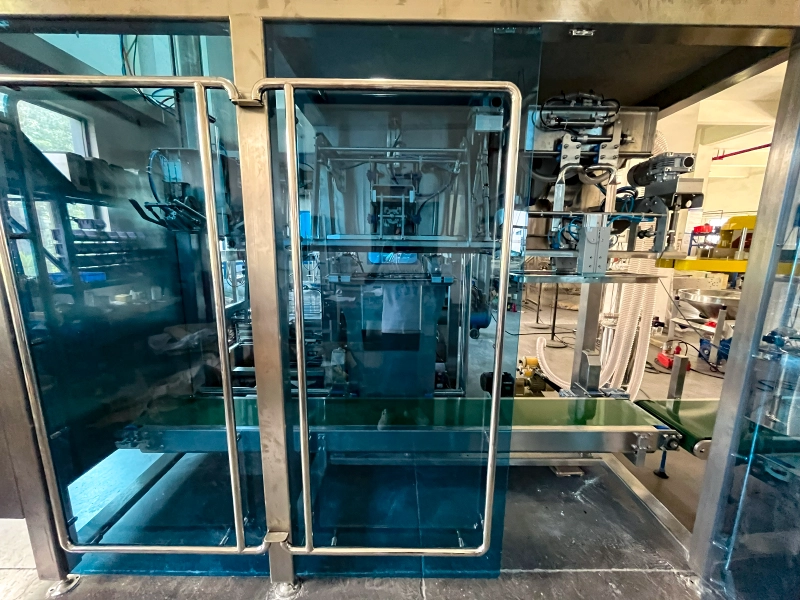
On this line the sequence is set by the machine, not by an operator’s timing. The magazine holds the stack flat, guides keep the picked bag centred, and the clamp closes on the bag mouth before the fill begins. The fill zone is enclosed in a stainless steel station with blue inspection windows, so the operator can watch the bag mouth and the dust without opening a guard. That is the practical difference between an automatic bagging machine for powder and a filler with a conveyor bolted onto it.
What we change: bag magazine height and side guides, vacuum pickup, clamp alignment at the fill spout, an enclosed stainless fill station with inspection windows, and a guided handoff. The bag reaches closure on the same axis it was filled on.
What to specify before you buy, and what is already built in
Buyers usually start with throughput. The specifications that decide rework are smaller: bag format, bag stack flatness, clamp position, inspection access and the length of the handoff. Each of them has a direct answer on the machine. A kraft paper bag and a coated woven bag need different pickup and clamp settings, and the magazine and clamp on this line are built to run both in a 25 kg format. A plant running three shifts needs the fill zone visible from the aisle, which is why the station is built with windows rather than solid panels. Maintenance access is designed in as well: hinged guards, a top platform for filter and spout checks, and a control cabinet mounted on the outside of the frame, away from the dust path.
Pricing follows the same logic. A compact layout that keeps the same bag control costs less than a long line with settling, checkweighing and metal detection, and a full line that carries the bag from magazine to pallet handles more work per operator. Ask for a station list and a bag trial plan, not a single machine price.
| Stage | Design on the Mipline line | Why it matters before sewing |
|---|---|---|
| Bag supply | Flat magazine conveyor beside the fill station | Bags stay square, so pickup is repeatable |
| Pickup and opening | Vacuum pickup presents the bag to the clamp | No hand-opening and no bag held under the spout |
| Filling | Clamp-held bag mouth inside a stainless steel station | Mouth stays aligned and dust stays inside |
| Inspection | Blue windows on the fill zone | Operator sees the mouth without breaking containment |
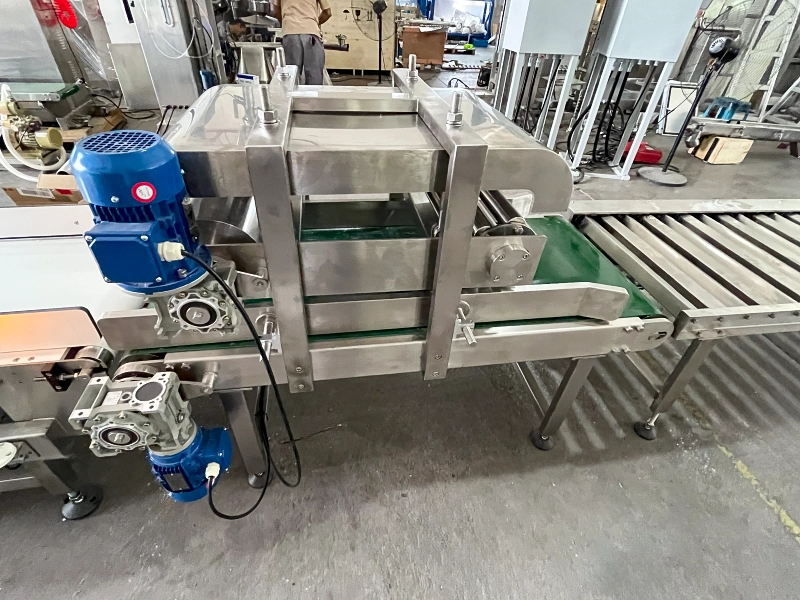
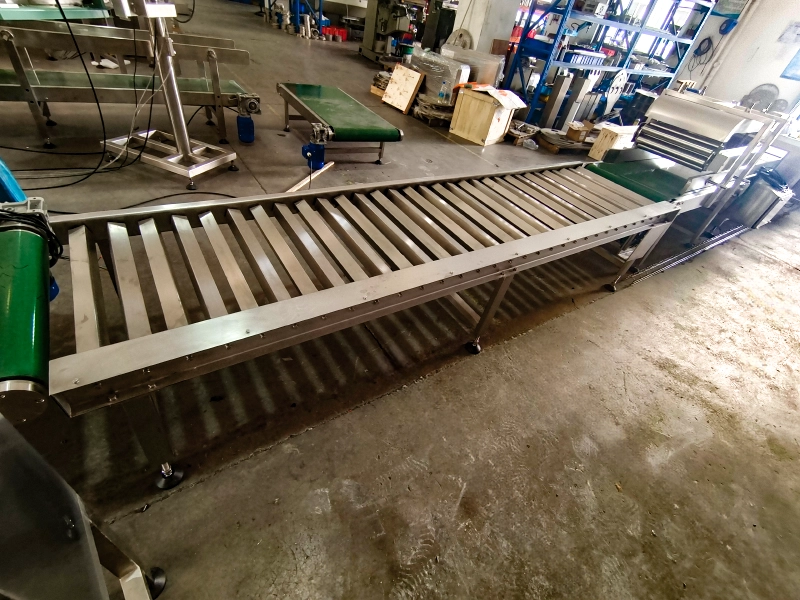
| Handoff | Roller transfer and twin-belt section with adjustable guides | A straight mouth reaches the sewing head |
Send one bag and one powder sample
Tell us your bag format, your fill weight and your powder type, and we will return a layout, a station list and a bag trial plan for your floor. If you want the background first, read how the 25 kg powder bagging line handles the handoff before sewing, and how bags are settled and inspected before palletizing.
Запросить аудит линии English
 Русский