
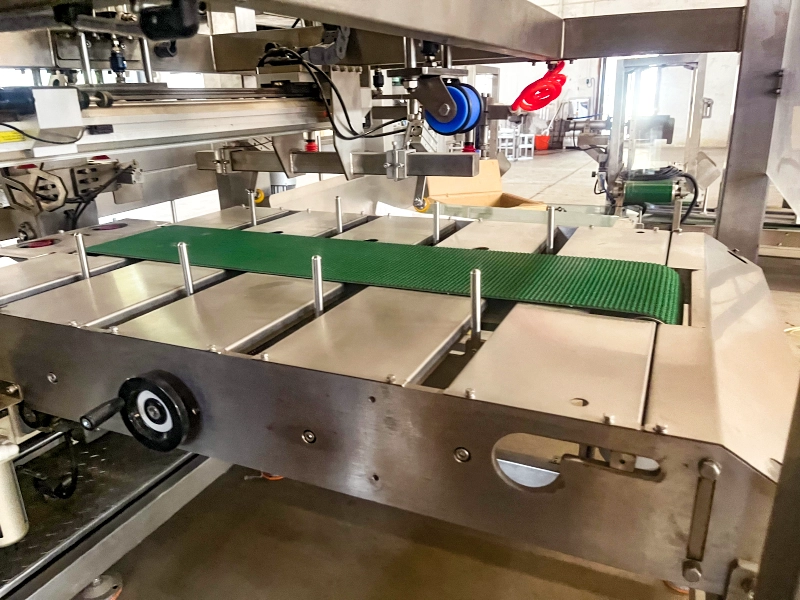
Линия для групповой упаковки во вторичный пакет автоматическая подача
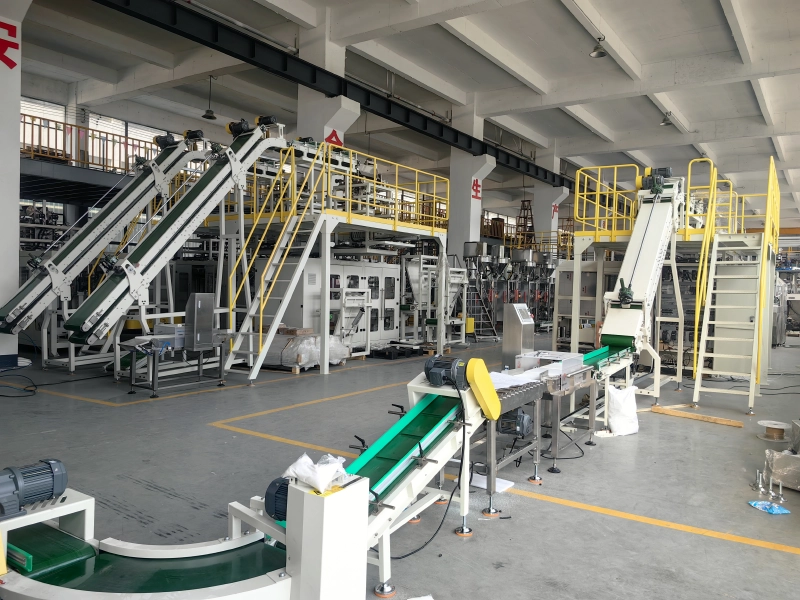 | Is your salt or fertilizer turning into “bricks” before it reaches the customer? In the corrosive environment of chemical and mineral processing, manual bagging is a profit killer. Hygroscopic clumping, “balloon” bags that slide off pallets, and the relentless rust eating your equipment are not just nuisances—they are logistics disasters. Stop paying for manual labor to stack unstable pallets. It’s time to automate the most difficult part of your line. |
The Hidden Cost of Manual Secondary Packaging in Aggressive Environments
For plant managers in the salt, fertilizer, and chemical sectors, the “end of the line” is often where the real headache begins. You have successfully filled your 1kg consumer bags, but the transition to the 25kg or 50kg master bag is a bottleneck. Manual packers cannot consistently squeeze the air out of aerated powders or granules. The result? “Balloon bags.”
When these air-filled small bags are stuffed into a woven sack, the final master bag becomes rounded and unstable. Stacking these “cylinders” on a pallet is a nightmare. They slide, they lean, and during transport on rough roads, the pallets collapse (the dreaded “flowering” effect). Furthermore, in salt and chemical plants, the air is thick with corrosive dust. Standard carbon steel equipment starts to rust within weeks, seizing up bearings and contaminating your product with iron oxide.
This is where a dedicated Линия для групповой упаковки во вторичный пакет автоматическая подача (Automatic secondary packaging line) changes the game. It is not just about saving labor; it is about engineering the physics of your stack.
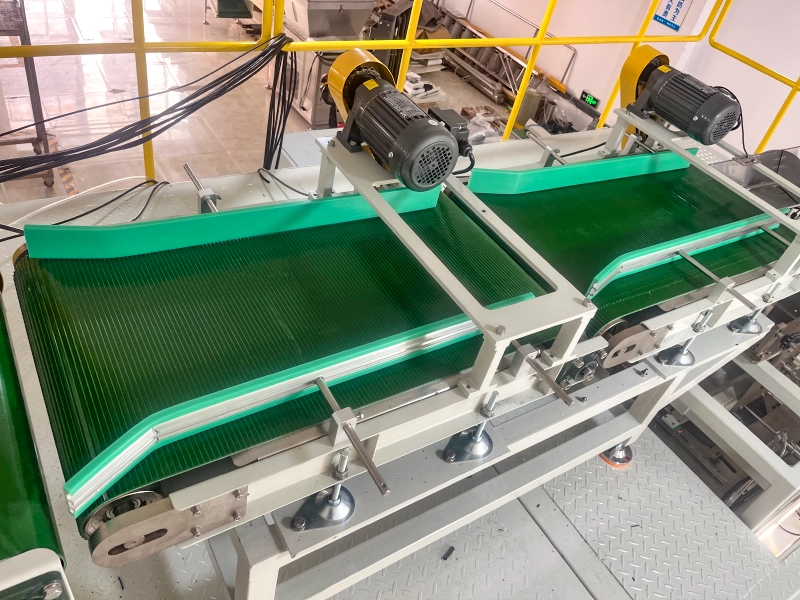
The double-deck shaping conveyor forcibly flattens bags, removing excess air to ensure a brick-like consistency for stable stacking.
Engineering Solutions for “Difficult” Bulk Solids
Our Bag-in-Bag (BIBPU) system is specifically engineered to handle the unique challenges of the salt and chemical industries. Unlike generic packaging lines, we address the root causes of downtime and product loss:
1. The “Anti-Balloon” Shaping Technology
As shown in the image above, before the small bags are counted, they pass through a Double-Deck Shaping Conveyor. This system acts like a press, applying physical pressure to the bag while it travels. This forces the air out through the micro-perforations in your film, transforming a “pillow” into a flat “brick.” Flat bags mean tighter packing inside the master bag, and a rock-solid pallet that can be stacked 3-high in your warehouse without toppling.
2. 316L Stainless Steel Armor
Salt eats steel. We know this. That is why critical contact points and mechanisms in our Secondary Packaging Machine are constructed from 316L medical-grade stainless steel. This alloy provides superior resistance to chloride corrosion compared to standard 304 stainless steel, ensuring your investment lasts for a decade, not just a season.
3. The Diamond Roller “Self-Cleaning” System
In salt production, bag breakage is inevitable. A broken 1kg bag can contaminate the entire line. Our unique Filtering Conveyor utilizes diamond-patterned rollers that vibrate the bags as they travel. If a bag is leaking, the loose salt falls through the roller gaps and is collected below, preventing it from entering the final master bag or jamming the sewing machine.
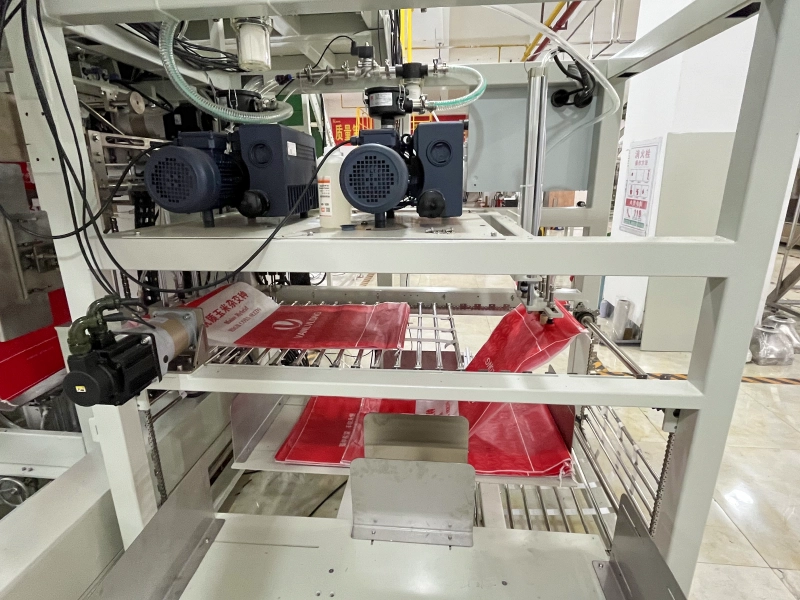
Precision automatic bag opening and placement system handles woven bags (PP) reliably, eliminating the need for manual operators in high-dust zones.
From Chaos to precision: The Automated Workflow
The transition from chaos to order happens in the counting and filling unit. The system automatically fetches a woven PP bag from the magazine, opens it using high-power vacuum suction (or mechanical grippers for porous bags), and positions it under the chute.
Concurrently, the Counting and Arranging System groups your 1kg bags (e.g., 20 bags or 50 bags) into a predefined pattern. The servo-controlled “trap door” opens, and the grouped bags slide into the master sack. There is no human counting error. No “giveaway” (extra bags accidentally added). No short shipments.
Once filled, the bag is transferred to the heavy-duty sewing line. For hygroscopic products like fertilizer, we can integrate a heat-sealing liner closer before the woven bag is stitched, providing a hermetic seal against moisture.
Logistics Optimization: Shipping More Product, Less Air
The ultimate ROI of this system is realized in the logistics department. By automating the secondary packaging and palletizing process, you achieve a standardized, dense pallet load.
Look at the container loading efficiency below. With manual packing, inconsistent bag shapes force you to leave safety gaps, and you cannot stack pallets high for fear of collapse. With the Линия для групповой упаковки, the pallets are perfectly square and stable.
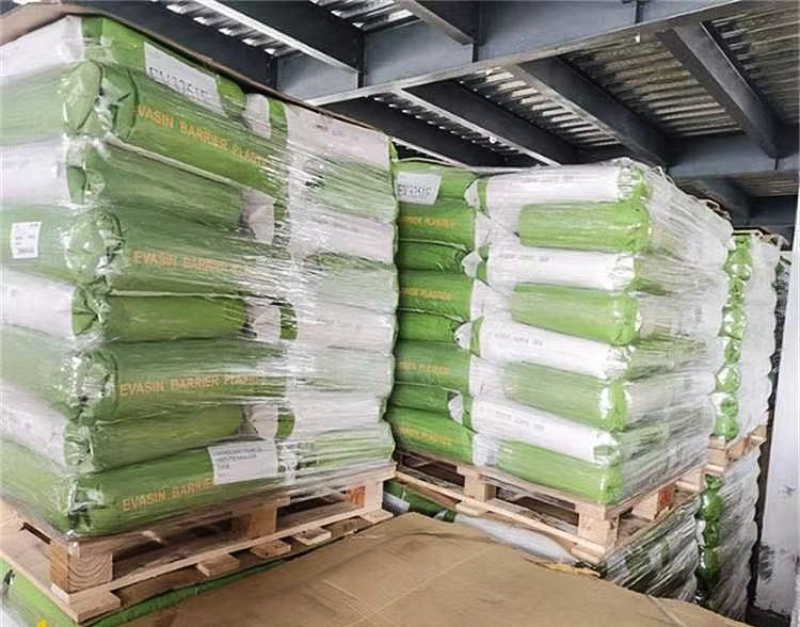
High-density container loading enabled by robotically palletized, perfectly shaped master bags. Maximize your tonnage per shipment.
This allows you to utilize the full height of the shipping container or truck. In an industry where margins are dictated by logistics costs per ton, increasing your load efficiency by 15-20% directly impacts your bottom line.
Frequently Asked Questions (Salt & Chemical Industry)
Q1: Our salt plant has high humidity and corrosive dust. Will this machine survive?
A: Yes. We offer a specialized “Anti-Corrosion Package” for the salt industry. This includes upgrading all product contact parts to 316L stainless steel, using IP65/IP67 rated electrical cabinets, and applying special anti-corrosion coatings to the carbon steel frame. We also use sealed bearings to prevent salt intrusion.
Q2: Can the machine handle both woven PP bags and paper laminated bags?
A: Absolutely. The automatic bag feeding and sewing system is versatile. We can equip the line with different sewing heads (e.g., Newlong) or heat sealers depending on your bag material. Changing between bag types typically requires a simple mechanical adjustment and a recipe change on the Siemens HMI.
Q3: How does the system handle “caking” or hard blocks of salt in the small bags?
A: The key is the upstream conditioning. Our double-deck shaping conveyor applies pressure to break up minor clumps and flatten the bag before it enters the master sack. If the salt is already a hard brick from the VFFS machine, we can install a “bag flattener” module with higher compression force.
Q4: What happens if a 1kg bag breaks inside the machine?
A: We utilize a “Salt Filtering Conveyor” design. The transport rollers have gaps that allow loose salt to fall through into a collection tray, rather than accumulating on the belt and entering the master bag. This keeps the final package clean and prevents customer rejection.
Q5: We currently pack 20 bags of 1kg. Can we switch to 50 bags of 500g?
A: Yes. The counting logic is fully programmable via the PLC. You can change the grouping pattern (e.g., from 5 rows of 4 to 10 rows of 5) through the touchscreen interface. Physical guide adjustments may be needed if the small bag dimensions change significantly.
Нужна консультация по упаковочному оборудованию?
СВЯЗАТЬСЯ С НАМИ → English
 Русский
Leave a Reply