
How to Buy Sugar Stick Packaging Equipment: Match the Pack Format Before You Choose a Machine
A food producer searching for sugar stick packaging equipment should first separate narrow stick sachets from 1–5 kg premade paper bags. Zpacker is an automatic powder packaging line for M-fold square-bottom paper or paper-plastic bags, with screw dosing, dust removal and downstream inspection—not a roll-film stick-pack machine.
Start with the customer’s actual sugar pack format
For a mill, food factory or bakery supplier, the first buying question is not simply “which packaging machine is fastest?” It is whether the line receives a roll of film, a narrow premade stick tube, a valve sack, or a finished kraft bag. A true sugar stick format normally requires a dedicated stick-pack or vertical form-fill-seal system. Verify any sugar stick packaging equipment against the actual sachet format before purchase. Zpacker addresses a different requirement: automatic filling and closing of premade M-fold, square-bottom bags in common 1 kg, 2 kg and 2.5–5 kg ranges.
This distinction prevents a costly mismatch. If the project needs retail sugar sticks, request a stick-pack test and a film specification from the equipment supplier. If the project needs larger paper bags supplied already formed, Zpacker can automate bag feeding, opening, powder dosing, settling, dust control and adhesive closing in one continuous line.
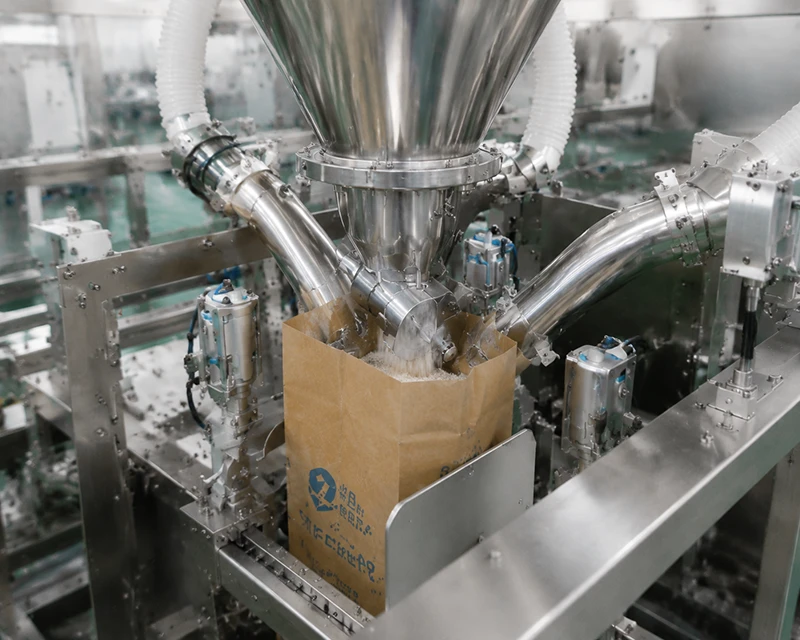
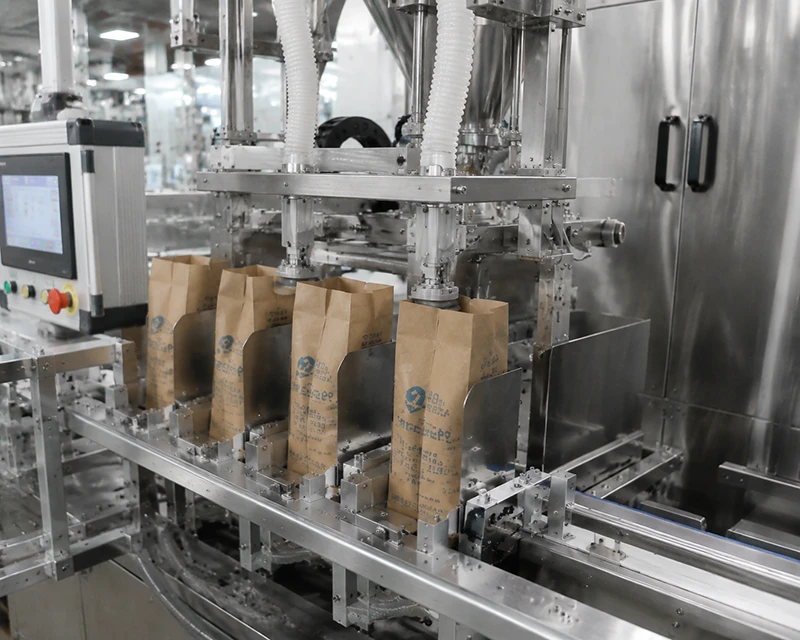
Manual bag placement, opening, filling and closing creates multiple handoffs. With powder, the open bag can release dust, settle unevenly and carry product into the sealing area. A basic filler also does not automatically restore the M-fold after the bag becomes three-dimensional, so trimming, rolling and closing remain operator-dependent.
How Zpacker fits premade paper-bag powder packaging
The line uses belt-fed bag handling and two coordinated bagging stations. A bag magazine supplies the premade bag; clamps open and position it below the dosing outlet. A screw dosing unit meters powder into the bag, while vibration and dust-removal stages help release air, settle the product and reduce powder escape. The process then folds the M edges, trims and rolls the top, applies hot-melt glue by dot or line spray, and presses the closure.
The equipment can be connected to a screw elevator or feeder, conveyor, checkweigher, metal detector, date printer, bag arranger and secondary packing. Safety logic prevents opening, filling and sealing when a bag is missing, and alarms can be configured for air pressure, guarding, drive and glue-temperature faults. These functions target the real production problem: fewer manual transfers while keeping the bag, powder and sealing steps in the correct sequence.

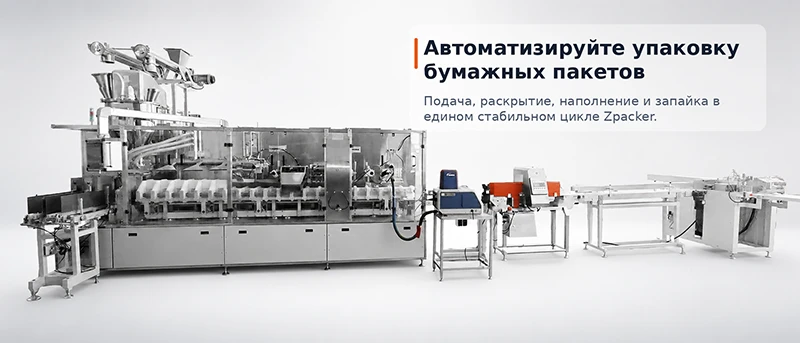
Selection insight: For sugar, flour or another powder, confirm flowability, dust behavior, bag direction, paper-layer construction and glue compatibility before ordering. A paper-plastic bag must be checked for layer adhesion and top-seal performance. Zpacker’s final speed and configuration should be confirmed through the customer’s material, bag samples and acceptance test; it should not be presented as a stick-pack solution without that validation.
Reference specifications to confirm before you buy
The following figures are engineering references for a Zpacker project, not a substitute for a final quotation. They show which inputs a buyer should prepare: target weight, bag geometry, material behavior, utility supply and the required downstream line.
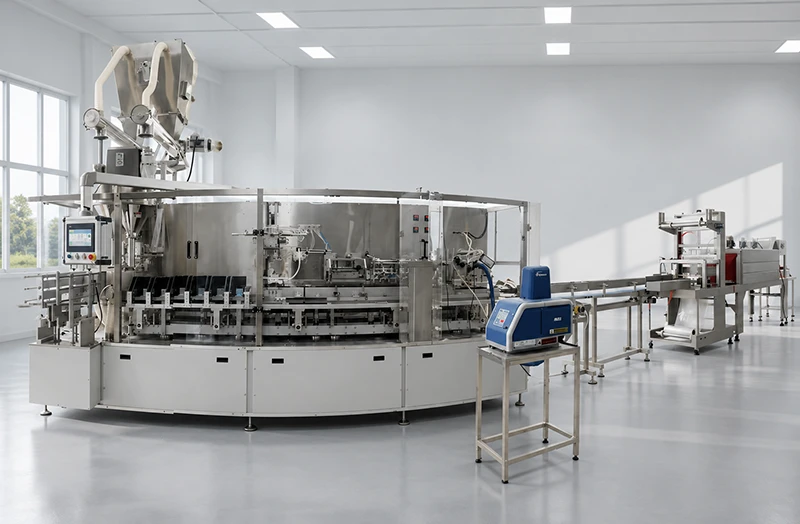
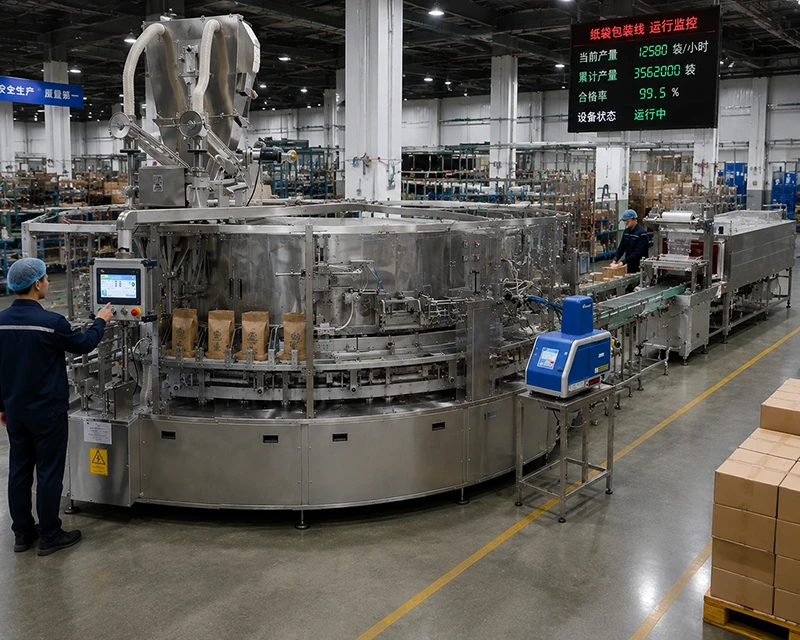
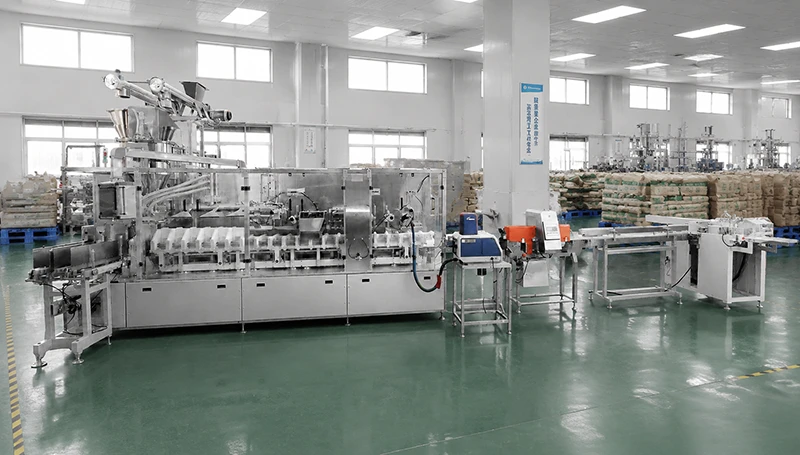
For a complete automatic packaging line, combine the main machine with the right feeding, inspection and secondary packing modules. The factory-floor view below also illustrates why the installation space, operator access and product transfer route must be checked early. When comparing sugar stick packaging equipment with a paper-bag line, the floor footprint differs greatly.
| Item | Zpacker reference | Buying confirmation |
|---|---|---|
| Product and bag | Powder in premade M-fold square-bottom paper or paper-plastic bags | Send product sample, bag sample and bag direction |
| Pack weights | About 1–2 kg; another format about 2.5–5 kg | Confirm the required retail range and changeover plan |
| Reference speed | About 30–35 bags/min for 1–2 kg; 15–20 bags/min for 2.5–5 kg | Validate with material, feeder and acceptance conditions |
| Dosing accuracy | About ±0.5% (5‰) | Define the test method and permitted tolerance |
| Bag dimensions | W about 80–140 mm; L about 240–320 mm; M-side about 60–80 mm | Confirm final dimensions from approved samples |
| Utilities | 15.5 kW; 380 V ±10%, 50 Hz; air consumption about 0.76 m³/min | Confirm final air pressure and site connection |
| After-pack inspection | Checkweigher, metal detector, date printer and grouping options | Specify compliance, rejection and secondary-pack needs |
Need the right sugar packaging format and line scope?
Send the target pack weight, product properties, bag drawings or samples, desired output and available utilities. BPM can confirm whether the project calls for a dedicated stick-pack machine or a Zpacker premade paper-bag packaging line, then define the dosing, dust-removal, inspection and secondary-packing configuration. Share drawings early so the sugar stick packaging equipment scope matches your format.
 English
 Русский