
25 kg Powder Bagging Line: Keeping Bags Straight Before Sewing
A powder packaging line should do more than fill a 25 kg bag. Mipline connects controlled filling, bag clamping and guided transfer so milk powder, flour and starch bags arrive cleaner and more stable at the sewing or sealing station.
Why the last meter becomes the weak point
For a flour mill, dairy powder plant or starch processor packing industrial bags, the visible problem often appears after filling. A 25 kg bag can twist, sag or shift while it travels to the sewing head. If the mouth arrives skewed, an operator has to stop and straighten it by hand. That manual correction adds handling, interrupts the line rhythm and still does not guarantee a square handoff.
A basic conveyor only moves the bag forward. It does not necessarily control the bag mouth, support the bag shape or create a repeatable interface with the next machine. Mipline treats bag supply, opening, clamping, filling and transfer as one powder bagging line, with the handoff before sewing or sealing designed as part of the process rather than an afterthought.
The more useful question is: can the filled bag stay aligned through the transfer, reach closure in a controlled position and leave the line ready for inspection or palletizing?
How Mipline adapts the filling and bag handoff
Mipline is configured for dry powders in kraft paper, paper-plastic composite or coated woven bags, subject to material and site checks. Its bottom-up filling structure keeps the fill point close to the material. The source configuration uses three-stage screw feeding—fast fill, medium fill and slow final dosing—to support controlled weighing instead of an uncontrolled free-fall drop. Where required, vacuum extraction or de-aeration can be integrated before closure.
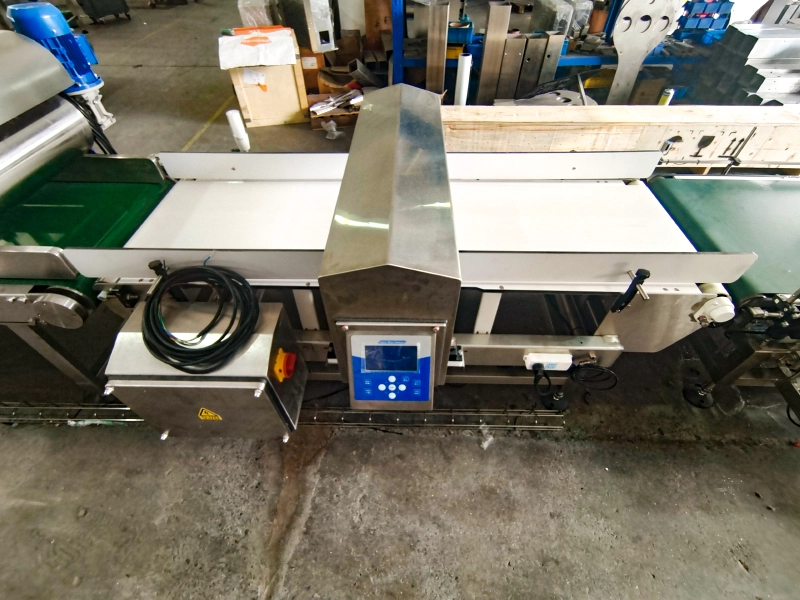
After filling, the bag can move through dust cleaning, trimming, inner-bag heat sealing, pressing, sewing, hot-melt paper-tape wrapping and final pressing according to the selected closure method. Turning, settling, shaping, metal detection, checkweighing, reject and roller discharge can then be added to match the plant layout. This is why the line is better specified as an automatic bagging machine for powder with downstream handling—not as a standalone filler.
Engineering view: the transfer section should be specified together with the bag mouth, closure head and downstream inspection. A stable bag handoff before sewing depends on the bag construction, powder aeration, target weight and conveyor guide geometry—not on conveyor speed alone.
Visible structures that support a cleaner transfer
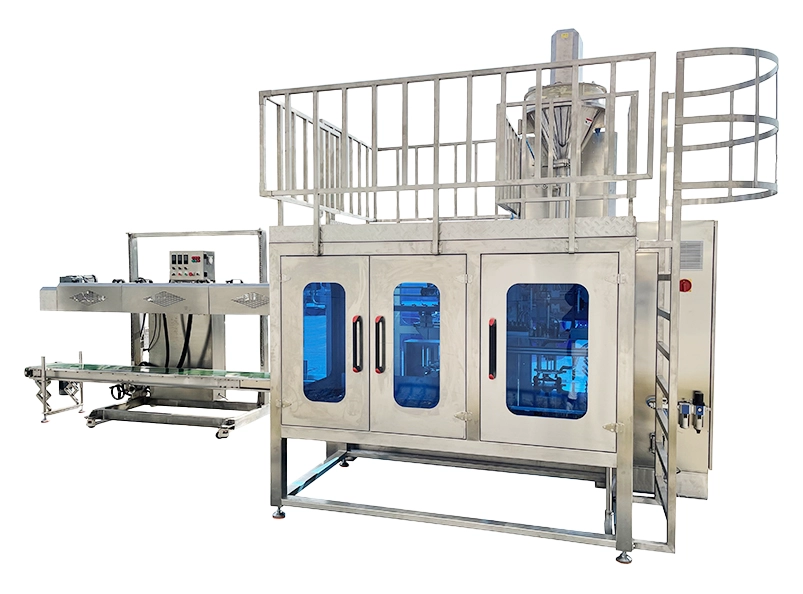
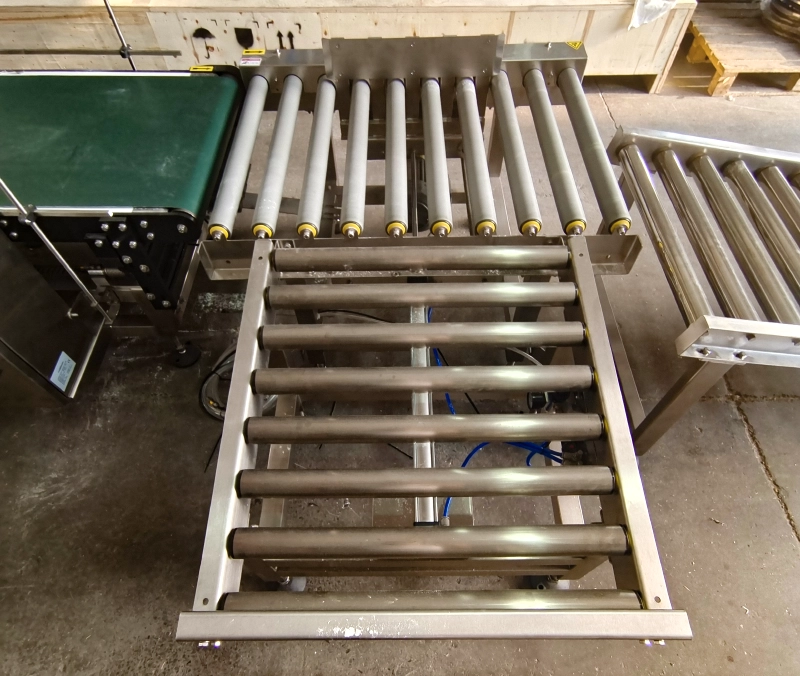
The production images show the physical evidence behind the layout: an enclosed stainless-steel bagging station with blue inspection windows and a bag magazine conveyor; roller transfer sections for controlled bag movement; and a twin-belt conveyor with adjustable side guides. These components give operators access to the process while keeping the bag path defined between stations.
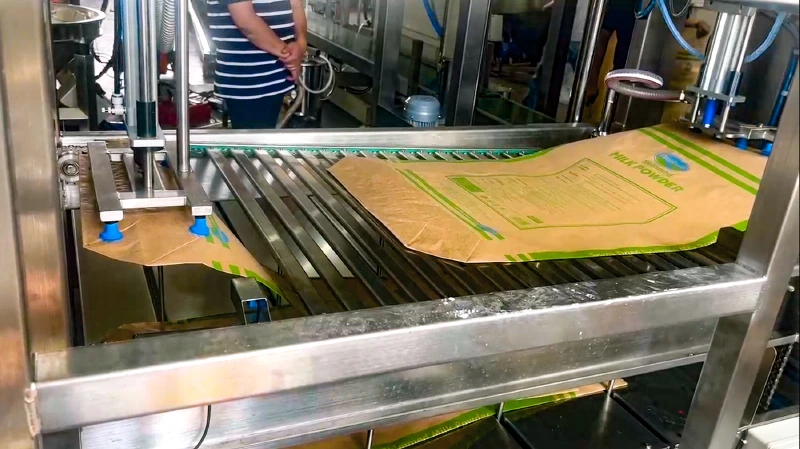
A clamp station can hold the kraft-paper powder bag while the filling and closure sequence is completed. Guided belts and rollers then help reduce manual bag straightening at the last meter. The line can also include HMI control, emergency-stop protection and final inspection equipment. Exact capacity, accuracy and reject settings remain configuration dependent and should be confirmed against the selected material, bag and approved datasheet.
| Line requirement | Ответ Mipline | What to verify |
|---|---|---|
| 25 kg powder bag handling | Bag magazine, opening, clamp and guided transfer are combined in one line concept. | Bag dimensions, material, bulk density and target speed. |
| Cleaner filling before closure | Bottom-up filling and staged screw dosing support a controlled fill point. | Powder flowability, aeration, dust extraction and test results. |
| Stable handoff before sewing | Roller, belt or twin-belt transfer with guides supports bag alignment. | Closure head interface, guide adjustment and conveyor layout. |
| Finished-bag quality control | Shaping, metal detection, checkweighing and reject can follow closure. | Approved detector and checkweigher range, accuracy and throughput. |
Plan a powder filling and bag sewing line around the handoff
Share the powder type, bag construction, target weight, closure method, required throughput and palletizing layout. BPM can use those inputs to define the filling, transfer, inspection and reject configuration for your 25 kg powder packaging line.
Discuss Your Powder Bagging Line English
 Русский