
Flour Packaging Equipment for Mills: How Zpacker Controls Dust and Cuts Manual Handling
For a flour mill, food factory, or bakery plant, an automatic flour packaging line must do more than dose powder. Zpacker connects premade paper-bag handling, screw dosing, bag settling, dust removal, sealing, and downstream inspection for practical 1–5 kg retail formats. This overview shows where the equipment fits, what a manual or semi-automatic process leaves unresolved, and which bag, utility, and line conditions should be confirmed before quotation.
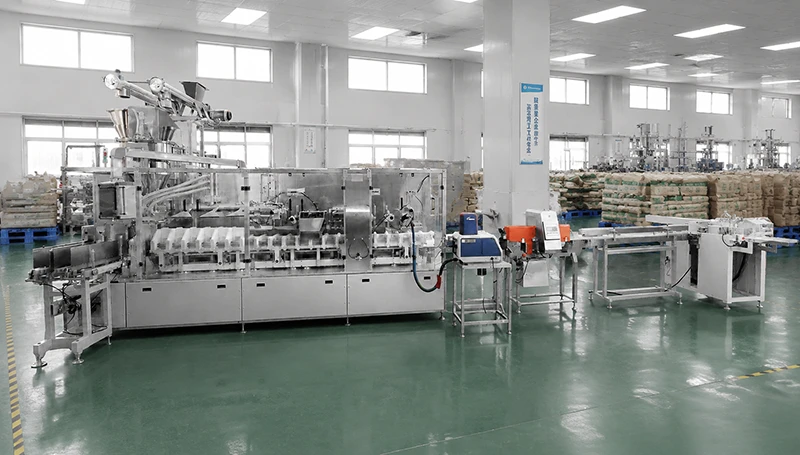
From flour storage to a controlled paper-bag process
A mill or food production plant normally starts with flour storage silos or a buffer hopper, then moves powder through a screw conveyor or elevator to the packing area. The requirement is not simply a powder filling machine. The line must take a preformed paper or paper-plastic bag, open and orient it, dose the flour, settle the material, close the top, and transfer a stable finished pack to inspection or secondary packing.
Zpacker is built around this sequence. Its full automatic, two-station linear format is intended for M-fold, square-bottom premade bags rather than roll film. A typical configuration covers about 1–2 kg on one specification and about 2.5–5 kg on another, with the final range confirmed through the customer’s bag samples and material test. That makes it relevant to the 1 kg, 2 kg, and 5 kg paper-bag formats commonly planned for retail flour.
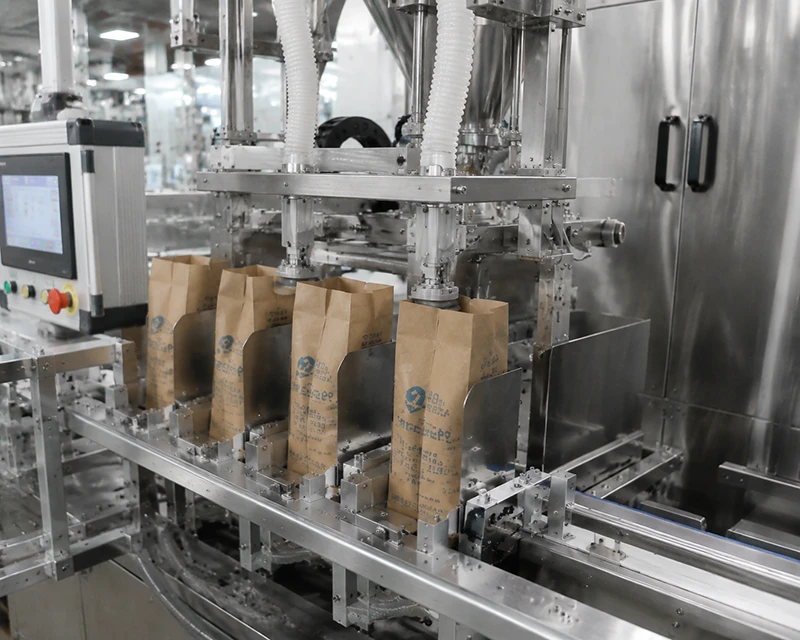
With manual filling, operators repeatedly pick bags, open them, hold the mouth below the filling point, and close each pack. A semi-automatic machine may improve dosing but still leave bag opening, M-fold forming, trimming, gluing, and hand-off between stations to people. The result is an uneven workflow: powder can escape around the mouth, flour may not settle before sealing, and a dusty seal area can weaken the finished closure. Changing between retail weights also creates repeated adjustment and handling work.
Why the bag shape and powder route matter
After the premade bag is picked from its magazine, the clamps open it into a three-dimensional bag for filling. Once the flour is dosed, the process continues with several vibration and dust-removal positions to help release air and settle the powder. The M-fold is then folded back, the top can be trimmed and rolled, and hot-melt adhesive is applied by dot or line spray before the top is pressed into shape. This is a paper-bag sealing process, not heat sealing of a film pouch.
The two bag magazines, feeding action, dosing positions, and safety logic are coordinated in one line. If a bag is missing, the machine is designed not to open, fill, or seal that position and can alarm; the exact interlock and acceptance logic belong in the final configuration. A 10.4-inch touchscreen and PLC-based control give the operator a clear point for recipe and status management, while the exposed product-contact areas use 304 stainless steel.
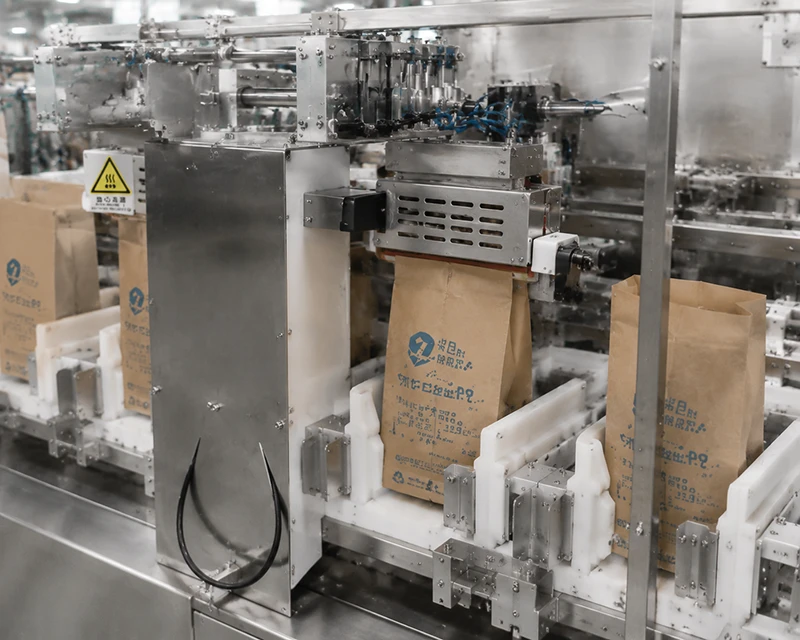
Engineering view: The key selection question is not only whether a screw doser can weigh flour. It is whether the bag magazine, clamps, dust-removal path, M-fold handling, adhesive sealing, and downstream conveyor can keep the complete paper-bag cycle together. Confirm bag direction, mouth construction, M-side, paper or paper-plastic bonding, and adhesive compatibility before treating a nominal speed as a production promise.
Match the flour packaging line to weight, bag, and downstream checks
For a quotation, the mill should provide the actual flour properties, target weights, bag drawings or samples, and the required downstream route. Zpacker can be arranged with screw feeding and twin screw dosing, then connected to a conveyor, checkweigher, metal detector, date printer, bag arranger, and either group shrink wrapping or manual outer-bag packing. These additions turn an isolated packaging machine into an automatic packaging line without assuming that every project needs the same equipment.
The table below separates reference values from items that must be validated. The approximate speeds are planning figures affected by flour flowability, feeding stability, bag construction, and the final acceptance method. The machine reference power is 15.5 kW, with 380 V ±10%, 50 Hz supply; compressed-air pressure should be confirmed from the final BOM because project documents use different reference ranges.
| Quotation check | Zpacker reference | Why it affects the result |
|---|---|---|
| Retail weight | About 1–2 kg or 2.5–5 kg by configuration | Sets the dosing and bag-handling range; test 1 kg, 2 kg, or 5 kg samples. |
| Reference throughput | About 30–35 bags/min for 1–2 kg; about 15–20 bags/min for 2.5–5 kg | Use as a planning reference only; final speed depends on material and acceptance conditions. |
| Bag format | Premade M-fold square-bottom bag; W about 80–140 mm, L about 240–320 mm, M-side about 60–80 mm | Bag direction, dimensions, and paper-layer bonding determine opening and sealing stability. |
| Dosing and quality control | Screw dosing, about ±0.5% reference accuracy; checkweigher and metal detector can be added | Weight control and foreign-metal detection support retail compliance and product protection. |
| Utilities and layout | About 0.76 m³/min air consumption; pressure and layout confirmed by final design | Stable air, feed capacity, and installation space protect cycle continuity and dust control. |
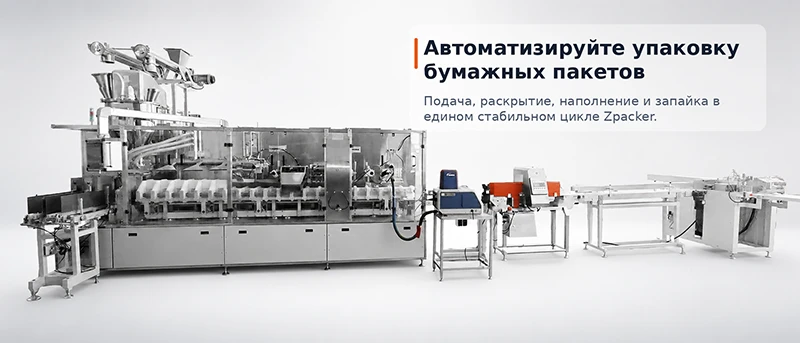
Plan a flour packaging equipment test around your real bags
Send the flour specification, target 1–5 kg weights, bag samples, expected output, and downstream inspection requirements. BPM can use those inputs to confirm the zpacker configuration, dust-removal route, adhesive sealing method, utilities, and layout before a final offer and acceptance plan.
Request a Zpacker Packaging Line Review English
 Русский