
Milk Powder Packaging Line: Keeping 25 kg Bags Stable Before Sewing
A milk powder packaging line is judged at the sewing head, not at the filler. On a 25 kg kraft paper or coated woven bag, a few degrees of skew, a puff of powder at the bag mouth, or a bag that still holds air is enough to slow the whole line down and put an operator back at the last metre, straightening bags by hand. Mipline is configured around that handoff: an enclosed stainless steel bagging station, a bag magazine conveyor, clamped bottom-up filling, guided roller and twin-belt transfer, then settling, shaping, checkweighing and discharge before palletizing.
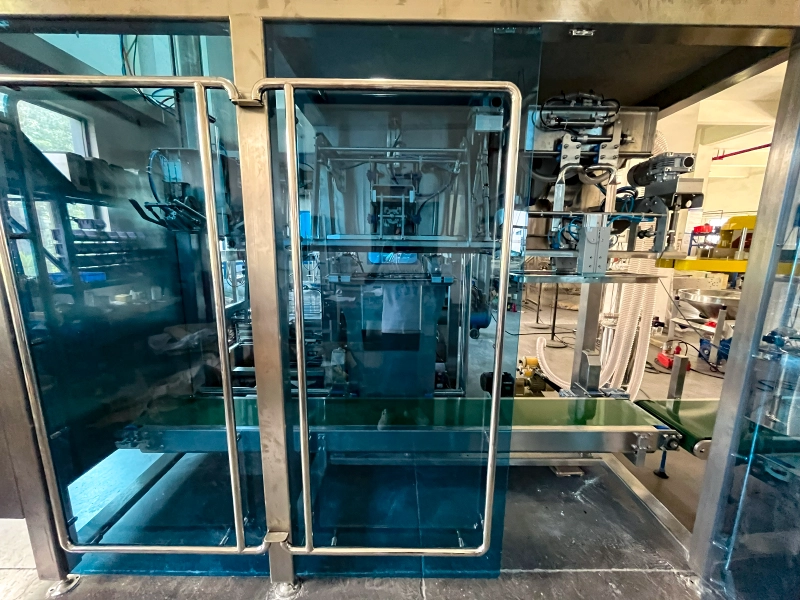
Bag supply and opening: the first failure point
Most reworked bags are not caused by the weigher. They are caused by how the bag arrives at the fill point. When an operator pulls a bag from a stack, opens it by hand and holds the mouth over the filling spout, the bag angle changes from bag to bag. A bag that starts three degrees out of square is still three degrees out of square when it reaches the sewing head, and by then it is carrying 25 kg of product. On a milk powder packaging line that runs a full shift, correcting that small variation is what the operators are actually doing instead of checking weight or watching the closure.
Mipline takes the bag out of the operator’s hands earlier. A bag magazine conveyor feeds flat bags to the station, a vacuum pickup lifts and opens one bag at a time against a fixed reference, and the opened bag is positioned and clamped before filling starts. Because the bag is held by the machine rather than by a person, the position of the bag mouth at the fill point stays repeatable from the first bag of the shift to the last. The factory image below shows the infeed and discharge side of that station: bag magazine feed, control cabinet with the vacuum circuit and hose run, and the green transfer belt that carries the opened bag into the filling position.
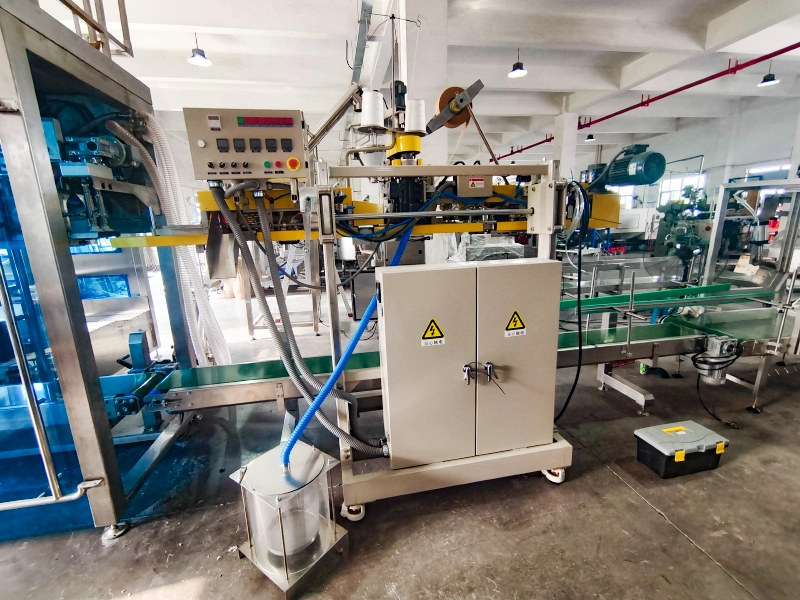
Free-fall filling throws dust up into the bag mouth. Operators straighten heavy bags by hand. The sewing head then receives a skewed, dusty, air-filled bag and produces a seam that has to be reworked before the bag is fit for a pallet.
Bottom-up filling on a milk powder packaging line: clean bag mouth, repeatable weight
On a milk powder packaging line the fill method decides how much cleaning the bag mouth needs. Free-fall filling drops powder from above, so air is displaced upward through the open bag and carries fines onto the sealing surface. Bottom-up filling does the opposite: the bag is clamped and lifted as it fills, so the fill point stays close to the rising product surface and there is far less free fall, far less dust in the air stream and far less build-up around the mouth. A three-stage vertical screw feed then finishes the job in three steps — fast fill, medium fill and a slow final dose — so the last part of the weight is added gently instead of dropped.
The practical result is a bag mouth that is cleaner when it leaves the fill station and a gross weight that drifts less from bag to bag. On dairy powder this counts twice: powder left on the sealing surface weakens the closure, and powder on the outside of an industrial bag is a hygiene problem on a food-grade floor. Weight verification is still a separate step, and a checkweigher is selected per project, because reference datasheets quote different belt widths, throughputs and accuracies for the same 25 kg duty.
Field note: Start from the bag, not the machine. Bag construction, gusset, bag height and powder bulk density set the fill geometry; the filling head, settling section and closure method follow from there. Filling accuracy figures quoted for one powder should never be copied onto another without confirmation.
Stable bag transfer before sewing on a milk powder packaging line
The transfer between filling and closure is where most 25 kg lines lose their rhythm. A filled bag sitting loose on a plain belt can twist, lean or settle unevenly, and the sewing head becomes unstable because the bag mouth arrives skewed. Mipline uses guided roller conveyor sections and adjustable side guides to keep the bag square through the handoff, with clamping on the bag body instead of relying on an operator to keep pace with the line. Twin-belt transfer sections with adjustable guides carry the same alignment further downstream.
Downstream the logic continues: turning and settling so the powder levels out, shaping so the bag is flat and stackable, metal detection and checkweighing on the formed bag, a defined reject path, and roller discharge to the palletizer. A milk powder packaging line that treats closure and inspection as one sequence delivers fewer rejects at the pallet than a line that treats sealing as the end of the process. Around all of it sits an enclosed stainless steel frame with blue inspection windows, guarding, an emergency-stop point and a top access platform — so the line can be watched, cleaned and maintained without dismantling the bagging station.
| Параметр | Reference value | What it changes on the line |
|---|---|---|
| Bag weight and format | 25 kg industrial bags; kraft paper, paper-plastic composite or coated woven | Sets fill geometry, clamp size and conveyor loading |
| Stated capacity | 1.5–2 bags/min (referenced configuration) | Shift planning only; confirm against your powder and bag |
| Stated filling accuracy | ≤±0.1–0.2% | Giveaway control; verify on the actual material |
| Feeding system | Vertical screw, three-stage dosing with bottom-up lift fill | Dust at the bag mouth and weight repeatability |
| Body and hygiene | SUS304 stainless steel enclosure and product-contact parts | Cleaning access and food-grade finish |
| Closure path | Dust removal, trimming, sealing, sewing and paper tape where configured | Seam condition after filling and transfer |
| Inspection and discharge | Metal detection plus checkweighing on the formed bag, reject path, roller discharge | Catches contamination and weight drift before the pallet |
Planning a milk powder packaging line around your own bag?
Send the bag drawing, target weight, powder bulk density and the output you need per shift. We will come back with the station layout, the transfer and alignment sections, and the closure and inspection sequence for a milk powder packaging line that matches your product and your floor, not a generic catalogue machine.
Запросить аудит линии English
 Русский