
Automatic Powder Bagging Machine: Cleaner Bag Transfer
For dairy powder, flour, starch, feed, and compatible dry chemicals, Mipline connects controlled filling with bag handling, guided transfer, closure, and inspection so 25 kg bags arrive at sewing or sealing in a more stable condition.
Start with the bag and the handoff, not only the filler
A plant searching for an automatic powder bagging machine usually has a familiar production problem: the powder can be weighed, but the filled bag still twists, collapses, or arrives crooked at the sewing head. This is common on 25 kg kraft paper, paper-plastic composite, or coated woven bags when the operator has to open the bag, hold the mouth, straighten the body, and push it toward the next station by hand. The line may appear to be running, yet the last metre creates rework and interrupts the closure step.
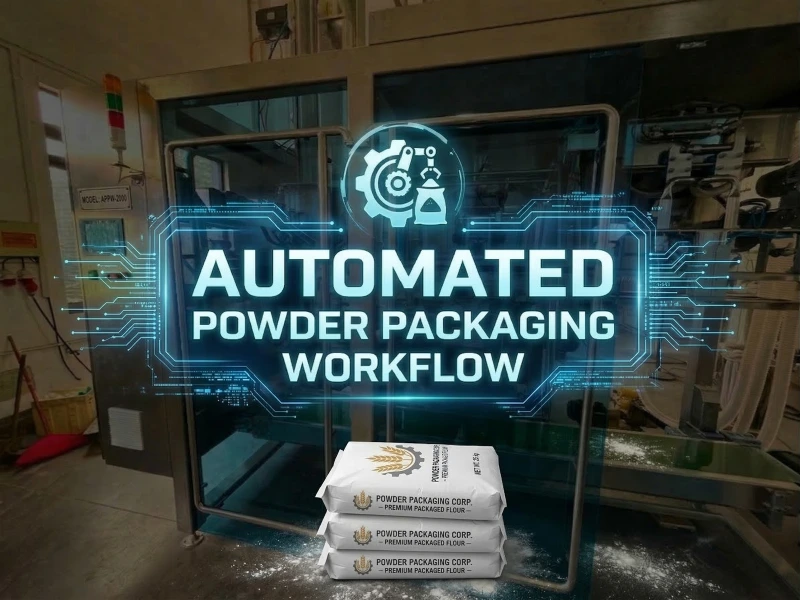
The old semi-manual route also exposes the bag mouth to powder. Free-fall filling can leave product around the sealing or sewing area, while a loose conveyor only moves the bag without controlling its posture. Mipline treats the automatic powder bagging machine as a process line: bag magazine supply, pickup, opening, clamping, bottom-up filling, closure, settling, shaping, inspection, reject, and discharge are planned as connected operations. That approach is relevant to a dairy powder bagging line as well as flour or starch packaging when the bag format and powder behaviour are confirmed during project design.
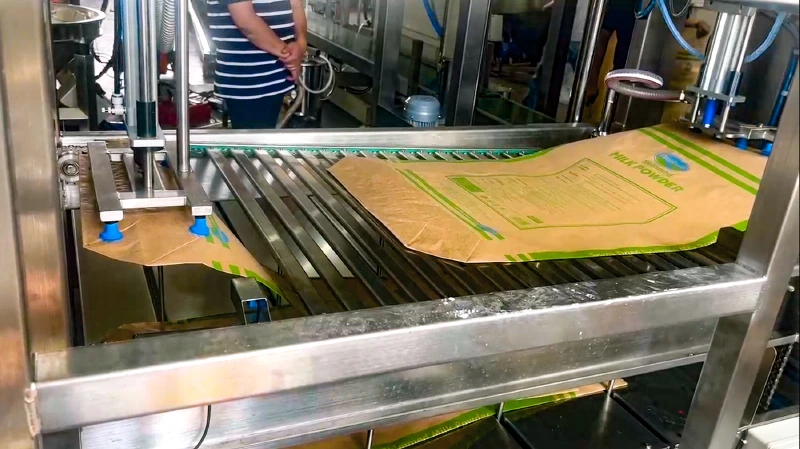
If an operator must repeatedly square the bag before sewing, the problem is not solved by adding speed to the filler. The handoff needs support, alignment, and a defined next position.
Why Mipline fits 25 kg dry-powder lines
Mipline uses a lifting platform for bottom-up tracked filling, keeping the fill point close to the rising material rather than allowing a long open drop. A vertical screw feeder can be arranged for fast, medium, and slow final dosing, while weighing control manages the target fill. Where the material and bag require it, vacuum extraction or de-aeration can be included before closure. These functions give the automatic powder bagging machine a direct answer to dust around the mouth, trapped air, and unstable bag shape instead of leaving each issue to an operator.
Bag clamping and guided conveying then carry the filled bag into the next operation. Depending on the approved configuration, closure can combine dust removal, trimming, inner heat sealing, sewing, hot-melt paper tape, and pressing. After closure, settling and shaping help the bag develop a more repeatable profile before metal detection, checkweighing, reject handling, and roller discharge. The goal is not an unsupported claim of one universal speed or accuracy; it is a controlled route that can be matched to bulk density, flowability, moisture, aeration, bag construction, and the required sewing or sealing method.
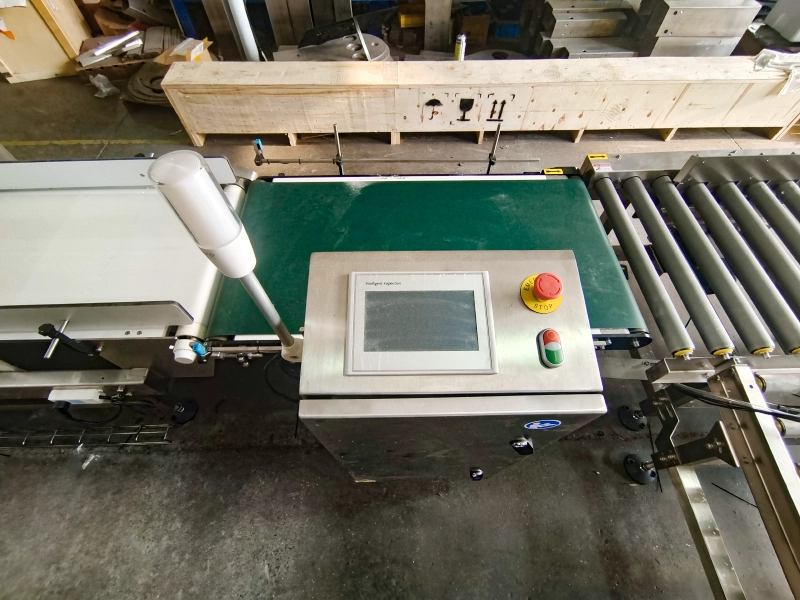
Engineering view: The value of an automatic powder bagging machine is measured at the interface between stations. A clamp, guide, roller section, or settling step matters when it removes a specific correction that used to happen by hand.
Structure and reference data behind the line
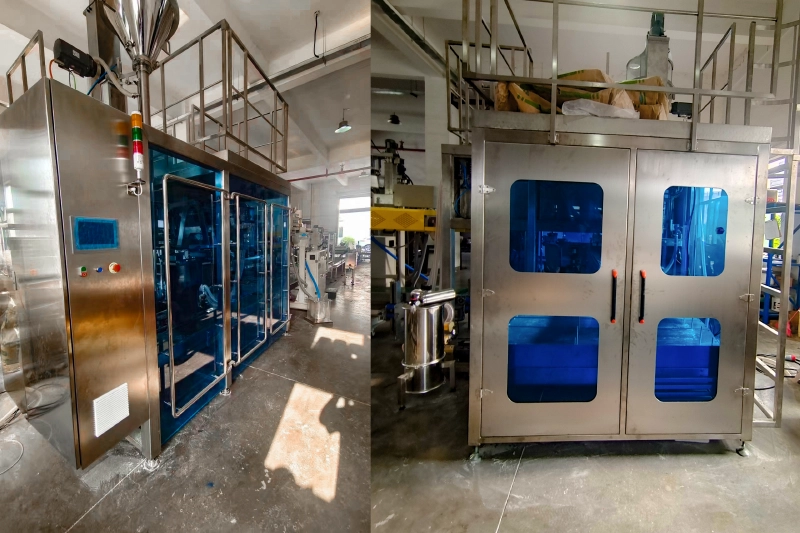
The factory evidence shows an enclosed stainless-steel machine body, blue inspection windows, guarded access, HMI control, green belts, roller transfers, and a downstream path for finished bags. Those visible structures support the intended workflow, but an image alone does not prove capacity, customer identity, or final performance. The automatic powder bagging machine must be confirmed against a powder sample, bag drawing, target weight, utilities, closure method, and layout.
| Элемент линии | Reference evidence | Project check |
|---|---|---|
| Bag format | Nominal 25 kg industrial powder bags | Confirm dimensions, material, mouth, and filled-bag profile |
| Filling sequence | Bottom-up lifting fill with three-stage screw feeding | Match screw and control logic to density, flowability, and aeration |
| Reference capacity | 1.5–2 bags/min in one 11889 line list | Verify the selected variant, material, and downstream cycle time |
| Reference utilities | SUS304 body, 5 kW main power, 5.5 m³/h air consumption | Confirm the approved electrical and compressed-air specification |
| Vacuum option | 63 m³/h vacuum rate in the referenced configuration | Confirm whether de-aeration or residual-oxygen targets apply |
| Final quality gate | Metal detection, checkweighing, reject, and roller discharge options | Use the selected detector and checkweigher datasheets |
With these inputs fixed, the result is practical: fewer manual bag-straightening actions, a cleaner and more repeatable handoff before sewing or sealing, and a finished-bag inspection path that is easier for production and quality teams to manage. Review the Mipline powder packaging line overview or send the bag and powder details for a project fit review.
Confirm your powder bagging line configuration
Share the powder type, target weight, bag construction, closure method, required output, and available utilities so the automatic powder bagging machine can be configured around the real handoff problem.
Request a project fit review English
 Русский