
Powder Packaging Line: Settling Before Inspection
A powder packaging line must control more than the fill point. For 25 kg dairy, flour, starch, feed, and compatible dry-powder bags, Mipline links bag supply, bottom-up filling, closure, settling, shaping, inspection, and guided discharge so the bag reaches sewing or sealing in a controlled condition.
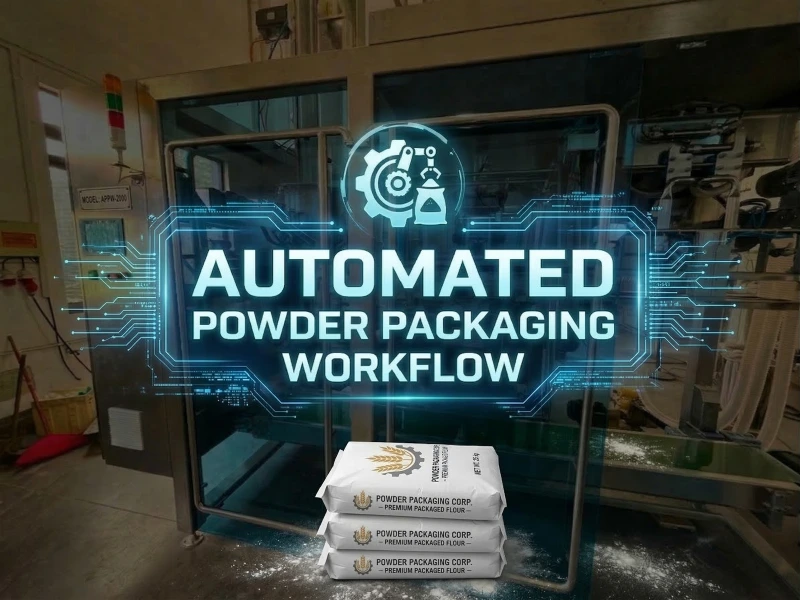
A 25 kg powder line starts with the handoff problem
A dairy powder, flour, or starch plant may have a reliable weigher and still lose time at the next station. The filled kraft paper, paper-plastic composite, or coated woven bag leaves the filler with a soft body, trapped air, or a mouth that is no longer square. Before the sewing or sealing head, an operator then has to catch the bag, straighten it, pull the mouth into position, and keep the next bag from closing the gap. That is the real operating context for a powder packaging line: not only filling kilograms, but carrying a heavy bag through the last controlled transfer.
The older arrangement is usually a filler followed by a plain belt or roller conveyor. It moves the bag, but it does not necessarily hold its geometry. A twist at the discharge can become a skewed sewing path; a dusty mouth can weaken the closure step; uneven settling can make the bag hard to stack. Mipline addresses this gap as a connected process. Its bag magazine, pickup and clamp logic, filling station, closure equipment, and downstream transfer are specified together instead of leaving the last meter to manual recovery. For a related view of this handoff issue, see the Mipline final-bag inspection workflow.
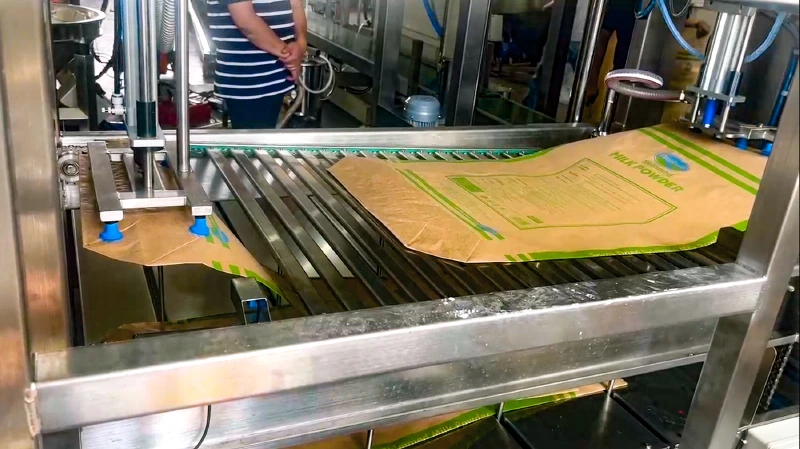
Manual bag opening, free-fall filling, loose transfer, and late bag straightening create a chain of small interruptions: powder on the mouth, unstable sewing, bags that retain air, missed weight deviations, and reject decisions made too late. A conveyor alone transports the problem; a coordinated line gives each handoff a defined job.
Why Mipline fits the dry-powder workflow
Mipline is configured around the behaviour of the material and the bag, rather than sold as a generic automatic packing machine. The sequence can include bag magazine storage, vacuum pickup, opening, placement and clamping; a lifting platform for bottom-up tracked filling; and vertical screw feeding with fast, medium, and slow dosing stages. Keeping the fill point close to the rising powder level is designed to reduce dust escape compared with open free-fall filling. Where the project requires it, vacuum extraction or de-aeration can be added before closure.
After filling, the line can combine dust removal, trimming, inner heat sealing, pressing, sewing, hot-melt paper tape, or other approved closure steps for the selected bag construction. The finished bag then moves through turning, settling, shaping, metal detection, checkweighing, reject handling, and roller discharge. This is why the powder packaging line is suitable for 25 kg milk powder and other dairy powder, flour, starch, feed, food powder, and selected dry-chemical projects—but the final configuration still depends on bulk density, flowability, moisture, aeration, bag dimensions, closure method, target speed, and site layout. A milk-powder example is described in the stable 25 kg bag transfer guide.
Engineering point: Treat settling and shaping as quality-control preparation, not as an afterthought. A bag that is square and supported before inspection gives the metal detector and checkweigher a more repeatable product presentation, while the guided handoff reduces the need for manual straightening at the sewing station.
Reference structure and parameters to verify
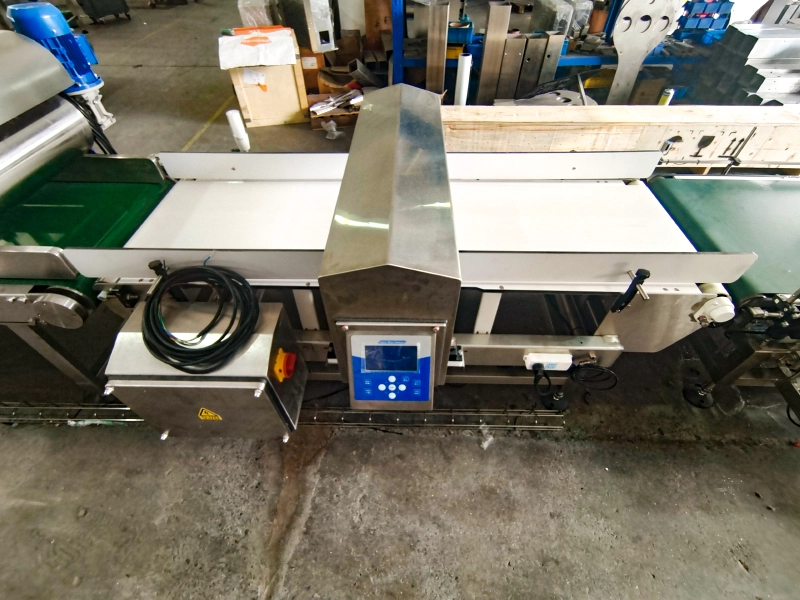
Factory evidence for this powder packaging line shows the type of physical control the buyer should inspect: an enclosed powder packaging station, stainless-steel guarding, green belts, roller sections, bag gripping, adjustable side guides, and visible control hardware. The images show machine structure and application logic; they do not by themselves prove capacity, accuracy, customer identity, or a universal material fit. Those items must be confirmed against the approved project datasheet and bag sample.
The reference values below explain how the line is sized without turning one variant into a promise for every plant. The 11889 configuration lists 25 kg bags, 1.5–2 bags/min, stated accuracy of no more than ±0.1–0.2%, 5 kW main power, 5.5 m³/h air consumption, and a SUS304 body. The DS25K reference covers 5–25 kg, 1–3 bags/min, and stated accuracy of no more than ±0.2%. Conveyor and inspection modules also change with layout and product effect, so commissioning targets should be agreed before purchase.
| Line point | Reference configuration | Buyer verification |
|---|---|---|
| Bag and fill | Nominal 25 kg industrial bags; bottom-up tracked lift and three-stage screw feeding | Bag construction, dimensions, density, flowability, moisture, and target weight |
| Capacity | 1.5–2 bags/min on one 11889 reference; 1–3 bags/min on DS25K reference | Material test, closure cycle, operator concept, and line balance |
| Settling and shaping | 3,000 mm settling conveyor, 600 mm width, 15 m/min; 1,500 mm shaping section, 600 mm width, 15 m/min reference | Available floor length, bag height, palletizing interface, and required residence time |
| Inspection | ER6023 reference: 520 mm belt, up to 28 m/min, 600 × 230 mm window; checkweigher values vary by model | Product effect, Fe/NF/SUS test pieces, checkweigher datasheet, and reject logic |
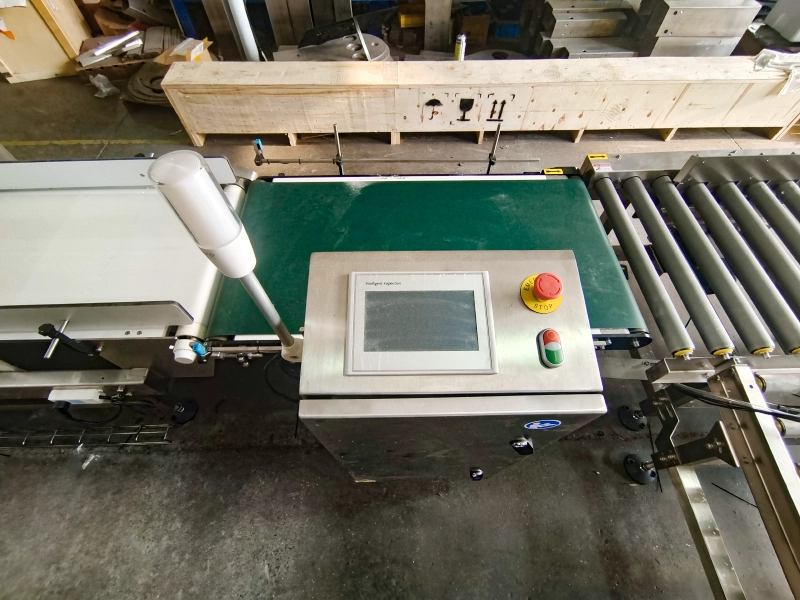
At the end of a correctly matched project, the result is not simply a filled bag. It is a cleaner, supported, and inspectable 25 kg bag moving from filling through closure and controlled transfer, with a defined reject path and a more predictable handoff to sewing, sealing, palletizing, or warehouse handling. That is the practical value of selecting a powder packaging line around the full bag journey.
Confirm the right powder packaging line configuration
Send the powder sample, bag construction, target weight, output requirement, closure method, utilities, and available layout. Mipline can then be reviewed as a complete dry-powder process rather than as an isolated filler.
Request a project fit check English
 Русский