
50 kg Cement Valve Bag Packing Line: Price Drivers
A 50 kg cement valve bag packing line is not a 25 kg line with thicker steel. The fill mass nearly doubles, the bag-handling kinematics change, and the pallet pattern shifts from short retail pallets to one- or two-ton export blocks. Every one of those shifts shows up on the price sheet. Here is how a 50 kg cement valve bag packing line is typically priced, which stations move the number the most, and what project conditions move it again.
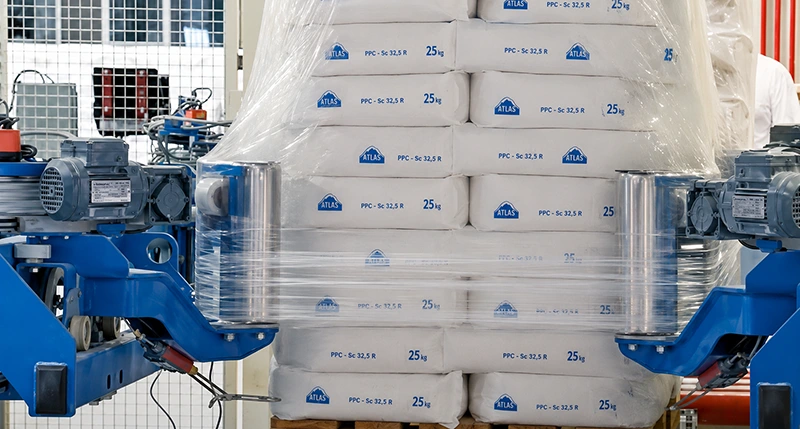
Why a 50 kg Cement Valve Bag Packing Line Is Not Just a Scaled-Up 25 kg Line
A 25 kg valve bag of OPC or slag cement sits at the limit of what one operator can still swing by hand. A 50 kg bag crosses that limit. The empty blank is longer, wider, and stiffer; the same bag filled with cement hits roughly 50 kg on the scale. Three things change on the line when the format moves from 25 kg to 50 kg.
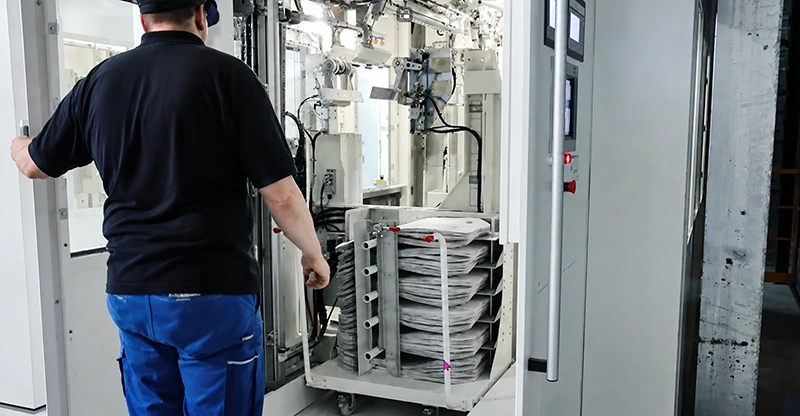
First, the wheeled bag magazine has to hold bigger blanks. Each pocket is wider, and the wheeled rack cannot be hand-loaded with the same density as the 25 kg magazine. The bag-magazine frame on VPLINE uses a steel skeleton with casters and a side handle so one operator can swap a full magazine during a shift change without blocking the bagger.
Second, the twin-arm bagger gripper has to open a wider, thicker bag blank without tearing the corner. The pneumatic gripper pattern and the suction-cup layout are scaled to the 50 kg bag footprint, and the clamp closing force is re-rated. The robot reach also has to clear the deeper bag before slipping it onto the filling nozzle.
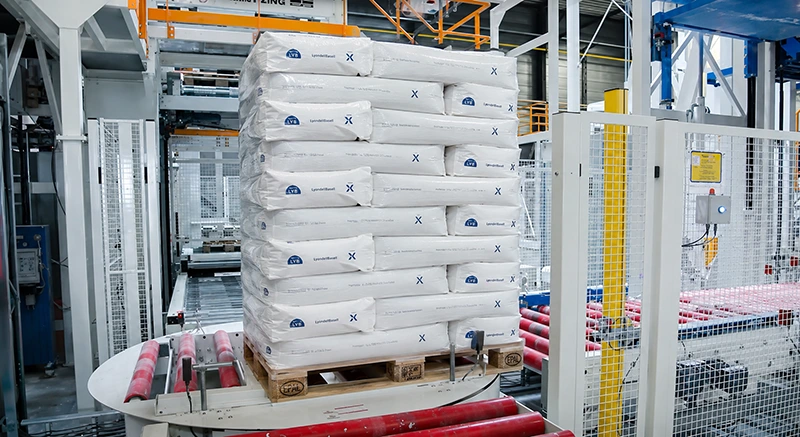
Third, the palletizer must place heavier bags without losing cycle time. A 50 kg bag placed at the edge of the pallet exerts more moment on the layer, so layer count, interlock pattern, and pallet pattern all become decisions, not assumptions.
Three questions come up on almost every 50 kg cement RFQ: how does the line hold 50 kg bags without tearing, where does the dust go at the fill point, and what does the pallet pattern look like at the end of the cell. The price only makes sense once those three answers are fixed.
Where the Price Actually Goes on a 50 kg Cement Valve Bag Packing Line
The headline number for a 50 kg cement valve bag packing line is rarely the price of one machine. It is the sum of seven stations, plus engineering, plus site integration. Buyers see this split during proposal review and the seven stations are:
1. Wheeled bag magazine with casters and a side handle.
2. Twin-arm robotic bagger with pneumatic grippers.
3. Air-conveyed filling station with an expandable valve-bag nozzle and a clamping collar.
4. Ultrasonic valve sealing head running at 20 to 40 kHz.
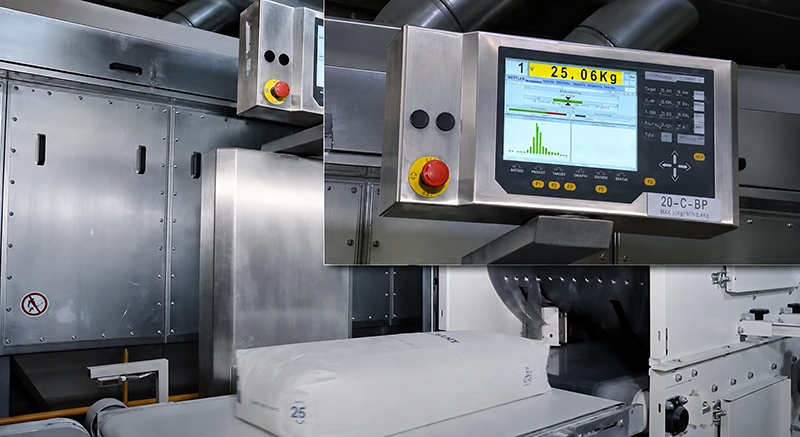
5. Checkweighing and metal detection over a stainless steel conveyor.
6. Robotic palletizer with bag-turn, layer-sheet dispenser, and stretch-hood infeed.
7. Controls: HMI, PLC, E-stop network, and the safety guarding that wraps the cell.
Most 50 kg cement valve bag packing line proposals sit inside one of three configurations: a single filling host with one robot palletizer, a twin-filling host that shares one robot palletizer, or a turnkey cell that also covers the dust extraction duct, the metal-detector gate, and the stretch-hood wrapper at the outfeed.
Buyer note: A 50 kg cement valve bag packing line price is set station-by-station, not as one machine number. If a quote does not split the seven stations, ask for the split before comparing it with a competing proposal.
Spec-by-Spec: Components and What They Cost on a 50 kg Cement Valve Bag Packing Line
Below is a typical price-driver map for a 50 kg cement valve bag packing line. The exact percentages shift with throughput and bag format, but the order rarely does.
| Station | What it does on a 50 kg cement valve bag packing line | Cost driver |
|---|---|---|
| Wheeled bag magazine | Holds 50 kg valve bag blanks, hand-swappable during shift change | Frame size, casters, magazine count |
| Twin-arm robotic bagger | Picks, opens, and slips the empty 50 kg bag onto the nozzle | Gripper force, vacuum pump, pneumatic circuit |
| Air-conveyed filling | Expandable nozzle with a two-channel fill and return-air circuit | Stainless contact parts, dosing valve size, dust extraction port |
| Ultrasonic seal head | 20 to 40 kHz weld across the coated valve area | Sealing layer compatibility, dust extraction at the head |
| Checkweigher and metal detector | Online weight check and tramp-metal reject | Belt width, reject mechanism, conveyor length |
| Robotic palletizer | Layer forming, layer sheet, and pallet handling | Robot reach and payload, gripper head, layer pattern software |
| Controls and guarding | PLC, HMI, safety fence, E-stop network | Cell footprint, number of access gates, audit history |
The two biggest single line items on a 50 kg cement valve bag packing line are the filling station (because the nozzle, the air system, and the ultrasonic head are made for cement-specific dust load) and the robotic palletizer (because the 50 kg bag weight and the layer pattern drive the robot specification).
Project Conditions That Move the 50 kg Cement Valve Bag Packing Line Price
Beyond the seven stations, project conditions can shift a 50 kg cement valve bag packing line price by a double-digit percentage. The four most common are throughput target, bag format, pallet pattern, and site integration.
Throughput target. A 50 kg cement valve bag packing line running at 5 bags per minute and one running at 9 bags per minute do not share the same filling head, the same palletizer, or the same controls budget. Each 1-bag-per-minute step up typically requires a larger filling nozzle, faster checkweighing, and a higher-payload palletizer.
Bag format. A 50 kg valve bag with a paper outer ply and a PE inner ply welds differently under ultrasonic than a 50 kg woven PP bag with a coating. The sealing head is selected against the exact 50 kg bag sample, which is part of why the ultrasonic station has its own price band rather than a flat rate.
Pallet pattern. A 50 kg cement pallet stacked in three-bag layers with a layer sheet on every fourth layer uses more layer sheet and more palletizer cycle time than a 50 kg pallet stacked without layer sheets. Layer-sheet count, pallet height, and pallet weight target are quoted as line items, not defaults.
Dust extraction and site integration. A 50 kg cement valve bag packing line running inside an existing building needs a coordinated dust extraction duct, compressed-air supply at 0.5 to 0.7 MPa, and a 380 V, 50 Hz, 15 kW power drop. Where the building has none of these, the integration price grows.
Request a 50 kg Cement Valve Bag Packing Line Quote
Send the 50 kg bag sample, target throughput in bags per minute, the pallet pattern you want to land on dispatch, and the existing utilities at the site. We will return a station-by-station price breakdown for your 50 kg cement valve bag packing line, with the ultrasonic head model, the palletizer payload and reach, and the stretch-hood wrapper type written into the proposal.
Request Quote English
 Русский