
Flour Bagging Line Uptime: From Bag Magazine to Sewing Head
A flour bagging line rarely loses output at the dosing screw. It loses it at the bag magazine, at the clamp, and in the last metre of conveyor, where a 25 kg kraft bag has to reach the sewing head square. This walk-through follows those three stations and shows what each one has to hold on a Mipline flour bagging line.
Station one: the bag magazine decides the bag’s first shape
A kraft bag that leaves the magazine with a curled gusset or a folded corner cannot be corrected by any amount of guide rail downstream. Flour has almost no weight at the mouth, so a soft 25 kg paper bag keeps whatever shape it was picked in. That is why the magazine and the pick-up conveyor are built as one unit: bags are stacked flat, picked one at a time, and handed to the filling station already open and vertical.
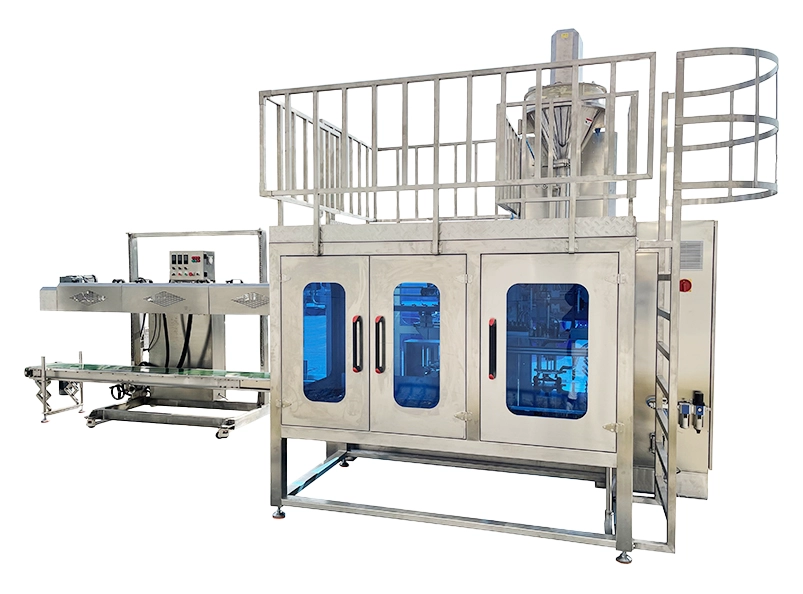
On the Mipline flour bagging line the pick-up station sits behind a stainless frame with a transparent guard, beside a control cabinet and vacuum hose. The operator loads a stack from the side and watches the pick through the guard, and the magazine is refilled while the filling station keeps running. Because the stack lies flat instead of hanging in a vertical chute, bag faces stay square and the pick point stays the same from the first bag to the last. That single detail removes most of the manual bag straightening crews do at the front of the line.
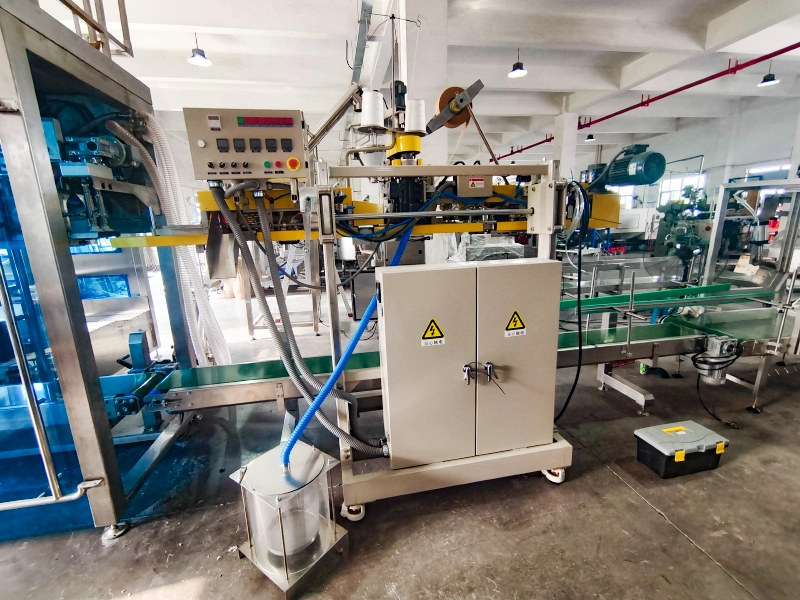
In most flour plants the filler holds weight well. What costs output is the last metre before the sewing head: an operator straightening a leaning bag, a bag mouth arriving skewed, or a sewing head re-threaded because the bag collapsed under it. Each event is a short stop, and they accumulate across a shift.
Station two: clamped filling keeps the mouth where it was placed
Filling into an open bag that is only resting on a platform lets the mouth widen and drop as the flour column rises. A clamp changes the mechanics: the mouth is gripped before dosing starts, so the bag is held in place while it fills. On a flour bagging line this is the difference between a bag that stands on the conveyor and a bag that leans on the next one.
The clamp station runs inside a stainless enclosure with blue inspection windows and double doors. The guarding is not only a safety item: it keeps the filling zone free of the draughts and drifting dust that push a light kraft mouth sideways. What to confirm with your own bag sample before ordering: mouth width, gusset depth, whether the paper is PE-lined, the print position the clamp will touch, and the clamp pressure that grips the paper without marking it. Send the bag, not a drawing, because the way a gusset folds after transport is what the clamp actually sees.
Line-side view: The inspection windows sit at the height where the clamp and the filled bag meet, so the operator can watch the mouth, the dust collar and the bag face without opening a guard or stopping the line. The top platform with guard rails gives access to the filling head above the clamp for the weekly clean.
Station three: guided transfer to the sewing head
Between the clamp and the sewing head there are usually two or three metres of conveyor, and that is where square bags become twisted bags. A single centre belt gives a filled 25 kg bag nothing to hold it. A twin-belt transfer with adjustable side guides holds both faces at once and keeps the mouth at a constant height. The guides are set to the bag width once, then left alone for the run, which is why a powder bagging line should be specified around the bag, not around an average bag.
On a Mipline flour bagging line the bag leaves the clamp onto a belt section, crosses a roller transfer, and reaches the sewing head at a speed matched to the sewing head rather than to the filler. Matching matters more than raw speed: if the belt runs faster than the sewing head the bag compresses at the needle, and if it runs slower the mouth bunches and the seam wanders.
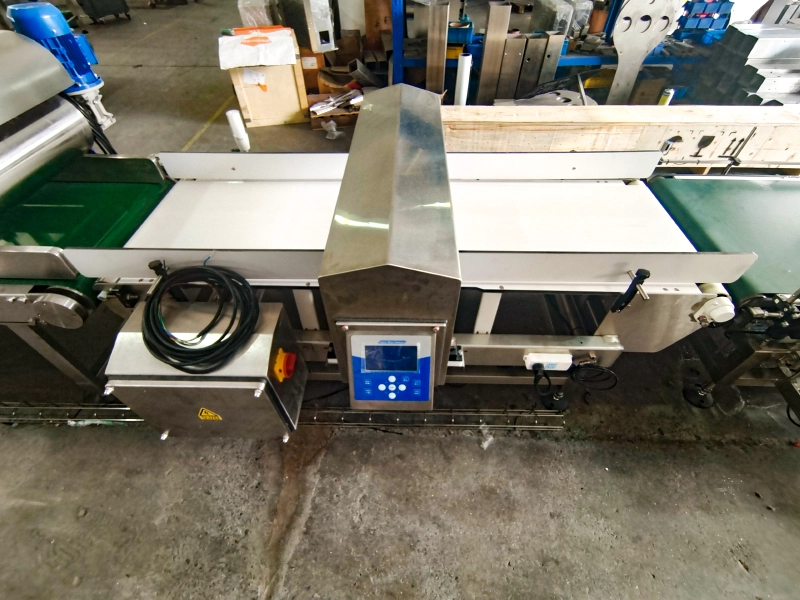
Access decides uptime as much as the guides do. Rolls, belt tension and the sewing head are reachable from the operator side, the HMI panel with emergency stop sits at the end of the transfer section where the operator already stands, and the frame is stainless throughout so a flour spill is washed rather than scraped out of paint. The table below maps the symptoms buyers describe to the station that answers them.
| Symptom at the sewing head | Что делает линия | What to confirm with your bag |
|---|---|---|
| Bag arrives rotated or leaning | Twin-belt transfer with adjustable side guides holds both faces | Bag width and fill weight; guide setting for that width |
| Mouth collapses before the needle | Clamp holds the mouth open through filling; transfer starts at matched speed | Gusset depth and paper stiffness, kraft against PE-lined |
| Weight drifts at the checkweigher | Bag settles on the belt after filling instead of dropping off the clamp | Where the checkweigher and metal detector sit in your layout |
| Frequent stops to reload bags | Flat magazine with side loading; pick point unchanged through the stack | Stack height operators can load, and bag pack quality from your supplier |
| Dust builds around the clamp | Enclosed stainless filling zone with an extraction connection at the spout | Extraction capacity at the spout and your cleaning routine |
Send us your flour bag sample
Tell us the bag size and type, the flour you run, and the bags per hour you need. We reply with the station list for a flour bagging line sized to that bag, plus a layout for your building.
Request a line proposal English
 Русский