
Granule Packaging Machine: Keeping 25 kg Bags Square to the Pallet
A fertiliser or resin plant that buys a granule packaging machine is not buying a weigher. It is buying a film width, a bottom seal that survives the first 25 kg of drop, and a bag that is still square enough for a palletizer to pick up eight hours into the shift. FFSline forms the bag from PE roll film on the machine, cools the bottom seal before dosing, cools the mouth seal after dosing, and hands a square bag downstream.
Where a 25 kg granule bag is actually lost
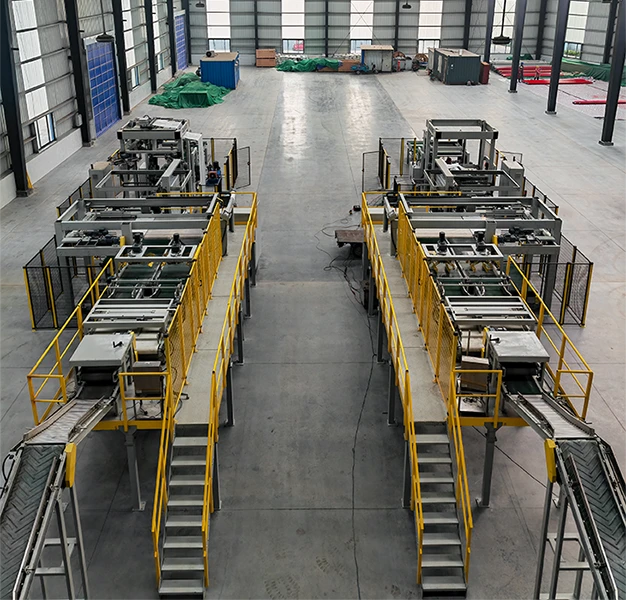
Take a blended NPK plant running 25 kg pre-made woven bags through a net weigher, a bag placer and a sewing head. At 400 to 500 bags an hour the line looks healthy in the monthly report. The losses sit in three places that nobody invoices separately: the bag magazine, the last two metres of conveyor before the sewing head, and the pallet that never gets built square enough to pass a stretch hood without a manual reshape.
All three losses start with the same root cause. The bag was made in another factory, to another tolerance, and arrives with its own stiffness, its own gusset memory and its own humidity. In a wet week the bags stick in the magazine and the operator peels them apart by hand. In a dry week the mouth curls and the sewing head receives a bag already rotated two degrees, so the seam walks off the edge. A granule packaging machine built on the FFS principle removes most of that variance, because the bag is formed on the same frame that fills it, seconds before filling, from film held at one controlled tension.
Labour for bag placing, mouth straightening and pallet stacking; one bag size of premade stock per SKU, ordered months ahead; and pallet rejects at the stretch hood, where a leaning stack is unloaded and rebuilt by hand before it can be shipped.
Why film forming changes what the bag does under load
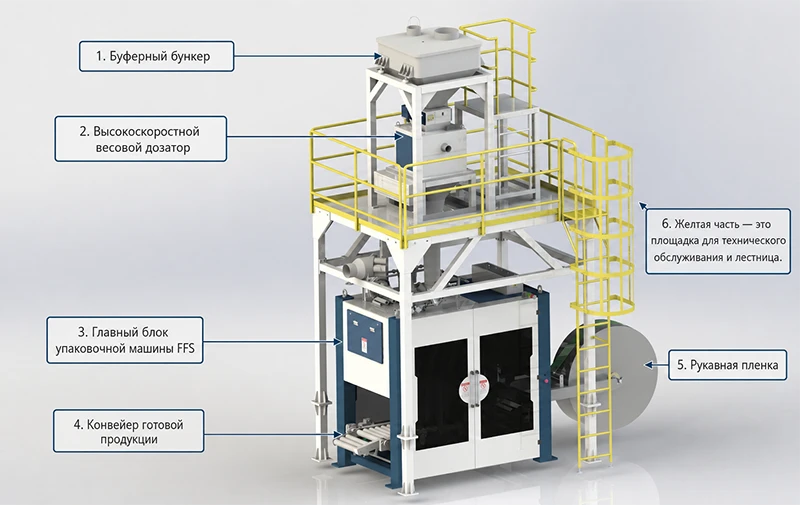
The first structural answer is the seal sequence. In an open-mouth line the bag already exists, so the bottom is only as strong as the bag maker’s seam. On FFSline the tube is formed from M-type PE film, the bottom is sealed and then actively cooled before the product arrives. That cooling station is not cosmetic: it is what keeps a hot bottom seam from being pushed open by the impact of 25 kg of granule falling into it. The same logic repeats at the top, where the mouth is sealed and cooled again after weighing, so the bag reaches the flattening and coding stations closed rather than merely pinched.
The second answer is feed continuity. Granules with a wide particle size spread, or ammonium phosphate that bridges in a hopper, punish any packaging line that has no buffer. A 3 m³ transition silo between the plant and the weigher absorbs the difference between a steady upstream flow and a batch that arrives late; for bridging-prone fertiliser grades an anti-bridging or vibration arrangement and a sampling point can be engineered into the same silo. A granule packaging machine without that buffer is a machine that runs at whatever rhythm the upstream dryer allows.
What to inspect on site: run an empty-film cycle and watch the former, not the weigher. A former that walks or a film that drifts sideways will produce a bag that fills acceptably and seals badly, and it will only show up as complaints at the pallet.
Structure and settings that decide the finished bag
The hardware on a granule packaging machine of this class is inspectable and finite. Film runs from a roll up to roughly 1500 mm outside diameter on a 150 mm core, through a forming collar that turns a flat web into an M-type tube at 350 to 450 mm film width. A single-head servo weigher doses the target weight into the clamped tube, the mouth is sealed, cooled, and the bag is released to the outfeed where a flattener squares it before coding. Everything downstream of that point, from checkweigher and reject to bag labelling, pallet labelling and stretch hood, is a configuration decision rather than a fixed part of the machine.
Rate is where catalogue numbers mislead. The 2024 ammonium phosphate scheme was engineered around 500 bags/h on 25 kg bags; project references for free-flowing granules discuss the 1,000 to 1,200 bags/h class. Which figure applies to your plant depends on bulk density, particle size uniformity, moisture, how continuously the silo is fed, and the acceptance terms written into the contract, so a supplier who quotes one figure for every material is quoting a preference, not a capacity.
| Item | Reference value | Notes |
|---|---|---|
| Bag material | PE or PP roll film, M-type tube | Bag is formed on the machine, not premade |
| Film width | 350 – 450 mm | Sets the flat bag width |
| Film thickness | 0.14 – 0.18 mm typical | Confirm with film supplier per project |
| Roll size | Max OD approx. 1500 mm, core 150 mm | Drives roll change interval |
| Bag weight range | 20 kg, 25 kg, 50 kg | Recheck against material density |
| Design rate (project) | 500 bags/h on 25 kg | 2024 ammonium phosphate scheme |
| Rate class (free-flowing) | 1,000 – 1,200 bags/h | Material and acceptance dependent |
| Main machine power | Approx. 25 – 30 kW | Full line utilities calculated separately |
| Air consumption | Approx. 3,000 – 3,500 L/min | Machine only, not full line |
| Upstream buffer | 3 m³ transition silo | Anti-bridging option for fertiliser |
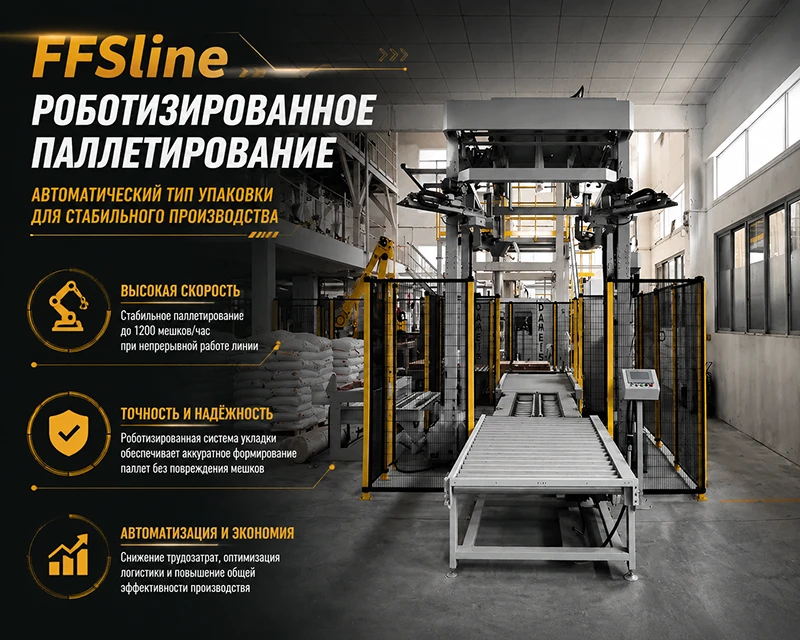
The end of the line decides whether any of that matters commercially. A granule packaging machine that produces square, cooled, coded bags but still needs two people to stack them has moved the labour problem, not solved it. Where the target sits above roughly 1,000 bags/h, a high-level palletizer generally fits the continuous rhythm better than a robot cell; below that, a robotic palletizer with safety fencing is often the more flexible choice, especially when bag sizes change between campaigns. Pallet magazine, full-pallet labelling, cold stretch hood and forklift outfeed complete the loop from film roll to shippable pallet.
Specify a granule packaging machine against your material
Send the material name, bulk density, bag weight, hourly target and available floor space. You get back a film width, a bag format, a silo and outfeed arrangement, and the acceptance figures that belong to that configuration, rather than a catalogue rate that has to be renegotiated later.
Request a line layout English
 Русский