
How a Russian Salt Plant Kept Bulk Bags Straight Before Sewing
On a bulk-material line, the real trouble often starts after filling, not before it. When a woven bag comes out of transfer with a twist, the sewing head has to fight the bag instead of closing it cleanly. This project shows how ppline-style bag handling helps a salt plant keep the bag upright, aligned, and ready for a stable stitch.
What the customer was dealing with on the line
The customer was not asking for a cosmetic upgrade. The real need was simple: move bulk-filled bags from the filling area to the sewing point without introducing a twist, a side pull, or a dropped edge. In a salt plant, the material is heavy, the bags are coarse woven polypropylene, and the work area is usually busy with pallets, forklifts, and operators who must keep the flow moving.
When the transfer is unstable, the sewing operator has to reposition every bag by hand. That slows the line, increases stitching errors, and raises the chance of damaged bag mouths. ppline fits this scenario because it is built as a stable bag-handling line, not just a filler. The line structure keeps the bag supported through the transition, so the bag reaches the sewing point in a controlled position instead of drifting across the conveyor.
The common failure is not the filling itself. It is the handoff. If the bag mouth is not held firmly, the woven sack can rotate as it leaves the filling zone, the top edge can fold unevenly, and the sewing operator ends up correcting the same mistake again and again.
Why ppline matches this bulk-material bagging job
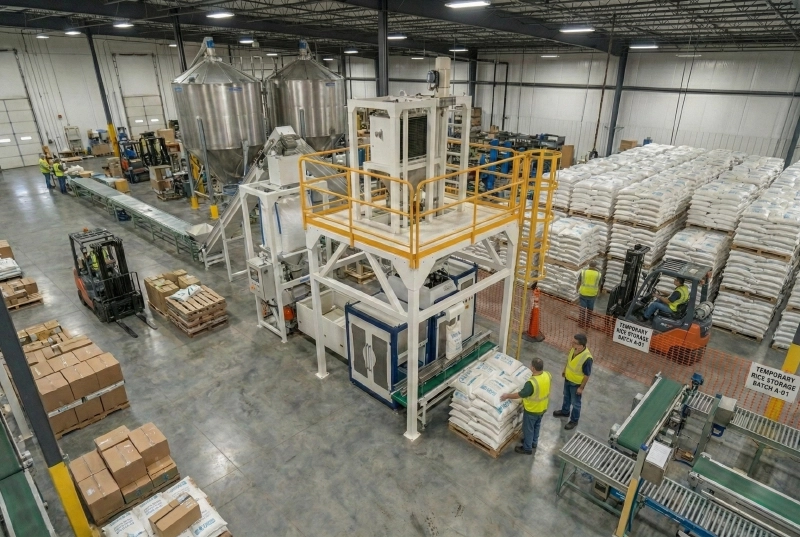
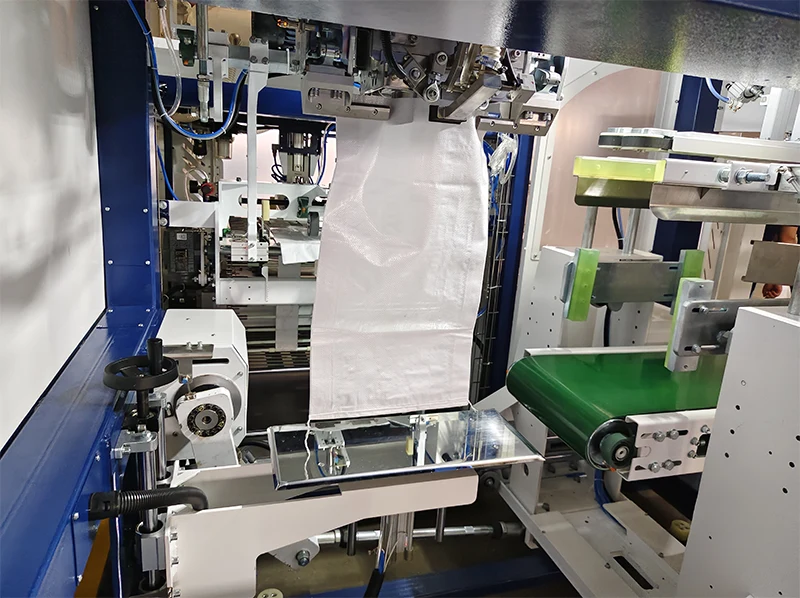
The first match is mechanical stability. The line shown in the site photos combines a rigid steel frame, elevated working platform, conveyor sections, and a controlled discharge path. That matters because a bag that is still carrying product mass needs support from below and guidance from the side. The second match is the visible bag control point: the internal close-up shows vacuum suction cups, a robotic placing arm, and a green conveyor working together to keep the sack aligned.
For a salt application, that combination is more valuable than raw speed alone. Salt bags are dense and abrasive in daily handling, so the line must reduce unnecessary drop, slide, and re-grip actions. ppline solves that by giving the operator a cleaner handoff window. The bag does not need to be dragged into position by force; it is already presented in a better sewing orientation, which improves seam consistency and reduces rework downstream.
bpmpack Инженерный взгляд: On bulk-material packaging lines, the most expensive seconds are the ones spent correcting a bad bag angle. A stable transfer path, positive bag support, and a visible alignment zone usually improve sewing quality more than simply increasing conveyor speed. That is why the best line layout is the one that protects the bag mouth before it reaches the stitching head.
Structure evidence and the outcome on the floor
The photos give the structure evidence clearly. In the wide operational view, the line sits inside a real plant environment with silos, conveyors, and forklift traffic, which confirms that the system is built for continuous industrial use rather than a showroom demo. In the close-up image, the core handling zone is visible: suction, placement, and guided transfer are doing the work before the bag reaches the stitching point.
The result is a cleaner bag posture at the sewing station. Operators spend less time straightening sacks, the seam line becomes more consistent, and the whole end-of-line flow is easier to manage around palletizing and warehouse movement. For a salt plant, that means fewer stoppages caused by bag correction, better use of labor, and a packaging line that keeps moving even when the floor is busy.
| Observed issue | ppline response | Practical result |
|---|---|---|
| Bag mouth twists before sewing | Controlled handoff and guided bag positioning | Straighter bags at the stitching head |
| Operator corrects every sack by hand | Vacuum-assisted placement and conveyor support | Less manual rework and less downtime |
| Busy floor with forklifts and pallets | Rigid frame and organized transfer path | More stable flow in a real plant layout |
| Inconsistent seam quality | Bag stays aligned before closure | More repeatable sewing quality |
Need a cleaner bag handoff before sewing?
If your bulk-material line is losing time on bag straightening, ppline can be configured around the handoff point first, not only the filling point. That is usually where the gain shows up fastest: fewer corrections, steadier sewing, and a more predictable packing rhythm.
Talk to bpmpack about your line layout English
 Русский