
Automatic Granule Bagging Line: 25 kg Woven Sack Output
For a feed mill, seed plant, or fertilizer producer shipping 25 kg woven sacks, a BPMpack automatic granule bagging line keeps bag pickup, weighing, filling, and downstream transfer under one control scheme so a single shift can ship stable, pallet-ready bags without manual straightening at the last meter.
Why a 25 kg granule project is a line, not a machine
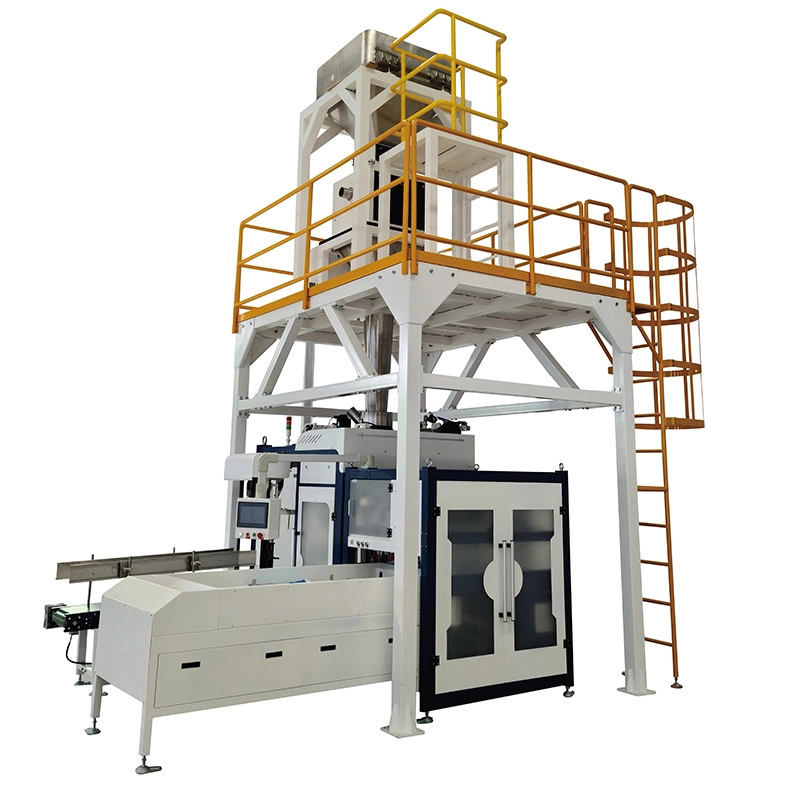
A granule producer shipping 25 kg woven sacks to farms, distributors, or bagging stations rarely has a single problem. The bag magazine runs low, the weigher drifts, the bag tilts on the outfeed belt, the checkweigher rejects a sack, and someone still has to hand-place it on a pallet. That is why BPMpack treats the automatic granule bagging line as one engineered flow: bag magazine to robotic placer, opening jaws, double-bucket or single-head servo scale, fill spout, heat seal or sewing, bag turner, checkweigher, reject conveyor, buffer, pallet magazine, and robot palletizer. Buying only the bagger leaves the transfer and palletizing side open; buying only the palletizer leaves the front end unstable. The line is the product.
Typical customers running a BPMpack automatic granule bagging line include compound feed plants, seed processors handling corn, sunflower, soybean, or rapeseed, fertilizer producers packing urea, NPK, or ammonium phosphate, plastic pellet and resin lines, and mineral granule operations. Most run 10 to 50 kg bag formats with a common 25 kg core range, and some projects switch between 5 kg and 25 kg on the same frame. Throughput targets sit around 700 bags per hour on standard builds, with high-speed configurations reaching 900 to 1200 bags per hour when the layout, scale, and PLC stack are matched to the bag size and material flow.
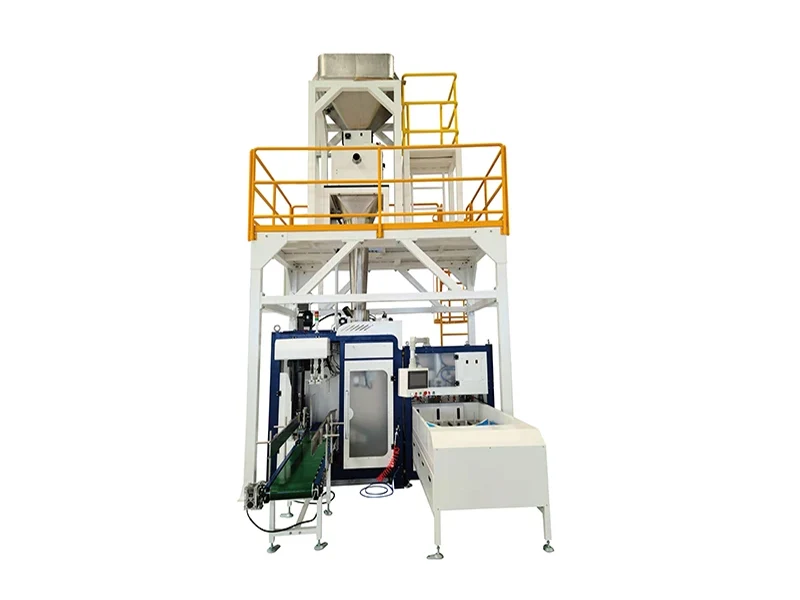
The new line has to hold the bag from pickup to pallet without operators bending over each sack at every transition.
Where a single-machine setup fails, and how the line corrects it
Three pain points keep showing up on legacy bagging-and-sewing stations. First, the front-end bagging speed does not match the back-end palletizing speed, so bags queue on the floor or the robot idles between cycles. Second, two bag sizes or two weight ranges must run on the same shift, but the old weigher only holds one recipe and the bag magazine only holds one bag type, forcing changeovers that swallow a shift. Third, heavy-bag packaging does not end at filling — turning the upright sack into a horizontal one, checkweighing, rejecting out-of-tolerance bags, and presenting a square face to the palletizer are part of the real process, and a standalone bagger simply does not reach them.
A BPMpack automatic granule bagging line addresses each of these inside one control scheme. The double-station servo scale or single-head servo scale holds multiple recipes, so a 5 kg and a 25 kg run can swap with one HMI selection. The bag magazine is sized for the project bag mix rather than a single SKU. The right-angle bag turner flips upright sacks into horizontal ones for checkweighing, and the buffer conveyor plus reject lane absorb the speed mismatch between the bagger and the palletizer. Power supply stays at AC380V plus or minus 5 percent at 50 Hz with about 15 kW total draw and 0.5 to 0.7 MPa air at roughly 1200 to 2000 NL per minute, so the line drops into a standard granule plant without a separate utility room.
Project note: For a 25 kg compound feed project running two shifts, the realistic gain is not a faster bagger — it is removing the manual bag-straightening, manual weight re-check, and manual pallet-staging steps that the old setup leaks at every transition between the filling cabinet, the sealer, and the pallet.
Inside the line: modules, accuracy, and what the drawings confirm
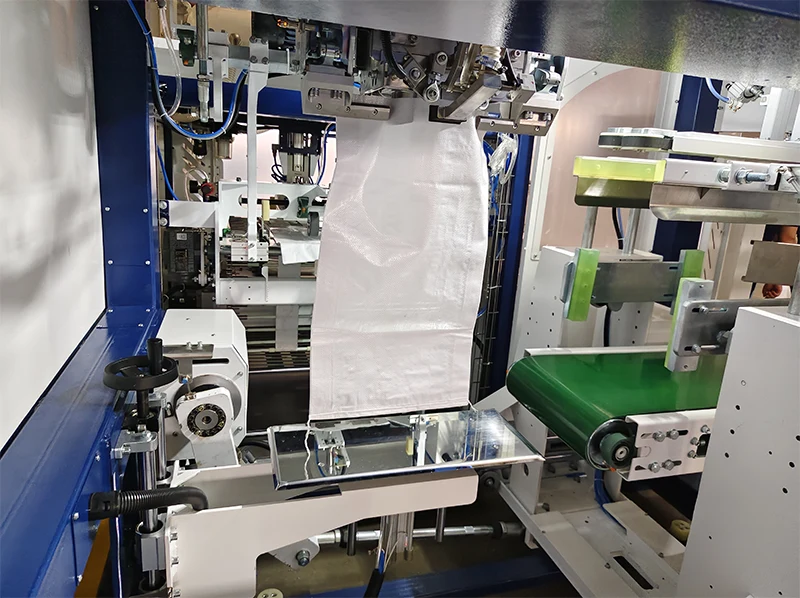
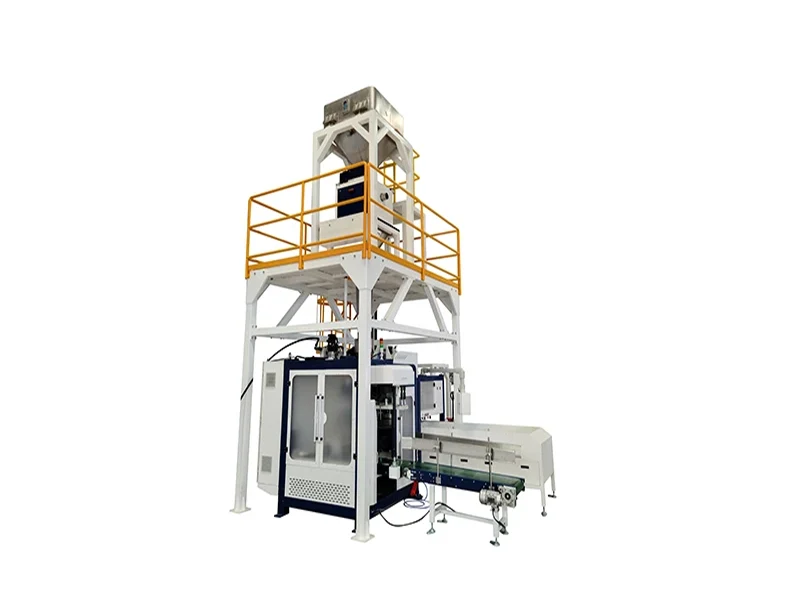
The core frame is a white-coated steel tower with an elevated maintenance platform, safety cage ladder, yellow guard rails, and an enclosed bagging cabinet. Inside the cabinet, a vacuum suction cup array and robotic placer pick each woven polypropylene bag from the magazine, open it, and present it to the fill spout. A swing-arm HMI touchscreen keeps the operator off the platform during normal runs and gives the automatic granule bagging line one screen for recipes, alarms, and throughput counters, so a recipe change does not pull someone onto the tower.
On the dosing side, the line typically uses a CY-CJD50K double-station servo scale for standard 25 kg granular products, with plus or minus 0.2 percent accuracy on feed materials and tighter plus or minus 0.1 to 0.2 percent on seed projects where the buyer asks for it. Sealing options are stacked: heat seal, sewing, heat seal plus sewing, or heat seal plus sewing plus hot-melt tape, depending on the dust level and warehouse handling. The right-angle bag turner, dual-layer incline conveyor, and buffer hopper bridge the height difference between the filling cabinet and the palletizing cell, so the bags arrive square at the pallet magazine instead of leaning into the operator.
| Параметр | Значение |
|---|---|
| Bag weight range | 5 kg / 25 kg dual-spec, core 10 to 50 kg |
| Производительность | ~700 bags/hour standard; 800 bags/hour extended; 900 to 1200 bags/hour high-speed |
| Weighing accuracy | ±0.2% feed; ±0.1 to 0.2% seed |
| Scale type | CY-CJD50K double-station servo scale; single-head servo for 5 / 25 kg dual-spec |
| Sealing options | heat seal / sewing / heat seal + sewing / heat seal + sewing + hot-melt tape |
| Checkweigher | 5 to 50 kg range, ±10 g accuracy, 18 to 20 bags/min, 100 recipe memories |
| Sewing machine | ~2700 rpm, stitch width 7 to 10.5 mm |
| PLC stack | Inovance for standard builds; Siemens for high-speed or higher-demand projects |
| Power supply | AC380V ±5%, 50 Hz, ~15 kW total |
| Air supply | 0.5 to 0.7 MPa, 1200 to 2000 NL/min |
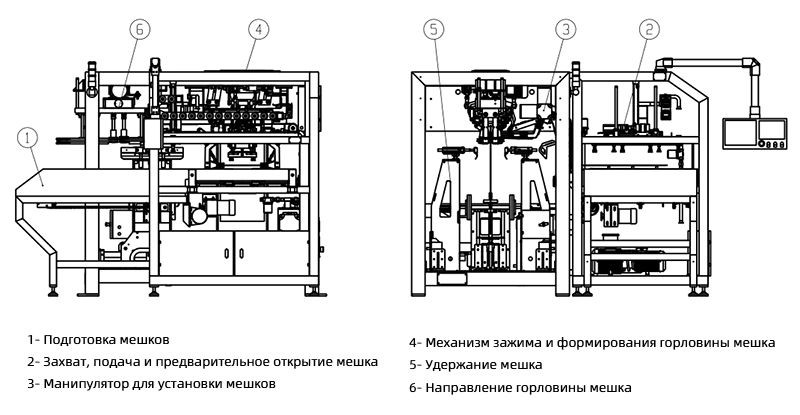
Send your site drawing, get a line proposal
A working automatic granule bagging line is not a catalog SKU — it depends on the plant floor, the bag mix, the bag weight, the throughput target, and how the palletizer ties in. Send your factory layout, the bag types you actually ship, and your two-shift throughput target, and BPMpack will return a line proposal with module selection, scale type, sealing route, and a layout that matches your columns, forklift aisle, and palletizing direction.
Запросить предложение на линию English
 Русский