
Automatic Packaging Line for Granules: Heavy-Bag Layout
A 25 kg granule producer with throughput stuck at 600 bags/hour usually blames the bagger. An automatic packaging line for granules from BPMpack moves bag pickup, weighing, transfer, sealing, checkweighing, and pallet handoff into one chain so the front end runs at the speed the back end actually accepts on a real shift.
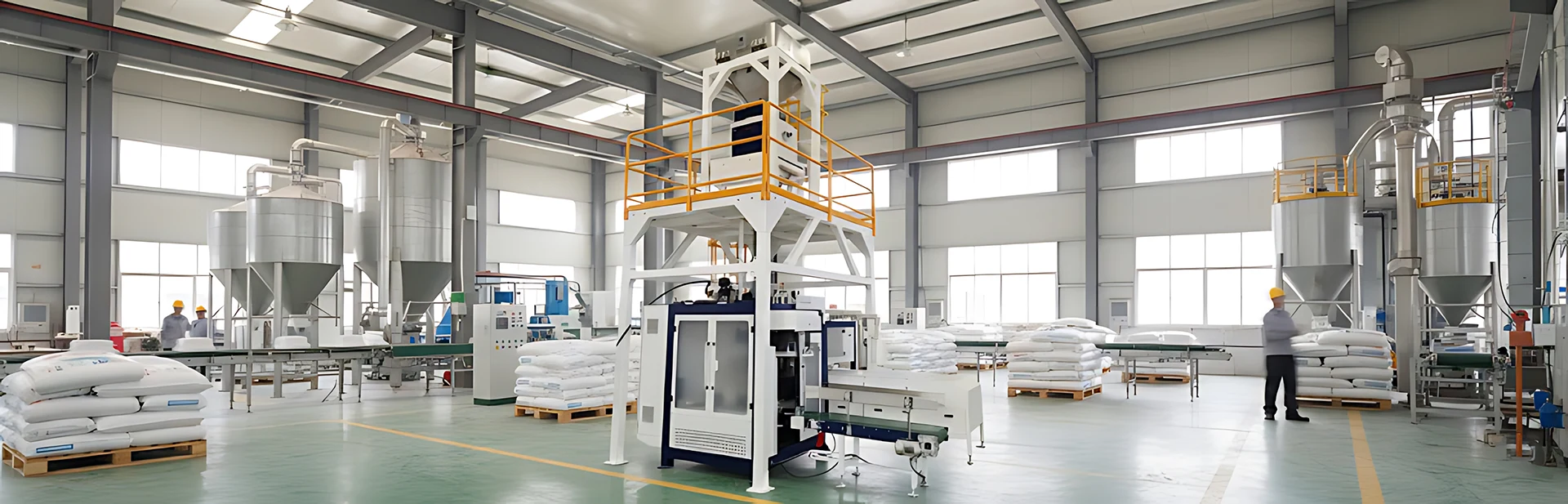
Where a heavy-bag line really loses bags
A heavy-bag granule line that runs at 700 bags/hour on day one usually drops to 500 bags/hour within six months. The bagging head is rarely where the bags go missing. They go missing at the hand-off: between the gross weigher and the sewing head, between the sewing head and the checkweigher, between the checkweigher and the palletizer. Each hand-off adds dwell time, and each dwell time compounds into lost bags per shift on the plant floor.
An automatic packaging line for granules in the 10–50 kg range has to be specified as a chain, not as a set of machines. BPMpack plans every heavy-bag project from the fill point backward — how the bag leaves the gross weigher, how it reaches the seal, how it sits on the palletizer in-feed, and where the forklift picks it up from the outfeed belt. Until those four answers are fixed on a CAD layout, no spec sheet on the bagger tells you what the line will do on a real two-shift production day.
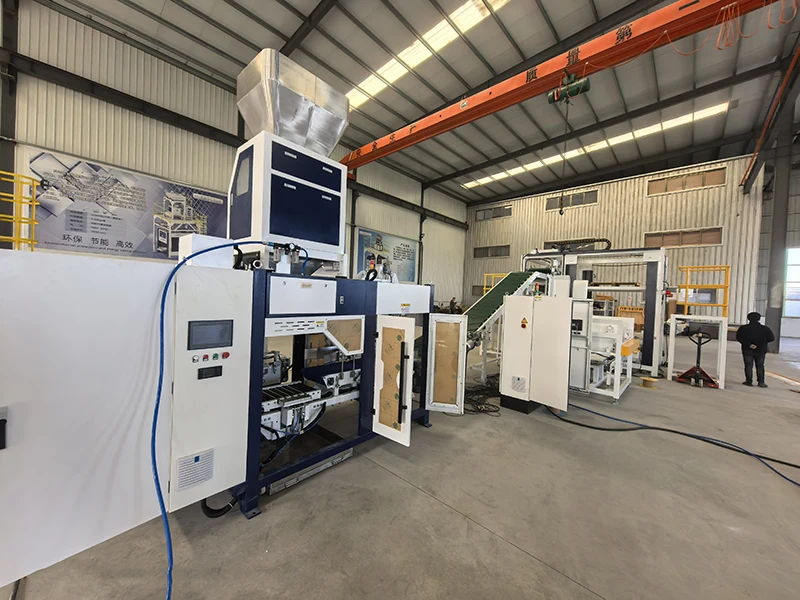
Most 25 kg granule producers blame the bagging head when throughput drops. The bottleneck is the back end: the right-angle bag turner, the dual-layer incline conveyor, the checkweigher, the reject lane, and the palletizer. If those four are off-spec against the front end, the bagger will be parked and idle within two shifts, regardless of how new the servo scale is.
From bagger thinking to line thinking
The bagging head is the most visible part of a heavy-bag granule line. It is also the most standardized. What changes project to project is everything around it. A single-head servo scale runs roughly 15–25 cycles per minute and suits 5 kg / 25 kg dual-spec work or heavy-bag projects where recipe changeover is frequent across feed and seed batches. A double-bucket scale holds steady on standard granular lines and is the default for 700–800 bags/hour builds. A single-bucket four-servo high-speed scale is what you spec when the project targets 900–1200 bags/hour.
What locks in the line is downstream. The right-angle bag turner must convert upright bags into horizontal bags without stalling the seal station. The dual-layer incline conveyor must bridge the height difference between the filling section and the palletizing section without dropping a bag on the way up. The checkweigher must keep a 5–50 kg range, ±10 g accuracy, and 100 recipe memories so recipe changeovers do not open a quality risk during production. The labeler must hold around 12–13 pcs/min. The sewing machine must run at about 2700 rpm with a stitch width of 7–10.5 mm. Each of those numbers is a contract with the bagger speed, and BPMpack wires them into the conveyor interlocks, not just the bagger PLC.
Engineering note: A 25 kg granule line with manual bag straightening at the sewing head loses 8–12% of throughput at the last meter. The straightening station is not on the spec sheet, but it eats bags every shift and is the single most common reason a “700 bags/hour” line actually ships 615 bags/hour on a real day.
What the chain looks like in numbers
An automatic packaging line for granules is not a single spec sheet. It is a chain of contracts between modules, and BPMpack ships each contract as a defined module with a defined electrical and mechanical interface. The numbers below are the typical project data for a 10–50 kg granule project. This is a typical range, not a fixed promise — final speed, dose accuracy, and sealing configuration depend on material flow, bag type, and downstream palletizing direction.
Before any metal is cut, BPMpack asks for site CAD drawings, fill point coordinates, aisle widths, column positions, and palletizing direction. Without those, even a spec’d chain stays preliminary. Once they are fixed, the line is issued as a layout drawing and then as a confirmed project data sheet, with the PLC stack — Inovance for standard builds, Siemens for high-speed or higher-demand projects — wired into the conveyor interlocks, not just the bagger.
| Module | Спецификация |
|---|---|
| Packaging weight range | 10–50 kg (5 kg / 25 kg dual-spec optional) |
| Packaging speed | ~700 bags/hour standard; 900–1200 bags/hour high-speed |
| Weighing accuracy | ±0.2% feed; ±0.1–0.2% seed |
| Power supply | AC380V ±5%, 50Hz |
| Total power | ~15 kW |
| Air supply | 0.5–0.7 MPa |
| Air consumption | ~1200–2000 NL/min |
| PLC stack | Inovance (standard) / Siemens (high-speed) |
| Checkweigher | 5–50 kg, ±10 g, 18–20 bags/min, 100 recipes |
| Labeler | ~12–13 pcs/min |
| Sewing machine | ~2700 rpm, stitch 7–10.5 mm |
| Sealing options | Heat seal / sewing / heat seal + sewing / heat seal + sewing + hot-melt tape |
Get a project review for your heavy-bag granule line
Send site dimensions, fill point coordinates, bag type, throughput target, and palletizing direction. BPMpack will return a CAD layout and a confirmed project data sheet for the heavy-bag run, with the bagger, conveyors, checkweigher, and palletizer specified as one chain instead of four separate machines.
Request a project review English
 Русский