
Flour Bagging Line in a Pasta Factory: From Clamped Filling to a Square Sewing Handoff
A pasta plant rarely loses output at the filler. It loses it in the last two metres, where a filled 25 kg semolina bag twists on its way to the sewing head and an operator stops the line to straighten it. This flour bagging line clamps the mouth before filling, holds both bag faces through guided transfer and hands the bag over square, at the same height and angle every cycle.
Why a pasta factory judges bag quality before fill speed
In a dry pasta plant, flour is rarely a finished retail product. Wheat flour and durum semolina arrive in 25 kg kraft or woven bags, are milled, blended or reclaimed, and then move again as a handling unit: the bag has to stand flat on a pallet, survive a forklift, stack without collapsing and open cleanly at the mixer. The traditional arrangement is well known on the floor. An operator holds the empty bag under the spout, fills it, lifts it, straightens the mouth by hand and walks it into the sewing head. Every part of that sequence depends on one person’s timing, and the flour bagging line is judged on the shifts when that person is not there.
What changes first is not the filling speed but the point at which the bag is restrained. On a Mipline machine the bag is taken from a magazine, opened and clamped at the mouth before any product enters it. Because the clamp holds the bag in a fixed position, filling happens inside a bag that cannot slide, sag or rotate, and the weight is delivered into a bag that is already square. That single decision upstream removes most of the manual straightening downstream, as covered in our walk-through of 25 kg powder filling and bag control.
A 25 kg flour bag that reaches the sewing head skewed gets a wavy seam, a dusty mouth or a reject. The operator straightens it, the line pauses, and the bag that finally leaves the station is often the one that splits on the pallet two weeks later. None of that appears in the filler’s fill-accuracy figure, which is why bag handoff problems survive so long in a plant that already measures weights carefully.
How the flour bagging line holds the bag between filling and sewing
From the clamp, the bag moves onto a green belt transfer with adjustable side guides that keep both faces vertical. Roller conveyor sections then carry it through the settle zone, where aerated flour is given time to drop before the bag is closed, so the bag arrives dense and flat instead of ballooned. On the twin-belt transfer the bag is supported along both sides rather than pushed from one end, which is what stops it from rotating as the line decelerates. The same sequence of clamp, settle and guided transfer is described in the flour bag fill-to-handoff walk-through.
The handoff itself is deliberately unspectacular. The bag leaves the transfer at the same height and the same angle on every cycle, so the sewing head sees a mouth that is already aligned and the operator’s job becomes monitoring instead of straightening. For a pasta plant running several flour grades through one line, that consistency is what separates a line one person can supervise from a line that needs two.
Line design note: Bag mouth quality is decided before the sewing head, not at it. If the clamp position, the transfer guide width and the handoff height are set for one bag format, every bag in that format arrives at the needle with the same geometry, and the sewing head stops being a tuning point that operators adjust by feel.
Structure and evidence on the flour bagging line
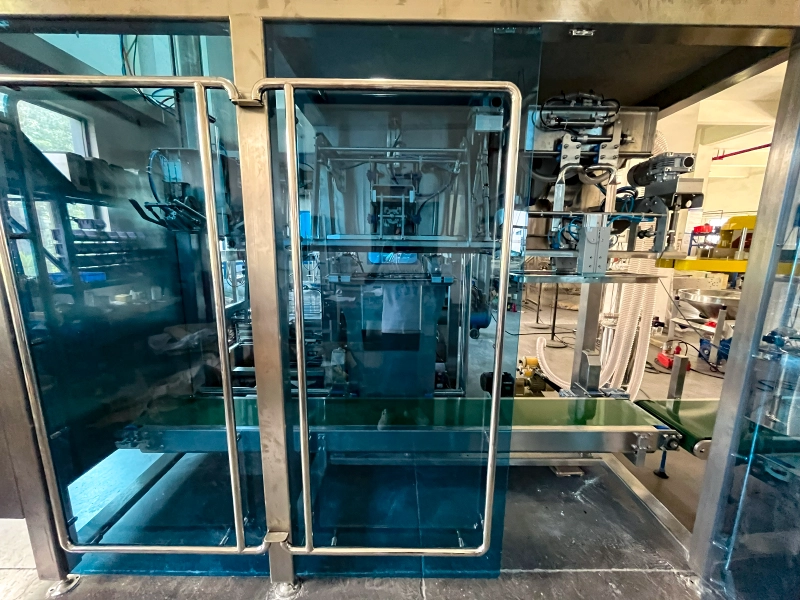
The bagging station is an enclosed stainless steel frame with blue inspection windows, so the clamp, the fill spout and the start of the transfer stay visible without opening a guard door. A top access platform with railing gives maintenance a safe place to stand when a vacuum cup, a clamp pad or a guide needs attention. The HMI panel groups the run controls, the status beacon and the emergency stop within reach of the handoff point, which is exactly where an operator stands when a bag starts to run off line.
For a food plant the stainless enclosure and the viewing panels do more than safety compliance. Flour dust settles on everything; a station that can be inspected through glass and cleaned at the fill point without dismantling the line is what makes a grade change realistic between wheat flour and semolina. That is also the reason the machine is specified as a stainless steel powder packaging line rather than a painted frame with a bag clamp bolted to it.
| Line step | What the machine does | What it fixes in a pasta plant |
|---|---|---|
| Bag pickup | Flat kraft bags are drawn from the magazine and opened by vacuum | No operator holding a bag under the spout all shift |
| Clamped filling | The mouth is clamped before product enters the bag | Bag cannot slip, sag or rotate while it fills |
| Settling on transfer | Green belt and roller sections let aerated flour drop | Bag reaches closure flat instead of ballooned |
| Guided transfer | Adjustable side guides and twin-belt support hold both faces | Bag stops twisting in the last two metres |
| Sewing handoff | Bag leaves at a fixed height and angle | Seam starts straight; no manual straightening |
| Inspection access | Blue viewing windows and top maintenance platform | Quicker cleaning and adjustment between flour grades |
Check the handoff against the bag you actually fill
Send the 25 kg bag you really use — kraft, woven or paper laminate — together with your flour grade, bag dimensions and target output. We will show you where the clamp, the transfer guides and the sewing handoff sit for that bag on a Mipline flour bagging line, and what happens to the bag mouth at each step.
Request a line proposal English
 Русский