
Gypsum Powder Packaging Line for Beige Gypsum Bags
Beige gypsum is milled fine, it carries almost no moisture, and it is judged at the last meter of the line: dust settles on the bag mouth, the aerated bag slumps out of square, and the sewing or sealing head inherits whatever shape arrives. This gypsum powder packaging line treats bag supply, clamping, bottom-up filling, closure, settling, shaping and finished-bag inspection as one sequence instead of four separate machines.
What beige gypsum asks of a bagging line
Gypsum powder is milled fine and it aerates the moment it leaves the filler. On a free-fall station the falling stream lifts a dust cloud inside the bag, the displaced air escapes upward through the open mouth, and the top section of the bag — exactly the band the sewing head or heat sealer has to grip — ends up coated. A dusty mouth gives a weak seam, a seam that has to be trimmed, or a bag that gets cut open and refilled.
The material also stays slightly clingy and abrasive. Powder left on the clamp and bag-holding faces transfers to the next bag, and the same fines that spoil a seam can shift a metal detector reading, which is why product effect is verified with the customer’s own beige gypsum on the actual belt. That is the reason a gypsum powder packaging line is specified around bag handling and transfer as much as around a filling head.
Rarely at the filler. At the last meter: an operator straightening a heavy bag by hand, a skewed bag mouth entering the sewing head, a bag reaching the palletizer out of square, and a reworked bag that has to be opened and refilled. That last meter is what a gypsum powder packaging line is designed around.
The old solution: a scale, a pair of hands and a crooked bag
Most gypsum and plaster plants start with a manual station: an operator holds the empty bag under a screw outlet, fills to weight on a platform scale, then lifts and drops the bag to settle the powder. Filling is free-fall, so dust escapes at the mouth and the operator works inside that dust plume for a full shift. That is the station a gypsum powder packaging line replaces — bag supply, clamping and controlled filling instead of a hand on the spout.
The second half of the problem arrives after filling. A freshly dropped gypsum bag is still aerated and unstable; it slumps, twists and loses its rectangular footprint before it reaches the sewing head. Someone straightens it by hand, at the last meter, several times a minute, and when the mouth still arrives skewed the sewing head runs unevenly. The result shows up on the pallet a day later as leaning stacks, damaged bags in transit and a complaint that is hard to trace back to a shift. A comparable dairy installation is described in the milk powder packaging line with stable bag transfer, and the gypsum-specific bag route is covered in the gypsum plaster 25 kg bagging article.
What we ask before configuring: the material sample, the bag the plant runs today, the pack format and target weight (an industrial 25 kg bag and a 1 kg retail pack are different dosing and bag-handling questions), the required bags per minute, and the closure method. Bulk density, flowability, moisture, aeration and bag construction decide how the filling head, clamp and transfer are set — a configuration cannot be finalised from a material name alone.
Matching the gypsum powder packaging line to the bag it has to close
Mipline is built as one controlled sequence. A bag magazine and vacuum pickup present the bag, the clamp holds it square, and a lifting platform raises it while a three-stage screw feed fills bottom-up: fast, medium, then slow final dosing. Because the fill point stays close to the rising product surface, there is far less free fall, and far less dust lifting into the mouth, than on an open free-fall station. After dosing, the composite-bag closure path runs dust removal, trimming, inner heat sealing, pressing, sewing and paper-tape wrapping where the project requires it, and the filled bag is then settled, shaped, checked for metal, checkweighed, rejected if out of tolerance, and discharged on rollers.
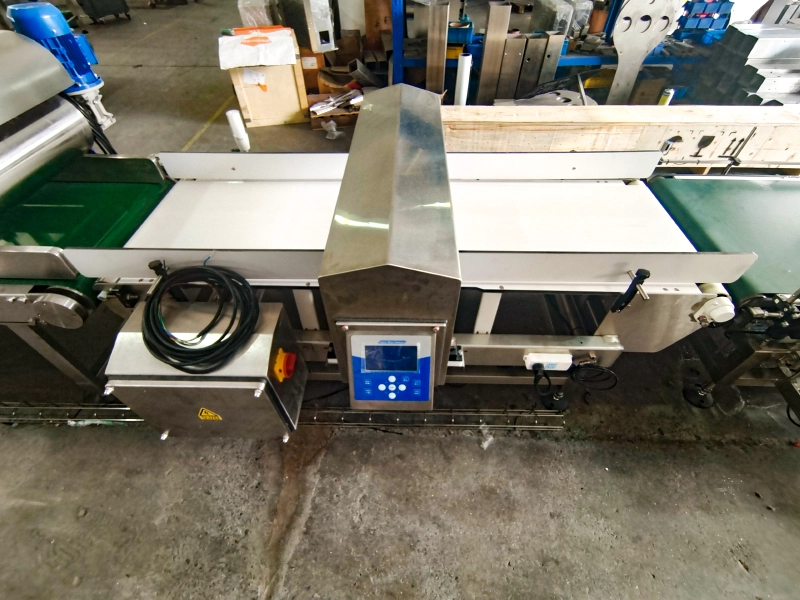
The transfer section is where a gypsum powder packaging line earns or loses its rework rate, so it is specified as a process step rather than an accessory. A twin-belt transfer conveyor carries the bag between adjustable side guides and hands it over with the mouth still aligned, as seen in the transfer photo above; a settling conveyor gives the powder time to drop; a shaping section brings the bag back to a square footprint before it is stacked.
Format and target weight are confirmed per project: the gypsum powder packaging line is sized on the bag and the pack format, not on a material name. The DS25K reference covers 5–25 kg with stated accuracy within ±0.2% and 1–3 bags per minute; the 25 kg line reference is stated at 1.5–2 bags per minute with accuracy within ±0.1–0.2%, a 63 m³/h vacuum rate, 5 kW main power, 5.5 m³/h air consumption and a SUS304 body. A small retail format such as a 1 kg pack is reviewed as its own dosing and bag-handling case instead of being assumed from the 25 kg reference. Checkweigher accuracy above all must come from the project-approved datasheet: published source values differ between ±15 g and ±25 g at different throughputs, so no single number is quoted here.
| Stage | Reference data (confirm per project) |
|---|---|
| Bag formats | 25 kg kraft paper, paper-plastic composite and coated woven bags; small retail formats reviewed individually |
| Filling | Bottom-up lifting fill with three-stage screw feed; 5–25 kg working range on the DS25K reference |
| Stated accuracy | Within ±0.2% (DS25K reference); ±0.1–0.2% on the 25 kg line reference |
| Производительность | 1–3 bags/min (DS25K reference); 1.5–2 bags/min (25 kg line reference), material dependent |
| Utilities | 380/220 V, 50–60 Hz, 5 kW; air supply 6 kg/cm²; 63 m³/h vacuum rate on the 25 kg configuration |
| Body and guarding | SUS304 stainless steel body, enclosed stations, blue inspection windows, guarding and access platform |
| Conveying | 5,000 mm PVC belt at 10 m/min; 3,000 mm settling conveyor 600 mm wide at 15 m/min; 1,500 mm shaping section, 600 mm belt width |
| Metal detection | ER6023 reference: 600×230 mm aperture, maximum product 550×200 mm, Fe ≥1.2 mm, non-ferrous ≥2.0 mm, SUS304 ≥2.5 mm, 520 mm belt at 28 m/min; product effect to be verified |
| Checkweighing | Range, belt width and tolerance to be confirmed from the approved datasheet for the actual bag |
Send the bag, the powder and the target weight
A gypsum powder packaging line is decided on the material sample, the bag construction and the format you actually sell — a 1 kg retail pack and a 25 kg industrial bag are configured differently. Share the powder, the bag, the target weight and the required bags per minute, and the filling, clamping, settling, inspection and transfer sections can be matched to your floor before anything is quoted.
Запросить аудит линии English
 Русский