
Secondary Packaging Automation for a Russian Salt Plant: Stable Handoff Before Sewing
A salt line does not fail only at filling. The real risk starts when the inner packs are already made and the outer woven sack still has to stay flat, aligned, and ready for sewing. BIBPU is built for that handoff.

Where the line was losing control
The customer scenario is straightforward: a Russian salt plant needs secondary packaging that can collect small finished bags, place them into a larger woven sack, remove excess air, keep the bag mouth aligned, and send the load to sewing without distortion. In practice, the old workflow usually depends on operators correcting shape, position, and tension by hand.
That is where the problems start. Salt bags are light enough to drift, but heavy enough to bulge once they are gathered in the outer sack. If the handoff is loose, the mouth closes unevenly. If the film tracking or transfer path wanders, the pack arrives skewed. In humid salt service, poor tracking, sticking, and corrosion resistance become daily issues instead of edge cases.
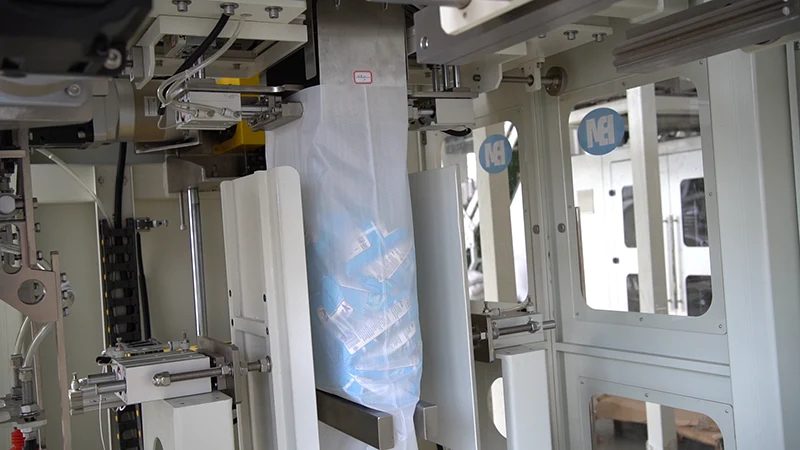
When the inner packs reach the outer sack with trapped air, uneven edges, or poor alignment, sewing starts from a bad position. That causes stitch drift, shape loss, more rework, and a higher chance of bags sliding during handling.
Why BIBPU fits the job
BIBPU fits this application because it treats secondary packaging as a controlled chain, not a single machine. The line uses corrosion-resistant product-contact structure, including UNS S31603 (316L) on the dosing side, and pairs that with transport, shaping, and discharge modules that keep the packs stable from feeding to the sewing head. The dimpled forming shoulder reduces film sticking, the tension rollers keep the web tracking clean, and the sealing and deaeration stations flatten the bag before it reaches the next step.
For the outer sack stage, the structure matters just as much. Dual belt feeders, side compression plates, and controlled pneumatic holding keep the woven sack mouth open and centered. That means the sewing machine receives a bag that is already squared, compressed, and ready. The result is not just cleaner appearance. It is more repeatable closure quality and less operator correction under humid, abrasive salt conditions.
bpmpack Инженерный взгляд: The line works because every transfer point has a job: feed, shape, compress, align, and close. If any one of those points is left to chance, the sewing head has to solve a problem it should never see. BIBPU removes that risk by making the mechanical handoff stable before the stitch begins.
Evidence from the machine structure
The workshop image shows the line assembled as a real production system, not a concept sketch. The dosing and transfer equipment, the control cabinets, and the conveyor stages all point to one objective: move product cleanly and keep the packaging shape under control. The hopper and feed side use corrosion-resistant structure, while the bagging side uses shaping and sealing components designed to hold a stable geometry.
The sewing-side evidence is even clearer. The open and closed sealing jaws, the foam de-aeration pads, the side compression plates, and the final industrial sewing head show a complete downstream sequence. In other words, the machine does not merely fill and release. It actively removes the weak points that normally create bag distortion before the closing stitch.
| Stage | Structural evidence | What it solves |
|---|---|---|
| Feed and dosing | 316L corrosion-resistant contact parts and controlled hopper structure | Helps the line stay reliable in humid salt service and reduces corrosion risk |
| Shaping and deaeration | Dimpled forming shoulder, sealing jaws, and foam compression pads | Reduces sticking, removes excess air, and keeps the bag flat |
| Outer sack closure | Pneumatic clamps, side compression plates, dual belt feeders, and Newlong sewing head | Centers the woven sack mouth and makes sewing repeatable |
The final result is practical: fewer manual corrections, a cleaner bag mouth before sewing, steadier handling after closure, and a line that matches the rough reality of salt packaging instead of pretending the environment is dry and easy.
Need a stable secondary packaging line?
If your salt bags are arriving to the sewing station with air, drift, or shape loss, BIBPU can be configured around your bag size, output target, and corrosion environment. Share the pack format and line speed, and we will match the handoff structure to the job.
Talk to BPM English
 Русский