
Powder Packaging Line: Guides That Keep 25 kg Bags Square
A flour, starch, dairy or protein plant rarely loses output at the filler. It loses it at the last metre, after the filled bag has been released and the sewing head has to cope with whatever shape arrives. The Mipline powder packaging line designs that metre instead of leaving it to an operator with a gloved hand and a foot on the frame.
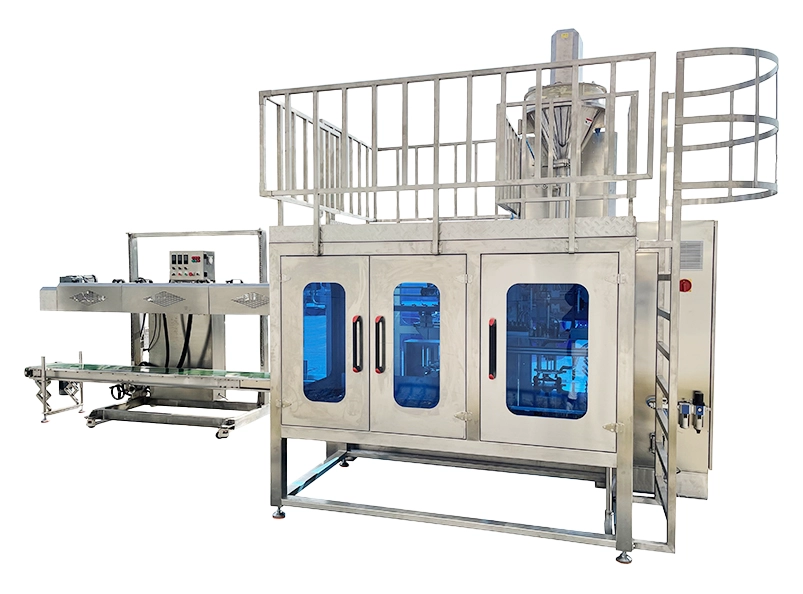
The last metre, not the filler, is where bags go crooked
The familiar layout is a filler, a short gravity roller table and a sewing head bolted to the end of it. A 25 kg kraft bag leaves the spout still breathing powder, the operator drags it onto the rollers, straightens the mouth by hand, then lets it go. If the bag lands half a degree off square, the sewing head stitches a wandering seam, the bag leans on the pallet, and the next bag arrives before anyone has fixed the first. On a powder packaging line running continuously, that half degree repeats several hundred times per shift, so plants add a second operator purely to stand at the last metre.
The physics is not complicated. A settled 25 kg bag has most of its mass low in the bag, the mouth is soft and unsupported, and any belt that pushes the bag from behind also tips it. Open roller gaps let the bag base sag between rollers, which twists the body and, with it, the mouth. Once the mouth is skewed, the sewing head has nothing stable to follow.
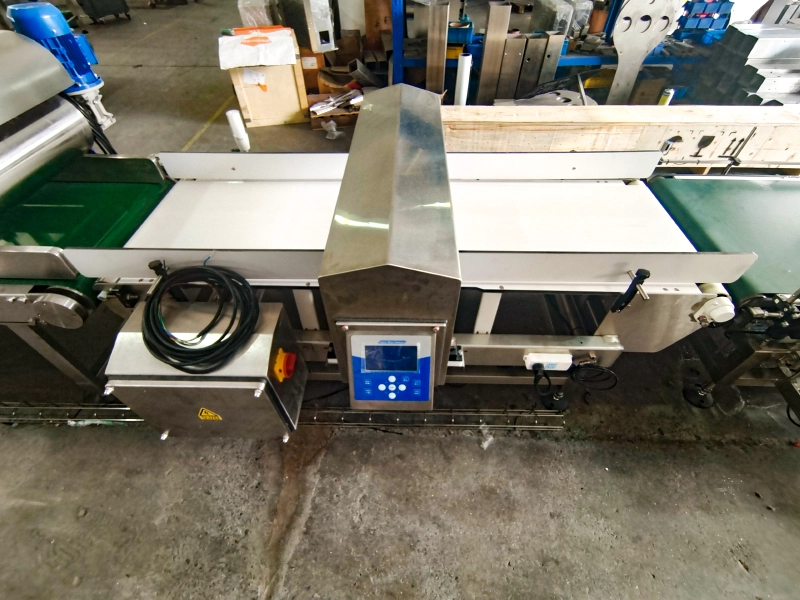
Not at the spout. It starts when a filled bag is released onto an open roller table with no side reference, then pushed from behind toward a sewing head that expects a straight mouth. Manual straightening hides the defect; it does not remove it.
Why the Mipline powder packaging line holds the bag instead of chasing it
Mipline reverses the order. The bag is fed flat from a magazine conveyor into an enclosed stainless steel bagging station, clamped at the mouth before filling, and held there through dosing, so the bag body never has a chance to settle out of square. Operators watch the clamp and the mouth through the blue inspection windows rather than leaning into the machine, and the guarded enclosure keeps hands away from the moving handoff. Nothing about the bag’s position is decided by the operator’s timing.
The transfer that follows is where the earlier layout fails, so it is where this powder packaging line carries the most structure: a twin-belt section with adjustable side guides that reference the bag from both sides, then stainless steel roller conveyor sections that support the base across its full width instead of letting it sag between rollers. The bag arrives at the sewing head already square, already at the right height, and already travelling in line with the seam.
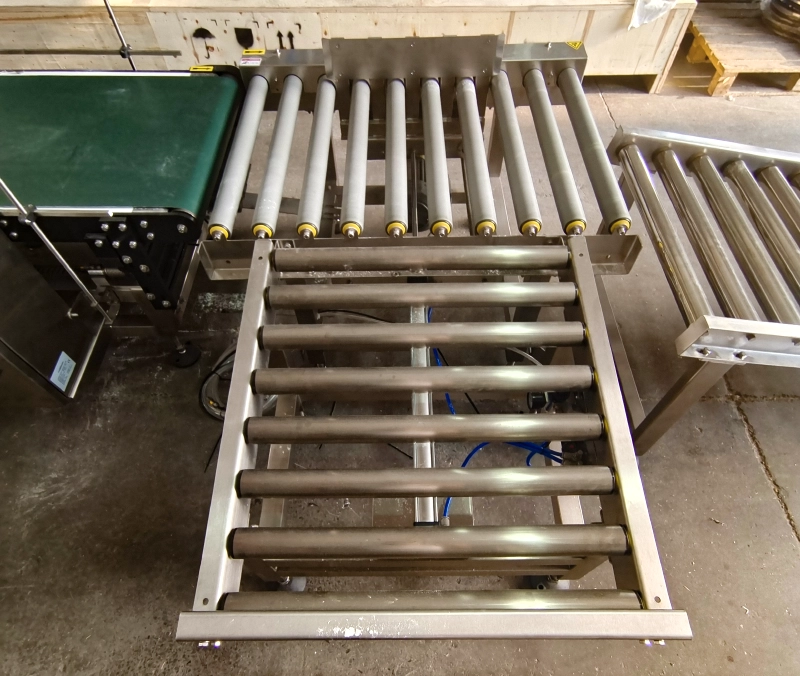
From the shop floor Bag shape is decided by two adjustments, not by operator skill: where the clamp closes on the mouth, and how much clearance the side guides leave on the transfer. Set them once against a filled bag and the handoff repeats; leave them loose and every bag becomes a judgement call.
What to verify before you commit a 25 kg bag to the layout
Send a filled bag, not a drawing. Bag width and gusset decide guide spacing, mouth construction decides whether the line sews or seals, and powder behaviour decides how much settling time the transfer needs before the closure. A dairy powder that fluidises easily needs a longer, gentler handoff than a dense starch. The clamp, guide and roller spacing on this powder packaging line are set against those three inputs, which is why the same station handles kraft paper and woven bags without changing the frame.
Then walk the access, not just the footprint. The enclosed station opens through double doors with viewing windows, and the top maintenance platform is reachable without dismantling guarding, so guide changes and clamp checks happen during a break instead of a shutdown. That is the practical difference between a line that stays square for a season and one that drifts back to manual straightening after the first busy month. Related layouts are compared in the 25 kg powder bagging line transfer walkthrough and the flour bagging clamp-to-sewing handoff.
| Stage | Visible component | Job it performs |
|---|---|---|
| Bag feed | Magazine conveyor feeding flat kraft or woven bags | Presents a square, uncreased bag to the clamp instead of a hand-held one |
| Filling | Enclosed stainless bagging station with blue inspection windows and mouth clamp | Holds the mouth open and the body vertical through dosing |
| Transfer | Twin-belt section with adjustable side guides | References both bag faces so the body cannot rotate on the way out |
| Handoff | Stainless roller conveyor with full-width base support | Carries the settled bag to the sewing head without sag or twist |
| Управление | Touch-screen HMI with emergency stop at the line | Lets one operator run the handoff and stop it at the transfer |
Match the handoff to your bag
Send one filled 25 kg bag and its empty sample. We will return the clamp position, guide spacing and transfer length for a Mipline powder packaging line built around that bag.
Send your bag sample English
 Русский