Automatic Bagging Machine & Palletizing Systems Manufacturer

Category: English

  • Flour Bagging Line in a Pasta Factory: 25 kg Bags

    Flour Bagging Line in a Pasta Factory: 25 kg Bags

    Pasta factory · 25 kg dry flour bags

    Flour Bagging Line in a Pasta Factory: From Clamped Filling to a Square Sewing Handoff

    A pasta plant rarely loses output at the filler. It loses it in the last two metres, where a filled 25 kg semolina bag twists on its way to the sewing head and an operator stops the line to straighten it. This flour bagging line clamps the mouth before filling, holds both bag faces through guided transfer and hands the bag over square, at the same height and angle every cycle.
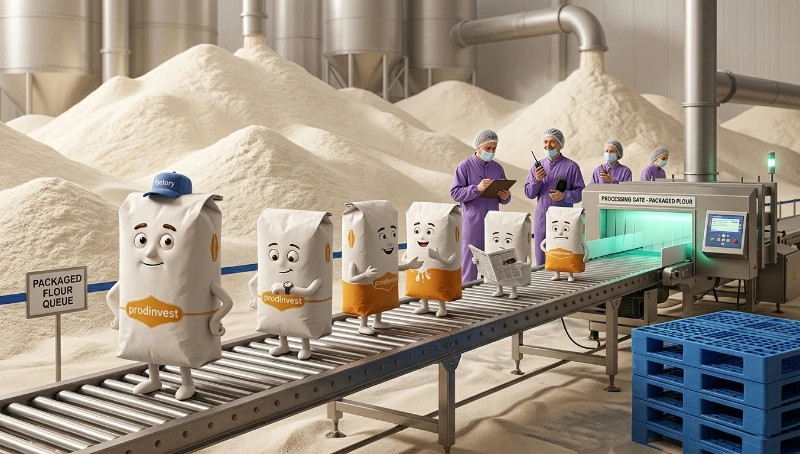
    Automated flour bagging line conveyor moving sealed flour bags inside a pasta factory

    Why a pasta factory judges bag quality before fill speed

    In a dry pasta plant, flour is rarely a finished retail product. Wheat flour and durum semolina arrive in 25 kg kraft or woven bags, are milled, blended or reclaimed, and then move again as a handling unit: the bag has to stand flat on a pallet, survive a forklift, stack without collapsing and open cleanly at the mixer. The traditional arrangement is well known on the floor. An operator holds the empty bag under the spout, fills it, lifts it, straightens the mouth by hand and walks it into the sewing head. Every part of that sequence depends on one person’s timing, and the flour bagging line is judged on the shifts when that person is not there.

    What changes first is not the filling speed but the point at which the bag is restrained. On a Mipline machine the bag is taken from a magazine, opened and clamped at the mouth before any product enters it. Because the clamp holds the bag in a fixed position, filling happens inside a bag that cannot slide, sag or rotate, and the weight is delivered into a bag that is already square. That single decision upstream removes most of the manual straightening downstream, as covered in our walk-through of 25 kg powder filling and bag control.
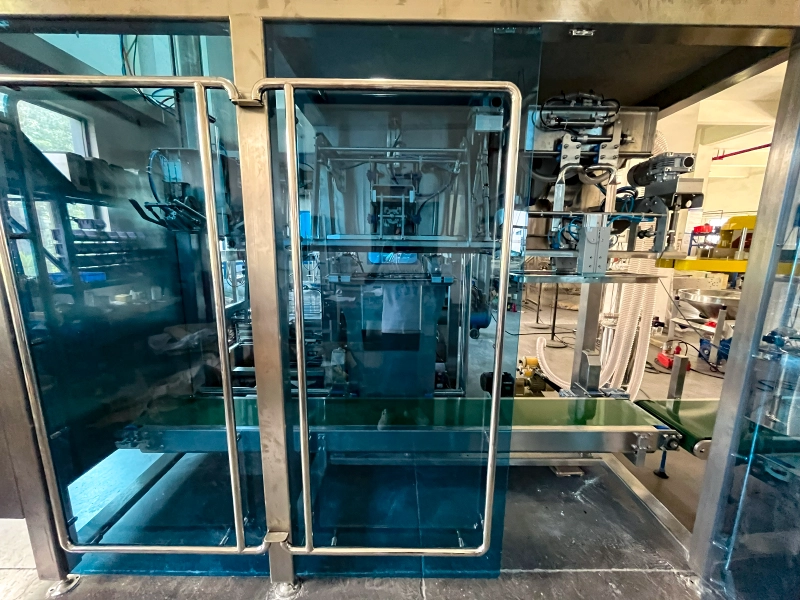
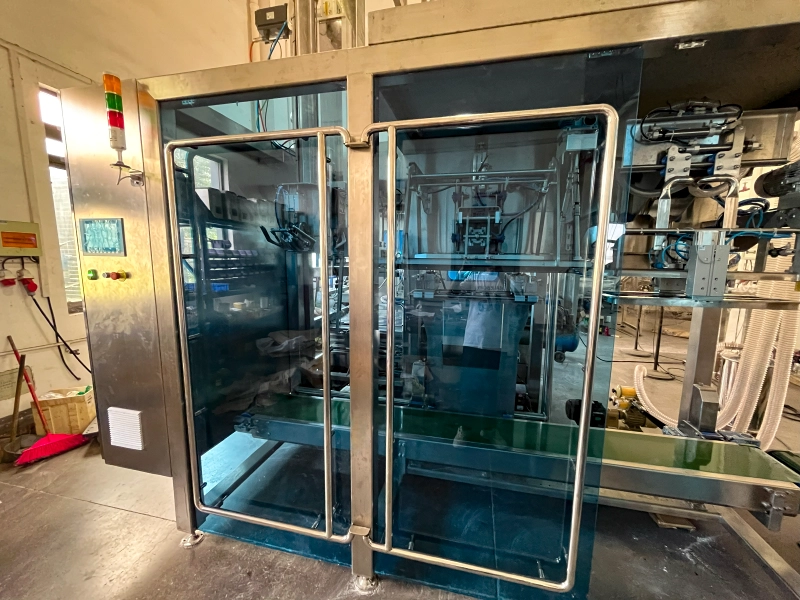
    Enclosed flour bagging line station with stainless steel guarding, blue viewing window and green conveyor
    Where the last two metres cost money

    A 25 kg flour bag that reaches the sewing head skewed gets a wavy seam, a dusty mouth or a reject. The operator straightens it, the line pauses, and the bag that finally leaves the station is often the one that splits on the pallet two weeks later. None of that appears in the filler’s fill-accuracy figure, which is why bag handoff problems survive so long in a plant that already measures weights carefully.

    How the flour bagging line holds the bag between filling and sewing

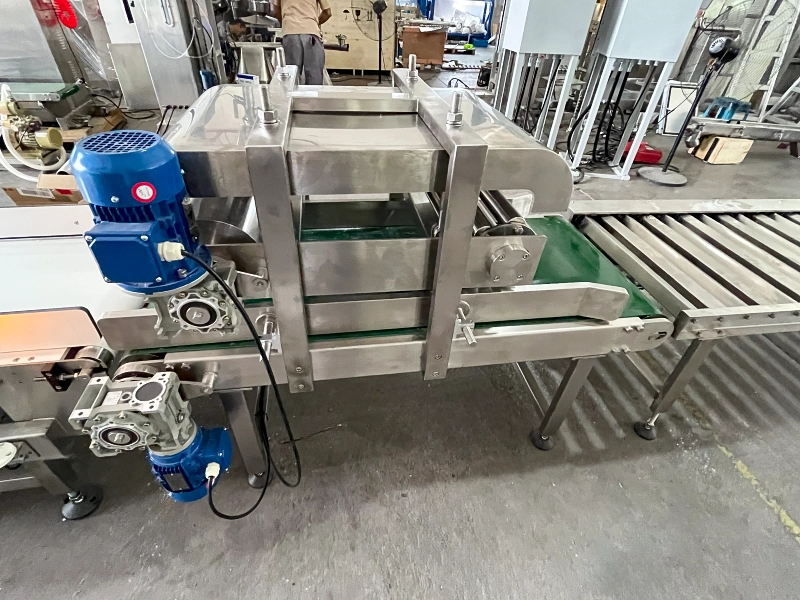
    From the clamp, the bag moves onto a green belt transfer with adjustable side guides that keep both faces vertical. Roller conveyor sections then carry it through the settle zone, where aerated flour is given time to drop before the bag is closed, so the bag arrives dense and flat instead of ballooned. On the twin-belt transfer the bag is supported along both sides rather than pushed from one end, which is what stops it from rotating as the line decelerates. The same sequence of clamp, settle and guided transfer is described in the flour bag fill-to-handoff walk-through.

    The handoff itself is deliberately unspectacular. The bag leaves the transfer at the same height and the same angle on every cycle, so the sewing head sees a mouth that is already aligned and the operator’s job becomes monitoring instead of straightening. For a pasta plant running several flour grades through one line, that consistency is what separates a line one person can supervise from a line that needs two.
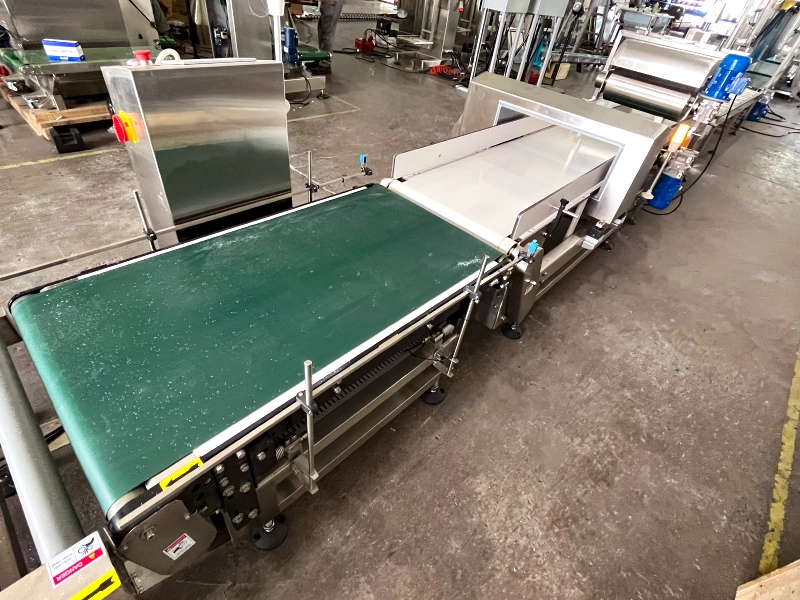
    Flour bagging line transfer modules with steel frames and green belts on a factory floor

    Line design note: Bag mouth quality is decided before the sewing head, not at it. If the clamp position, the transfer guide width and the handoff height are set for one bag format, every bag in that format arrives at the needle with the same geometry, and the sewing head stops being a tuning point that operators adjust by feel.

    Structure and evidence on the flour bagging line

    The bagging station is an enclosed stainless steel frame with blue inspection windows, so the clamp, the fill spout and the start of the transfer stay visible without opening a guard door. A top access platform with railing gives maintenance a safe place to stand when a vacuum cup, a clamp pad or a guide needs attention. The HMI panel groups the run controls, the status beacon and the emergency stop within reach of the handoff point, which is exactly where an operator stands when a bag starts to run off line.

    For a food plant the stainless enclosure and the viewing panels do more than safety compliance. Flour dust settles on everything; a station that can be inspected through glass and cleaned at the fill point without dismantling the line is what makes a grade change realistic between wheat flour and semolina. That is also the reason the machine is specified as a stainless steel powder packaging line rather than a painted frame with a bag clamp bolted to it.
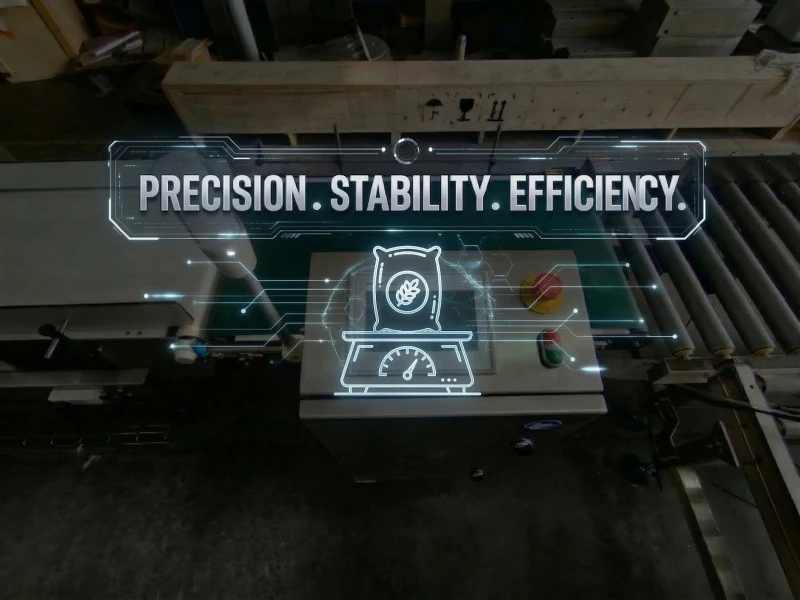
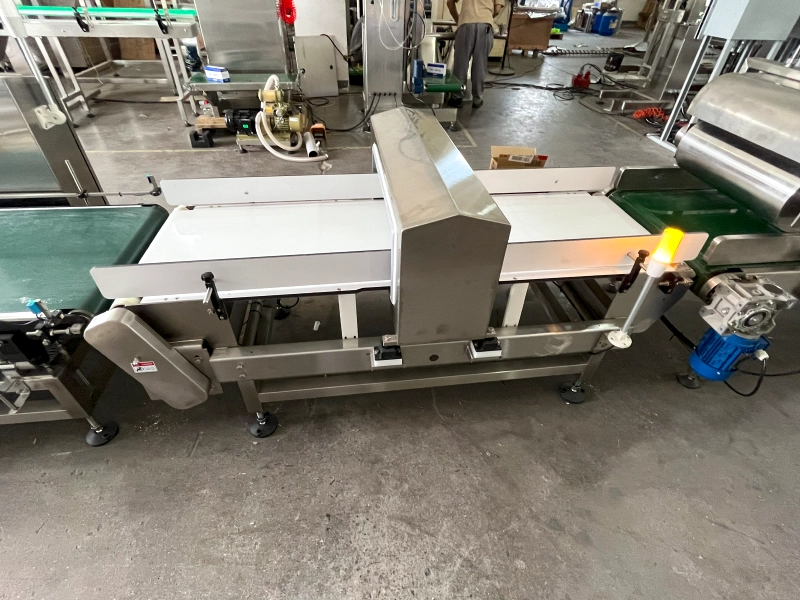
    Flour bagging line control panel with emergency stop next to the bag conveyor
    Line stepWhat the machine doesWhat it fixes in a pasta plant
    Bag pickupFlat kraft bags are drawn from the magazine and opened by vacuumNo operator holding a bag under the spout all shift
    Clamped fillingThe mouth is clamped before product enters the bagBag cannot slip, sag or rotate while it fills
    Settling on transferGreen belt and roller sections let aerated flour dropBag reaches closure flat instead of ballooned
    Guided transferAdjustable side guides and twin-belt support hold both facesBag stops twisting in the last two metres
    Sewing handoffBag leaves at a fixed height and angleSeam starts straight; no manual straightening
    Inspection accessBlue viewing windows and top maintenance platformQuicker cleaning and adjustment between flour grades

    Check the handoff against the bag you actually fill

    Send the 25 kg bag you really use — kraft, woven or paper laminate — together with your flour grade, bag dimensions and target output. We will show you where the clamp, the transfer guides and the sewing handoff sit for that bag on a Mipline flour bagging line, and what happens to the bag mouth at each step.

    Request a line proposal
  • Coffee Powder Packaging Line: 25 kg Bag Handoff

    Coffee Powder Packaging Line: 25 kg Bag Handoff

    Coffee powder · 25 kg kraft bags · export filled

    Coffee Powder Packaging Line: Keeping 25 kg Coffee Bags Square Before Sewing

    Throughput on a coffee powder packaging line is usually lost in the last two metres, not at the filler. Roasted and spray-dried coffee is light, aerated and still degassing, so a 25 kg kraft bag leaves the spout soft and off-square, then twists on its way to the sewing head. Mipline clamps the bag mouth before product enters, holds both faces through guided belt and roller transfer, and hands the bag over square.

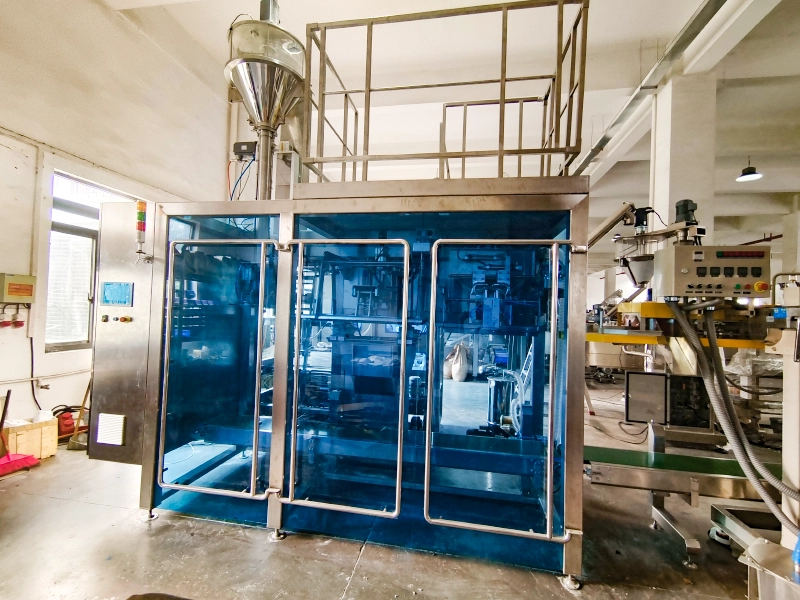
    Stainless steel automatic bagging station with blue safety enclosure, top hopper and control cabinet on a coffee powder packaging line

    Why a 25 kg coffee bag is harder to hold than a flour bag

    A 25 kg flour bag settles into a firm block as soon as the product lands. A 25 kg bag of ground or spray-dried coffee does not. Bulk density is low, so the same weight needs far more bag volume, and the bag reaches the discharge soft, inflated and slightly gassy. Filling suction pulls the mouth inward, the coffee releases gas and pushes it back out, and the mouth ends up open at one corner and folded at the other.

    That is where manual labour enters most coffee plants: one operator stands at the last metre, grabs every bag, pulls it straight and pushes it into the sewing head. The seam then depends on how carefully that operator worked that shift. A coffee powder packaging line has to take that decision away from the operator and put it into a clamp, an adjustable guide rail and a held belt. Dairy plants fight the same problem with aerated powder, which is why the same clamp-first logic is used on a milk powder packaging line.

    3D render of 25 kg food powder bags moving on a roller conveyor inside a food processing factory
    The last two metres decide the pallet

    A filled bag twists on the roller conveyor, the mouth arrives at the sewing head skewed, the head pulls the seam off-centre, and the pallet fills with leaning bags. Whoever straightens bags at the end of the line is, in practice, the quality control of the whole bagging station.

    Where Mipline takes over: flat bag to clamped mouth

    The front of the station is a bag magazine conveyor. Flat kraft bags are presented one at a time, picked, opened and placed on the filling position. The clamp closes on the mouth before any coffee enters, so the mouth geometry is set by a stainless steel clamp rather than by the weight of the product. Coffee dust lands on the clamp jaw, not inside a folded mouth. On a coffee powder packaging line this single detail decides whether the seam runs straight two metres later.

    The filling zone sits inside an enclosed stainless steel bagging station with blue inspection windows and safety doors. Operators can watch the mouth, the clamp and the product stream without opening a guard, and the top of the station carries a maintenance platform with guardrails. A separate control cabinet with a touch-screen HMI and emergency stop keeps the whole coffee powder packaging line operable from one point, with the fault visible instead of guessed.

    Field note: a 25 kg coffee bag that arrives at the sewing head crooked was already crooked three metres earlier, at the clamp. Fixing the clamp fixes the seam.

    Guided transfer: belts, guides and rollers before the sewing head

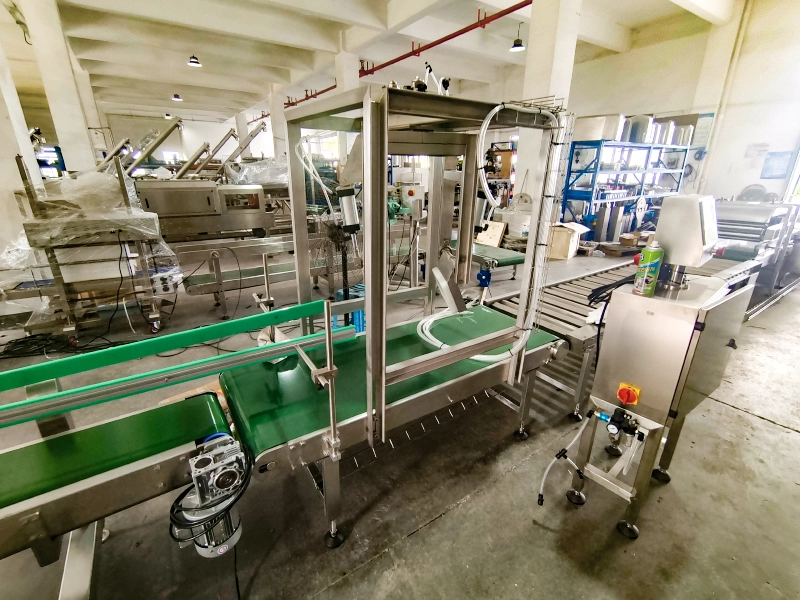
    After filling, the bag is released into a twin-belt transfer conveyor with adjustable side guides. Both faces are held, so the bag cannot twist or collapse while it moves, and the guides can be reset per bag width and paper grade. Roller conveyor sections carry it the rest of the way to the sewing head, and a weighing platform mounted on the conveyor frame checks the 25 kg fill in line. The conveyor runs on a stainless steel frame with adjustable feet, so the transfer height lines up with the sewing head instead of being shimmed on site. The same belt-and-guide arrangement is described station by station in this powder filling and bag sewing line walk-through.

    The change that matters is not filler speed. It is fewer stops at the last metre: bags arrive square, the seam runs straight, bags stand up on the pallet instead of leaning, and the operator moves from straightening bags to checking weight. On a coffee powder packaging line packing 25 kg export bags, that is the difference between a line that needs a person standing at the sealer and a line that does not.

    StationVisible evidenceWhat it changes for coffee
    Bag magazine conveyorFlat kraft bags presented one at a timeNo operator peeling a bag off a stack
    Bag clamp stationMouth held open and square before fillingMouth geometry fixed before product weight acts
    Enclosed stainless station with blue windowsFill zone visible without opening guardsMouth checked without stopping the line
    Twin-belt transfer with adjustable guidesBoth bag faces held between beltsNo twisting between filler and sealer
    Roller conveyor handoffBag guided into the sewing headFewer manual straightening stops
    Conveyor weighing platformWeight check mounted on the belt frameOver and under bags caught before pallet
    Touch-screen HMI with e-stopSingle control point with emergency stopFaster fault recovery, less restart scrap

    Specify the line around your coffee bag, not around a catalogue

    Send the bag width, the paper grade, the 25 kg target weight and the sewing head position, and the coffee powder packaging line is laid out from the clamp outwards. BPMpack quotes the station mix as a drawing, so the transfer height, guide settings and control point match the coffee you actually pack.

    Send your coffee bag sample
  • Powder Filling and Bag Sewing Line: 25 kg Bag Control

    Powder Filling and Bag Sewing Line: 25 kg Bag Control

    Powder bagging · last-metre bag control

    Powder Filling and Bag Sewing Line: Keeping 25 kg Bags Square Before Sewing

    A powder filling and bag sewing line is rarely limited by the filler. It is limited by the last two metres, where an aerated 25 kg bag has to stay square long enough for the sewing head to close a straight mouth. Mipline builds that stretch as a controlled handoff instead of a conveyor gap.

    Green belt bagging conveyor on a powder filling and bag sewing line with vertical guide frame and emergency stop box

    Where a powder filling and bag sewing line loses output

    Start with three plants that look nothing alike: a dairy filling spray-dried skimmed milk into 25 kg kraft bags, a flour mill running woven bags, a starch line on paper-laminated sacks. The filler holds weight inside a few grams. Output still drops, because the loss shows up downstream — a bag arriving at the sewing head with a skewed mouth, an operator pulling it straight by hand, a seam cut open and re-closed. That is where a powder filling and bag sewing line earns or loses its rated speed.

    The usual answer is more people. Two operators stand at the last metre: one squares the bag after filling, the other steers the mouth into the sewing head. It works on a good shift and fails on a bad one. Seam quality then depends on who is standing there, and the filler keeps producing bags faster than the back end can dress them.

    Powder filling and bag sewing line stainless steel packaging station with safety enclosure and finished 25 kg bags
    The bottleneck sits between the clamp and the sewing head

    A 25 kg bag of aerated powder is at its least stable the moment it leaves the filling spout. If the conveyor under it only carries weight, the bag leans, the mouth closes unevenly, and the sewing head inherits a problem it cannot solve. Bag settling is slower than the machine cycle, and the gap is paid for at the seam.

    Why the bag moves on a powder filling and bag sewing line

    On a Mipline powder filling and bag sewing line the bag mouth is clamped before dosing starts, and the fill runs inside that clamped bag. The bag is held by both faces rather than resting on the belt, so the powder column builds vertically and the mouth stays at a fixed height. From the clamp, the bag is carried on green belt and twin-belt sections with adjustable side guides set to the bag width, then onto roller sections for the run to the closing station. No unsupported drop, no rolling on a bare roller bed.

    The visible hardware matches that sequence. Flat bags come off a magazine conveyor into a fully enclosed stainless steel station with blue inspection windows; vacuum grippers lift the top bag and open it at the clamp; control is a touch HMI with an emergency stop on the housing. Operators can watch the bag through the windows while adjusting guides, so alignment is set against the real bag, not a drawing.

    What we ask before quoting: a filled bag sample, not just a powder spec. The guide spacing, transfer length and handoff height on a powder filling and bag sewing line are set by bag face width, fill weight and how much the powder settles in the first seconds after dosing.

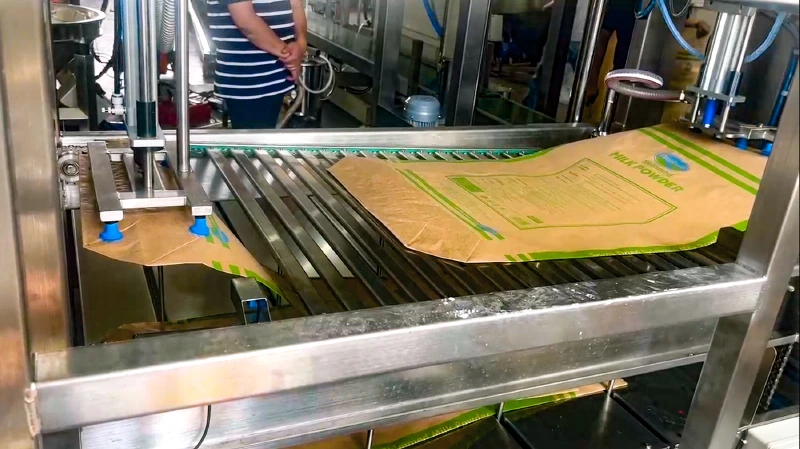
    Roller conveyor with vacuum grippers holding kraft paper powder bags at the infeed of a bag sewing line

    What to check on a powder filling and bag sewing line before you approve the layout

    Buyers usually arrive with a checklist: bag pickup, mouth control, dust, transfer stability, maintenance access. Each item has to end somewhere concrete on the machine, otherwise it stays a promise. The table maps the common evaluation points to what is actually visible on the Mipline build.

    Evaluation pointVisible evidence on the Mipline lineWhat it removes from the shift
    Bag pickupFlat bag magazine conveyor feeding an enclosed stainless station through a guarded infeedHands out of the bag path at the start of every cycle
    Mouth controlClamp station holding both bag faces through fillingA mouth that reaches the sewing head at the same height and width each time
    Dust and aerationFilling inside the clamped bag, station enclosed behind blue inspection windowsPowder cloud around the mouth and product settling after the seam
    Transfer stabilityGreen belt, twin-belt and roller sections with adjustable side guidesBag drift and twist on the run between filling and closing
    Access and safetyTop maintenance platform with railing, touch HMI, emergency stop on the housingGuide adjustments made without opening the process or stopping the line for long
    HandoffGuided handoff before sewing or sealing, bag square to the sewing headManual straightening at the last metre and re-closed seams

    The two items that decide throughput are the transfer length and the position of the sewing handoff. A short transfer on a 25 kg dairy or flour bag leaves the powder still moving when the head closes. A longer, guided run on belt and roller sections lets the bag settle upright, so the seam is closed on a stable column. If the line also carries a checkweigher or metal detector, the same setting decides whether the bag is still square when it crosses that station — the sequence is covered in our automatic bagging machine for powder walk-through.

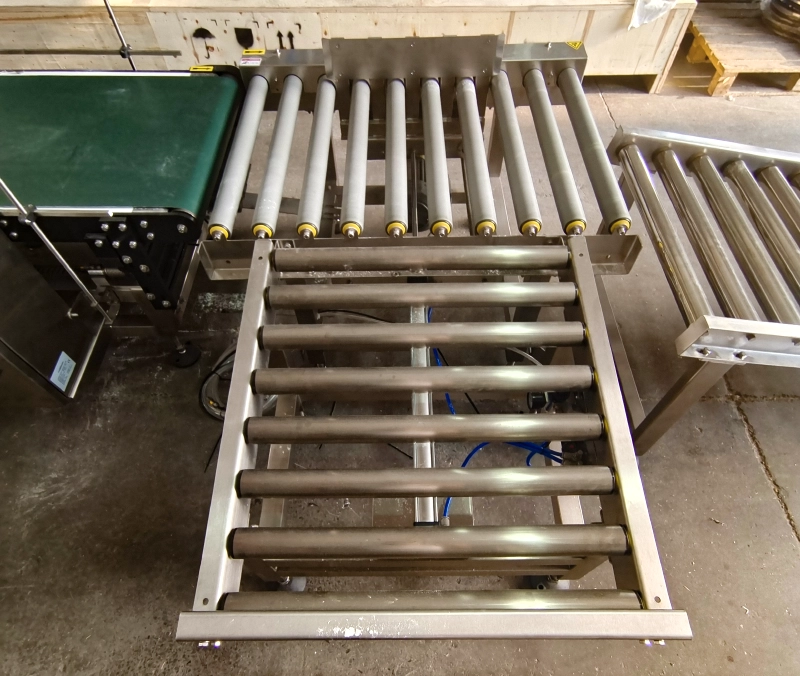
    Stainless steel roller conveyor transfer section keeping powder bags aligned on a powder filling and bag sewing line

    The result on a working line is unglamorous and useful: the sewing head receives the same square bag every cycle, the operator who used to straighten bags is released, and the seam closes on the first pass. If your current line still needs a person at the last metre, the transfer section — not the filler — is the place to start. Our starch powder packaging line case shows the same fix applied to a paper-laminated bag.

    Send your bag and powder spec

    Tell us bag type (kraft paper or woven), fill weight, powder bulk density and target bags per minute. We return a powder filling and bag sewing line layout with transfer length, guide settings and the sewing handoff position marked on the drawing.

    Request the line layout
  • Powder Bagging Line: Settling Before Checkweighing

    Powder Bagging Line: Settling Before Checkweighing

    25 kg dry powder bagging · closure and final inspection

    Powder Bagging Line: Settling Before Checkweighing

    A flour, starch or dairy plant rarely loses output at the filler. It loses it in the last few metres, where a bag that is still full of moving powder arrives at the weigh cell leaning on one corner, and the checkweigher correctly rejects a bag that was filled correctly. A powder bagging line is judged by what happens between the closing head and the inspection gate: settling, shaping, transfer and the handoff to weighing.

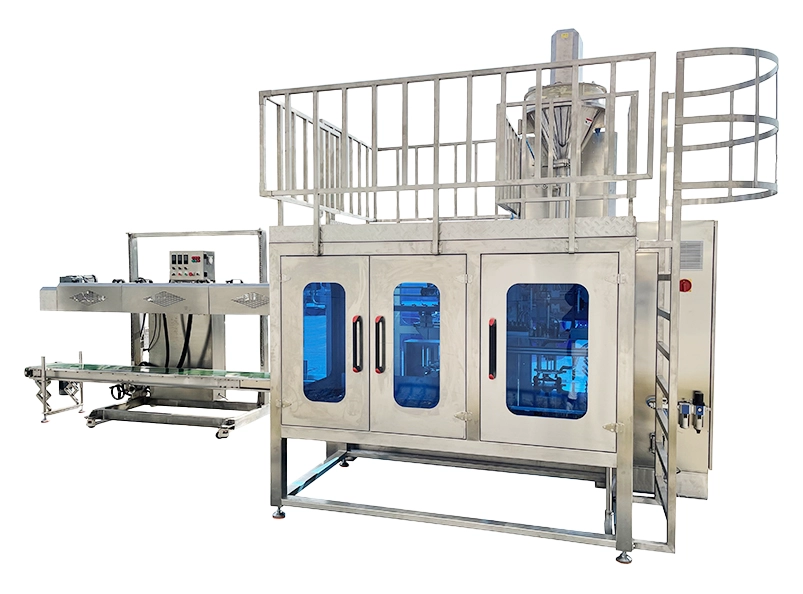
    Stainless steel automatic bagging machine on a powder bagging line with blue inspection windows and bag magazine conveyor

    Where a 25 kg bag actually loses its shape

    The closing head does not make a bad bag. The bag leaves the clamp with a column of aerated powder inside it, and that column keeps moving after the seam is shut. On a kraft paper or paper-plastic composite bag, the air has nowhere to go except into the bag faces, so the panel bulges, the bottom rounds over and the bag starts to sit on a corner instead of on its base. Twenty metres of flat conveyor will not fix that; it only carries the problem further down the powder bagging line.

    The filling step is where the air enters. Bottom-up filling with a lifting platform that follows the fill level keeps the dosing outlet close to the rising material instead of dropping powder from a fixed height. Three-stage screw feeding — fast, medium, then a slow final dose — shortens the time the powder is in free fall at the end of the cycle, which is the moment that puts the most air into the bag and the most dust around the mouth. Fewer airborne fines at the mouth means a cleaner heat-seal or sewing zone, and a bag that has less internal pressure to release afterwards.

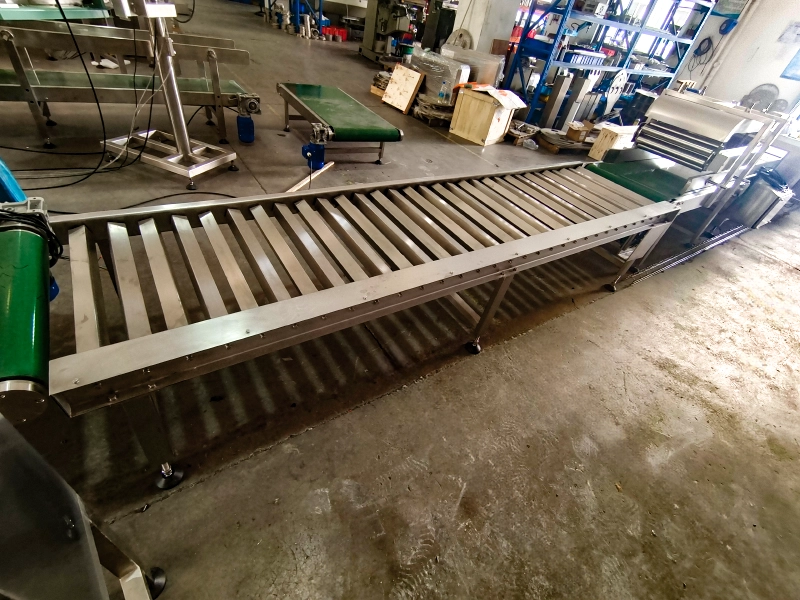
    Stainless steel settling conveyor on a powder bagging line with green belt infeed and roller outfeed for bag transfer
    The last metre, not the first

    Operators usually report the symptom as “the bag arrives crooked”. What they are watching is an aerated bag being tipped from a belt onto rollers, then straightened by hand before it reaches the inspection gate. Every manual correction at that point costs a second of line time and introduces a variable the weigh cell cannot separate from a genuine weight error.

    Settling and shaping: two jobs, two sections

    Settling and shaping are often treated as the same conveyor. They are not. A settling section gives the powder time and a low-vibration run to release air while the bag is still supported on a flat, level belt — on the Mipline layout this is a 3,000 mm section with a 600 mm belt running at 15 m/min on a 0.75 kW drive. A shaping section then works on the bag geometry: a 1,500 mm section with the same 600 mm belt width, running at 15 m/min, brings the two bag faces back to parallel and squares the base.

    On the powder bagging line the shaping stage is where adjustable side guides earn their place. Guides set to the actual bag width, rather than to a nominal 25 kg size, stop the bag from rotating as it is handed from the twin-belt transfer to the roller run. The twin-belt arrangement holds both faces at once, so a bag that entered the section slightly rhomboid leaves it as a rectangle, and the mouth that reaches the sewing head or the heat-seal press is straight rather than skewed.

    Engineering note. Set the guides by running twenty filled bags, not by measuring one empty bag on a bench. Kraft paper bags swell at the gusset once filled, and a guide gap set on the flat bag will pinch the filled one and re-introduce the tilt the section was installed to remove.

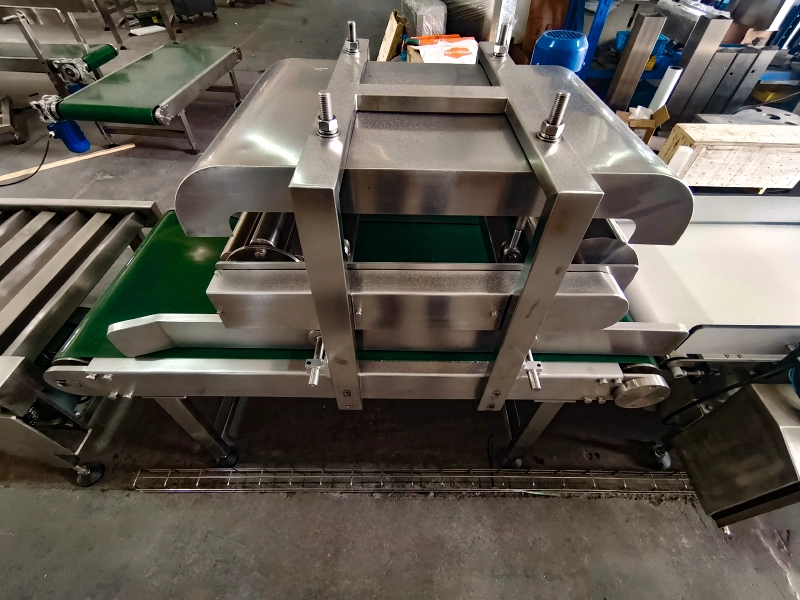
    Stainless-steel twin-belt shaping conveyor on a powder bagging line with adjustable side guides

    Handing the bag to the metal detector and checkweigher

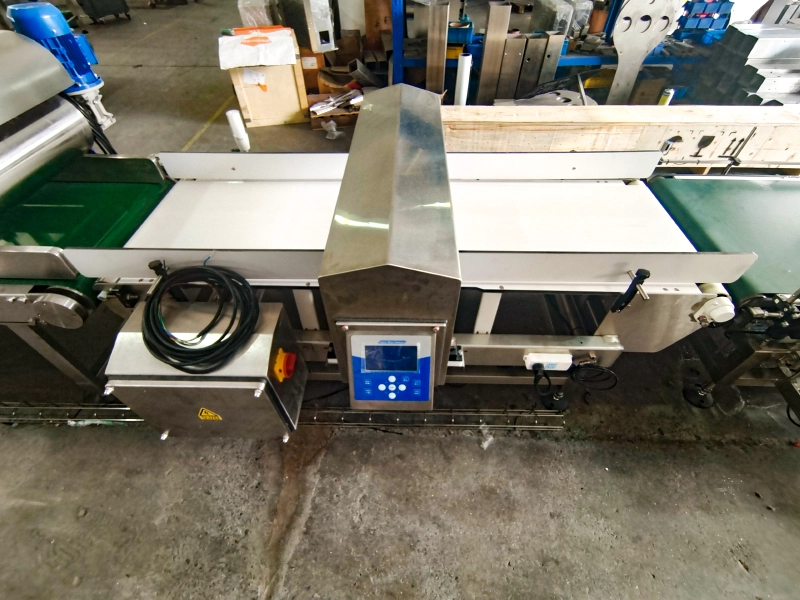
    Inspection equipment is where an unstable bag becomes a visible number. A metal detector on a 25 kg powder line is normally specified by aperture: the ER6023 reference carries a 600 × 230 mm window, a maximum product size of 550 × 200 mm and a 520 mm belt at 28 m/min, with sensitivity quoted per product and per belt condition. If the bag arrives at that aperture with a bowed face, the effective product height changes and the detector sees a varying mass of powder in the field — which shows up as false rejects that the operators then learn to ignore.

    The checkweigher is stricter still. Dynamic weighing needs the bag to be at rest relative to the belt and fully supported across the weigh platform, which is why the platform frame on the line is built with an adjustable support and threaded leveling bolts rather than fixed feet. Reference units run up to a 50 kg range with a 590 mm belt and an AC 220–240 V, 750 W drive, but published accuracy and throughput figures for 25 kg powder bags vary between sources and between product densities. Fix accuracy against your own bag and powder on a FAT, not from a brochure.

    Stage on the lineReference hardwareWorking figureWhat it controls
    Clamp fillingBottom-up lifting fill, three-stage screw25 kg nominalAir and dust entering the bag mouth
    SettlingFlat belt section, 3,000 mm600 mm belt, 15 m/min, 0.75 kWPowder stops moving inside the bag
    ShapingTwin-belt section with side guides, 1,500 mm600 mm belt, 15 m/minBag faces parallel, base square
    Metal detectionAperture detector, 600 × 230 mm520 mm belt, 28 m/minContamination in the closed bag
    CheckweighingDynamic weigh platform, up to 50 kg range590 mm belt, AC 220–240 V, 750 WWeight drift after closure
    DischargePVC belt conveyor, 5,000 mm10 m/min, 0.75 kWHandoff to palletizing without tipping
    • If bags arrive skewed, check guide width on the shaping section and bag gusset swell before blaming the sewing head.
    • If the weigh cell drifts on the same filled weight, check that the settling section is level and that the bag is not rolling onto the platform.
    • If the detector false-rejects, measure the bag face height at the aperture instead of raising sensitivity.
    • If operators still straighten bags by hand, the line length between closure and inspection is too short for your powder.

    A well-set powder bagging line removes those four causes in the same order, because each one is a mechanical condition rather than an operator skill.

    Stainless steel checkweigher platform on a powder bagging line with adjustable support frame and leveling bolts

    Size the settling and shaping sections around your powder

    Bag width, gusset, powder bulk density and target speed decide how much settling length a powder bagging line needs before inspection. Send one filled bag sample, the powder type and your target bags per minute, and we will return a layout with the settling, shaping and inspection sections sized to them.

    Send your bag sample
  • Milk Powder Packaging Line: Dry Milk Bag Handoff

    Milk Powder Packaging Line: Dry Milk Bag Handoff

    Dry milk · 25 kg kraft bags

    Milk Powder Packaging Line: Dry Milk Bag Handoff

    A dairy plant filling 25 kg kraft bags with spray-dried skimmed milk rarely loses output at the filler. It loses it in the last metre, where the full bag leaves the clamp and meets the sewing head. This milk powder packaging line clamps the bag mouth before filling, holds both bag faces through a guided transfer and hands the bag over square.

    Automated milk powder packaging line with stainless steel safety enclosure, conveyor section and stacked finished bags

    Where Dry Milk Bags Lose Their Shape

    The older layout is familiar. An auger or screw filler sits on a short spout, an operator holds the bag mouth by hand, the filled bag drops onto a two-metre roller table and gets pushed toward a sewing head. Dry milk makes that layout expensive. The powder is light, it fluidises while it falls, and the second half of the fill shifts weight into one corner. A bag that was straight at 10 kg is leaning at 25 kg, the block bottom is skewed, and the sewing head receives a mouth that is not square. The operator then walks the last metre to straighten the bag by hand, which is exactly where dust escapes and where the seam starts to wander. That manual step is the cost this milk powder packaging line is built to remove.

    A milk powder packaging line replaces the hand with a mechanical hold. Flat kraft bags sit in a magazine conveyor. A bag is picked, opened and pushed onto a clamp station where the mouth is gripped on both faces before the first kilo of powder enters. Filling runs bottom-up, so the bag builds its own base instead of dropping into a slack sack. The clamp releases only when the bag is formed, square and standing on a supported conveyor surface.

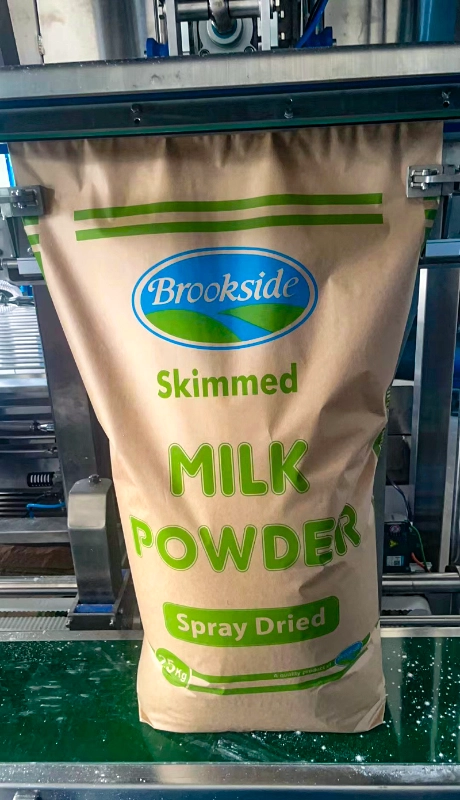
    Kraft milk powder bag held at the automatic bag clamp station of a powder packaging line
    The bottleneck is the handoff, not the dosing

    Dairy plants usually discover this after a capacity upgrade: the filler keeps up, the sewing head does not, because half the bags arrive with a twisted mouth or a collapsed shoulder. Manual straightening hides the problem at line speed and shows it again at the palletizer.

    Why This Milk Powder Packaging Line Fits Dairy Powder

    Dry milk is not flour. It is low in bulk density, it aerates, and it holds air after dosing, so a filled 25 kg bag stays soft for several seconds after the clamp opens. A milk powder packaging line has to keep the bag supported through that settling window instead of dropping it. On the Mipline layout the bag stays inside an enclosed stainless steel bagging station with blue inspection windows, then moves onto green belt and roller conveyor sections sized for that settling distance.

    Three details matter more than tonnage for this product. First, the mouth is clamped on both faces, so the fill cannot push the bag sideways. Second, the transfer after filling is guided: adjustable side guides on the twin-belt section hold the bag body upright. Third, access is designed for cleaning — top maintenance platform, hinged inspection doors and an open stainless frame — because dairy powder residue is a sanitation issue, not only a dust issue.

    Shop-floor note: most sewing complaints we receive are actually clamp and transfer complaints. Check where the bag is supported in the last metre before replacing the sewing unit.

    From Clamp to Sewing Head: The Evidence

    The photo evidence is easy to read. A milk powder packaging line from Mipline moves the bag through four supported states: clamped at the mouth, filled bottom-up, released onto a belt with fixed side guides, and handed to the sewing head at a height and angle set by the conveyor line rather than by the operator’s hands. Twin-belt transfer with adjustable guides, green infeed and outfeed sections and a welded stainless frame carry a 25 kg kraft bag without sagging between supports. A touch-screen control box with emergency stop sits beside the transfer section, so a jam is visible and reachable.

    Twin-belt transfer conveyor with adjustable side guides keeping 25 kg powder bags aligned before sewing

    Where does the gain show up? Fewer stops in the last metre, fewer skewed seams, fewer bags re-shaped by hand, and squareness that survives palletizing. If you already run a 25 kg layout, compare it with our 25 kg powder bagging line walkthrough and the automatic bagging machine for powder magazine-to-clamp sequence.

    Line stageWhat the machine holdsWhat it prevents
    Bag pickup from magazineFlat kraft bag drawn, opened and pushed to the clamp stationOperator holding the bag mouth by hand
    Clamp before fillingMouth gripped on both faces, fill runs bottom-upWeight shifting into one corner
    Release after fillingBag set down on a supported belt, not droppedCollapsed shoulder on aerated powder
    Guided transferTwin-belt section with adjustable side guidesTwisted bag body and skewed mouth
    Handoff to sewingHeight and angle fixed by the conveyor lineUnstable seam start and rework

    Send Your Dry Milk Bag Sample

    Tell us the bag you already buy — 25 kg kraft, woven or laminated — the powder you run and your target bags per hour. We will size the milk powder packaging line around that bag and your sewing position, not around a catalogue page.

    Request a line proposal
  • Starch Powder Packaging Line: Stable 25 kg Bag Transfer

    Starch Powder Packaging Line: Stable 25 kg Bag Transfer

    Mipline · 25 kg starch and dry powder bagging

    Starch Powder Packaging Line: Where 25 kg Bags Stay Square Before Sewing

    A starch plant rarely loses output at the filler. It loses it in the last three metres, where a filled 25 kg kraft bag leaves the spout, settles, and reaches the sewing head slightly rotated. This starch powder packaging line clamps the bag mouth before filling, holds both bag faces on a guided transfer, and hands the bag to the sewing head square, so the operator stops straightening bags by hand.

    Enclosed stainless steel powder packaging line with safety doors and conveyor interface on a starch powder packaging line

    Why a 25 kg starch bag arrives skewed at the sewing head

    Starch is fine, free-flowing and easy to aerate. On a conventional setup — a gravity or auger filler above a bank of free rollers, with an operator holding the bag mouth by hand — three things happen in sequence. Air enters with the powder, the bag balloons and its base widens, the operator releases the mouth, and the bag drops onto the conveyor at a slight angle. Over the following metres of unguided roller travel that angle becomes a rotation, and the sewing head receives a mouth that is no longer perpendicular to the seam line.

    The usual remedy is a person at the last metre with a straightening board. That person is the bottleneck: every bag needs the same correction, the load rises with bulk density and fill weight, and nothing on the line learns from it. Retuning the sewing head does not help either, because the head is being fed an unstable bag — a starch powder packaging line cannot solve at the closing end what went wrong at the clamp.

    Belt conveyor with adjustable guide rails and enclosed transfer tunnel holding 25 kg starch bags square
    Where the hour goes

    A line that needs one operator at the closing end pays for that operator on every single bag, and the correction hides the real defect: a bag that is not square was already mis-formed at the clamp station. The seam is a symptom, not the cause.

    How the Mipline starch powder packaging line keeps the bag square

    Mipline starts at the bag, not at the powder. Flat kraft or woven bags are stacked in a magazine and fed by conveyor to the bagging station, where the mouth is clamped before any product enters. Because the mouth is held for the whole fill, the bag cannot sink, rotate or unfold while it gains weight. The clamp sits inside an enclosed stainless steel station with blue inspection windows, so the operator can watch the mouth and the dosing stream without opening a guard, while the cabinet and HMI stay outside the dust zone.

    When the bag is released it is already square, and the transfer is built to protect that. A twin-belt transfer with adjustable side guides carries the bag on both faces, then a roller conveyor transfer section moves it to settling and the closing head. Vacuum grippers keep the gusset from folding back onto the seam face, and the bag enters the sewing head level, with its mouth plane held by guides rather than by a hand. That is the difference between a starch powder packaging line that runs and one that gets nursed.

    Roller conveyor transfer with vacuum grippers handling kraft paper bags before sewing on a starch powder packaging line

    Engineering note The clamped mouth is the only stable datum on a filled bag. Every guide downstream is set from that datum, which is why the same frame handles 25 kg kraft bags and woven bags after a guide changeover instead of a rebuild.

    Specifying a starch powder packaging line against your actual bag

    Buyers normally arrive with three things: an empty bag, a bulk density and a target rate. Those three decide the layout. Bag type and gusset set the clamp and guide width; the seam type decides whether the closing end is a sewing head or a sealer; dust level decides where the enclosure and extraction points sit; available floor length decides how much settling conveyor fits between filling and closing. Nothing on a starch powder packaging line should be quoted before the bag sample is measured.

    The table below is the configuration logic Mipline applies to those inputs, and what each station is actually protecting.

    StationWhat the machine providesWhat it prevents on a starch line
    Bag feedMagazine conveyor feeding flat kraft or woven bags into the stationTorn gussets and double picks before the bag is ever filled
    FillingMouth clamp inside an enclosed stainless steel station with blue inspection windowsBag sinking, rotating or ballooning while it gains 25 kg
    TransferTwin-belt transfer with adjustable side guidesRotation on free rollers between filling and closing
    HandoffRoller conveyor transfer with vacuum grippers, then a settling runFolded gusset and a skewed mouth arriving at the sewing head
    OperationTouch-screen HMI, emergency stop, top maintenance platformSlow cleaning, unsafe guide adjustment and avoidable stops

    Every row is answered by a part, not a promise. The side guides are adjustable, so one setting range covers 25 kg kraft and woven bags; clamp height is set from your bag sample; the enclosure holds dust near the filling point so the floor and the sewing head stay cleaner; inspection windows and the top access platform let your maintenance team clean and re-set guides without dismantling guards.

    What changes on the floor

    When the bag is held from magazine to closing head, the last metre stops being a manual station. The operator moves to supervision, bag magazine reloads and weight checks; seam rejects caused by skewed mouths fall; and changing to another 25 kg format becomes a guide adjustment. A starch powder packaging line built this way removes the correction step instead of automating it. Related walk-throughs are in our notes on a 25 kg powder bagging line and on a clean bag mouth before sewing.

    If bags are still being straightened by hand at the closing end, look upstream of the sewing head first. Send an empty bag, the bulk density and the target rate per hour, and the station sequence and settling distance can be laid out around your bag rather than around a catalogue size.

    Send the bag before you sign the layout

    Mipline quotes are built from a measured bag sample. Share two or three empty 25 kg bags with your target bags per hour and we will return a station layout with clamp and guide settings for your starch, flour or dairy powder.

    Request a line review
  • Flour Packaging Line: 25 kg Bag Handoff Before Sewing

    Flour Packaging Line: 25 kg Bag Handoff Before Sewing

    Mipline · 25 kg dry powder bagging

    Flour Packaging Line: Holding 25 kg Bags Square Before Sewing

    A flour packaging line is judged at the last metre, not at the filling spout. On a Mipline flour packaging line the bag is clamped before filling, carried on guided twin-belt and roller sections, settled, and handed to the sewing head already square. This walk-through shows where 25 kg kraft flour bags twist, which structure keeps them straight, and what a flour, starch or dairy powder plant should specify before the line is built.

    Flour packaging line stainless steel conveyor with enclosed centre module, side guides and motorised drive

    Where a 25 kg flour bag loses its shape

    In most flour packing halls the filler is not the problem. The way the bag is held is. A 25 kg kraft bag has to be opened, pushed onto the spout, held at chest height through a six to nine second fill, and lifted clear. While the bag hangs from a spout and a shoulder, the mouth leans, the bottom bulges forward, and the paper takes a crease that never comes out. Nobody sees it at the filler. It appears three metres later, at the sewing head, on any flour packaging line that still relies on an operator to hold the bag.

    That is the usual pattern behind bag-quality complaints: the seam wanders, the thread skips, the mouth arrives skewed, and one operator spends the shift straightening the last bag with both hands while the next bag is already coming. Throughput falls, seam rejects climb, and the sewing head is asked to close a bag that is no longer square. None of that is solved by adding a second operator to the same handoff.

    Automated powder packaging line with safety enclosure, conveyor section and stacked finished flour bags
    The last-metre trap

    Manual straightening hides the real defect. If the bag leaves the clamp square and travels square, the sewing head only has to close a straight mouth, and the operator moves from bag handler to line supervisor.

    Why a filled flour bag rotates on the transfer

    Once a clamp releases a filled 25 kg bag, it is a soft column of powder standing on a paper base. Air entrained during filling makes the product behave like a liquid for a couple of seconds, the centre of gravity sits high, and any small misalignment at the filler turns into a slow rotation on the transfer run. A plain belt section without side support does not correct that movement; it carries the bag forward to the sewing head exactly as it was released.

    A Mipline flour packaging line removes that free moment. The bag is clamped at the filling station, filled bottom-up so product builds from the base and displaces air upwards, and released only when the mouth is straight. From the clamp the bag enters a twin-belt transfer conveyor with adjustable side guides that hold both faces, then stainless roller conveyor sections that carry the weight without squeezing the paper. The bag reaches the sewing head in the same orientation it left the filler. Plants that also run dairy formats can compare the same handoff on a milk powder bagging line.

    Line engineer’s note: bag alignment is set at the clamp and preserved by the guides. If a crew still straightens bags by hand at the end of the run, either the side guides are set too wide or there is a gap between the roller section and the sewing infeed that lets the bag turn.

    Stainless steel automated bagging line with dual safety doors, conveyor transfer and control stack light

    Structure evidence on the flour packaging line

    The photographs on this page come from an installed line, not a render. The bagging station is an enclosed stainless steel frame with blue inspection windows and double doors; the bag magazine conveyor feeds flat kraft bags to the clamp from the front, and green transfer conveyors carry filled bags away on both sides. A top maintenance platform with guard rail gives access to the filling head, and the electrical cabinet with stack light and emergency stop stays within reach of the operator.

    The transfer is where bag quality is decided. Roller conveyor sections on adjustable leveling feet carry a 25 kg load without belt sag, the twin-belt section holds both faces through the handoff, and the guides are set to the bag width rather than to a nominal size. Change from one kraft bag format to another and the guides move; the geometry of the handoff stays. The same clamp-and-guide sequence is used on the flour bagging line for clamped filling, and the transfer logic repeats on a 25 kg powder bagging line.

    Specification itemWhat to verifyMipline structure
    Bag format25 kg kraft paper or woven bag, flat magazineBag magazine conveyor feeds flat bags into an enclosed stainless bagging station
    Mouth control during fillBag clamped before filling, mouth held squareBag clamp alignment at the filling station with bottom-up filling, no manual hold
    Transfer to the sewing headNo free-standing belt run between filler and sewingTwin-belt transfer conveyor with adjustable side guides plus roller conveyor transfer sections
    Product air and settlingFill clamped, settle before closureSettling distance on the transfer run ahead of the sewing head
    Access and cleaningGuarded openings, inspection and maintenance accessBlue inspection windows, double doors, top maintenance platform, stainless frame
    Enclosed automatic bagging station with blue safety enclosure, stainless guarding and green conveyor belt

    For a dairy powder, flour or starch plant ordering a flour packaging line, the practical test takes ten minutes: stand at the last three metres and watch. If somebody touches every bag, the transfer needs guides and a bag clamp, not more manpower. Send the bag format, fill weight and filler discharge height, and the clamp, transfer and sewing infeed can be laid out to that bag instead of to an average.

    Send the bag, not only the tonnage

    Share your bag format, fill weight and existing filler discharge height. We will return a flour packaging line layout with the clamp, transfer and sewing handoff drawn to your bag.

    Request a line layout
  • Powder Packaging Line: Guides That Keep Bags Square

    Powder Packaging Line: Guides That Keep Bags Square

    Powder bagging · bag handoff before sewing

    Powder Packaging Line: Guides That Keep 25 kg Bags Square

    A flour, starch, dairy or protein plant rarely loses output at the filler. It loses it at the last metre, after the filled bag has been released and the sewing head has to cope with whatever shape arrives. The Mipline powder packaging line designs that metre instead of leaving it to an operator with a gloved hand and a foot on the frame.

    Stainless steel automatic bagging machine with blue inspection windows and bag magazine conveyor on a Mipline powder packaging line

    The last metre, not the filler, is where bags go crooked

    The familiar layout is a filler, a short gravity roller table and a sewing head bolted to the end of it. A 25 kg kraft bag leaves the spout still breathing powder, the operator drags it onto the rollers, straightens the mouth by hand, then lets it go. If the bag lands half a degree off square, the sewing head stitches a wandering seam, the bag leans on the pallet, and the next bag arrives before anyone has fixed the first. On a powder packaging line running continuously, that half degree repeats several hundred times per shift, so plants add a second operator purely to stand at the last metre.

    The physics is not complicated. A settled 25 kg bag has most of its mass low in the bag, the mouth is soft and unsupported, and any belt that pushes the bag from behind also tips it. Open roller gaps let the bag base sag between rollers, which twists the body and, with it, the mouth. Once the mouth is skewed, the sewing head has nothing stable to follow.

    Stainless steel twin-belt transfer conveyor with adjustable side guides keeping 25 kg powder bags aligned before sewing
    Where the twist starts

    Not at the spout. It starts when a filled bag is released onto an open roller table with no side reference, then pushed from behind toward a sewing head that expects a straight mouth. Manual straightening hides the defect; it does not remove it.

    Why the Mipline powder packaging line holds the bag instead of chasing it

    Mipline reverses the order. The bag is fed flat from a magazine conveyor into an enclosed stainless steel bagging station, clamped at the mouth before filling, and held there through dosing, so the bag body never has a chance to settle out of square. Operators watch the clamp and the mouth through the blue inspection windows rather than leaning into the machine, and the guarded enclosure keeps hands away from the moving handoff. Nothing about the bag’s position is decided by the operator’s timing.

    The transfer that follows is where the earlier layout fails, so it is where this powder packaging line carries the most structure: a twin-belt section with adjustable side guides that reference the bag from both sides, then stainless steel roller conveyor sections that support the base across its full width instead of letting it sag between rollers. The bag arrives at the sewing head already square, already at the right height, and already travelling in line with the seam.

    Stainless steel roller conveyor transfer section with angled rollers for powder bag handoff on a powder packaging line

    From the shop floor Bag shape is decided by two adjustments, not by operator skill: where the clamp closes on the mouth, and how much clearance the side guides leave on the transfer. Set them once against a filled bag and the handoff repeats; leave them loose and every bag becomes a judgement call.

    What to verify before you commit a 25 kg bag to the layout

    Send a filled bag, not a drawing. Bag width and gusset decide guide spacing, mouth construction decides whether the line sews or seals, and powder behaviour decides how much settling time the transfer needs before the closure. A dairy powder that fluidises easily needs a longer, gentler handoff than a dense starch. The clamp, guide and roller spacing on this powder packaging line are set against those three inputs, which is why the same station handles kraft paper and woven bags without changing the frame.

    Then walk the access, not just the footprint. The enclosed station opens through double doors with viewing windows, and the top maintenance platform is reachable without dismantling guarding, so guide changes and clamp checks happen during a break instead of a shutdown. That is the practical difference between a line that stays square for a season and one that drifts back to manual straightening after the first busy month. Related layouts are compared in the 25 kg powder bagging line transfer walkthrough and the flour bagging clamp-to-sewing handoff.

    StageVisible componentJob it performs
    Bag feedMagazine conveyor feeding flat kraft or woven bagsPresents a square, uncreased bag to the clamp instead of a hand-held one
    FillingEnclosed stainless bagging station with blue inspection windows and mouth clampHolds the mouth open and the body vertical through dosing
    TransferTwin-belt section with adjustable side guidesReferences both bag faces so the body cannot rotate on the way out
    HandoffStainless roller conveyor with full-width base supportCarries the settled bag to the sewing head without sag or twist
    ControlTouch-screen HMI with emergency stop at the lineLets one operator run the handoff and stop it at the transfer

    Match the handoff to your bag

    Send one filled 25 kg bag and its empty sample. We will return the clamp position, guide spacing and transfer length for a Mipline powder packaging line built around that bag.

    Send your bag sample
  • Automatic Bagging Machine for Powder: Magazine to Clamp

    Automatic Bagging Machine for Powder: Magazine to Clamp

    Powder bagging line · bag supply and clamp

    Automatic Bagging Machine for Powder: From Bag Magazine to Clamp

    The first metre of a powder line decides the last one. On a Mipline automatic bagging machine for powder, a bag magazine conveyor, a clamp-held fill station and a guided handoff keep 25 kg kraft and woven bags flat, square and dust-tight from pickup to the sewing head, so operators stop straightening bags by hand at line speed.

    Stainless steel powder bag feed conveyor with dual gear motors and clamping frame on an automatic bagging machine for powder

    Where a 25 kg powder bag stops being square

    A dairy, flour or starch plant rarely loses output at the filler. It loses it at the front of the line, where the bags are still flat. In a manual layout an operator pulls one bag from a pallet stack, opens the mouth by hand and holds it under the spout while the powder falls in. The mouth wrinkles against the spout, the clamp closes on a fold, and the filled bag leaves the station already leaning. By the time it reaches the sewing head, the bag has twisted, the bag mouth is skewed and someone has to straighten it before the needle arrives.

    A Mipline automatic bagging machine for powder removes that hand-off from the cycle. Bags sit in a magazine conveyor next to the fill station, are taken one at a time, opened and presented to the clamp in the same position on every cycle. Because the bag is held and not balanced by an operator, the mouth stays square while the powder goes in, and the bag leaves the clamp already in line with the transfer conveyor behind it.

    Enclosed stainless steel bagging station with blue inspection windows and green bag conveyor for 25 kg powder bags
    What the floor actually reports

    Filled bags arrive at the sewing head twisted, with a skewed mouth. Powder sits on the outside of the bag, and the operator steps in on the last metre to straighten what the machine should have delivered straight.

    Why the failure starts at the magazine, not the filler

    Most plants try to correct this downstream: a guide bar bolted to the conveyor, a second operator at the last metre, a slower sewing speed. Those measures treat the symptom. If the bag was already rotated when the clamp released it, no guide bar will bring the bag mouth back onto a straight line. The correction has to happen where the bag is picked up and where it is held during filling.

    On this line the sequence is set by the machine, not by an operator’s timing. The magazine holds the stack flat, guides keep the picked bag centred, and the clamp closes on the bag mouth before the fill begins. The fill zone is enclosed in a stainless steel station with blue inspection windows, so the operator can watch the bag mouth and the dust without opening a guard. That is the practical difference between an automatic bagging machine for powder and a filler with a conveyor bolted onto it.

    What we change: bag magazine height and side guides, vacuum pickup, clamp alignment at the fill spout, an enclosed stainless fill station with inspection windows, and a guided handoff. The bag reaches closure on the same axis it was filled on.

    What to specify before you buy, and what is already built in

    Buyers usually start with throughput. The specifications that decide rework are smaller: bag format, bag stack flatness, clamp position, inspection access and the length of the handoff. Each of them has a direct answer on the machine. A kraft paper bag and a coated woven bag need different pickup and clamp settings, and the magazine and clamp on this line are built to run both in a 25 kg format. A plant running three shifts needs the fill zone visible from the aisle, which is why the station is built with windows rather than solid panels. Maintenance access is designed in as well: hinged guards, a top platform for filter and spout checks, and a control cabinet mounted on the outside of the frame, away from the dust path.

    Pricing follows the same logic. A compact layout that keeps the same bag control costs less than a long line with settling, checkweighing and metal detection, and a full line that carries the bag from magazine to pallet handles more work per operator. Ask for a station list and a bag trial plan, not a single machine price.

    StageDesign on the Mipline lineWhy it matters before sewing
    Bag supplyFlat magazine conveyor beside the fill stationBags stay square, so pickup is repeatable
    Pickup and openingVacuum pickup presents the bag to the clampNo hand-opening and no bag held under the spout
    FillingClamp-held bag mouth inside a stainless steel stationMouth stays aligned and dust stays inside
    InspectionBlue windows on the fill zoneOperator sees the mouth without breaking containment
    HandoffRoller transfer and twin-belt section with adjustable guidesA straight mouth reaches the sewing head
    Stainless steel roller conveyor with green belt infeed and outfeed keeping 25 kg powder bags aligned before sewing

    Send one bag and one powder sample

    Tell us your bag format, your fill weight and your powder type, and we will return a layout, a station list and a bag trial plan for your floor. If you want the background first, read how the 25 kg powder bagging line handles the handoff before sewing, and how bags are settled and inspected before palletizing.

    Request a line review
  • 25 kg Powder Bagging Line: Bag Transfer Before Sewing

    25 kg Powder Bagging Line: Bag Transfer Before Sewing

    Mipline · flour, starch and dairy powder bags

    25 kg Powder Bagging Line: Bag Transfer Before Sewing

    In most flour, starch and dry dairy plants the filler is not the bottleneck — the last metre is. A 25 kg powder bagging line earns its place at the handoff between clamping, transfer and sewing, where a bag that arrives skewed still has to be closed cleanly.

    Stainless steel automatic bagging machine with blue inspection windows and bag magazine conveyor on a 25 kg powder bagging line

    Where a 25 kg Powder Bagging Line Loses Its Rhythm

    A powder plant usually starts from a filler that already hits weight and a sewing head that already sews. Between the two sits a stretch of conveyor that nobody engineered as a process step. The bag leaves the filling spout with a full body and an open mouth, lands on a belt, settles unevenly, and is free to rotate a few degrees on the way to closure. That is enough. By the time the bag reaches the sewing head, the mouth is no longer square to the head.

    The usual fix is labour. An operator stands at the last metre, straightens each bag by hand, flattens the mouth and feeds it into the sewing infeed. That is a 25 kg lift repeated all shift, and it makes closure quality depend on how tired the person is. A 25 kg powder bagging line should remove that correction step instead of staffing it.

    Stainless steel belt conveyor with adjustable guide rails and enclosed transfer tunnel before sewing on a 25 kg powder bagging line
    The last metre is the real quality gate

    A bag that leaves the filler at 25 kg still has to arrive at the sewing head square, with the mouth flat and the body supported. A twisted bag does not fail at the filler — it fails at closure, and the plant pays for it in rejected seams, dust and rework.

    What Holds the Bag Square Between Filling and Closure

    On a Mipline 25 kg powder bagging line the bag is never free to fall. The bag magazine conveyor feeds the next kraft paper or woven bag to the clamp; the clamp holds the mouth open through filling, so the body hangs straight instead of ballooning sideways; and the filled bag is lowered onto a guided transfer rather than dropped. From there twin-belt and roller conveyor sections carry it with side guides set to the bag width — which is what stops the rotation that later shows up as a skewed mouth at the sewing head.

    The structure is stainless steel throughout: welded frames, adjustable feet for levelling to the existing floor, blue inspection windows over the clamp and guide area, and a top access platform for the clamp and hopper. Because the guides are adjustable, moving from a gusseted kraft bag to a flat woven bag is a setting change on the transfer, not a rebuild of the line.

    Field note — most bag-straightening habits on a flour line are compensating for a transfer section that was never aligned to the bag. Fix the clamp path and the guides, and the manual correction disappears — without asking the operator to work faster.

    Specifying a 25 kg Powder Bagging Line Without Guessing

    Buyers open a specification with throughput and close it with price. The questions that decide whether the line actually runs sit between the two — and each one has a structural answer.

    Specification questionWhy it decides closure qualityStructure that answers it
    Which bag must the line clamp?Paper and woven bags behave differently when filledBag magazine conveyor and clamp set to the bag, not to the powder
    How does the bag leave the filling spout?Free fall folds the bag body on landingClamp-held filling, then the bag is lowered onto the transfer
    Can the bag rotate on the way to closure?A few degrees of rotation skew the mouth at the sewing headTwin-belt and roller transfer sections with adjustable side guides
    Is skew corrected or prevented?Correction depends on an operator standing at the last metreGuides and conveyor speed set so the bag arrives square
    Can maintenance reach the clamp and guides?Guides drift out of setting if nobody can see or touch themBlue inspection windows, removable guarding, top access platform
    Does the frame stay level and cleanable?Uneven floor and dust build-up both move the bag pathStainless steel welded frame with adjustable feet

    Read the last column as one continuous path. The clamp sets the mouth; the transfer with adjustable guides keeps the body from rotating; the twin-belt and roller sections hold the bag level until the sewing head takes it. On a 25 kg powder bagging line that continuity is what replaces the operator at the last metre, and it is also what makes the line easier to clean, because every section is stainless with open frames that shed dust instead of trapping it. The result on the dispatch floor is a bag that reaches the pallet square, with a seam that repeats from the first bag of the shift to the last.

    Send the bag, not just the powder

    The useful starting point for a 25 kg powder bagging line quote is the bag itself: material — kraft paper or woven — filled dimensions, gusset, and the height of the sewing head it has to meet. With those, the clamp, the guides and the transfer length can be set as one continuous path from filling spout to closure.

    Talk to a Mipline engineer