Automatic Bagging Machine & Palletizing Systems Manufacturer

Category: English

  • Flour Bagging Line: Clamp Filling to Sewing Handoff

    Flour Bagging Line: Clamp Filling to Sewing Handoff

    Flour bagging line · milling and bakery supply

    Flour Bagging Line: Clamp Filling to Sewing Handoff

    A flour bagging line loses more output in the last metre than at the filler. Flour keeps air when it drops into a 25 kg kraft bag, the bag reaches the sewing head soft and slightly turned, and an operator steps in to straighten it by hand. Mipline answers that with a clamp-held filling station, a twin-belt transfer section with adjustable guides, a short settling run and a roller conveyor that presents the bag mouth square to sewing or sealing.
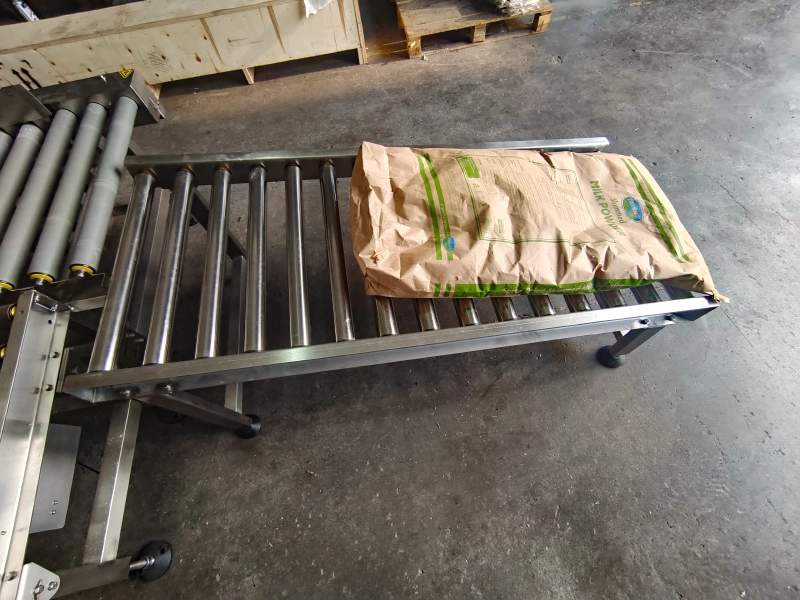
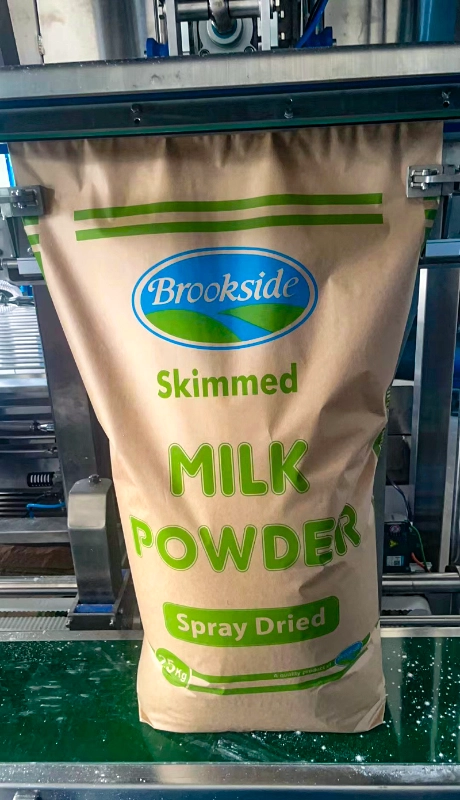
    Stainless steel roller conveyor carrying a kraft paper flour bag at the transfer stage of a flour bagging line

    Where a 25 kg flour bag actually goes wrong

    Walk the dispatch floor of a flour mill and the sequence looks simple: empty bag, filling spout, conveyor, sewing head, pallet. What the layout drawing hides is the second of hesitation after the bag leaves the spout. Flour is not a plastic pellet. It holds entrained air, it settles after filling, and the column inside the bag shifts whenever the bag changes direction. On a line built only from a filler and an open belt conveyor, that shift lands on the operator. Someone stands at the end of the transfer, grabs the bag mouth, walks it straight and feeds it into the sewing head. When two bags arrive together, the queue stops. When the bag arrives skewed, the seam wanders.

    Plants that run this way usually buy a second filler when orders grow, then find the bottleneck did not move. The filler is measurable and therefore blamed; the handoff between filling and closure is invisible, so it stays manual. That is the gap a purpose-built flour bagging line is meant to close, and the first question is not capacity but how the bag is held after the weight is inside it.

    The one-metre problem

    Between the filling spout and the sewing head there are roughly three seconds in which a 25 kg flour bag can twist, slump or shed a corner. No weighing accuracy earlier in the line recovers a bag that reaches the sewing head out of square, and no operator works that station all shift without fatigue affecting the seam.

    Why Mipline suits flour, not just free-flowing powders

    Mipline was built around the physical behaviour of dry, air-retaining powders packed in industrial bags: dairy powder, flour, starch, gypsum-type fillers. The bag is taken from a magazine conveyor and clamped at the mouth, so the filler fills a bag that is already squared and supported instead of a bag an operator is holding open by hand. Filling runs bottom-up, which keeps the product column rising rather than falling, so the bag does not balloon at the shoulders and blow dust back through the spout.

    The transfer section is where this Mipline arrangement differs from a generic conveyor handoff. A twin-belt section with adjustable side guides carries the filled bag on both faces, holding the rectangle square, and hands it to a roller section before the sewing head. Between those stages there is a short settling run: the bag pauses long enough for air to leave the flour column, so the sewing head closes a firm bag mouth rather than a slack one. Operators still watch the line, but no longer hold it straight; the guides and the clamp alignment do that work, which is the difference between a two-person dispatch station and a one-person inspection station.

    What to check on the bag, not the brochure. Dust extraction at the spout, bag-mouth support during filling and settling time before closure decide whether a flour bag sews square far more than any nominal output figure. Ask for a trial on your own kraft or coated woven bag, filled to your declared 25 kg weight, and watch the last metre rather than the first.

    What the structure on site proves

    On an installed flour bagging line the evidence is visible without opening a manual. The bagging station is an enclosed stainless steel frame with blue inspection windows in the door panels, so the clamp, bag mouth and spout can be watched while the door stays shut. A bag magazine conveyor feeds the pickup station on the infeed side. A top access platform with guard rails sits over the station for maintenance of the spout and clamp. Pneumatic lines run to the pickup and clamp cylinders, and the control cabinet stands next to the station rather than in a separate room, which keeps a fault visible at the point where it happens.

    Downstream, the line reads as transfer hardware: green belt sections mated to stainless roller sections, each with adjustable side guides and leveling feet, joined by welded frames that keep the pass height consistent from the bagging station to the sewing head. That consistency is what stops a bag from dropping, bouncing and turning between stations. Anyone specifying a second line for a flour mill, bakery supply plant or starch processor can check the same visible points and stop asking the wrong question about filling speed.
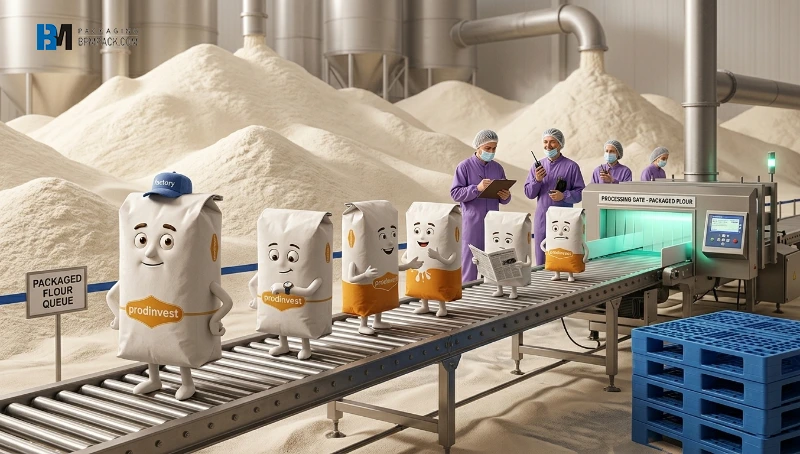
    3D render of an automated flour bag conveyor line inside a food processing factory
    Line stageWhat the station controlsFailure it removes
    Bag magazine and pickupBag taken from the magazine conveyor and squared before it is openedDouble picks, crushed bag mouths, bags opened by hand
    Clamp-held fillingBag mouth clamped under the spout, product delivered bottom-upBallooning shoulders, dust blowback, corner splits
    Settling runShort pause after filling so air leaves the flour columnSlack bag folding under the sewing head
    Guided transferTwin-belt section with adjustable guides, then roller conveyorTwisted bags and manual straightening at the last metre
    InspectionIn-line weight check, with metal detection where the plant specifies itOff-weight bags reaching the pallet
    Closure handoffBag mouth presented square to sewing or sealingWandering seams, open seams, reject pile at the head
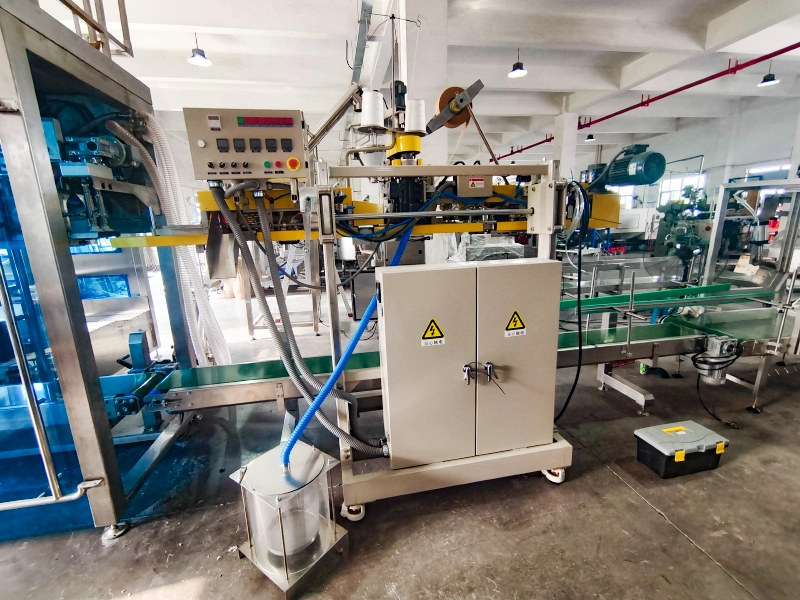
    Factory shot of a Mipline bagging station with conveyor, control cabinet and vacuum hose on a powder bagging line

    The result on the floor is a dispatch station that one operator can supervise instead of two operators feeding. Seam quality stops depending on who is standing at the head, bags reach the pallet square enough to stack, and flour dust stays inside the enclosed station instead of settling on the frame and the floor. For a mill weighing the cost of the last metre against the cost of a rebuild, that is the part worth measuring first — and the related layouts for clean bag handoff before sewing and milk powder bag mouth control show the same logic on other powders.

    Specify the handoff, then the output

    Send one empty bag and one filled bag from your own production, with the declared weight and the sewing or sealing method you already use. We will quote a Mipline flour bagging line around that bag format rather than around a catalogue figure.

    Send your bag sample
  • Protein Powder Packaging Line: Keeping 25 kg Bags Square

    Protein Powder Packaging Line: Keeping 25 kg Bags Square

    Protein & Dairy Powder · 25 kg Industrial Bags

    Protein Powder Packaging Line: Keeping 25 kg Bags Square Before Sewing

    A sports-nutrition plant packing bulk whey into 25 kg kraft bags rarely loses output at the filler. It loses it in the last metre, where a soft, aerated bag has to reach the sewing head straight. This walk-through follows a protein powder packaging line from clamp-held filling through guided transfer and in-line weight check, and shows which hardware keeps the bag square.

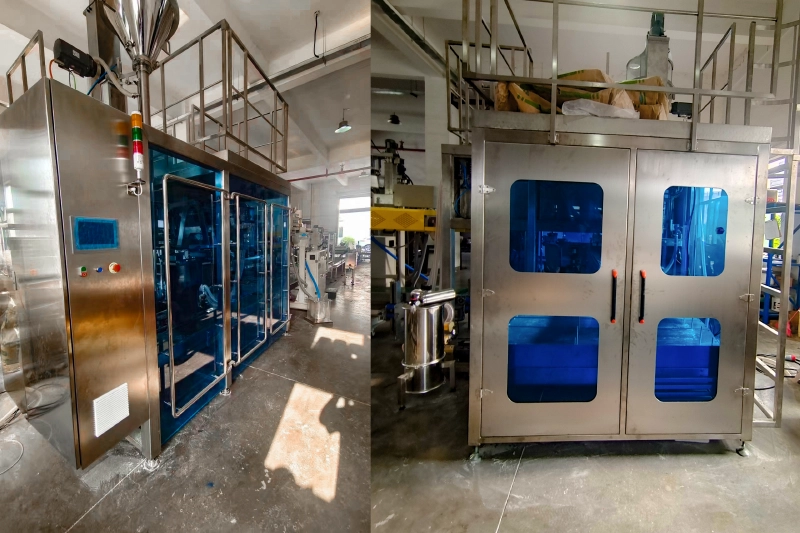
    Stainless steel protein powder packaging line enclosure with blue inspection windows, hinged doors and top maintenance platform

    Where protein powder costs you the last metre

    Protein blends do not behave like salt or sugar in the same bag format. Whey concentrate, isolate, collagen and plant-protein blends are light for their volume, they hold air after dosing, and they are hygroscopic enough to cake on any surface that stays damp. A 25 kg kraft bag filled with that material is not a rigid block. It is a soft column with a mouth that wants to close on itself.

    In a manual layout the sequence is always the same. One operator holds the bag mouth under the spout, a second carries the filled bag to the sewing head, and a third straightens the mouth at the last metre. When the pace rises, the mouth arrives at an angle, the sewing head drags the paper instead of guiding it, the seam wanders, and the rejected bag is cut open and reworked. The real cost is not the rework. It is that the throughput of the line is set by the slowest pair of hands in that metre.

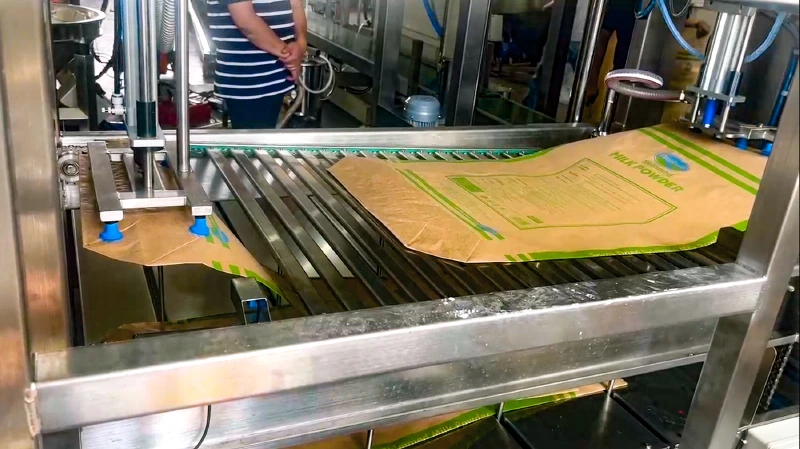
    Roller conveyor with vacuum grippers lifting a kraft paper protein powder bag on a 25 kg powder packaging line
    The sewing head rarely fails because it is worn. It fails because the bag mouth arrives skewed.

    Every 25 kg bag that has to be straightened by hand on the belt is a bag the machine did not control — and on a night shift, that hand is also the most expensive component of the line.

    Holding the bag instead of chasing it

    On a Mipline powder packaging line the bag is the fixture, not the payload. Kraft paper or coated woven bags are lifted from a bag magazine conveyor and presented to an enclosed stainless steel bagging station, where the clamp takes the mouth and holds it square for the whole filling cycle. Because the mouth is fixed, filling runs from the base upward: the powder builds a column from the bottom instead of dropping into an empty bag and ballooning the paper outward.

    The enclosure is doing real work. Full-height stainless panels and hinged doors with blue inspection windows keep the operator out of the bag path while still allowing a visual check of the mouth, the clamp and the seam line. A top access platform and guardrail put maintenance above the machine instead of inside it, and the control cabinet stands outside the dusty zone. For a protein plant that matters twice: fine powder that escapes the bag does not migrate into the drive area, and the operators can confirm bag position without leaning into the frame.

    Transfer, settling and the sewing handoff

    Between filling and closing, the bag has to be carried rather than handed over. On this powder packaging line the transfer runs on a twin-belt conveyor with adjustable side guides, feeding roller conveyor modules at both ends, so the bag body is supported on both flanks while it moves. The guides are set to the bag width, which stops the column from rotating, and the roller sections carry the load between driven belts so a 25 kg bag crosses a gap instead of slumping into it.

    Then come the two steps most manual layouts skip. The bag is weighed in line on a conveyor weighing platform, so an underfilled bag is caught before the mouth closes rather than after palletising. And it is given settling length — a few metres of guided conveyor — so the aerated protein column comes down before the seam is made. A bag sewn while the powder is still airborne looks full on the belt and looks soft on the pallet a shift later.

    Conveyor weighing platform module with adjustable support frame for in-line weight check on a powder packaging line

    What each station does to the bag

    The table maps the hardware you can see on this powder packaging line to the job it performs on the bag. It is the part worth arguing about in a technical review, because it is where a quotation stops being a list of machines and becomes a sequence.

    StationJob on the bagVisible hardware
    Bag pickupKraft bag lifted from the magazine, mouth opened and squared before fillingRoller conveyor with vacuum grippers, bag magazine conveyor
    Clamp fillingMouth held at a fixed height while powder builds from the base upwardEnclosed stainless bagging station with blue inspection windows
    SettlingAerated column allowed to come down before closureGuided belt length between filling and closing
    TransferBag carried on both flanks with no rotation between modulesTwin-belt transfer conveyor with adjustable side guides
    Weight checkBag weighed without leaving the conveyorConveyor weighing platform with adjustable support frame
    Sewing handoffMouth arrives aligned, at the height the sewing head expectsGuided handoff before the sewing head

    The result on the dispatch floor

    On a powder packaging line the change that shows up first is not top speed, it is the number of bags that reach the pallet untouched. When the mouth is clamped, the transfer is guided and the weight is checked before closing, three things stop at once: manual straightening disappears from the job description, the sewing head stops chasing a moving seam, and the pallet stack stops leaning because every bag lands square.

    Format change is where the same hardware has to earn its keep. Going from a 20 kg to a 25 kg protein format is done at the side guides and the clamp, not by rebuilding the line, and the inspection windows let an operator confirm the bag is seated correctly after the change instead of running a scrap bag to find out. The same handoff logic is written up for a flour bagging line and for a milk powder packaging line, because the failure mode is shared: the bag, not the filler, decides the seam.

    What we ask for first: send the bag, the fill weight and a note on how the powder behaves in a hopper. Two bags of the same size run differently if one is laminated and the other is plain kraft, and the guides, clamp height and settling length are all set from that sample.

    Send your bag and your fill weight

    Tell us the bag format, the protein type (whey concentrate, isolate or blend) and the target bags per minute. You get a layout proposal with the clamp, transfer and closure stations drawn around your bag, plus a straight answer on where a powder packaging line for your format differs from a dairy or flour line.

    Request a line review
  • Milk Powder Bagging Line: Clean Bag Mouth Before Sewing

    Milk Powder Bagging Line: Clean Bag Mouth Before Sewing

    25 kg dry powder bagging

    Milk Powder Bagging Line: Clean Bag Mouth Before Sewing

    Most 25 kg milk powder bagging line problems start at the last metre, not at the weighing hopper. The bag is already full, heavy and dusted with fine powder when it reaches the sewing head. Mipline is built around that handoff: bag magazine and clamp, bottom-up filling, guided roller and twin-belt transfer, settling and shaping, then metal detection and checkweighing before the bag leaves the cell.

    Enclosed stainless steel milk powder bagging line with safety doors, control cabinet and conveyor interface for 25 kg bags

    Where a full 25 kg dry milk bag loses its shape

    Dry milk is fine, hygroscopic and slow to settle, so the bag shape is decided long before the pallet. In many dairy plants the 25 kg kraft paper or paper-plastic composite bag is still started by hand: an operator lifts it from the stack, opens the mouth, holds it under the spout and squares it after filling. Filling ends and control of the bag ends with it. The bag leaves the fill point with a folded gusset, powder on the seam area and a mouth that is no longer parallel to the sewing head. On a milk powder bagging line that is not cosmetic. A skewed mouth gives a wandering seam, a dusty mouth gives a weak seal, and both end up in the reject bin with the weight already paid for.

    Mipline treats bag supply, opening and clamping as part of the filling process rather than a manual pre-step. A bag magazine conveyor feeds the stack, vacuum pickup opens the bag at the top, and clamp points hold it square while a lifting platform follows the fill level, so the screw outlet stays close to the powder surface. Fast, medium and slow screw stages trim the weight at the end of the fill instead of at the weigher, and dust removal plus trimming at the mouth follow before the bag is released to transfer. The same logic is described in the bottom-up filling and dust control configuration.

    Kraft paper dry milk bag held square at an automatic bag clamp station, seam area kept clear for sewing
    The fault at the sewing head is usually made three metres earlier

    A twisted or dusty bag mouth is rarely a sewing head problem. It comes from an uncontrolled handoff: the bag is released off-square, runs on a belt without side guides and arrives with the gusset folded inward. At 25 kg, correcting it by hand is a lifting risk and a new dust source at the seam at the same time.

    Why the last transfer decides the seam, not the filler

    Filling accuracy gets the attention in the quotation, but on a milk powder bagging line the transfer decides whether that accuracy survives to the pallet. Roller sections and twin-belt transfer conveyors carry the closed bag at a fixed height with adjustable side guides on both faces, so the bag cannot rotate between the clamp and the sewing head. Straight is also what the downstream stations need. A settling conveyor gives the powder time to move inside the bag, a shaping section presses the bag to a repeatable profile, and the metal detector then sees a stable window instead of a bag that changes shape as it passes. The same handoff principle is worked through for flour bags before the sewing head.

    Conveying references from the Mipline line build: a 5,000 mm PVC belt at 10 m/min and 0.75 kW, a 3,000 mm settling conveyor 600 mm wide at 15 m/min, and a 1,500 mm shaping section with a 600 mm belt running at the same speed. Guides are adjustable in height and width, so one section accepts a different bag gusset without rebuilding the line, and emergency stop boxes sit at the operating positions rather than only at the main cabinet. On an enclosed station the operator sets the guides through the blue inspection windows and checks the bag path without opening the guard.

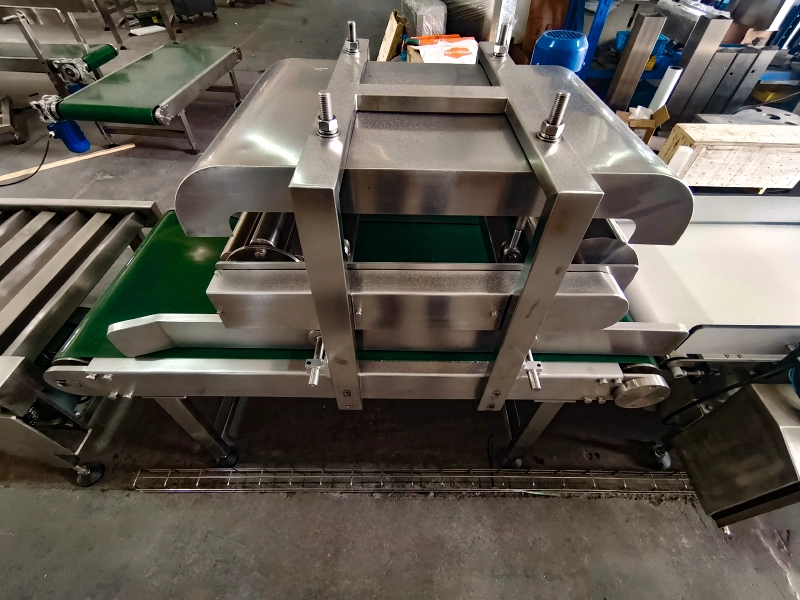
    Stainless steel twin-belt transfer conveyor with adjustable side guides keeping 25 kg bags aligned before sewing

    Field note: measure from the clamp release point to the first pair of guide rails. If that gap is longer than the bag length, the bag has room to rotate before anything corrects it, and no sewing-head adjustment will recover the seam.

    Specify the bag first, then the machine

    No quotation for a milk powder bagging line is meaningful before the bag itself is measured. Length, width and gusset decide the magazine, the opening cups and the clamp stroke. Bag construction decides the closure: a paper-plastic composite with an inner liner needs dust removal, trimming, inner heat sealing, pressing, sewing and often a hot-melt paper tape, while a plain sewn kraft bag needs a different sequence at the same station. Powder behaviour decides the fill, because bulk density, flowability, moisture content and how much air the material holds after conveying all change the dosing profile.

    The reference layout below is a 25 kg dairy powder build. Throughput, stated accuracy and residual oxygen are configuration values, not universal promises: they are confirmed against the bag sample and the material test, and they move when the bag, the closure or the target weight changes.

    SpecificationMipline referenceConsequence for the bag
    Bag weight25 kg industrial powder bags; DS25K reference covers 5–25 kgSets magazine size, clamp stroke and platform travel per project
    Fill methodVertical screw feed with bottom-up lifting platform, fast / medium / slow stagesFill point stays near the powder surface, so less dust reaches the mouth
    Stated accuracy≤ ±0.1–0.2% on the referenced 25 kg configurationConfirm on a bag sample before the figure enters a contract
    Closure pathDust removal, trimming, inner heat sealing, pressing, sewing, hot-melt paper tape, final pressingSeam area is cleaned and protected before the sewing head, not after it
    TransferRoller conveyor and twin-belt sections with height and width adjustable guidesBag stays square from clamp release to sewing head
    Settling and shaping3,000 mm settling conveyor and 1,500 mm shaping section, 600 mm belts at 15 m/minPowder settles and the bag takes a repeatable profile
    InspectionMetal detection window 600 × 230 mm at 28 m/min; checkweigher per project datasheetReject decision is taken on the finished, closed bag
    Body and accessSUS304 body, enclosed guarding, blue inspection windows, top platform and ladderCleaning and maintenance without breaking the process line

    That list is also the budget. Bagging station, closure module, transfer sections and inspection equipment are priced as one line because they are commissioned as one line; buying the filler alone and adding conveyors later is exactly what produces the manual straightening this milk powder bagging line is designed to remove.

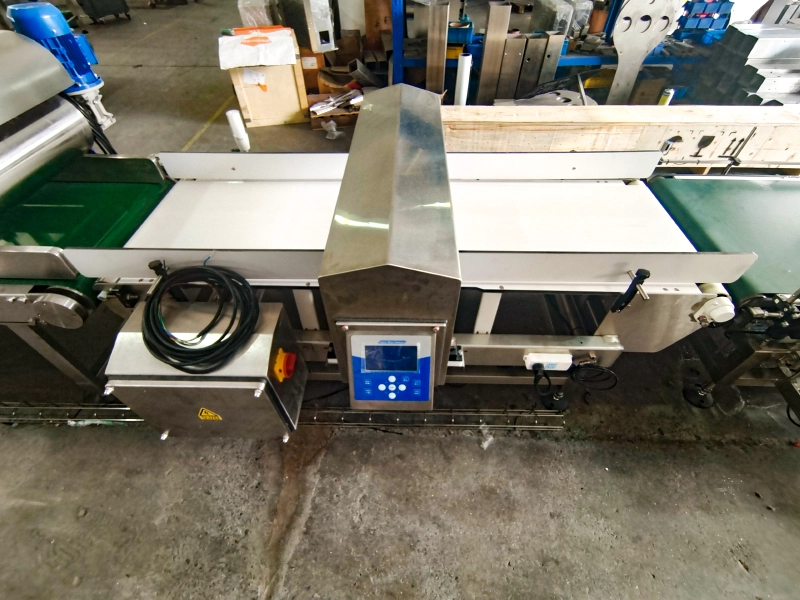
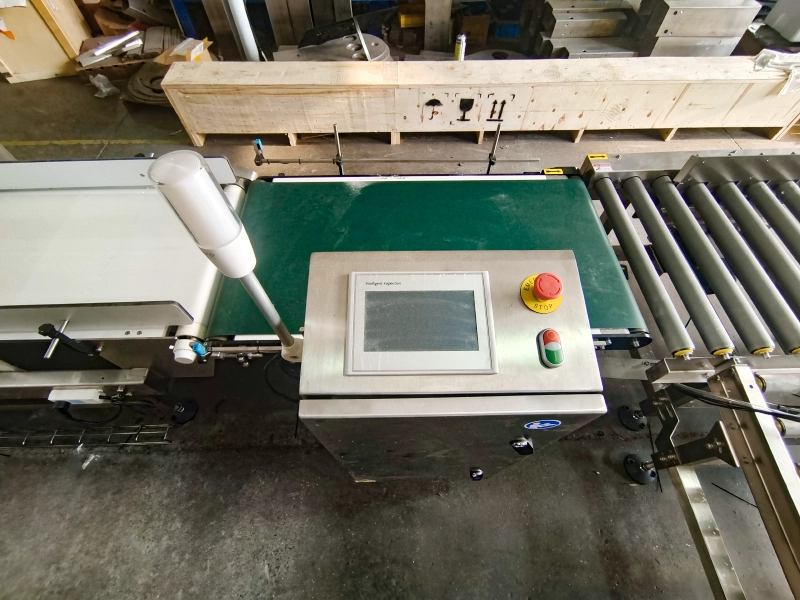
    Conveyor line with touch-screen control box, emergency stop and roller transfer sections feeding bag inspection

    Send the bag, the weight and the closure

    For a dairy or dry milk project the fastest route to a usable proposal is a bag sample with its dimensions, target weight, throughput and the closure method your buyers already accept. Send those four items with the site layout, and the milk powder bagging line is quoted station by station against your own bag instead of a catalogue format.

    Request a project review
  • 1 kg Gypsum Powder Packaging Machine: Beige Plaster Bags

    1 kg Gypsum Powder Packaging Machine: Beige Plaster Bags

    Powder bagging · 1 kg retail format

    1 kg Gypsum Powder Packaging Machine: Beige Plaster in Kraft Bags

    Gypsum powder is cheap to produce and expensive to pack. A 1 kg gypsum powder packaging machine runs beige plaster and putty into premade M-fold kraft bags: flat bag pickup, opening, auger dosing under dust extraction, vibration settling, M-fold reforming, edge trim, hot-melt dot or line glue and top press. The walk-through below follows one retail programme, station by station.

    Clean full-line view of a 1 kg gypsum powder packaging machine with paper bag bagging unit, dosing system and outfeed conveyor

    Where a 1 kg beige gypsum bag fails before it reaches the shelf

    A plaster producer we quote for sells beige gypsum in printed 1 kg kraft bags for touch-up and small repair work. The manual line has not changed for years: an operator takes a flat bag from a stack, opens the mouth against a spout, holds it with one hand, steps the pedal and watches the scale. Nothing in that motion controls the bag mouth. Fine beige gypsum leaves the spout at speed, the paper mouth takes a dust coat, and a second operator closes the bag by folding the M gusset by hand and running it over a glue pot. On a beige kraft surface the dust marks show in daylight, so cosmetic rejects are added to the weight rejects.

    The failure pattern is predictable. Filling weight drifts because a cup or a timer cannot follow bulk density changes between silo batches. Bag shape collapses because a 1 kg premade M-fold bag keeps its block shape only if it is opened square and re-formed after filling. The seam opens because hot-melt glue will not bond to a paper surface carrying powder. And throughput depends on how fast a person repeats the same four actions, which is where the second and third shifts become expensive. A 1 kg gypsum powder packaging machine is bought to remove those four dependencies, not to add a faster spout.

    1 kg gypsum powder packaging machine line with main bagging machine, upper dosing structure and conveyor platform
    The bag mouth, not the filler, decides your reject rate

    On fine powders the cost sits between the dosing spout and the glue seam. Dust on the paper, an unopened gusset or a bag leaning a few millimetres out of square will fail the checkweigher, the carton or the pallet long after the weight itself was correct.

    Why the 1 kg gypsum powder packaging machine is built around a premade M-fold bag

    Zpacker is a twin-station in-line machine for premade paper and paper-plastic bags. Two bag magazines feed flat M-fold flat-bottom bags that are picked, opened into a three-dimensional block and clamped under the dosing head. The 1–2 kg specification covers bags 80 to 140 mm wide and 240 to 320 mm long with a 60 to 80 mm M gusset; the 2.5–5 kg specification uses the same architecture for larger formats. Because the bag is finished before it enters the machine, the printed brand panel, barrier layer and retail look are already fixed by your bag supplier, and the machine’s job is to dose, settle, re-form and close without damaging them. That is also the practical difference from a vertical form-fill-seal unit, which makes the bag from roll film on the same frame: if your 1 kg beige gypsum bag is already printed, glued and approved by the retail chain, a premade bag platform is the shorter route. The trade-off is bag handling, and that is exactly what the twin stations are for.

    Dust is handled in the layout rather than at the end of the line. The filling station is fitted with extraction, and the bag then passes several vibrating and dust-extraction positions that settle the powder, release air and firm the block before the M gusset is folded back. Trimming and edge rolling follow, then hot-melt glue is applied by dot or line, and the top is pressed. Sequence matters for beige gypsum: the powder is dense and marks easily, so a bag that is settled and squared at the filling stage arrives at the trimmer straight, and the seam stays clean enough for the glue to hold. See how the same settling logic is applied on a flour packing machine with dust capture at the bag mouth.

    Field note: Gypsum is not flour. Bulk density, abrasion and the tendency to cake differ between batches, so we quote a 1 kg gypsum powder packaging machine only after a bag sample and a material test. The same rule applies to paper-plastic bags: the bond between paper and film has to survive the M-fold and the glue, or the seam opens in the carton.

    Close view of the 1 kg gypsum powder packaging machine bag feeding and opening station with kraft bags, clamps and touchscreen

    The numbers behind a 1 kg gypsum powder packaging machine

    Use the table as a filter, not as a promise. Output on the 1–2 kg specification is listed at roughly 30 to 35 bags per minute, while walk-through notes for the same frame record about 40 to 50 bags per minute at 1 kg and 30 to 35 at 2 kg; the difference comes from material flow, feed capacity, bag size and how the glue station is timed. Weight accuracy is stated at about ±0.5%, which is what a 1 kg retail bag needs to stay inside legal tolerance without systematic giveaway. Every figure below is confirmed on the final technical scheme and on the acceptance run, not on a brochure.

    ParameterPublished valueWhat it decides on a 1 kg beige gypsum bag
    Machine typeTwin-station in-line machine for premade paper and paper-plastic bagsRetail bag design stays with your bag supplier
    Weight range1–2 kg specification; 2.5–5 kg specification on the same architecture1 kg retail bags plus 2 kg and 5 kg SKUs
    Bag dimensionsWidth 80–140 mm, length 240–320 mm, M gusset 60–80 mmVerified against your printed bag sample
    Output, 1–2 kg specAbout 30–35 bags/min in the technical table; about 40–50 bags/min at 1 kg in walk-through notesMaterial flow, feed and glue timing set the real rate
    Weight accuracyAbout ±0.5%Legal tolerance without giveaway
    Dust controlExtraction at the filling station plus multi-position vibrating and dust stationsClean glue seam on beige paper
    ClosureHot-melt glue, dot or line spray, then top pressPaper is glued, not heat sealed
    Contact material304 stainless steel contact and exposed parts; powder-coated carbon steel frameMineral powder duty and daily cleaning
    Control10.4-inch touchscreen, Siemens PLCRecipe change and fault access for the operator
    Air and power0.6–0.8 MPa, about 0.76 m³/min; 15.5 kW at 380 V ±10%, 50 HzUtility capacity before the machine arrives
    Machine weightAbout 3000 kgFloor loading and rigging plan

    Two more conditions decide whether a 1 kg gypsum powder packaging machine runs as drawn. First, air: the machine works on 0.6–0.8 MPa at roughly 0.76 m³/min, so a dedicated supply and dryer belong in the project, not in a later retrofit. Second, space: the reference layout discussed for a full line is about 17 m long and 3.6 m wide including feeding, checkweighing, metal detection, coding and secondary packing. That is a layout reference only and is replaced by a CAD drawing against your hall. The downstream stations are not decoration on a gypsum line: a checkweigher rejects the 1 kg bag that drifted, a metal detector removes the foreign body before it reaches the retail carton, and a coder keeps the batch legible on a beige printed panel.

    With those stations in one line, the result on a beige gypsum programme is a 1 kg bag that leaves the machine square, settled and glue-sealed, weighed and checked before it is packed. One operator supervises instead of four people handling bags, and the dust that used to settle on the printed panel stays inside the extraction system. The same frame covers the 2 kg twin-station format described in our 2 kg flour bag packaging machine reference, and the general format logic is set out in the 1–5 kg paper bag packing machine guide.

    Side detail of the premade paper bag mechanism in a 1 kg gypsum powder packaging machine with bag magazine and air lines

    Send a 1 kg beige gypsum bag before you sign

    The fastest way to size this line is a bag sample plus three numbers: bulk density, target bags per minute and the retail weight tolerance your market enforces. BPMpack checks the bag against the 1–2 kg specification, proposes the dosing, dust and closure stations, and returns a scheme with speeds and acceptance conditions written down.

    Send your bag sample
  • Paper Bag Packing Machine for 1–5 kg Flour Bags

    Paper Bag Packing Machine for 1–5 kg Flour Bags

    Flour and powder packaging

    Paper Bag Packing Machine for 1–5 kg Flour Bags

    A paper bag packing machine only earns its place when it matches the bag your retail buyers already accept. This walk-through covers what a premade M-fold paper bag line has to do between 1 kg and 5 kg — bag pickup, clamp-held auger dosing, dust extraction, glue closure, checkweighing — and where semi-automatic filling and roll-film machines stop fitting.

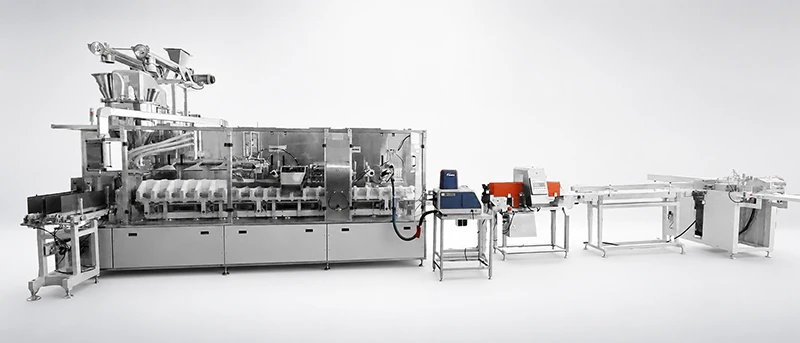
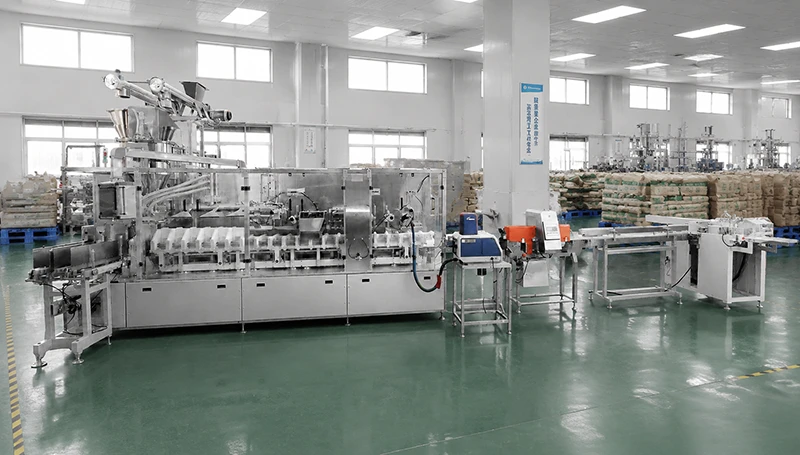
    Wide bright workshop view of zpacker full packaging line with horizontal bagging machine, upper feeding system, conveyor, and bag handling area

    Where semi-automatic filling and roll-film bagging stop matching the bag

    Most flour plants that ask us for a quote are running one of two older routes. The first is a semi-automatic filler: an operator lifts the empty kraft bag onto the spout, holds it through the whole auger cycle, then carries it to a separate seamer. Output depends on the operator’s arms rather than on the dosing system, and the dust that escapes at the bag mouth settles exactly on the seam area the next station has to bond.

    The second route is a vertical form-fill-seal machine running roll film. It is fast and it is cheap per bag, but it makes a pillow or fin-seal pack. When the shelf and the customer’s own print artwork call for a flat-bottom M-fold paper bag with a folded side gusset, roll film cannot produce it, and no downstream gadget converts one format into the other. That is the gap a premade paper bag packing machine is built for: the bag is finished before the machine ever sees it, so the machine’s job is to open, fill and close a known shape instead of creating one.

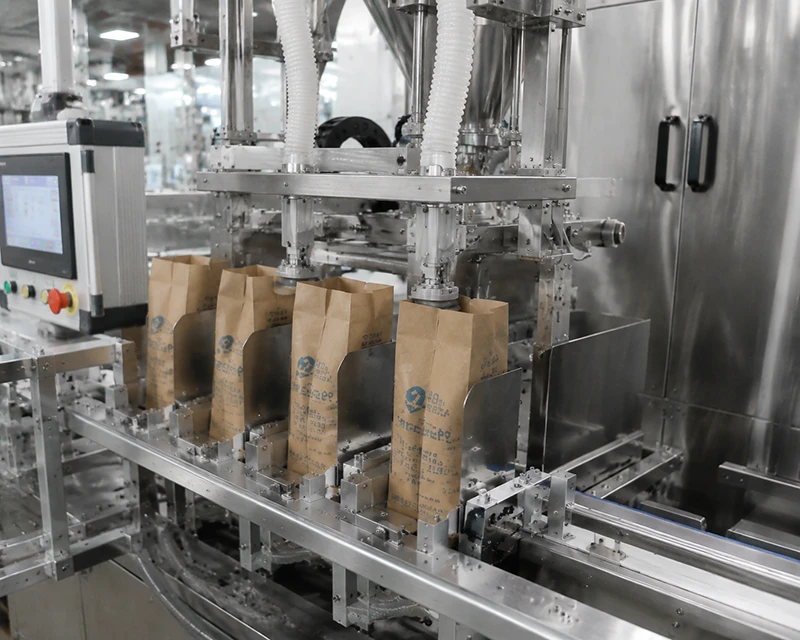
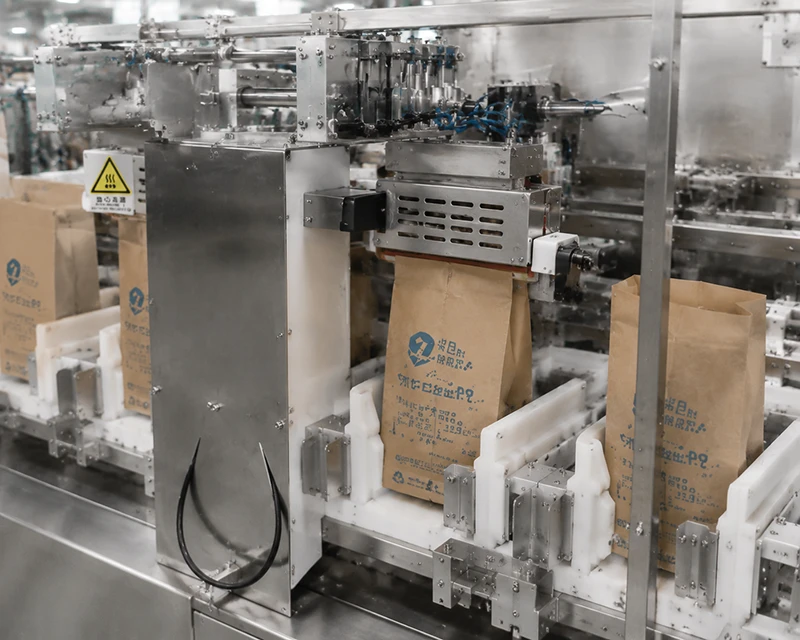
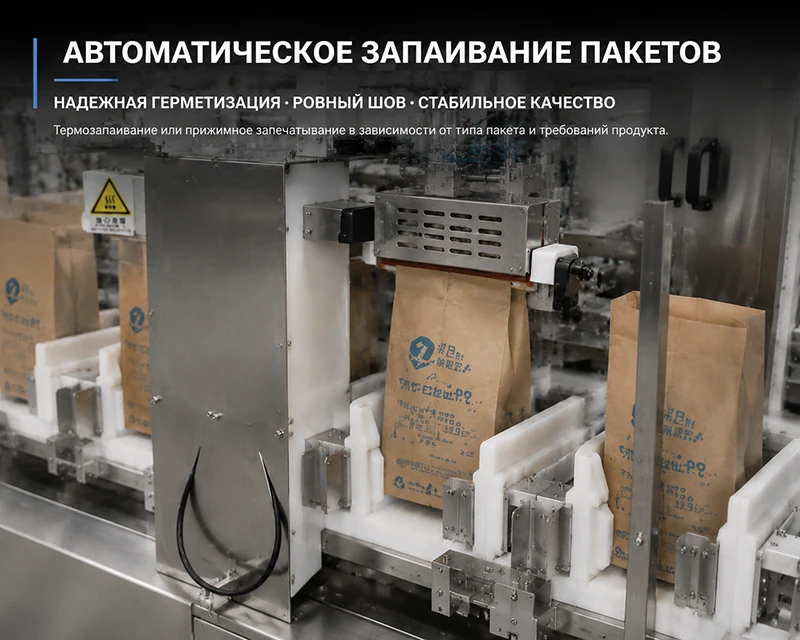
    Russian annotated image of zpacker automatic paper bag filling station with vertical mechanism, warning label, bag clamp, and filling area
    What the filling station quietly costs

    Flour that leaves the bag mouth is charged twice: once as lost material and cleaning time, and again as weight drift when the dose is corrected by eye. On a paper bag it is worse, because airborne dust lands on the glue line that has to hold the folded top shut.

    Why a premade design suits M-fold retail bags

    The Zpacker runs two bag stations on a linear frame. Belt feed carries each premade M-fold flat-bottom bag out of the magazine; the bag is picked, opened into a three-dimensional pouch, clamped under the dosing head and filled by twin vertical augers. From there the same machine vibrates and extracts dust at several positions, folds the M gusset back, trims the mouth, rolls the edge, applies hot-melt glue as dots or as a line, and presses the top closed. One paper bag packing machine therefore covers the pick, the open, the fill, the settle, the fold and the seal — the six operations that a semi-automatic line splits between an operator and two standalone units. The flat M-fold bag that leaves the press is the same bag the artwork was approved for, only standing up and closed.

    Dust control is designed into that sequence rather than bolted on afterwards: extraction sits at the filling position and again at the vibration stations, so the material settles before the gusset is folded and the glue is applied. The machine also refuses to work blind — with no bag in position it does not open, fill or seal, and it alarms on air-pressure loss, an opened guard, main motor or inverter faults, and abnormal glue temperature. For plants already running kraft bags, the same platform can be specified around the bag sample you send, as shown on the 1–5 kg kraft bag line page.

    Field note: paper-plastic laminate bags are not kraft bags with a coating. The paper layer and the film layer have to stay bonded through the fold, the trim and the press, and the glue has to grip the outer layer that is actually there. Test the real bag sample before the quotation instead of assuming the settings that close a 2 kg kraft bag will close a laminated 5 kg bag.

    Specifications that decide the line layout

    Two Zpacker formats cover the retail range: one for 1–2 kg and one for 2.5–5 kg. Sizing a paper bag packing machine starts with the bag drawing, not with the tonnage you want to ship — bag width, bag length and M-gusset depth decide whether a bag can be opened, clamped and folded at all on a given frame. The reference figures below come from the technical proposal; speed, air pressure and gusset examples vary between versions, so the signed specification and the bag test govern.

    The frame carries 304 stainless steel on product-contact and exposed parts, with a powder-coated carbon steel main frame and anodised aluminium in places, a 10.4 inch touchscreen, and 15.5 kW of connected load at 380 V ±10%, 50 Hz. Downstream, the same line can continue into a checkweigher and metal detector, a date coder, bag collation, and either shrink-wrapped multi-packs or manual outer-bagging; a 17 m by 3.6 m footprint is a layout discussion point, not a fixed drawing. Second-shift output on the 2 kg format is covered in more detail on the twin-station 2 kg page.

    Item1–2 kg format2.5–5 kg format
    Bag typePremade M-fold flat-bottom paper or paper-plastic bagPremade M-fold flat-bottom bag, bag sample to confirm
    Retail weights1 kg and 2 kg2.5–5 kg, commonly 5 kg
    Reference speedApprox. 30–35 bags/minApprox. 15–20 bags/min
    DosingTwin-station vertical auger, approx. ±0.5%Twin-station vertical auger, approx. ±0.5%
    Bag size referenceW 80–140 mm, L 240–320 mm, M gusset 60–80 mmSame range, to be confirmed on the bag drawing
    ClosureHot-melt glue dots or line, then top pressHot-melt glue dots or line, then top press
    Air and powerApprox. 0.6 MPa, 0.76 m³/min; 15.5 kWSame, pressure per final configuration
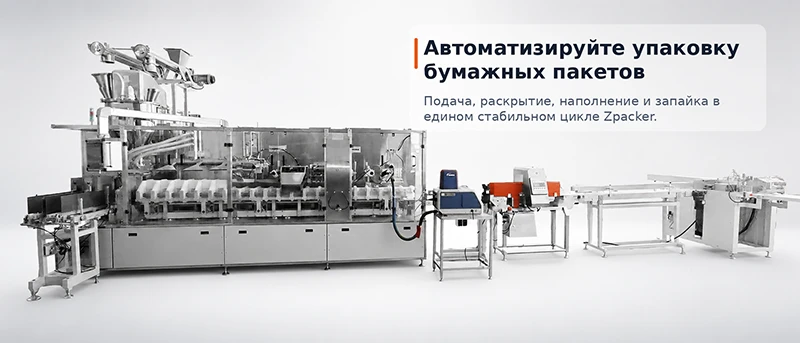
    Russian infographic view of zpacker horizontal automatic paper bag packaging machine with touchscreen, conveyor, and feature callouts

    Quote the line from the bag, not from the brochure

    Send the bag drawing or a physical sample, the target weight range and the output you need per shift. Our engineers will confirm which paper bag packing machine format covers your sizes, which stations the dust and closure sequence needs, and what the layout looks like on your floor.

    Send your bag sample
  • Flour Packing Machine: Dust Capture at the Bag Mouth

    Flour Packing Machine: Dust Capture at the Bag Mouth

    Flour milling and bakery · premade paper bags

    Flour Packing Machine: Dust Capture at the Bag Mouth

    Retail flour leaves a mill in a 1 kg, 2 kg or 5 kg kraft bag, and most quality complaints start at the bag mouth. A flour packing machine that extracts dust while the bag is held open, then closes that same bag with hot-melt glue, takes the operator away from the dosing spout and keeps weight, bag shape and glue line under control.

    Flour packing machine line in a bright workshop with horizontal paper bag bagging unit, upper feeding system, outfeed conveyor, and kraft bag handling area

    Where hand-filled flour bags fail

    Picture a mill or a bakery running three retail sizes on the same floor: 1 kg for small shops, 2 kg for families, 5 kg for bulk buyers. In a manual or semi-automatic setup, an operator lifts each flat kraft bag, opens it by hand, holds it under the dosing spout, watches the scale, then folds the M gusset, trims the top, applies glue and presses the seam. Every one of those actions depends on the same pair of hands, and every one of them leaves a small variation behind.

    The dust is the first problem. Flour leaves the spout as an aerated stream, and the open bag mouth is the only place it can escape. Dust settles on the glue area, on the outside of the bag and on the sealing jaw, so the seam that should be flat becomes a glued dust layer that opens later in the pallet. The second problem is weight: a person judging the end of the fill cycle tends to stop the stream early, which is why checkweigher rejects climb at the end of a shift. The third problem is shape. An M-gusset bag that has been opened and filled by hand rarely folds back to a square block, and a bag that is not square stacks badly and jams the case packer downstream. A semi-automatic filler keeps the human in the loop for exactly the steps that matter, so it does not remove any of these three failures.

    Flour packing machine main unit in a clean workshop with rotary horizontal bagging station, touchscreen, dosing structure, and outfeed conveyor
    The loss is concentrated in 40 cm of the line

    Between the bag magazine and the glue nozzle, an open flour bag loses product to the air, loses weight accuracy to the stop-start fill, and loses seal strength to dust on the fold. Fixing the last station only hides the first two.

    Inside the flour packing machine: from flat bag to glued block

    Zpacker is built as a dual-station linear machine for premade paper or paper-plastic bags, not as a form-fill-seal unit working from a roll. Two bag magazines feed flat M-gusset bags on a belt; each bag is picked by vacuum, opened into a three-dimensional shape, transferred to the filling station and clamped at the mouth. A vertical screw doser fills the bag while the clamp holds it, and dust extraction works at the filling position rather than somewhere downstream. After filling, the bag passes vibrating and dust-extraction positions that settle the product and let air out, then the M gusset is folded back, the top edge is trimmed, the fold is rolled, hot-melt glue is applied as spots or a line, and a top press closes the bag into the square block that retail shelves and case packers expect.

    The two stations are what make continuous output possible. When one lane runs out of bags, that lane stops and alarms while the other lane keeps packing, so the line does not have to be emptied and restarted. The same interlock logic blocks opening, filling and sealing when no bag is present, and the machine stops on air-pressure faults, open safety guards, main motor or inverter faults, and abnormal glue temperature. In practice the operator becomes a supervisor of bag magazines and glue, not a person holding a bag under a stream of flour.

    Why glue instead of heat sealing. Kraft paper and paper-plastic laminates do not weld to themselves the way a PE film does. Hot-melt spot or line application on a trimmed, rolled fold gives a mechanical bond that survives the fold geometry, which is why the machine trims and rolls the top edge before the nozzle fires. If a paper-plastic bag is used, the bond between paper layer and film has to be confirmed with the bag supplier first; a delaminating laminate will fail at the fold no matter how the glue is set.

    Specifications that decide output and bag fit

    Zpacker is quoted in two size classes so that one machine family covers a retail flour range without rebuilding the line for every SKU. The reference figures below come from the technical proposal; final speed, air pressure and gusset dimensions are fixed against the customer bag sample and acceptance conditions, because flour density, feed consistency and site conditions move the real number.

    Item1–2 kg configuration2.5–5 kg configuration
    Reference outputapprox. 30–35 bags/minapprox. 15–20 bags/min
    Filling accuracyapprox. ±0.5%approx. ±0.5%
    Bag width80–140 mm80–140 mm
    Bag length240–320 mm240–320 mm
    Side gusset (M fold)approx. 60–80 mmapprox. 60–80 mm
    Bag typepremade kraft or paper-plastic, flat-bottom M gussetpremade kraft or paper-plastic, flat-bottom M gusset
    Closinghot-melt spot or line glue plus top presshot-melt spot or line glue plus top press
    Control10.4 in touchscreen with PLC10.4 in touchscreen with PLC
    Power and mass15.5 kW, 380 V / 50 Hz, approx. 3000 kg15.5 kW, 380 V / 50 Hz, approx. 3000 kg

    Product-contact and exposed parts are 304 stainless steel, while the main frame is a coated carbon steel structure with anodised aluminium sections in places. That combination matters on a flour floor: the surfaces that meet food are cleanable, and the frame still carries the mass of a machine that runs two filling stations without walking. Pneumatic circuits, low-voltage components and bearings are specified in the BOM, so the brand list should be confirmed on the final quotation rather than assumed from a brochure.

    Flour packing machine on a factory floor with blue touchscreen control, upper hopper and piping, and surrounding production line

    What to send before a quote on a flour packing machine

    Flour is not a single material. Bread flour, cake flour and wholemeal behave differently in a screw doser and in a bag, and the dust load changes with extraction rate. The fastest way to a usable proposal is to send the material and the bag together, because the machine is configured around the pair.

    • Bag sample, ten pieces or more. The bag decides the magazine, the opening tooling and the gusset fold. Orientation matters: the printed front and back cannot be swapped, so the sample must show how the bag sits in the magazine.
    • Target weights and the size split. If the plan is 1 kg and 2 kg, the small class covers both; if 5 kg is in the range, the line needs the larger class or two machines. Mixing all three on one lane is a layout decision, not a software setting.
    • Flour specification. Bulk density, fat content, extraction rate and whether the product is sifted or wholemeal determine the screw diameter, the extraction points and the settling time.
    • Upstream supply. A screw conveyor or bucket elevator feeding the doser hopper has to match the machine’s consumption at peak output, otherwise the two lanes starve.
    • Air and power. Budget for roughly 0.6–0.8 MPa and about 0.76 m³/min of air at the reference figures, plus a 15.5 kW supply. The pressure is confirmed in the final technical proposal.
    • Downstream plan. A checkweigher and metal detector directly after the machine catch what the doser cannot, and the reject conveyor needs space before the case packer or shrink wrapper.
    • Floor space and layout. A full line runs around 17 m by 3.6 m in the reference discussion, but that is a planning figure and must be replaced by a CAD layout against the actual hall.

    What changes on the packing floor

    The visible change is that nobody holds a bag. The second change is quieter: because dust is pulled at the filling position and again at the settling positions, the glue area stays clean enough for the fold to bond, and because the doser closes on weight rather than on a person’s judgement, the checkweigher rejects less. Bags leave the top press as square blocks with a flat glued seam, which is what makes the downstream checkweigher, labeller and shrink wrapper behave predictably.

    If you are still comparing machine types, the useful distinction is bag supply, not speed: a vertical roll-fed machine makes its own bag from film, while this machine consumes premade kraft or paper-plastic bags and closes them with glue. Mills that already buy printed retail bags, and Russian retail formats built around 1 kg, 2 kg and 5 kg paper packs, are the cases where the premade route fits. For a closer look at the same platform in other weight classes, see the 2 kg twin-station paper bag line and the 1–5 kg kraft bag packaging machine.

    Operators monitoring a flour packing machine in a large workshop with control screen, automatic paper bag line, and bag handling area

    Send your bag sample, not just your weight range

    A flour packing machine is only correct when the bag, the flour and the target speed are tested together. Send a bag sample with its dimensions and gusset, the target weights and your hourly requirement, and the line will be quoted against your material instead of a catalogue number.

    Request a line proposal
  • Flour Bagging Machine: Dust-Controlled Kraft Bag Filling

    Flour Bagging Machine: Dust-Controlled Kraft Bag Filling

    Milling plant · 1–5 kg retail kraft bags

    Flour Bagging Machine: Dust-Controlled Kraft Bag Filling at 1–5 kg

    A flour bagging machine that runs premade kraft paper bags has one problem to settle before anything else: the powder has to stay inside the bag while the bag is open, filled, folded and glued. On a milling plant or bakery packing 1 kg, 2 kg and 5 kg retail flour bags, dust is not only a housekeeping cost — it lands on the M-fold panels and on the glue line, and that is where a bag comes out soft, slipping or leaking.

    Workshop view of the zpacker flour bagging machine with operator at the control screen, automatic paper bag packing line and material handling area

    What manual bag handling costs on a flour packing floor

    The traditional layout is simple: an operator lifts a flat bag from a stack, opens it by hand or with a short air blast, holds it under a dosing spout, then folds the M gusset and carries it to a separate gluing or sealing point. At retail rates the operator moves a bag every few seconds, and the bag is never held in the same position twice. Two operators on two shifts rarely produce the same bag twice either.

    The failures are predictable. The bag mouth stays open to the room while the auger doses, so fine flour leaves the bag and settles on the machine, the floor and the outside of the next bag. Powder on the top panels is what makes a hot-melt glue seam bond to flour instead of paper, and an open bag standing on a conveyor loses its square shape before it reaches the scale. A flour bagging machine earns its floor space only when it takes those three motions — holding, opening and settling — out of the operator’s hands.

    Wide workshop view of the flour paper bag packaging line with horizontal bagging machine, upper feeding system, outfeed conveyor and bag handling area
    Where the dust problem actually sits

    Dust is not a housekeeping complaint. Powder on the bag mouth and on the M-fold panels is what makes a glue seam fail, and a seam that fails on the pallet becomes a customer complaint at the shop shelf. Control the dust at the filling position and the seam becomes a paper-to-paper bond.

    How the fill, settle and glue chain is built

    Zpacker takes the bag from a flat blank to a closed retail pack in one straight line. Belt-type feeding draws the premade bag from two bag magazines; the bag is picked up, opened into a three-dimensional M-fold bottom bag and clamped under the dosing head. Screw dosing fills it at the filling station, where extraction is positioned to pull air and dust away from the open mouth. Behind that station the bag passes several vibration and extraction points that settle the powder and drive out air, then the M edge is folded back, trimmed, rolled, sprayed with hot-melt glue in dots or lines and pressed at the top. Material-contact parts are 304 stainless steel; the main frame is powder-coated carbon steel.

    A twin-station 2 kg layout is what makes the machine practical on a real floor. Two bag magazines and two pick-up and dosing positions work together, and the reference logic stops and alarms a station that has run out of bags while the other station keeps producing — final logic to be confirmed on the configured machine. The controller is a 10.4-inch touchscreen with a Siemens PLC as the reference configuration, and the safety chain is built around the bag: no bag, no opening, no filling, no sealing. Air-pressure, guard and glue-temperature faults stop the cycle with an alarm. That is the practical difference between a flour bagging machine and a filling head — the machine refuses to make a bag it cannot close.

    Close view of the automatic kraft paper bag feeding and opening station with bag clamps, stainless frame and touchscreen control

    Field note: Settling time is the hidden variable. The faster the dosing cycle, the less time the powder has to de-aerate, which is why the extraction at the filling position and the settling stations behind it decide seam quality more than the headline bag rate does. Run a bag trial on your own flour and your own kraft bag before you fix a cycle time.

    Specification check before you fix the bag size

    The reference specification is split in two: one machine size for 1–2 kg bags at roughly 30–35 bags per minute and a second for 2.5–5 kg bags at roughly 15–20 bags per minute, with weighing accuracy of about ±0.5%. Speed depends on flour flowability, feed capacity and the settling time you allow, so it belongs in the acceptance conditions rather than in a headline. Before a flour bagging machine is quoted, the bag itself has to be defined.

    Bag width 80–140 mm, bag length 240–320 mm and a side gusset around 60–80 mm are the reference window; a printed paper bag also has a front and a back, so bag direction must be fixed before the magazines are set. Closure is hot-melt glue, dot or line spray, then top press — not heat sealing, and paper-plastic laminates need the layer bond checked first. Air supply is quoted at 0.6 MPa or 0.6–0.8 MPa depending on configuration at about 0.76 m³/min; power is 15.5 kW at 380 V ±10%, 50 Hz, and the machine weighs about 3000 kg. Our 1–5 kg kraft bag reference walks the same sequence station by station.

    Reference parameterZpacker value
    Bag weight range1–2 kg specification / 2.5–5 kg specification
    Outputabout 30–35 bags/min (1–2 kg); about 15–20 bags/min (2.5–5 kg)
    Weighing accuracyabout ±0.5%
    Bag width / bag length80–140 mm / 240–320 mm
    Side gusset (M edge)about 60–80 mm, confirmed on the bag sample
    Bag materialpremade kraft paper or paper-plastic, M-fold flat bottom
    Closurehot-melt glue dot or line spray, then top press
    Material contact parts304 stainless steel
    Control10.4-inch touchscreen, Siemens PLC reference configuration
    Air / power0.6–0.8 MPa, about 0.76 m³/min / 15.5 kW, 380 V ±10%, 50 Hz
    Machine weightabout 3000 kg
    Clean workshop view of the horizontal paper bag packaging machine with rotary main unit, touchscreen, dosing structure and outfeed conveyor

    Send the bag, not just the weight

    A flour bagging machine is sized by the bag and the flour, not by a bag count per minute. Send one premade kraft bag, your target weight and your hourly requirement, and we will return the station layout, the extraction points and the line proposal behind it.

    Request a line layout
  • 2 kg Flour Bag Packaging Machine: Twin-Station Output for Retail Paper Bags

    2 kg Flour Bag Packaging Machine: Twin-Station Output for Retail Paper Bags

    Zpacker · premade paper bags · retail flour format

    2 kg Flour Bag Packaging Machine: Twin-Station Output for Retail Paper Bags

    A mill or bakery that sells flour in 2 kg paper bags is not short of filling options. It is short of a machine that can pull a flat M-fold bag from a magazine, open it into a block, dose 2 kg of flour while the mouth is clamped, extract the powder that escapes at the spout, then fold the gusset back and glue the top closed. The Zpacker 2 kg flour bag packaging machine runs that whole sequence as one linear twin-station flow, at a reference output of about 30–35 bags per minute.

    Zpacker 2 kg flour bag packaging machine line with horizontal bagging unit, dosing system and outfeed conveyor

    Where a 2 kg paper bag breaks the shift

    On a flour line supplying supermarket chains, two layouts still dominate. In the first, an operator holds each flat-bottom bag under a semi-automatic auger spout, watches the scale and pulls the bag away by hand. In the second, a semi-automatic filler handles the weighing, and a second person folds the side gusset, trims the top edge, applies glue and presses the bag shut.

    Both layouts work for one bag. Neither survives a full shift. Weight drift comes first: 2 kg is a small target, and an overfill of five to eight grams per bag is a material giveaway nobody catches until the month-end flour reconciliation. The closing step comes second. A paper bag that has just been filled is still settling, the glue line lands on a dusty flap, and the top seal opens later on the pallet. Air is the third problem: flour leaves the spout fast, the bag mouth is not a rigid container, and the person holding it works inside that dust cloud all day. A 2 kg flour bag packaging machine is worth its cost only if it removes all three, not just the weighing.

    Paper bag magazine and opening area on the 2 kg flour bag packaging machine with pneumatic lines and standing kraft bags
    The wrong machine is the roll-film machine

    A vertical form-fill-seal unit makes its own bag from roll film. If the retail bag is already printed, gusseted and sitting in the warehouse, that unit has nothing to fill. The 2 kg flour bag packaging machine is built around the premade bag instead, so the bag already approved by the retailer stays in the project.

    Why the premade M-fold bag changes the whole machine

    A flat-bottom M-fold bag arrives flat and stacked. Once opened, the side gussets push outward and the bag becomes a three-dimensional block. After filling it must be closed again along the same fold lines: re-flattened, trimmed square, roll-folded and glued. Ordinary filling heads stop at the spout, which is why so many plants still hand-finish the bag. The machine frame, the clamps and the tooling have to be designed for that closing sequence from the start, not bolted on afterwards.

    It also changes the output logic. Because the bag is pre-made, the line is no longer tied to a film roll width, but to the bag sample and its orientation. Bags have a front and a back; they cannot be loaded into the magazine at random. Every bag size that will run on the line needs its sample approved and its tooling set, and the machine must hold position without an operator re-seating the bag between cycles.

    Field note: the fastest way to lose a 2 kg retail order is a bag that looks sealed at the packing station and opens on the pallet. Trimming before gluing, and alarming on glue temperature, is cheaper than a returned pallet.

    What a 2 kg flour bag packaging machine does between pickup and glue

    The flow is linear and split across two stations, so the same frame runs one bag size at a time without rebuilding the line. A belt feeder carries the flat bag from the magazine to the pickup position. Clamps take the bag by the top edge, air opens the mouth, and the bag is held open under the dosing spout so nothing rests on an operator’s arms. A vertical screw doser fills by weight, and a dust extraction hood sits at the filling position, so displaced air and the fine flour fraction leave sideways instead of rising into the room. After filling, the bag passes vibration and dust-removal positions that settle the flour and let trapped air out before the mouth is closed.

    Closing is what separates this machine from a filler with a sewing head. The filled bag is re-flattened along its gusset, the top edge is trimmed, the flap is roll-folded, and hot-melt glue is applied as a dot or a line pattern before the top is pressed. Trimming first means the adhesive lands on clean paper, not on a dusty flap. Interlocks are equally unglamorous and equally useful: with no bag in position the machine will not open, fill or seal, and it stops with an alarm on low air pressure, an opened guard, a motor or inverter fault, or a glue temperature out of range. On a 2 kg flour bag packaging machine, those stops are the difference between one rejected bag and forty bags glued with cold adhesive.

    Full 2 kg flour bag packaging line with main bagging machine, conveyor platform and downstream checkweighing unit
    ItemReference value for the 2 kg retail format
    Bag formatPremade flat-bottom paper or paper-plastic bag, M side gusset, orientation fixed by sample
    Fill weight, this specification1–2 kg per bag
    Reference outputAbout 30–35 bags per minute, subject to material, feed and site conditions
    Dosing accuracyAbout ±0.5%
    Bag size rangeWidth W 80–140 mm, length L 240–320 mm, gusset about 60–80 mm
    ClosingHot-melt glue dot or line spray, then top press; not heat sealing
    Dust controlExtraction at the filling position plus multi-station vibration and dust removal
    Air supply0.6–0.8 MPa, consumption about 0.76 m³/min
    Power and weight15.5 kW, 380 V ±10%, 50 Hz; machine about 3000 kg
    Control and material10.4 inch touchscreen with PLC; 304 stainless steel on product-contact parts

    Confirm these points before a 2 kg flour bag packaging machine is quoted

    None of the items below is a shopping question. Each one maps to a setting on the machine, which is why the answers have to come before the drawing is fixed.

    Bag sample and orientation. Send the actual bag, not a photo. The magazine and pickup are set for a confirmed front and back, and a random pile of bags will jam the line.

    Weight range. Two specifications exist: one covers 1–2 kg, the other covers 2.5–5 kg. A 2 kg retail bag belongs to the first, and mixing ranges on one frame is a project decision, not a catalogue switch.

    Gusset and bag dimensions. Width, length and gusset are checked against the fold, trim and roll-fold tooling; a project drawing showed about 70 mm gusset, so the sample governs.

    Bag material. Plain paper closes predictably. Paper-plastic laminates must be tested for layer bonding and glue adhesion before the order is released.

    Air and power. Plan the compressor against 0.6–0.8 MPa and about 0.76 m³/min, and the supply against 15.5 kW at 380 V ±10%, 50 Hz.

    Dust routing. The extraction hood at the filling position and the downstream dust-removal stations need to be tied into the plant aspiration layout, not vented into the room.

    Space and layout. The machine weighs about 3000 kg. A layout of roughly 17 m by 3.6 m appeared in the technical discussion as a reference only; a CAD layout replaced it, because the twin-station footprint depends on the infeed and secondary packing chosen.

    Downstream scope. Decide early whether the 2 kg flour bag packaging machine hands over to check weighing and metal detection, coding, then shrink grouping or manual outer bags. That decision changes the conveyor length and the palletizing point.

    Factory floor view of the 2 kg flour bag packaging machine with blue touchscreen, upper hopper and production line

    What the end of the line should look like

    A 2 kg flour bag leaving this line is square, closed with glue that was applied to cleaned paper, and consistent enough that the checkweigher catches the exception rather than the average. Because the bag is opened, held and closed by the machine, the operator moves from holding bags to watching the touchscreen and reloading the magazine. Weighing to about ±0.5% and gluing only after trimming are what make the 2 kg retail paper bag a repeatable product instead of a hand craft.

    Send one bag sample with the target weight, the intended output per shift and the downstream equipment you plan to connect, and the 2 kg flour bag packaging machine can be specified against your bag instead of a generic format.

    Send your bag sample for a line proposal
  • Premade Paper Bag Packaging Machine: Flat-Bottom M-Fold

    Premade Paper Bag Packaging Machine: Flat-Bottom M-Fold

    Flour & Powder · Premade Bag Line

    Premade Paper Bag Packaging Machine: Flat-Bottom M-Fold

    Retail flour leaves a mill in a paper bag, not in a hopper. Between the flat kraft bag sitting in the magazine and the sealed 1–5 kg pack on the pallet there are six hand motions — open, dose, settle, fold, glue, press — and most plants still spread them across three operators. A premade paper bag packaging machine keeps all six inside one frame.

    Clean workshop view of zpacker horizontal paper bag packaging machine with rotary main unit, touchscreen, dosing structure, and outfeed conveyor

    Where the flat bag becomes a filled flour bag

    Walk the retail side of a flour mill or a bakery plant in Russia and the format list is short: 1 kg, 2 kg and 5 kg. The bag is normally a flat-bottom kraft bag with an M gusset, printed with the buyer’s artwork long before it reaches the packing hall. In the manual version of the line, an operator pulls a bag off the stack, snaps it open against the filler spout, holds it through the dosing cycle, then folds the gusset back, trims the top edge, rolls it down and glues it shut.

    Each motion looks small. Together they set the rhythm of the whole packing hall, and they are the reason a semi-automatic spout filler and a premade paper bag packaging machine are not the same purchase. A flat M-fold bag has a front, a back and a direction; opened by hand it hangs slack under the load, the fold-back line drifts from bag to bag, and the glue bead lands wherever the operator’s wrist happens to be. Output falls when a new shift takes over the table, not when the machine is slow. For the dosing side of this 1–5 kg format, our flour bag packaging machine breakdown covers weighing and spout filling; what changes here is that the unit also owns the bag.

    Close view of zpacker automatic paper bag feeding and opening station with kraft bags, bag clamps, stainless frame, and touchscreen
    Dust on the fold is a closing defect, not a housekeeping issue

    Flour that escapes at the filling spout settles on the M gusset, on the cut edge and on the inner faces of the bag mouth. Hot melt sprayed onto that film grips powder instead of paper, and the press bar then closes a bag whose two faces were never clean. The pack looks sealed at the plant and opens in the retail crate.

    Why the seal fails long before the glue is sprayed

    That is why the extraction on a premade paper bag packaging machine sits at the filling position and repeats at several vibration-and-dedusting stations downstream, before the gusset is folded back. Extraction at the spout catches the airborne fraction; the vibration stations let the column of flour settle and push residual air out through the fold area, so the M edge is folded and trimmed on a bag that has stopped shifting inside.

    The closing sequence is glue, not heat. Paper will not heat-seal to itself, so the head sprays hot melt as a dot or a line onto the rolled top and a press bar closes it; a temperature fault on the glue unit raises an alarm instead of quietly producing open packs. Paper-plastic laminate runs on the same frame, but the bond between paper layer and film has to be checked against a supplied bag sample before the order is fixed. Interlocks follow the same logic: no bag, no opening, no filling and no sealing, and low air pressure, an opened guard, a main-motor or inverter fault, or a glue-temperature fault stops the cycle.

    What to send instead of photos: one physical bag. Bag width 80–140 mm, bag length 240–320 mm, M gusset about 60–80 mm, fill weight, flour type and target speed — those numbers decide whether a premade paper bag packaging machine is quoted in the 1–2 kg size or the 2.5–5 kg size.

    Reference speed, and what sits on either side of the frame

    Two frame sizes cover the retail range. The 1–2 kg frame is quoted at roughly 30–35 bags per minute and the 2.5–5 kg frame at roughly 15–20; project notes on individual materials record about 40–50 bags per minute at 1 kg, 30–35 at 2 kg and 16–20 at 5 kg. Flour flow, feed height, bag quality and the number of downstream stations move those figures, so a premade paper bag packaging machine is specified against a bag test rather than promised from a catalogue. Metering accuracy is held at about ±0.5%, driven by the twin-screw dosing head above the filling position.

    The frame is only the middle of the line. Upstream, a screw elevator or silo outlet feeds a horizontal screw and the twin-screw weigher; downstream, filled bags pass a checkweigher and metal detector with a reject, a date coder, an aligning conveyor, and then either shrink-wrapped multipacks or manual outer bagging. Contact parts and exposed stainless are 304, the frame is coated carbon steel, the control panel is a 10.4-inch touchscreen, and the machine draws 15.5 kW at 380 V ±10%, 50 Hz, weighs around 3,000 kg and needs about 0.76 m³/min of air at 0.6–0.8 MPa. Two bag magazines and two filling positions run as one line: the station that runs out of bags stops and alarms while the loaded station keeps working. Against a vertical roll-film machine the choice is really about packaging material — a VFFS forms the bag from film and cannot produce the printed flat-bottom kraft bag the retail chain already buys, which is the whole reason a premade paper bag packaging machine exists as its own category.

    Retail formatReference outputBag format
    1 kgabout 40–50 bags/minM-fold flat-bottom kraft bag
    2 kgabout 30–35 bags/minM-fold flat-bottom kraft bag
    2.5–5 kgabout 15–20 bags/minM-fold flat-bottom bag, gusset about 70 mm in reference samples
    Wide bright workshop view of zpacker full packaging line with horizontal bagging machine, upper feeding system, conveyor, and bag handling area

    Run your own bag through the line

    Send a bag sample, the fill weight and the target output. BPMpack sizes the premade paper bag packaging machine, the dosing head and the downstream stations around that bag, and the acceptance figures stay tied to the sample that was tested.

    Request a bag-sample proposal
  • Flour Bag Packaging Machine: 1–5 kg Kraft Bags

    Flour Bag Packaging Machine: 1–5 kg Kraft Bags

    Flour milling · kraft bag filling

    Flour Bag Packaging Machine for 1–5 kg Kraft Paper Bags

    Flour millers who move 1 kg, 2 kg and 5 kg retail packs from silo to shelf hit the same wall: somebody has to hold the kraft bag under the spout while it fills. A flour bag packaging machine takes that hand out of the cycle — bag pickup, auger dosing, dust extraction, closing and checkweighing run as one sequence on pre-made paper bags, at a repeatable geometry instead of a pedal rhythm.

    Flour paper bag packaging machine from BPMpack with rotary horizontal bagging unit, touchscreen control and upper dosing structure in a clean workshop

    Where a flour line loses money today

    Picture a mill that already sells bulk flour from its silos and now wants 1–5 kg kraft packs on the same site. The usual first step is a semi-automatic auger filler: an operator stands at the spout, holds an open flat or side-gusset bag underneath, presses a pedal, watches the weight display and pulls the bag away at target. It works — for the first hour. By mid-shift the flour dust has settled on the frame, the operator is holding bags at an angle to keep them upright, and the display is being read by a tired eye. That is usually the point where a flour bag packaging machine starts to look less like a capital cost and more like a repair to the process.

    The losses are quiet, and they compound. A pack that leaves ten grams heavy is a giveaway multiplied by the day’s output; a pack pulled off the spout early has to be reweighed, opened and topped up. Dust escaping the bag mouth settles across the closing station, so glue grabs unevenly and the bags arrive on the pallet soft-cornered. And the whole line stops for lunch, for shift change, and for the one operator who has learned how this particular pedal behaves.

    Automatic kraft paper bag feeding and opening station on a flour paper bag packaging machine with bag clamps, stainless frame and touchscreen
    The hand-held bag is the real bottleneck

    Holding a kraft bag under a dosing spout couples the fill weight to grip strength and reaction time. It puts the operator’s face in the dust plume, and it leaves the closing station dependent on how straight the bag mouth happened to be released.

    What the machine does instead of the second operator

    A flour bag packaging machine works from a magazine of pre-made kraft paper bags or side-gusset M-fold bags. A pickup takes the front bag, clamps open the mouth, and the clamp keeps the bag square through dosing, settling and closing — the job the hand was doing, done with repeatable geometry. Dosing runs on an auger screw sized to the flour’s bulk density, so 1 kg, 2 kg and 5 kg targets are stored recipes on the touchscreen rather than a pedal rhythm. Servo-driven motions carry the bag from station to station without the jolt that shakes flour back out of the mouth.

    Dust is handled at the point where it is created. A shroud around the filling station pulls the displaced air away from the bag mouth, so less flour settles on the clamp, the closing jaw and the floor. The operator supervises instead of lifting: a PLC controller runs the sequence, the touchscreen shows the active recipe and any alarm, and the stainless steel frame survives a wash-down routine that painted mild steel will not. On a 1–5 kg retail line, that single change is what usually pays back first.

    Field note Ask how the closing station is fed before you discuss adhesives. If the bag mouth arrives crooked, the best glue line in the plant still produces a soft pack — clamp geometry, not adhesive choice, decides the seal.

    Flour paper bag packaging machine running on a plant floor with operator at the control screen and automatic outfeed line behind

    What to specify before the bag is approved

    Running 1 kg retail packs and 5 kg wholesale packs on the same flour bag packaging machine means the specification has to be written outward from the bag, not inward from a catalogue. Four items decide whether the line actually runs: the bag format and its tolerance (kraft grammage, flat or side-gusset, glued or stitched block), the fill range with its target accuracy, the extraction capacity matched to the filling rate, and how the closing station is fed — glue, hot-melt or sewing. Everything downstream, including the pallet pattern, follows from those four.

    Each of them has a matching design decision on our side. Bag format is answered by an adjustable magazine and clamp set that runs kraft and M-fold paper bags inside one format family. Fill range is answered by auger screws and a dosing programme per weight, with a checkweigher handshake closing the loop. Dust is answered by the extraction shroud and its ducting, sized together with the filling station rather than bolted on after commissioning. Closing is answered by a gluing or sealing station that receives the bag from the clamp, still square. Checkweigher, metal detector, date printer, shrink packer and palletizer then connect as downstream stations, and the layout is drawn against your floor before the first weld.

    Bag and duty requirementHow the line answers it
    Pre-made kraft paper bag, flat or side-gussetAdjustable magazine and clamp set running pre-made paper bags — no roll film
    1 kg, 2 kg and 5 kg target weights on one lineAuger dosing screw with stored recipes selected on the touchscreen
    Flour dust at the open bag mouthExtraction shroud and ducting sized with the filling station
    Repeatable closing geometryBag held in clamp through dosing and closing; glue, hot-melt or sewing
    Weight compliance for retailCheckweigher handshake and reject signal from the PLC controller
    Supervision instead of liftingPLC controller, servo drives, one operator at the control screen
    Food-plant hygiene routineStainless steel frame and washable surfaces around the filling station
    Wide view of a flour paper bag packaging machine line with upper feeding system, outfeed conveyor and kraft bag handling area

    Start from the bag you already buy

    Send us that bag — grammage, flat or side-gusset, and the 1 kg, 2 kg or 5 kg target you want in it — plus your packs per shift and the flour you run. We answer with the dosing, extraction and closing layout for that bag, drawn against your floor.

    Send bag samples and target weight