Automatic Bagging Machine & Palletizing Systems Manufacturer

Category: English

  • Polyethylene Granule Bagging Line: Clean 25 kg PE Output

    Polyethylene Granule Bagging Line: Clean 25 kg PE Output

    PE resin packaging

    Polyethylene Granule Bagging Line: Clean 25 kg PE Output

    A 25 kg polyethylene granule bagging line replaces manual weighing and free-fall filling with a controlled sequence from bag pickup to sealed PE resin sacks ready for palletizing.
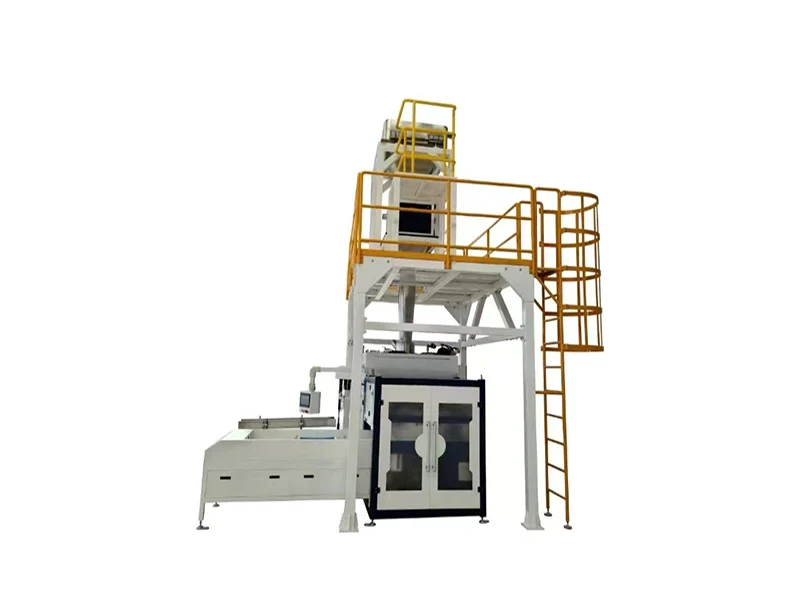
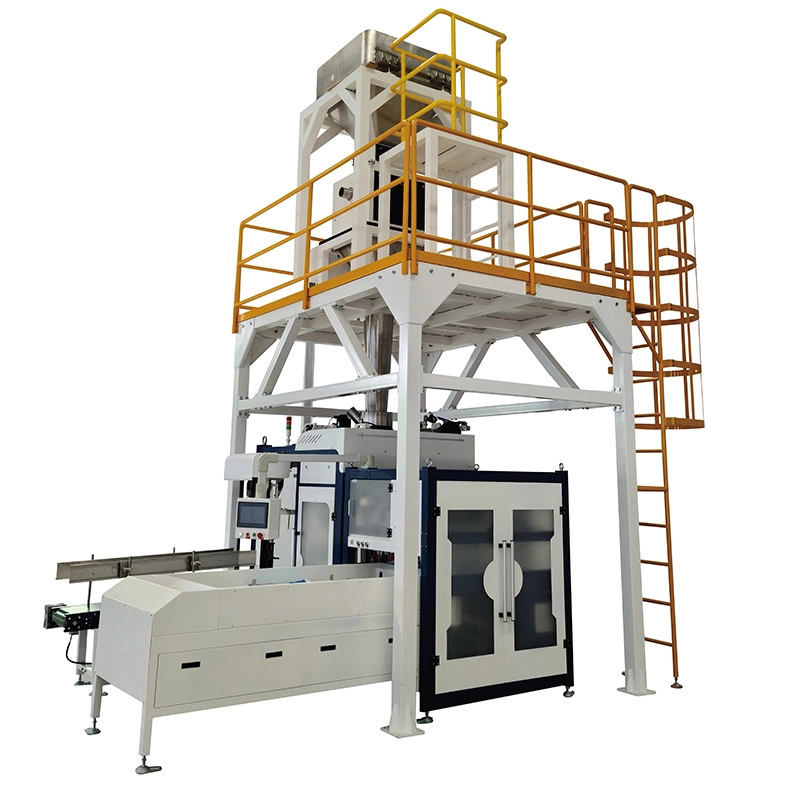
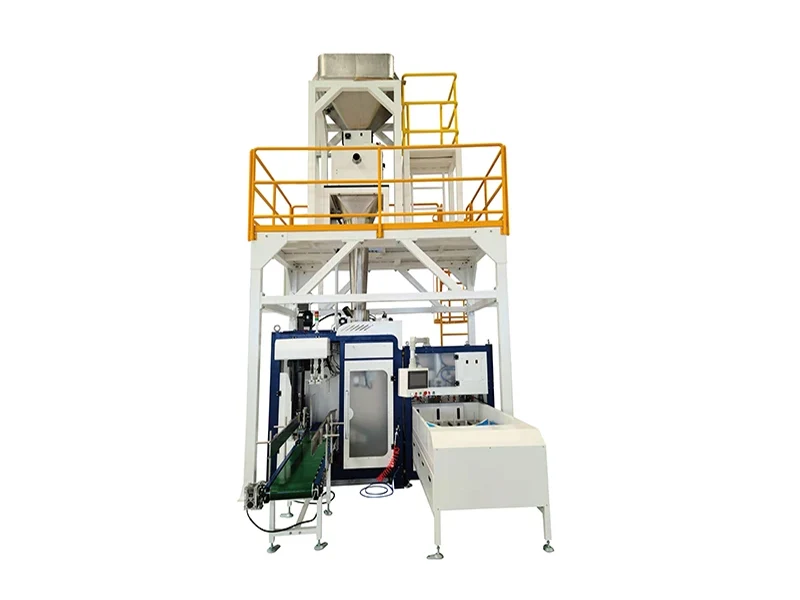
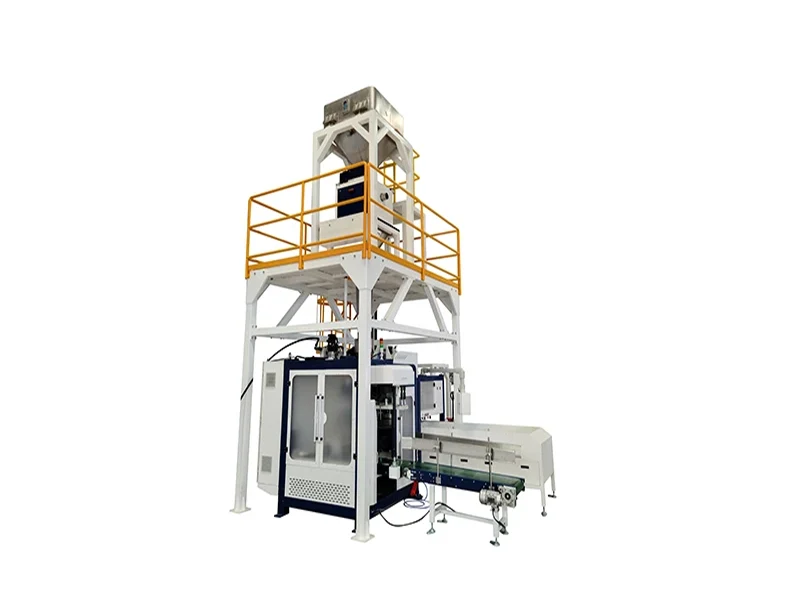
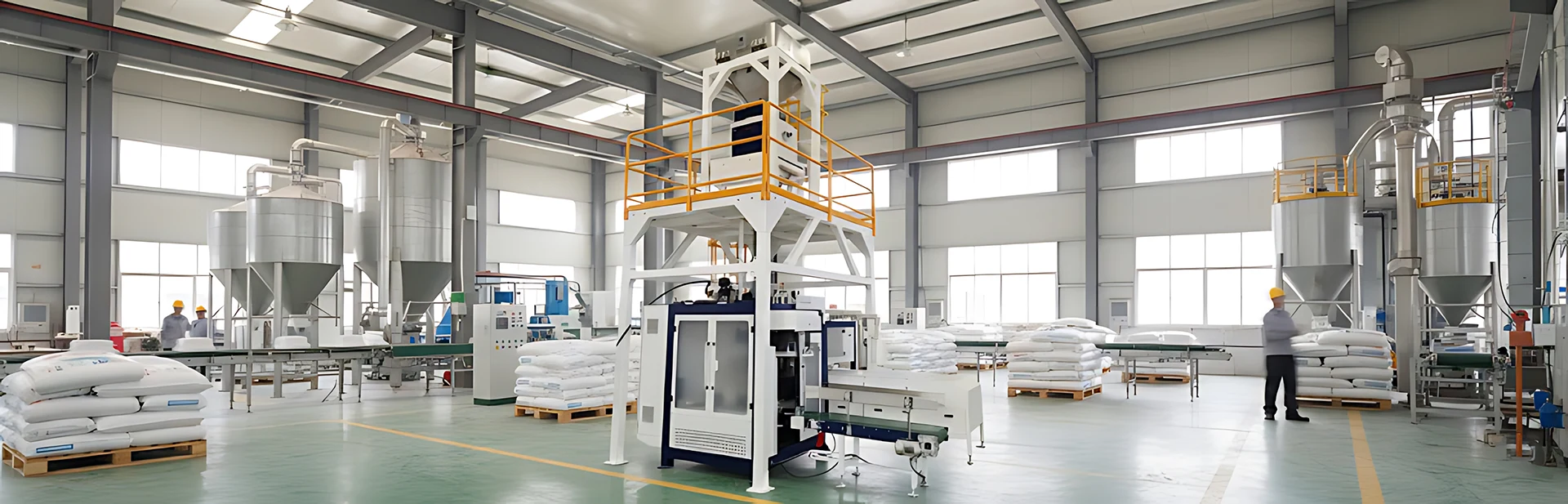
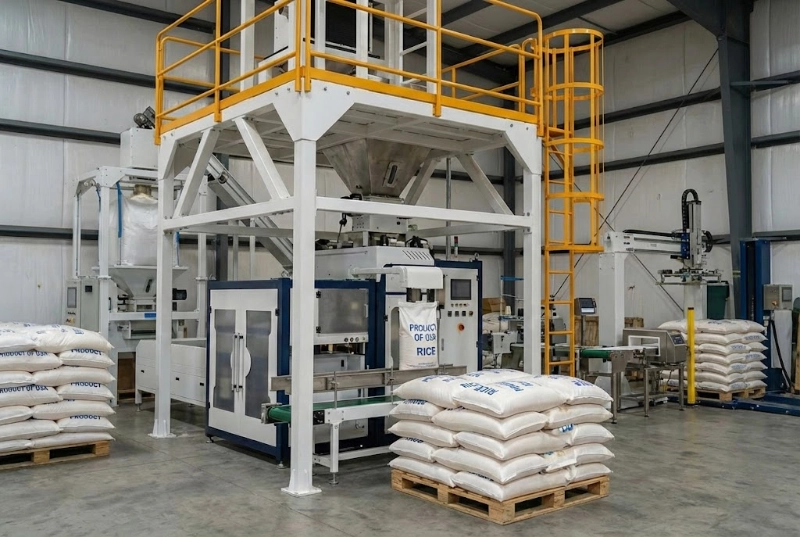
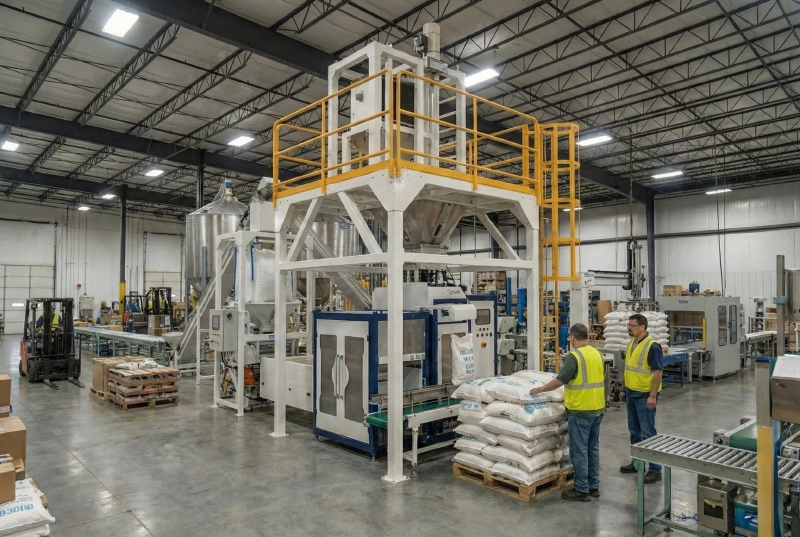
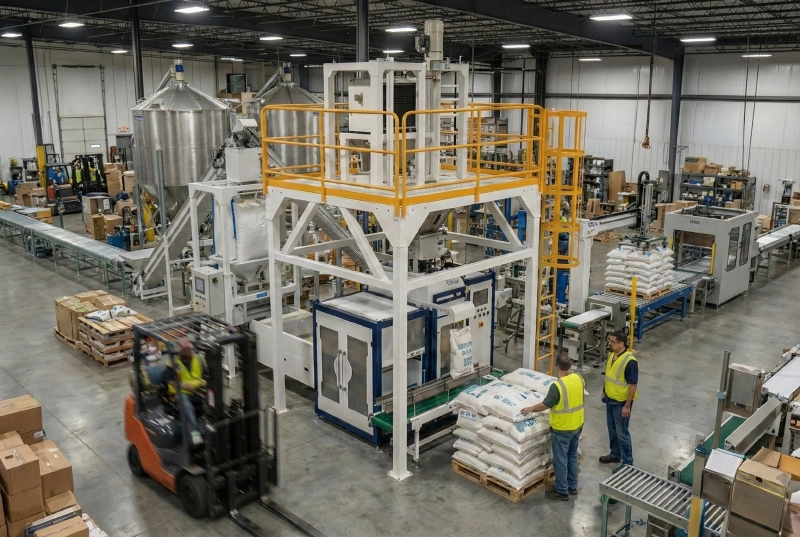
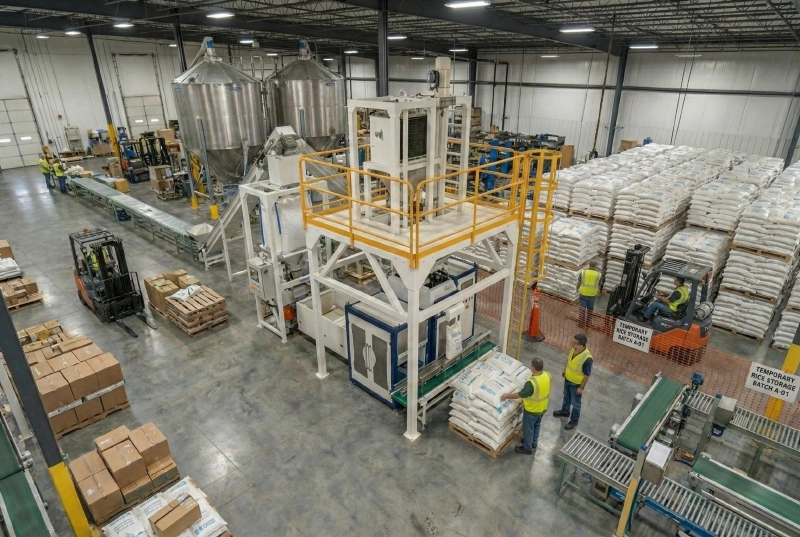
    Industrial steel equipment with elevated maintenance platform, safety rails, ladder, and enclosed service cabinet

    Where a 25 kg PE bagging bench falls behind

    On a manual polyethylene granule bagging line, an open-mouth woven bag is clamped by hand against a free-fall spout, walked to a separate stitching bay, then set on a pallet. A North American LDPE and LLDPE resin producer running that sequence found it workable for one shift, then impossible at three shifts. Operators held the bag against the fill stream, watched a mechanical scale trip, then carried the sack across the floor to a sewing head.

    That workflow looks fine on a sales sketch. On a real PE resin floor it means giveaway weight on every bag, micro-dust drift around the fill point, and a stitching reject rate that climbs the moment a 25 kg sack tilts more than 10 degrees before the needle drops. The compounding line behind the bench was rated for 8 t/h, but the bagging cell kept capping the whole plant at 6 t/h, and the missing tonnage showed up every month as overtime, not throughput.
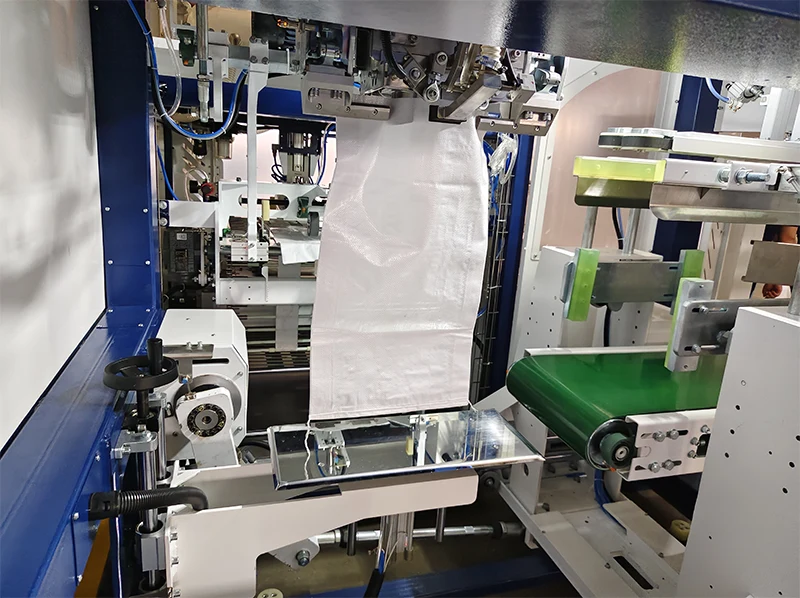
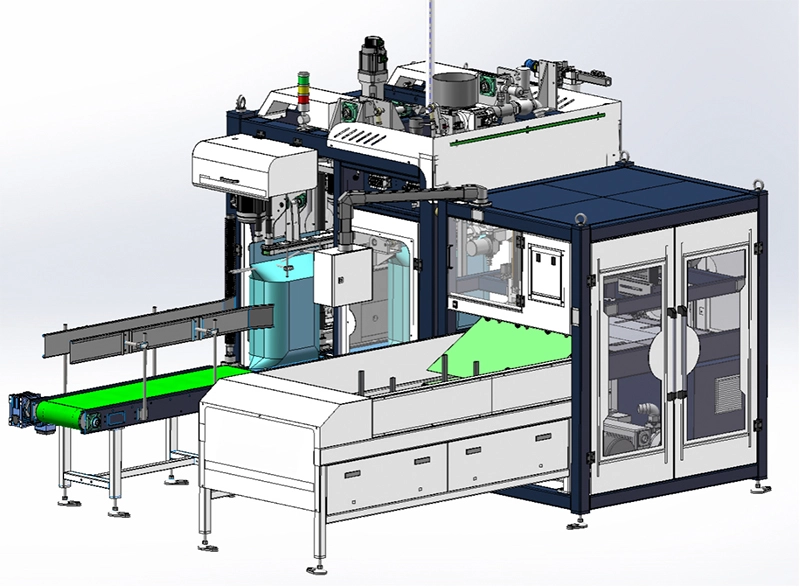
    Close-up internal photo of bagging unit with vacuum suction cups, robotic placing arm, green conveyor, and white woven bag
    Manual PE bagging: dust, giveaway weight, and unstable sack stacks

    A free-fall spout on PE resin sends fines into the air, every kilogram on a 25 kg sack turns into giveaway, and a tilted sack at the sewing head becomes a rejected pallet later in the warehouse. A controlled polyethylene granule bagging line has to fix all three at once.

    Why a QZK-1200 polyethylene granule bagging line fits a PE resin floor

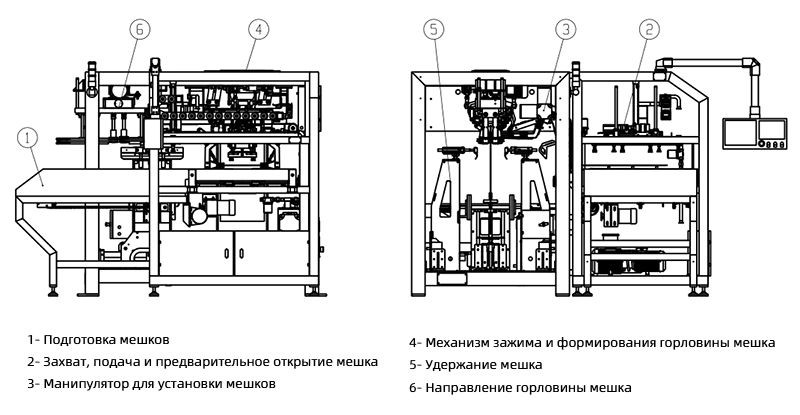
    The QZK-1200 polyethylene granule bagging line is built around three stations the manual bench never had. A vacuum suction cup arm picks a woven bag from the magazine and seats it on the filling spout without an operator’s hand. A double-station servo weigher drops the 25 kg PE dose in two stages to keep dust inside the cabinet. An outfeed conveyor with a stainless steel bed then carries the sealed sack to the sewing or heat-seal head before any human touches it.

    That sequence is what removes the giveaway weight and the manual straightening that defines a free-fall PE bagging cell. The enclosed filling cabinet pulls dust down at the fill point instead of letting it escape onto the floor. The double-station servo weigher holds 25 kg PE dose accuracy to ±50 g, which keeps the underweight-reject line quiet through a full shift and protects the bagging cell from being the bottleneck on the whole polyethylene granule bagging line.
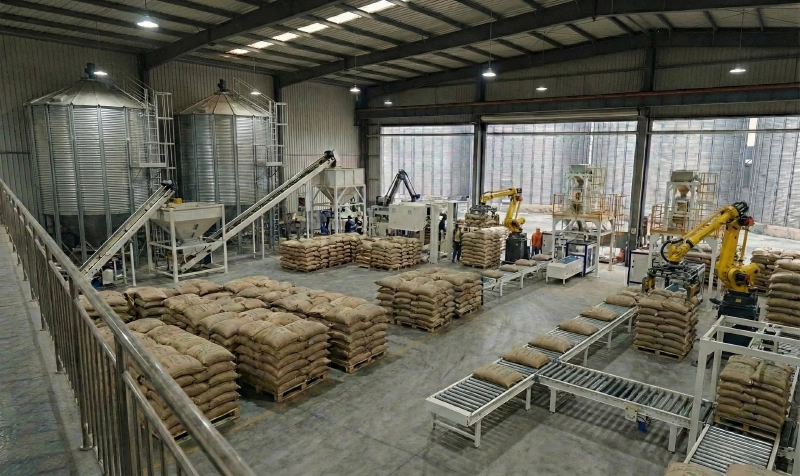
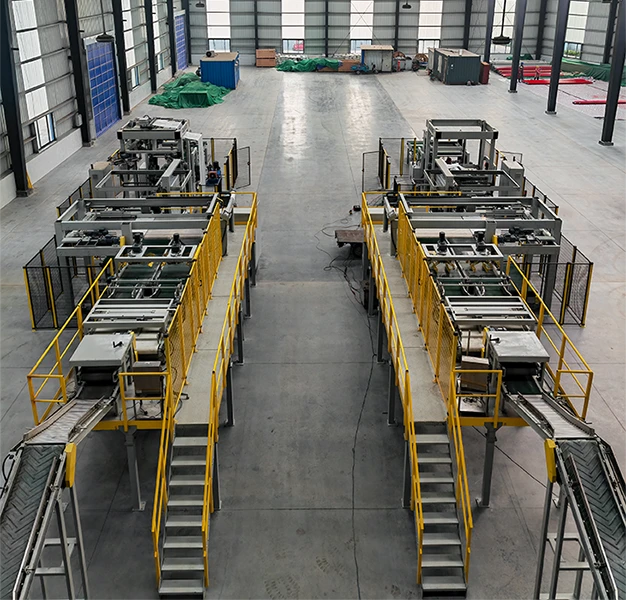
    Detailed 3D render of dual bagging lines with two yellow robotic palletizing arms, roller conveyors, and twin metal storage silos

    Field insight: For polyethylene resin, the bagging bench is rarely the bottleneck — the floor between the bench and the sewing head is. A polyethylene granule bagging line with guided transfer and a swing-arm HMI removes that floor from the equation and lets operators supervise three cells instead of holding one bag at a time.

    Specifying a polyethylene granule bagging line for 25 kg PE resin

    Before quoting a polyethylene granule bagging line, BPMpack’s engineers lock down four project inputs that decide the rest of the layout. The first is bag format — open-mouth woven PP, paper-PE laminate, or PE valve — because the bag magazine, suction cup count, and sealing station all change with it. The second is throughput — a QZK-1200 frame is sized for 400–600 sacks/h on 25 kg PE, and a parallel twin-tower layout doubles that on the same floor footprint.

    The third is the closure method: heat seal, fold-and-sew, or ultrasonic for paper-PE laminates that cannot tolerate a needle hole. The fourth is downstream handling — manual palletizing, a six-axis robotic palletizer, or stretch-hood wrapping for outdoor stacks. With those four inputs, the polyethylene granule bagging line drawing lands on the right cabinet width, the right conveyor length, and the right palletizer cell on the first revision instead of the third, which is where most PE resin projects lose weeks of installation time.

    ParameterSpecification
    Bag formatOpen-mouth woven PP / paper-PE laminate / PE valve
    Bag weight range10–50 kg (25 kg PE nominal)
    Throughput400–600 sacks/h single tower; 800–1,200 sacks/h twin tower
    Weighing accuracy±50 g at 25 kg
    Filling stationEnclosed cabinet with dust extraction at fill point
    Bag pickupVacuum suction cup arm from bag magazine
    SealingHeat seal, fold-and-sew, or ultrasonic
    FrameWelded steel with safety cage ladder and yellow rails
    ControlSwing-arm HMI with recipe storage
    PalletizingManual, robotic arm, or stretch-hood wrapper
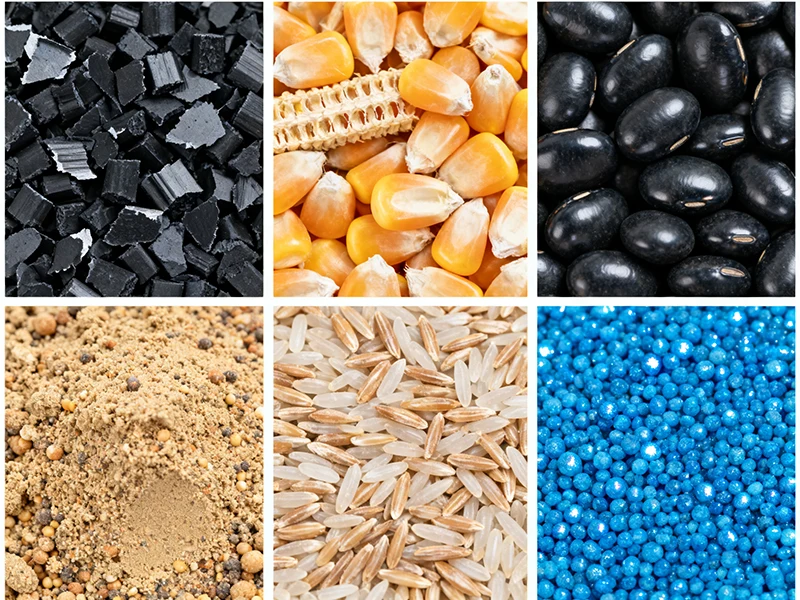
    Six-panel macro collage of bulk granular materials: plastic chips, corn kernels, beans, rice, sand, and blue pellets

    Send your PE resin bag format and target output

    BPMpack sizes a polyethylene granule bagging line around your 25 kg woven bag, dust budget, and downstream palletizer. Send the project inputs above and our engineers return a stamped layout with cabinet width, conveyor length, and palletizer cell sized to your real floor — not a generic quote sheet.

    Request a project review
  • Why the 25 kg Bagging Line Starts on a CAD Drawing

    Why the 25 kg Bagging Line Starts on a CAD Drawing

    25 kg Bagging Line Engineering

    Why the 25 kg Bagging Line Starts on a CAD Drawing

    For a feed, seed, fertilizer, plastic pellet or mineral granule plant, a 25 kg bagging line only behaves on site when the layout was solved on paper first. This is how BPMpack plans the flow before any steel leaves the workshop.

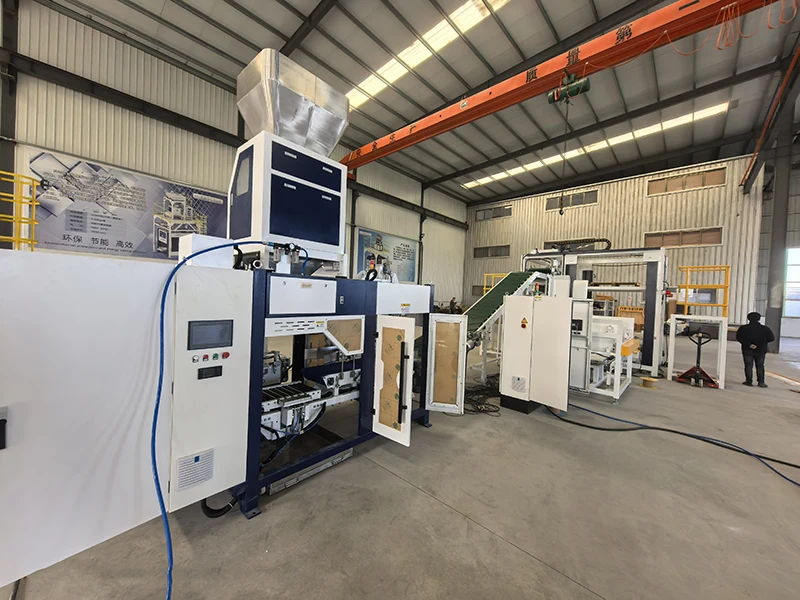
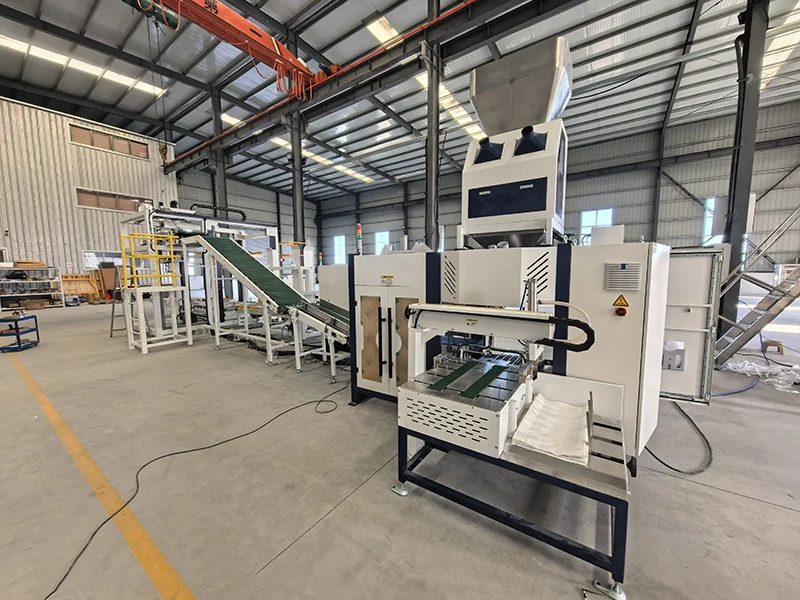
    On-site modular industrial processing line with hopper feeder, control cabinet, and inclined conveyor for 25 kg bagging

    The 25 kg Bagging Line Problem Is Layout, Not the Machine

    Talk to any plant engineer who has run a 25 kg bagging line for more than two years and the same complaint comes back. The filling head works. The sewing unit works. The checkweigher works. What does not work is the gap between those stations — the bag transfer, the outfeed turn, the incline bridge, the buffer before the palletizer. That gap is a layout problem, not a machine problem, and it only shows up when the line is standing on the real floor.

    For 10-50 kg heavy-bag projects running at 700-900 bags per hour, those gaps add up fast. A bag that stops for half a second at the wrong height costs the line five to eight bags per shift, every shift. Over a year that is the difference between meeting the dispatch target and missing it. BPMpack treats the line as one continuous flow from bag magazine to pallet exit, which is why the layout conversation starts before the proposal.

    Factory-installed 25 kg bagging line with top hopper, conveyor feed, and enclosed cabinet
    What Goes Wrong When the 25 kg Bagging Line Layout Is Decided Late

    Forklift aisles that do not line up with the palletizer exit. Columns nobody flagged in the first call. A buffer hopper dropped into the only forklift turning radius. A heavy-bag line that technically fills bags but blocks the dispatch lane. The buyer signs for throughput and ends up with congestion. None of these problems are visible in a single-machine photo. They only show up on a CAD drawing of the actual plant.

    Why the 25 kg Bagging Line Quote Begins With a Site Drawing

    When a buyer asks BPMpack for a 25 kg bagging line, the first file we ask for is not the bag spec and not the target throughput. It is the factory CAD drawing with column positions, ceiling height, forklift aisle widths, and the planned pallet exit direction. Without those numbers any line layout is just a guess. With them the line becomes a real engineering object — bag magazine, single-head servo scale or double-bucket scale, vertical bag conveyor, right-angle turner, incline conveyor, checkweigher, reject conveyor, labeler, and palletizer — placed in the only sequence that actually fits the room.

    The same data also decides the secondary choices that quietly change the project. PLC brand — Inovance for standard builds, Siemens for higher-demand projects — only matters once the cycle time and the I/O count are confirmed from the layout. Sealing option — heat seal, sewing, or heat seal plus sewing plus hot-melt tape — depends on the bag spec and the dispatch environment. Even the air supply at 0.5-0.7 MPa and the total power around 15 kW are recalculated against the real run length, not a generic number. That is how the line becomes a flow the buyer’s plant can actually run.

    Field note. On recent projects, switching from a one-line-per-machine plan to a CAD-driven 25 kg bagging line layout shortened installation time by roughly a week and removed three on-site modification cycles. The savings did not come from the equipment itself; they came from solving the layout before the truck arrived.

    Evidence From the 25 kg Bagging Line Drawings and Operating Scenes

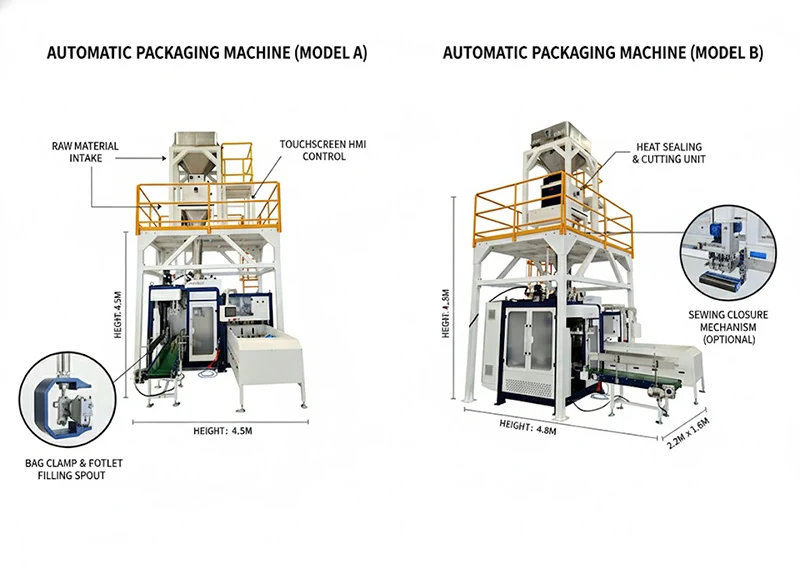
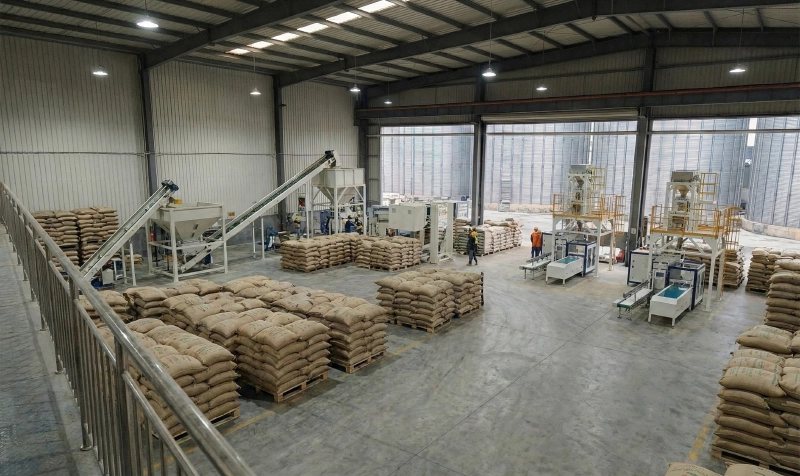
    The first piece of evidence is mechanical. The 3D CAD render shows two model variants side by side — bag clamp, filling spout, HMI control, heat sealing, and an optional sewing closure — built around a single steel tower with safety railings. That is the same configuration BPMpack drops into the buyer’s CAD drawing. The second piece of evidence is the layout render, which places two QZK-1200 bagging towers inside a real warehouse envelope with inclined conveyors feeding from the silo side and palletized sacks leaving on the dispatch side. Neither of those images is a showroom mockup. Both come from projects where the heavy-bag line was sized against an actual factory floor.

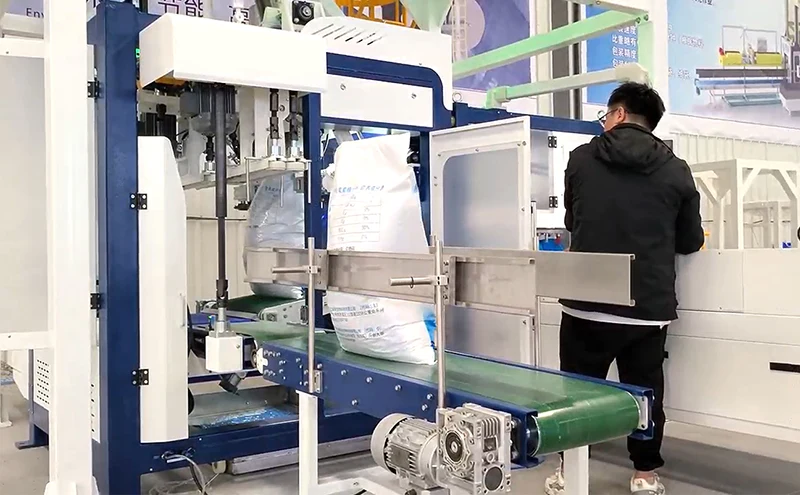
    The third piece of evidence is operational. The transfer section photo shows a guided outfeed belt with steel guide rails and a motorized green belt keeping each 25 kg sack aligned before pallet handoff. Combined with typical ±0.2% weighing accuracy on standard projects, the right-angle turner, the buffer hopper before the palletizer, and a checkweigher set to roughly ±10 g across 100 recipe memories, the line produces bags that are square, weighed, sealed, and ready to stack. That is what a buyer actually signs a 25 kg bagging line PO for.

    Layout DecisionWhat BPMpack Reads From Your CAD DrawingWhat It Sets on the 25 kg Bagging Line
    Forklift aisle widthPallet exit direction and clear width in mmRight-angle bag turner placement and buffer hopper length
    Column positionsSteel frame width and tower footprintSingle-head servo scale or double-bucket scale selection
    Ceiling heightVertical bag conveyor clearance and HMI swing-arm reachElevated platform height and safety cage ladder position
    Bag spec and dispatch environmentBag type, weight tolerance, dust levelSealing option, dust hood, checkweigher reject path
    Throughput targetBags per hour per shiftScale type, PLC brand, number of outfeed conveyors
    Industrial bag conveyor transfer section of a 25 kg bagging line with steel frame, guide rails, and motorized green belt
    3D render of automatic 25 kg bagging line models A and B with HMI, heat sealing, and optional sewing closure
    Wide-angle interior render of a large 25 kg bagging warehouse with dual bagging towers, inclined conveyors, and palletized sacks

    Send Your Factory Drawing to Plan a 25 kg Bagging Line

    If you are evaluating a 25 kg bagging line for feed, seed, fertilizer, plastic pellet, mineral granule, or grain projects, the fastest path to a working layout is a factory CAD drawing and the planned bag spec. BPMpack returns a 2D layout, a parameter table, and a quote that matches your site, not a generic showroom plan.

    Request a 25 kg Bagging Line Proposal
  • Automatic Granule Bagging Line: 25 kg Woven Sack Output

    Automatic Granule Bagging Line: 25 kg Woven Sack Output

    BAGGING LINE FOR GRANULES

    Automatic Granule Bagging Line: 25 kg Woven Sack Output

    For a feed mill, seed plant, or fertilizer producer shipping 25 kg woven sacks, a BPMpack automatic granule bagging line keeps bag pickup, weighing, filling, and downstream transfer under one control scheme so a single shift can ship stable, pallet-ready bags without manual straightening at the last meter.

    Isometric view of an automatic granule bagging line with swing-arm HMI touchscreen, steel framework, and enclosed bagging cabinet

    Why a 25 kg granule project is a line, not a machine

    A granule producer shipping 25 kg woven sacks to farms, distributors, or bagging stations rarely has a single problem. The bag magazine runs low, the weigher drifts, the bag tilts on the outfeed belt, the checkweigher rejects a sack, and someone still has to hand-place it on a pallet. That is why BPMpack treats the automatic granule bagging line as one engineered flow: bag magazine to robotic placer, opening jaws, double-bucket or single-head servo scale, fill spout, heat seal or sewing, bag turner, checkweigher, reject conveyor, buffer, pallet magazine, and robot palletizer. Buying only the bagger leaves the transfer and palletizing side open; buying only the palletizer leaves the front end unstable. The line is the product.

    Typical customers running a BPMpack automatic granule bagging line include compound feed plants, seed processors handling corn, sunflower, soybean, or rapeseed, fertilizer producers packing urea, NPK, or ammonium phosphate, plastic pellet and resin lines, and mineral granule operations. Most run 10 to 50 kg bag formats with a common 25 kg core range, and some projects switch between 5 kg and 25 kg on the same frame. Throughput targets sit around 700 bags per hour on standard builds, with high-speed configurations reaching 900 to 1200 bags per hour when the layout, scale, and PLC stack are matched to the bag size and material flow.

    Automatic granule bagging line with elevated steel platform, hopper, inclined conveyor, and safety railings feeding the bagging tower
    Old line thinking: a bagger, a sewing machine, and a forklift.

    The new line has to hold the bag from pickup to pallet without operators bending over each sack at every transition.

    Where a single-machine setup fails, and how the line corrects it

    Three pain points keep showing up on legacy bagging-and-sewing stations. First, the front-end bagging speed does not match the back-end palletizing speed, so bags queue on the floor or the robot idles between cycles. Second, two bag sizes or two weight ranges must run on the same shift, but the old weigher only holds one recipe and the bag magazine only holds one bag type, forcing changeovers that swallow a shift. Third, heavy-bag packaging does not end at filling — turning the upright sack into a horizontal one, checkweighing, rejecting out-of-tolerance bags, and presenting a square face to the palletizer are part of the real process, and a standalone bagger simply does not reach them.

    A BPMpack automatic granule bagging line addresses each of these inside one control scheme. The double-station servo scale or single-head servo scale holds multiple recipes, so a 5 kg and a 25 kg run can swap with one HMI selection. The bag magazine is sized for the project bag mix rather than a single SKU. The right-angle bag turner flips upright sacks into horizontal ones for checkweighing, and the buffer conveyor plus reject lane absorb the speed mismatch between the bagger and the palletizer. Power supply stays at AC380V plus or minus 5 percent at 50 Hz with about 15 kW total draw and 0.5 to 0.7 MPa air at roughly 1200 to 2000 NL per minute, so the line drops into a standard granule plant without a separate utility room.

    Project note: For a 25 kg compound feed project running two shifts, the realistic gain is not a faster bagger — it is removing the manual bag-straightening, manual weight re-check, and manual pallet-staging steps that the old setup leaks at every transition between the filling cabinet, the sealer, and the pallet.

    Inside the line: modules, accuracy, and what the drawings confirm

    The core frame is a white-coated steel tower with an elevated maintenance platform, safety cage ladder, yellow guard rails, and an enclosed bagging cabinet. Inside the cabinet, a vacuum suction cup array and robotic placer pick each woven polypropylene bag from the magazine, open it, and present it to the fill spout. A swing-arm HMI touchscreen keeps the operator off the platform during normal runs and gives the automatic granule bagging line one screen for recipes, alarms, and throughput counters, so a recipe change does not pull someone onto the tower.

    On the dosing side, the line typically uses a CY-CJD50K double-station servo scale for standard 25 kg granular products, with plus or minus 0.2 percent accuracy on feed materials and tighter plus or minus 0.1 to 0.2 percent on seed projects where the buyer asks for it. Sealing options are stacked: heat seal, sewing, heat seal plus sewing, or heat seal plus sewing plus hot-melt tape, depending on the dust level and warehouse handling. The right-angle bag turner, dual-layer incline conveyor, and buffer hopper bridge the height difference between the filling cabinet and the palletizing cell, so the bags arrive square at the pallet magazine instead of leaning into the operator.

    ParameterValue
    Bag weight range5 kg / 25 kg dual-spec, core 10 to 50 kg
    Throughput~700 bags/hour standard; 800 bags/hour extended; 900 to 1200 bags/hour high-speed
    Weighing accuracy±0.2% feed; ±0.1 to 0.2% seed
    Scale typeCY-CJD50K double-station servo scale; single-head servo for 5 / 25 kg dual-spec
    Sealing optionsheat seal / sewing / heat seal + sewing / heat seal + sewing + hot-melt tape
    Checkweigher5 to 50 kg range, ±10 g accuracy, 18 to 20 bags/min, 100 recipe memories
    Sewing machine~2700 rpm, stitch width 7 to 10.5 mm
    PLC stackInovance for standard builds; Siemens for high-speed or higher-demand projects
    Power supplyAC380V ±5%, 50 Hz, ~15 kW total
    Air supply0.5 to 0.7 MPa, 1200 to 2000 NL/min
    Close-up of vacuum suction cups and robotic bag placer picking a woven polypropylene bag inside the bagging unit of an automatic granule bagging line
    Dual-view technical CAD blueprint of an automatic granule bagging line showing bag magazine, robot arm, and bagging component annotations
    Tall automated automatic granule bagging line tower with steel platform, guard rails, enclosed processing cabinet, and side conveyor

    Send your site drawing, get a line proposal

    A working automatic granule bagging line is not a catalog SKU — it depends on the plant floor, the bag mix, the bag weight, the throughput target, and how the palletizer ties in. Send your factory layout, the bag types you actually ship, and your two-shift throughput target, and BPMpack will return a line proposal with module selection, scale type, sealing route, and a layout that matches your columns, forklift aisle, and palletizing direction.

    Request a Line Proposal
  • Automatic Packaging Line for Granules: Heavy-Bag Layout

    Automatic Packaging Line for Granules: Heavy-Bag Layout

    Heavy-Bag Granule Packaging

    Automatic Packaging Line for Granules: Heavy-Bag Layout

    A 25 kg granule producer with throughput stuck at 600 bags/hour usually blames the bagger. An automatic packaging line for granules from BPMpack moves bag pickup, weighing, transfer, sealing, checkweighing, and pallet handoff into one chain so the front end runs at the speed the back end actually accepts on a real shift.

    Industrial powder packaging line with stainless steel silos, elevated platform, conveyors, and bagged product stacks

    Where a heavy-bag line really loses bags

    A heavy-bag granule line that runs at 700 bags/hour on day one usually drops to 500 bags/hour within six months. The bagging head is rarely where the bags go missing. They go missing at the hand-off: between the gross weigher and the sewing head, between the sewing head and the checkweigher, between the checkweigher and the palletizer. Each hand-off adds dwell time, and each dwell time compounds into lost bags per shift on the plant floor.

    An automatic packaging line for granules in the 10–50 kg range has to be specified as a chain, not as a set of machines. BPMpack plans every heavy-bag project from the fill point backward — how the bag leaves the gross weigher, how it reaches the seal, how it sits on the palletizer in-feed, and where the forklift picks it up from the outfeed belt. Until those four answers are fixed on a CAD layout, no spec sheet on the bagger tells you what the line will do on a real two-shift production day.

    On-site modular industrial processing line with hopper feeder, control cabinet, and inclined conveyor
    The bottleneck is rarely the bagger

    Most 25 kg granule producers blame the bagging head when throughput drops. The bottleneck is the back end: the right-angle bag turner, the dual-layer incline conveyor, the checkweigher, the reject lane, and the palletizer. If those four are off-spec against the front end, the bagger will be parked and idle within two shifts, regardless of how new the servo scale is.

    From bagger thinking to line thinking

    The bagging head is the most visible part of a heavy-bag granule line. It is also the most standardized. What changes project to project is everything around it. A single-head servo scale runs roughly 15–25 cycles per minute and suits 5 kg / 25 kg dual-spec work or heavy-bag projects where recipe changeover is frequent across feed and seed batches. A double-bucket scale holds steady on standard granular lines and is the default for 700–800 bags/hour builds. A single-bucket four-servo high-speed scale is what you spec when the project targets 900–1200 bags/hour.

    What locks in the line is downstream. The right-angle bag turner must convert upright bags into horizontal bags without stalling the seal station. The dual-layer incline conveyor must bridge the height difference between the filling section and the palletizing section without dropping a bag on the way up. The checkweigher must keep a 5–50 kg range, ±10 g accuracy, and 100 recipe memories so recipe changeovers do not open a quality risk during production. The labeler must hold around 12–13 pcs/min. The sewing machine must run at about 2700 rpm with a stitch width of 7–10.5 mm. Each of those numbers is a contract with the bagger speed, and BPMpack wires them into the conveyor interlocks, not just the bagger PLC.

    Engineering note: A 25 kg granule line with manual bag straightening at the sewing head loses 8–12% of throughput at the last meter. The straightening station is not on the spec sheet, but it eats bags every shift and is the single most common reason a “700 bags/hour” line actually ships 615 bags/hour on a real day.

    What the chain looks like in numbers

    An automatic packaging line for granules is not a single spec sheet. It is a chain of contracts between modules, and BPMpack ships each contract as a defined module with a defined electrical and mechanical interface. The numbers below are the typical project data for a 10–50 kg granule project. This is a typical range, not a fixed promise — final speed, dose accuracy, and sealing configuration depend on material flow, bag type, and downstream palletizing direction.

    Before any metal is cut, BPMpack asks for site CAD drawings, fill point coordinates, aisle widths, column positions, and palletizing direction. Without those, even a spec’d chain stays preliminary. Once they are fixed, the line is issued as a layout drawing and then as a confirmed project data sheet, with the PLC stack — Inovance for standard builds, Siemens for high-speed or higher-demand projects — wired into the conveyor interlocks, not just the bagger.

    ModuleSpecification
    Packaging weight range10–50 kg (5 kg / 25 kg dual-spec optional)
    Packaging speed~700 bags/hour standard; 900–1200 bags/hour high-speed
    Weighing accuracy±0.2% feed; ±0.1–0.2% seed
    Power supplyAC380V ±5%, 50Hz
    Total power~15 kW
    Air supply0.5–0.7 MPa
    Air consumption~1200–2000 NL/min
    PLC stackInovance (standard) / Siemens (high-speed)
    Checkweigher5–50 kg, ±10 g, 18–20 bags/min, 100 recipes
    Labeler~12–13 pcs/min
    Sewing machine~2700 rpm, stitch 7–10.5 mm
    Sealing optionsHeat seal / sewing / heat seal + sewing / heat seal + sewing + hot-melt tape

    Get a project review for your heavy-bag granule line

    Send site dimensions, fill point coordinates, bag type, throughput target, and palletizing direction. BPMpack will return a CAD layout and a confirmed project data sheet for the heavy-bag run, with the bagger, conveyors, checkweigher, and palletizer specified as one chain instead of four separate machines.

    Request a project review
  • Granule Bagging Line: Steady 25 kg Woven Sack Flow

    Granule Bagging Line: Steady 25 kg Woven Sack Flow

    Heavy-bag projects · 10–50 kg · woven sacks

    Granule Bagging Line: Steady 25 kg Woven Sack Flow

    A heavy-bag granule bagging line replaces loose sack presentation, weighing gaps, and unstable handoffs with one continuous flow from hopper to pallet-ready stack.

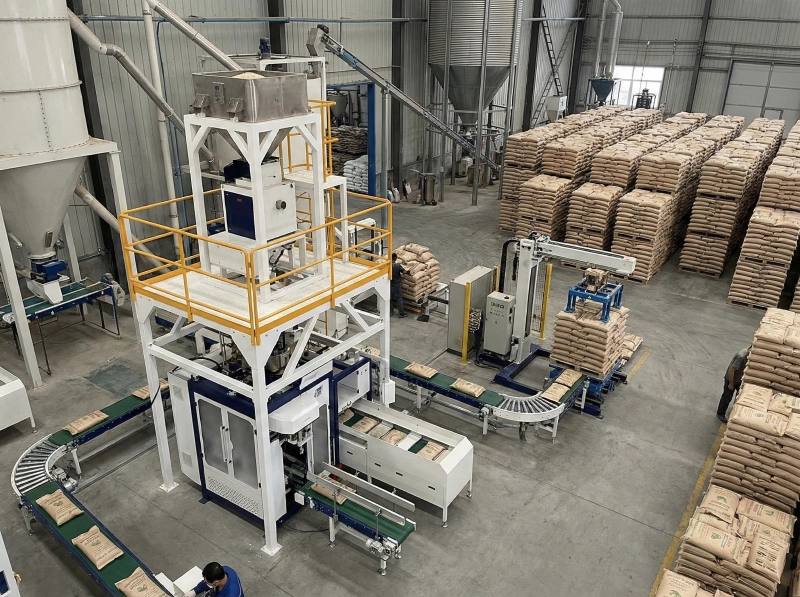
    Automated rice bagging line with steel hopper, weighing frame, and palletized sacks in factory

    Where woven-sack warehouses lose rhythm

    A 25 kg woven sack of grain, feed, plastic pellets, or fertilizer is heavy long before it is full. Manual sack presentation, separate weighing, and ad-hoc transfer between the filling and pallet stations slow the line. A granule bagging line solves that by combining bag pickup, gross weighing, fill, and guided outfeed into one controlled sequence. Once the stations are connected, operators stop rushing the same bag from point to point, and the workshop gets a predictable rhythm instead of stop-and-go.

    For buyers comparing a heavy-bag packaging line or an automatic bagging line for free-flowing granules, the practical question is the same: can the line keep a 25 kg sack square from gross weigher to pallet stack? On most factory floors, that is exactly where output drops. The granule bagging line answers with a closed-loop bagging station, tracked roller transfer, and an outfeed that hands each sack to the next station in the same orientation.

    Six-panel macro collage of bulk granular materials: plastic chips, corn kernels, beans, rice, sand, and blue pellets
    Why woven-sack warehouses slow down

    Loose sack presentation, weighing gaps, and unstable handoffs between filling and palletizing are the most common reasons a granule bagging line loses its target output. The fix is connecting bag pickup, weighing, fill, transfer, and outfeed into one controlled flow rather than a string of separate steps.

    Why this granule bagging line fits the heavy bag better

    The closed-loop design starts at the bag magazine. A robotic placing arm with vacuum suction cups opens the woven sack and seats it on the filling spout, so the bag mouth stays aligned with the dosing point. Below the fill station, a tracked roller section and a twin-belt conveyor carry the filled sack toward the checkweigher or sewing head without tipping the bag. That is the structural reason a granule bagging line can keep a 25 kg sack square at 700–800 bags per hour.

    For a 10–50 kg project, the heavy-bag granule bagging line runs at a standard 700–800 bags per hour and can climb toward 1200 bags per hour in a high-speed configuration. Typical accuracy sits at ±0.2%, the PLC stack uses Inovance for standard builds or Siemens for higher-demand lines, and air consumption stays around 1200–2000 NL/min at 0.5–0.7 MPa. Those numbers come straight from the project reference data BPMpack applies to the bagging line for granules.

    Engineering note. A granule bagging line is more than a single filler. The bag magazine, robotic placer, gross weigher, enclosed filling cabinet, guided roller transfer, and outfeed conveyor are engineered as one production object. That is why the bag orientation is preserved end to end and the warehouse pallet stack stays square instead of leaning.

    3D CAD rendering of modular secondary bagging line QZK-1200 with accumulation belt, large bag gripper, and discharge conveyor.

    What the structural and on-site evidence confirms

    The CAD layout for the QZK-1200 granule bagging line shows the bag magazine, large-bag gripper, accumulation belt, and discharge conveyor arranged as one serviceable assembly. That is the same arrangement BPMpack installs on a feed, seed, fertilizer, or pellet floor, which is why buyers comparing an automatic bagging line or a free-flowing-granule filler see the same line structure across projects.

    On the operational side, the granule bagging line runs in a real plant with forklift traffic and pallet handling. Operators in safety gear stack sacks onto wooden pallets at the discharge end, while the line keeps feeding the next sack in the same orientation. A 3D render adds the next step: a six-axis robotic palletizer takes the granule bagging line output and stacks it into a forklift-ready pallet without breaking the packing rhythm.

    Line moduleFunction in the granule bagging line
    Bag magazine and robotic placerAuto-pick and open woven sacks for the granule bagging line
    Gross weigher and enclosed fill station10–50 kg fill at ±0.2% accuracy
    Guided roller and twin-belt transferKeep 25 kg sacks square through the granule bagging line
    Checkweigher and reject conveyorFilter under- and over-weight sacks out of the line
    Outfeed conveyor and robotic palletizerHand off to forklift-ready pallet stacks
    Eye-level photo of operating QZK-1200 bagging station with steel safety cage ladder, conveyor, and operators stacking sacks.
    High-angle perspective photo of running QZK-1200 packaging line with active forklift logistics and high-visibility operators.
    3D perspective render of QZK-1200 automatic bagging line integrated with a robotic palletizer stacking paper sacks in a factory.

    Specifying a granule bagging line for your floor

    For a 10–50 kg project on grain, feed, seed, fertilizer, plastic pellets, or mineral granules, BPMpack builds the granule bagging line around your bag type, weight range, throughput target, and factory CAD layout. Send the project details and we will return a line layout, a module list, and an indicative price for review.

    Request a packaging line proposal
  • 10 kg Bagging Line: Steady Woven Sack Output

    10 kg Bagging Line: Steady Woven Sack Output

    10 kg bagging line for woven sacks

    10 kg Bagging Line: Steady Woven Sack Output

    A 10 kg woven sack is not a true workstation. Most plants still run a 10 kg bagging line with manual sack presentation, a stand-alone scale, separate sealing, and free-standing outfeed, then patch the rhythm with forklift movement. A purpose-built 10 kg bagging line ties feeding, weighing, bag transfer, sealing, and pallet-ready outfeed into one continuous flow so the workshop stops reacting to every single bag.

    10 kg bagging line based on QZK-1200 automatic bagging machine with elevated steel framework, double-station scale, and outfeed conveyor

    Why a 10 kg bagging line breaks rhythm under handheld stations

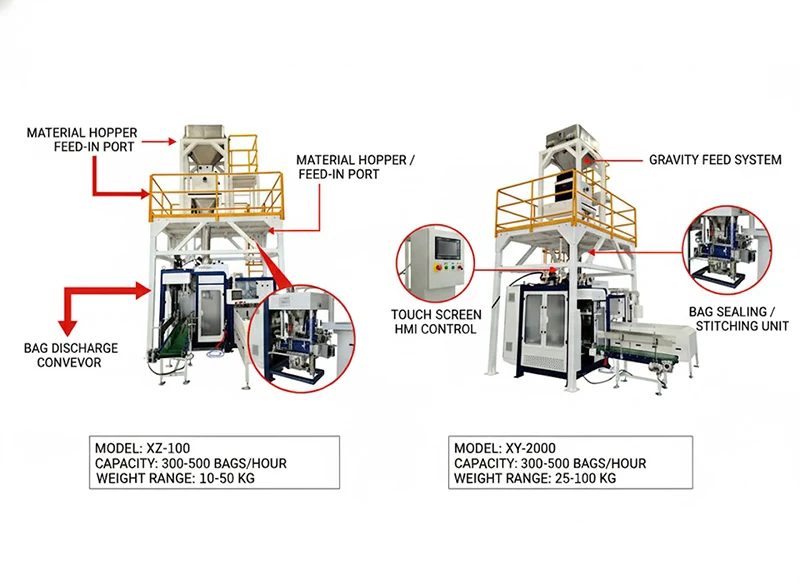
    The first image shows the spec panel most buyers compare when they shortlist a 10 kg bagging line. XZ-100 is rated 300-500 bags/hour on a 10-50 kg bag range with hopper feed, gravity dosing, HMI touchscreen, and an inline sewing unit. On paper, the figures look fine. On the floor, the same numbers tell a different story when every station is operated by a different worker and the bag has to be carried between them.

    A 10 kg bagging line under manual stations usually loses time at three points: sack presentation at the filling point, scale hand-off between weighing and clamping, and the gap between the sealer and the outfeed conveyor. Each gap is short, and each one is enough to break the cycle. Add a forklift waiting for a pallet at the end, and the line stops waiting with it. That is why most 10 kg bagging line projects end up running at 60-70% of the rated capacity on day one.

    10 kg bagging line spec panel showing hopper feed, gravity dosing, HMI touchscreen, and sewing unit for 10-50 kg woven sacks
    Where most 10 kg bagging lines lose bags

    Manual sack opening, stand-alone weighing, free-fall clamping, separate heat seal, and an outfeed that has to be caught by the next operator. Three hand-offs per cycle, every cycle, and the line only runs as fast as the slowest hand-off.

    Why the QZK-1200 layout fits a 10 kg woven sack

    The close-up shows what the QZK-1200 does at the bag pickup station. Vacuum suction cups grip the woven PP sack, a robotic placing arm moves it onto the filling spout, and the green belt takes the bag into the pneumatic clamp. There is no operator step between pickup and clamp on this station. For a 10 kg bagging line, that alone removes one of the three hand-offs that manual stations create, and it removes the slow closing step that operators tend to skip when the line is behind.

    The structural choice is just as important. The hopper is mounted directly above the dosing unit, so the 10 kg sack is filled from below by gravity rather than dropped from a free-fall chute. The HMI is mounted on a swing arm so the operator can see the recipe and the cycle counter without leaning over the bag. The enclosure keeps dust out of the bag mouth and keeps the sealer running at the same set temperature, which is what keeps a 10 kg bagging line accurate from the first bag to the 500th.

    Engineering note: For a 10 kg woven sack line, the bottleneck is rarely the bagger itself. It is the gap between weighing and the next clamp, and the gap between the sealer and the outfeed. A 10 kg bagging line that closes both gaps inside one structural frame usually beats a faster standalone unit that leaves both gaps open, because those gaps are where operators compensate and where giveaway drifts.

    Internal photo of a 10 kg bagging line showing vacuum suction cups, robotic bag placer, and green belt outfeed

    Evidence from structure and operating scene

    The operating scene shows the line working in a real plant, not as a showroom mockup. Twin stainless steel silos feed the line through inclined conveyors, the bagging tower drops 10 kg woven sacks onto the green outfeed belt, and a forklift clears the pallet stacks behind the line. That is the layout a 10 kg bagging line is meant to fit: silos at one end, dispatch at the other, and the bagging tower in between.

    The structure tells the same story. The bagging tower is a single welded steel frame with a top platform, a safety cage ladder, a swing-arm HMI, and an enclosed filling cabinet. The weigh frame sits under the silo, the dosing unit sits under the weigh frame, and the outfeed belt sits on the same base. For a 10 kg woven sack project, this is the difference between a line that has to be re-engineered on site and a line that drops onto the floor plan.

    ModuleWhat it doesWhy it matters for a 10 kg bagging line
    Bag magazine + vacuum placerPre-stages 10 kg woven PP bags and feeds them to the filling spoutRemoves manual bag presentation and aligns the bag mouth at the fill point
    Weigh frame + dosing unitHits plus or minus 0.2% target weight on 10 kg sacksKeeps giveaway inside a tight band so a 10 kg bagging line does not over-fill and over-pay for material
    Heat seal + sewing headCloses the 10 kg sack with heat seal, sewing, or heat-seal-plus-sewingMatches the bag spec without forcing the buyer to choose one closure before the bag type is locked
    Outfeed belt + checkweigherCarries the 10 kg sack to inspection, rejection, and pallet-ready outfeedStops the line waiting on a forklift and gives the line a clean handoff to palletizing
    PLC + HMI + load cell stackInovance for standard 10 kg lines, Siemens for higher-speed or higher-demand projectsMatches the control option of the original project brief without forcing a re-spec
    10 kg bagging line operating in a real plant with twin stainless steel silos, inclined conveyors, and forklift-loaded pallets

    Request a 10 kg bagging line proposal

    Send your bag size, target output, material bulk density, and floor layout. BPMpack will return a QZK-1200 based 10 kg bagging line proposal with CAD layout, dosing spec, and PLC option so engineering can sign off before fabrication starts.

    Talk to engineering
  • Granular Packaging Line: Stable 25 kg Bags

    Granular Packaging Line: Stable 25 kg Bags

    Heavy-bag FFS packaging

    Granular Packaging Line for 25 kg Bags: Stable Feeding, Sealing and Pallet-Ready Output

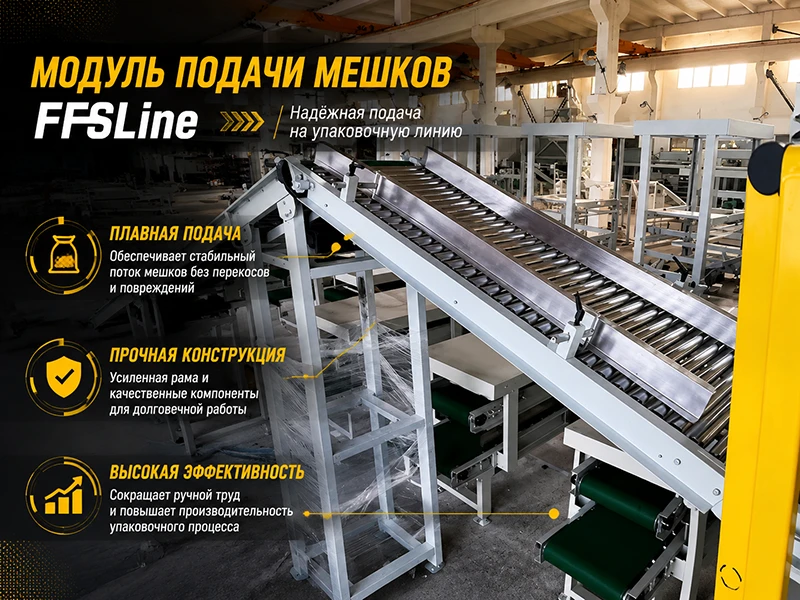
    A granular packaging line built on the FFSline range turns PE or PP roll film into filled, sealed 25 kg bags for fertilizer, plastic pellets and mineral bulk. Forming, weighing, dust-controlled filling, heat sealing with cooling, checkweighing and pallet handling run as one sequence, so granular product leaves the floor as a stable, forklift-ready pallet instead of a stack of hand-sewn sacks.

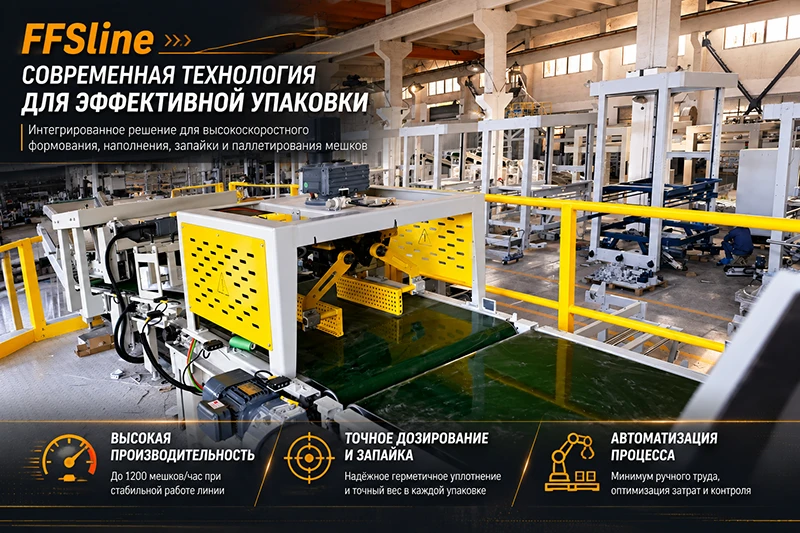
    FFS heavy-bag packaging machine with bag feeding module, inclined roller conveyor and steel guard frames

    Open-mouth bags, manual weighing and sewing: where heavy-bag output loses shape

    A fertilizer, urea or compound NPK plant that still packs granular product into open-mouth woven or kraft bags runs a chain of separate decisions: a weigher, a bag magazine, an operator holding the sack mouth under the spout, a sewing head, and a forklift waiting at the end of the row. Each step adds its own variation. Bag weight drifts with the operator, the mouth is stitched at a slight angle, and the filled sack leaves the sewing head soft, twisted or leaning. A granular packaging line replaces those separate steps with one controlled flow, and the difference shows up first in the reject rate and in the number of operators needed per shift.

    The problem is rarely the bag. It is the timing between the steps. Granular product flows fast, so a free-falling charge lands on a bag bottom that was closed only a moment earlier, while dust rises at the fill point and settles on the seal area. On a stitched open-mouth bag that dust is harmless. On a heat-sealed bag it is not. Most plants moving from sewn bags to a formed, heat-sealed bag discover this during the first full-speed trial rather than in the specification, which is why the sealing and cooling stations deserve more attention than the price list.

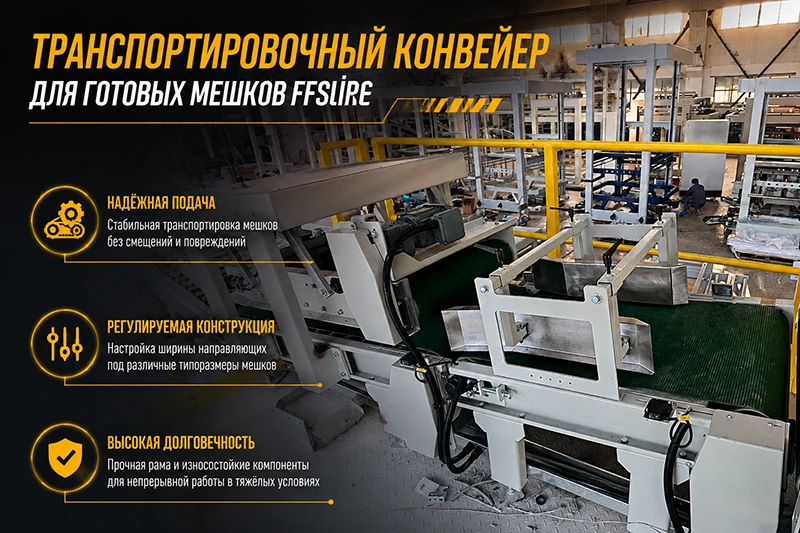
    Adjustable guide conveyor discharging sealed heavy sacks from an FFS line after heat sealing
    Pain point: a bag that is closed but never shaped

    If a 25 kg sack is sealed while it is still soft, it will not stack square. Pallets lean, wrap film bridges the gaps, and the load arrives at the customer looking like something nobody wants to unload. That rework happens at the very end of the line, which is the most expensive place on the floor to fix it.

    Why the FFS route fits granular product: film forming, controlled filling, sealed closure

    An FFS granular packaging line does not buy a bag, it makes one. PE or PP roll film is drawn over a forming collar, a bottom seam is created, the bag is filled, and the top seam is closed inside the same machine envelope. Because the bag exists for only a few seconds before it is filled, the film never sits in a warehouse picking up moisture, and there is no premade-bag magazine to reload, jam or re-order. For a plant shipping the same granular product every day, that removes an entire purchasing and logistics chain.

    Filling decides whether the rest of the sequence works. A single-head servo weigher feeds a controlled discharge rather than one blind dump, so the bottom seam is not asked to absorb the full impact of a free-falling charge. Both the bottom seam and the top seam are followed by pneumatic cooling, which is a structural measure rather than a finishing touch: a hot seam that is loaded the moment it closes is the most common reason a granular bag leaks at the corner. The same engineering logic is visible on a heavier FFS packaging line for 25 kg fertilizer bags, where closure quality is treated as a machine function, not an operator skill.

    Field note: watching a line run at design speed is useful; watching it recover after a feed interruption is more useful. Ask what happens to the bag already sitting in the sealing jaws when upstream feed stops, then restart the line three times and inspect the seam each time.

    Structure, parameters and the layout points worth confirming

    Everything below is a design reference, not a fixed promise. Bag weight, bulk density, particle shape and moisture content change what the line can hold, so a granular packaging line should be quoted against a confirmed bag format and a written acceptance scheme.

    The physical evidence on the floor is worth reading before the datasheet. The enclosure and frame show where material can escape and where a maintenance fitter can reach; the conveyor guides show how much a sack may rotate between the sealer and the checkweigher; the palletizing cell shows how many operators the plant expects to keep after commissioning. A granular packaging line is bought as a sequence, so each of those points belongs in the technical agreement before any frame steel is cut.

    ItemDesign referenceTo confirm with
    Bag weight20 kg / 25 kg / 50 kgBag format and material bulk density
    Bag materialPE or PP roll film, M-type heavy filmFormed bag route, not a premade-bag route
    Film width350-450 mmFinished bag size
    Film thickness0.14-0.18 mm typical; project ranges varyFilm supplier trial
    Film rollMax. outside diameter approx. 1,500 mm, core approx. 150 mmUnwind stand layout
    OutputDesign-level target, subject to even feedingFlowability, moisture, acceptance terms
    WeighingSingle-head servo weighingAccuracy fixed in the acceptance scheme
    Main machine powerApprox. 25-30 kWLine configuration
    Air consumptionApprox. 3,000-3,500 L/min at the main machineFull-line utility calculation
    Feed buffer3 m3 transition silo, optional vibration or anti-bridgingMaterial bridging behaviour
    Downstream, optionalMetal detection, checkweigher with reject, inkjet coding, bag and pallet labelling, robotic or high-level palletizing, stretch hoodProject scope

    Send your bag format and product sample data

    Tell us the granular material, the target bag weight, the rate you need and the floor space available. BPM will come back with a granular packaging line layout, a film specification and a clear split between stations that are standard and stations quoted as options for your project. Start with the contact form and attach your material test report if you have one.

    Request a project review
  • 25 kg Fertilizer Bagging Line: FFS Cooling for Stable Pallet Output

    25 kg Fertilizer Bagging Line: FFS Cooling for Stable Pallet Output

    FFS packaging line | Fertilizer packaging

    25 kg Fertilizer Bagging Line: FFS Cooling for Stable Pallet Output

    For a fertilizer plant shipping 25 kg ammonium phosphate or compound fertilizer, an automatic bagging line must do more than weigh bulk material. FFS online bag forming, controlled filling, heat sealing, cooling, checkweighing and pallet handling create a cleaner route from granules to a forklift-ready load.

    Factory-installed FFS packaging line with enclosed forming, filling, sealing and palletizing modules

    Why a 25 kg fertilizer line outgrows open bags and sewing

    A fertilizer producer supplying distributors, agricultural warehouses or export logistics often starts with open woven or kraft bags, manual weighing and a bag-closing machine. That route is familiar, but every extra handoff adds variation: an operator holds the bag, another corrects the weight, a third sews the mouth, and finished sacks still need manual transfer and pallet building. The result is a packaging process rather than a controlled packaging line.

    For granular fertilizer with reasonably stable flow, FFSline changes the sequence. PE or PP roll film is formed into the bag at the machine, then filled and sealed without a separate pre-made bag store. The target is not a universal speed promise: a 25 kg project is confirmed against bulk density, particle size, moisture, film specification, continuous feeding and the agreed acceptance test. In the right conditions, the line can be designed around a 500 bags/h project level, with higher published ranges treated as configuration- and material-dependent.

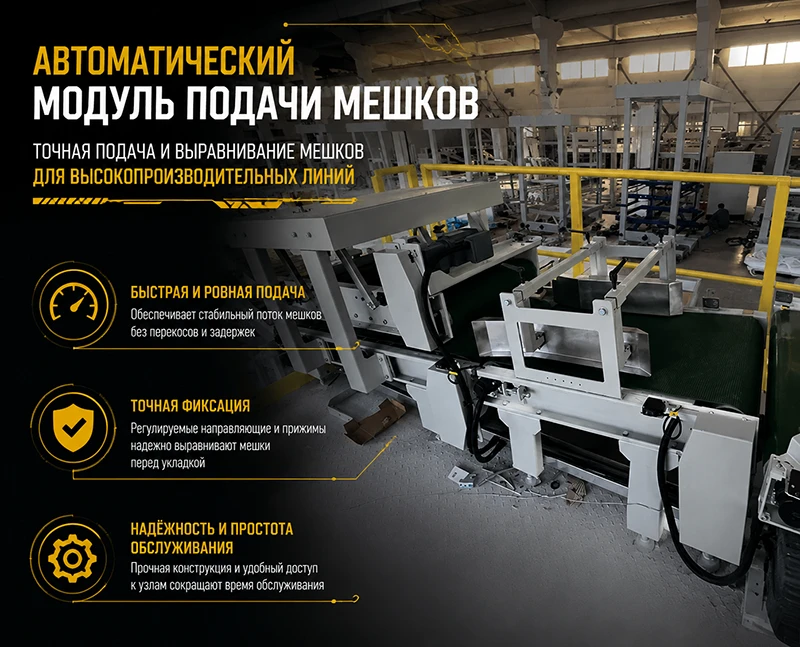
    Real factory photo of automated bag feeding module with conveyor, guide rails, and clamping alignment frame
    The old-scheme problem is usually at the handoffs

    Manual bag opening, weighing and sewing can hide unstable feed, bridging, dust at the filling point, impact on a fresh seal and inconsistent bag presentation. If inspection, labeling and palletizing are separate, the plant may produce filled sacks but still lack a repeatable dispatch unit.

    Why FFS cooling and controlled filling fit fertilizer granules

    The adaptation starts upstream. A project may use a 3 m³ transition hopper as a buffer and add vibration, anti-bridging or sampling devices when the fertilizer tends to form a bridge. A servo weighing unit, PLC and HMI then coordinate the dosing cycle. The common 25 kg format should be checked with the product density and the selected M-type heavy film rather than copied from a different material.

    The sealing point is equally important. FFSline forms the bottom seal, fills the bag and closes the mouth with heat sealing; pneumatic cooling at the bag bottom and mouth helps protect the seal from puncture while the filled sack enters the transfer section. The indexed heat-sealing station shows the physical relationship between the sealer, conveyor and safety enclosure. Optional checkweigher-and-reject equipment can remove over- or underweight bags, while metal detection and industrial dust collection are added when the product and quality plan require them.

    Engineering note: A 25 kg FFS specification should state film width, film thickness, roll diameter, bag geometry, target throughput, accuracy, air supply and downstream layout together. Typical reference values such as 350–450 mm film width, 0.14–0.18 mm film thickness and a 1,500 mm maximum roll outside diameter are starting points for confirmation, not blanket guarantees.

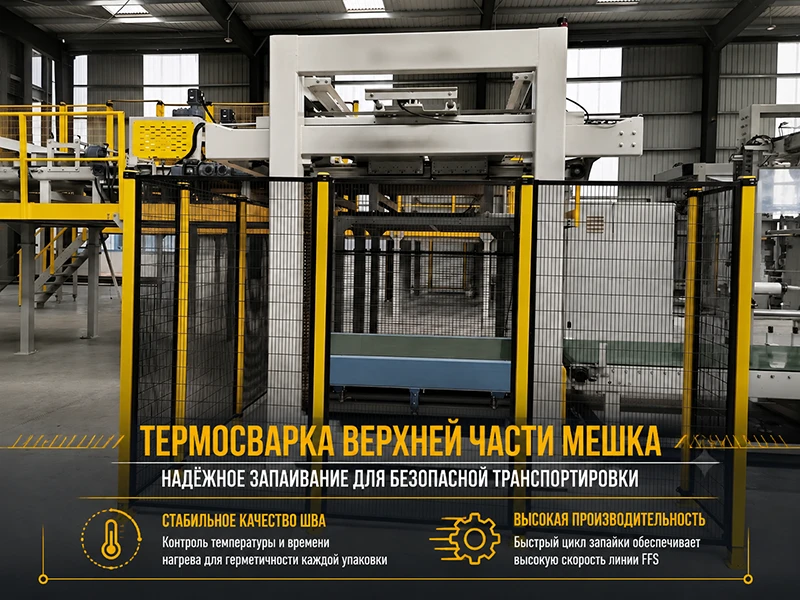
    Factory-installed upper-bag heat sealing unit for FFS line with safety fencing and conveyor integration

    From sealed sack to traceable, pallet-ready output

    A fertilizer packaging line is complete only when the accepted bag can be identified, grouped and moved. Bag-level date or batch marking and a pallet labeling machine serve different traceability tasks. The line can also include bag shaping, a high-level palletizer or robotic palletizing system, an automatic pallet magazine and a stretch hood machine. These modules are selected against the bag rate, pallet pattern, building height and forklift route; they should not be treated as automatic standard equipment.

    The factory palletizing station provides the final physical proof: guarded conveying, a robotic handling area and a controlled pallet interface. Together with online forming, filling, sealing and inspection, this turns bulk material bagging into a repeatable logistics unit. Labor is moved away from lifting and sewing toward supervision, quality checks and planned changeover.

    Line pointFFSline evidenceProject confirmation
    Bag and fillPE/PP roll film, online bag forming and controlled weighingMaterial flow, 20/25/50 kg format and film specification
    Seal protectionHeat sealing with bottom and mouth cooling logicSeal temperature, cooling time and bag-drop conditions
    Quality loopCheckweigher/reject and metal detection available as optionsAccuracy, reject policy and inspection standard
    DispatchConveyor, labeling, palletizing and stretch-hood modules can be linkedBag rate, pallet pattern, ceiling height and forklift flow
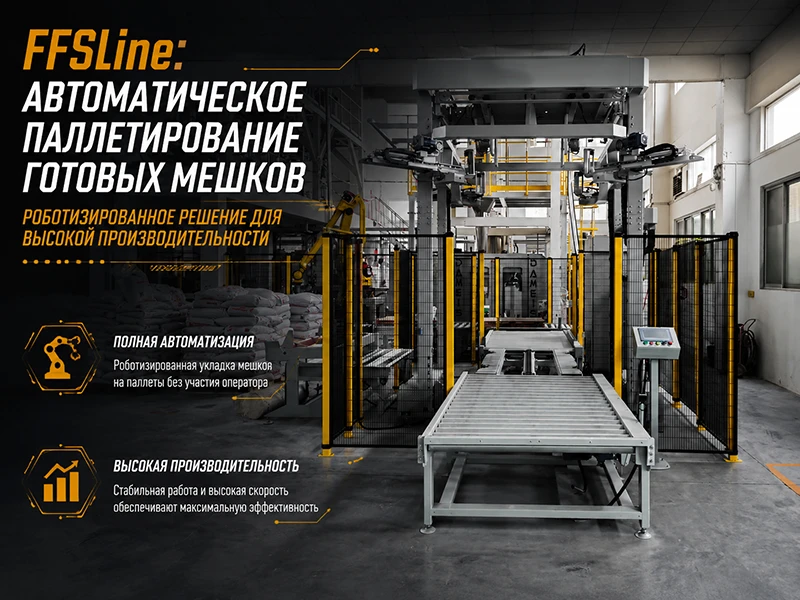
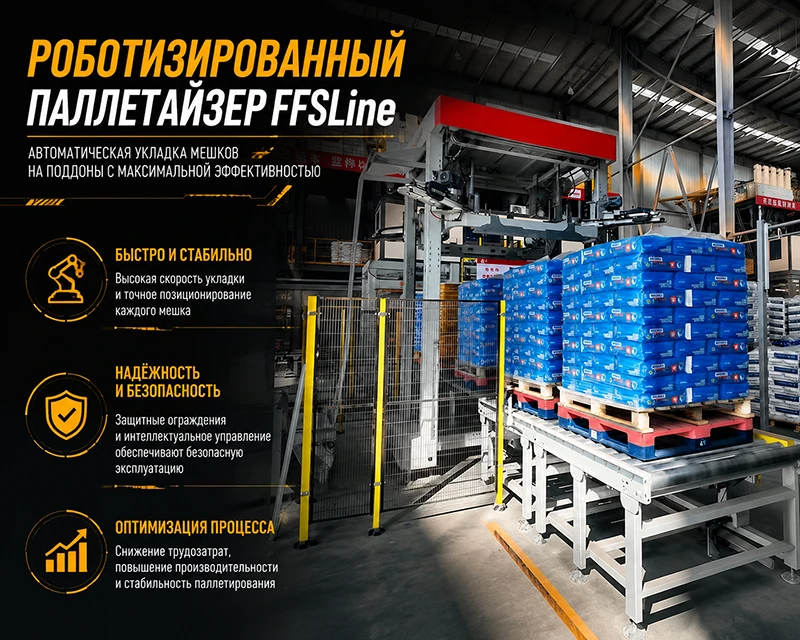
    Automated bag palletizing line with robotic arm, safety fencing, and conveyor in industrial warehouse

    Specify the material before specifying the machine

    Share the fertilizer type, bulk density, target bag weights, film data, required bags per hour, building constraints and pallet pattern. BPM can then size the form-fill-seal packaging machine, checkweigher reject system and palletizing route around the actual acceptance conditions.

    Discuss a 25 kg FFS packaging line
  • FFS packaging line: 25 kg fertilizer flow

    FFS packaging line: 25 kg fertilizer flow

    BULK MATERIAL BAGGING

    FFS packaging line: 25 kg fertilizer flow

    For a fertilizer producer shipping 25 kg bags, an FFS packaging line connects roll-film bag making, controlled filling, sealing, inspection, and palletizing so granular material reaches dispatch in a stable, traceable format.

    Factory-installed FFS packaging line with enclosed forming, filling, sealing and palletizing modules

    From manual fertilizer bagging to a connected line

    A fertilizer, polymer-granule, or feed producer usually starts with a simple target: fill a heavy bag and move it to the warehouse. The difficulty appears when output increases. Open woven bags or paper sacks require bag staging, manual positioning, separate weighing, sewing, label application, and hand palletizing. Each handoff adds a queue, a chance of weight variation, and another point where a freshly closed bag can be damaged.

    An FFS packaging line addresses this sequence at its source. PE or PP roll film is formed into the bag on the machine, then the product is metered, filled, heat sealed, cooled, checked, and transferred to the end-of-line section. The route is intended for free-flowing granules and suitable coarse powders; the final film, bag geometry, material density, and 20 kg, 25 kg, or 50 kg format still require a project trial and technical confirmation.

    Twin-lane FFS packaging line with elevated platforms, safety railings, and modular conveyor sections in a factory.
    Twin-lane layout evidence: elevated service platforms, guarded conveyors, and parallel packaging flow.
    The old-solution problem

    Manual bag handling hides the real production loss. Operators compensate for unstable feed, interrupted weighing, bag-bottom impact, and uneven stacking by slowing the line or correcting every sack. The result is labor tied to repetitive handling, inconsistent pallet shape, and more rework when a bag leaks or falls outside the accepted weight.

    Why an FFS packaging line fits heavy granular materials

    The FFS packaging line is configured as a sequence rather than a single filler. A transition hopper can buffer supply; the blog brief identifies a 3 m³ example for a project solution, with vibration, anti-bridging, or sampling features selected according to the fertilizer and feed behavior. A single-head servo weigher, PLC, and HMI coordinate the target quantity, while the forming collar and film-pull system keep bag production synchronized with filling.

    Heat sealing and cooling matter after the product has entered the bag. The bottom and mouth sealing zones need time and controlled contact before the filled sack is accelerated into downstream conveying. This protects the seal against impact-related leakage. Optional checkweigher and reject equipment can separate underweight or overweight bags; metal detection, dust collection, coding, bag labels, and pallet labels can be added when the quality and traceability plan requires them.

    Engineering note: Published figures must be read as design targets, not universal guarantees. A project may reference 500 bags/h for a fertilizer line or a higher 1,000–1,200 bags/h class, but flowability, particle-size distribution, moisture, continuous feeding, film, bag dimensions, and acceptance conditions decide the verified result.

    Factory-installed upper-bag heat sealing unit for FFS line with safety fencing and conveyor integration
    The upper-bag heat-sealing station shows how closure, guarding, and conveyor integration form one controlled handoff.

    Structure and end-of-line evidence

    The visible structure of an FFS packaging line explains the operating logic. A guarded forming and filling section handles the roll film and product contact zone. Downstream conveyors carry the sealed bags through settling, weight verification, coding, labeling, and rejection where specified. The layout can then connect to high-level or robotic palletizing, an automatic pallet store, and a cold stretch-hood unit so a finished pallet is ready for forklift transfer rather than manual rebuilding.

    Robotic palletizing is not only a labor-saving accessory. It controls the placement pattern and keeps the pallet profile repeatable for export loading and warehouse logistics. Bag-face identification and full-pallet identification are separate traceability tasks, so the label positions and data sources should be defined in the technical agreement. The same discipline applies to film width, film thickness, roll diameter, compressed air, power, and the available installation envelope.

    Automated bag palletizing line with robotic arm, safety fencing, and conveyor in industrial warehouse
    Robotic palletizing evidence: guarded transfer from the FFS packaging line to a repeatable pallet pattern.
    Project checkpointFFSline design responseConfirmation required
    Product and bagPE/PP roll film, commonly M-style heavy film, for granular or suitable coarse materialBulk density, moisture, particle size, bag size, and film trial
    Nominal format25 kg fertilizer is the reference scenario; 20 kg and 50 kg can be reviewedBag geometry, film width, seal dimensions, and changeover scope
    Quality loopCooling, checkweighing, reject, coding, and optional metal detectionAcceptance accuracy, inspection points, and product safety plan
    DispatchSettling, conveyor transfer, robotic or high-level palletizing, and stretch hoodThroughput, pallet pattern, warehouse route, and forklift interface

    Define the right fertilizer packaging route

    The final result is not simply a filled bag. It is a controlled flow from bulk material to sealed, inspected, labeled, and pallet-ready output, with less manual intervention and clearer responsibility at each handoff. Share the product, target bag weight, film data, required bags per hour, and floor plan with BPM for a project review of the FFS packaging line and its optional downstream modules.

    Request a project review
  • Plastic Pellet Packaging Line: Polyethylene Output

    Plastic Pellet Packaging Line: Polyethylene Output

    Polyethylene granule packaging

    Plastic Pellet Packaging Line: Polyethylene Output

    For a polyethylene resin producer shipping PE granules in 25 kg bags, a plastic pellet packaging line replaces manual weighing and separate bag closing with roll-film forming, controlled filling, heat sealing, inspection, and pallet-ready outfeed. The result is a repeatable bag flow for warehouse and export dispatch, subject to material, film, and acceptance trials.

    Plastic pellet packaging line with twin-lane conveyors, elevated platforms, and safety railings

    The production scene: from PE granules to pallet-ready bags

    A polyethylene and polypropylene pellet plant often has a clear dispatch requirement: turn free-flowing plastic granules into consistent heavy bags, identify each production batch, and move finished pallets to storage or a loading area without relying on a large manual packing crew. The same need appears in resin, color masterbatch, recycled polymer, and related bulk-material operations where a 20 kg, 25 kg, or 50 kg format must be confirmed against density, particle shape, and customer handling rules.

    The older route commonly combines pre-made woven or paper-plastic bags, manual weighing, hand positioning, sewing, and a separate palletizing step. That arrangement can work at low volume, but the handoffs create variation: operators correct bag position, rework weights, close bags at different speeds, and reshape units before stacking. A plastic pellet packaging line is a better fit when the plant wants one controlled sequence from roll film to sealed sack, while still keeping the final design conditional on trials.

    Plastic pellet packaging line robotic palletizer stacking bagged polyethylene pellets on pallets
    Why the old bagging route loses control

    Manual bagging separates weighing, bag closing, inspection, labeling, and pallet handling into different jobs. A small interruption at one point can stop the next point: unstable feeding causes weight variation, a newly sealed bag can be damaged during transfer, and a pallet may leave the line without the same batch information as the individual bags. Open handling can also increase product exposure and housekeeping work. These are process-control issues, not simply labor issues.

    Why this plastic pellet packaging line fits polyethylene granules

    A plastic pellet packaging line uses PE or PP roll film to form the bag online, then combines metered filling with bottom sealing, upper sealing, and post-seal cooling. This form-fill-seal route removes the need to store a matching quantity of pre-made bags and gives the engineering team a direct way to set film width, bag length, and sealing conditions around the selected pack. For free-flowing granules, the weighing unit can be configured around the product density and target bag weight rather than treated as a universal setting.

    The FFSline arrangement can include a transition hopper of about 3 m³, a servo weighing unit, PLC and HMI control, and a downstream sequence for settling, checking, rejecting, coding, labeling, palletizing, and stretch-hood wrapping. The standard project example is a 25 kg fertilizer-style heavy bag, while polyethylene pellets may require a different feeding profile, film structure, or discharge speed. Heat-seal cooling is important because it protects the fresh seal from impact while the filled bag moves into the transfer section.

    Engineering note: A 500 bags/h design level is a useful reference for the main line example. Product literature also describes 1,000–1,200 bags/h class configurations, but actual output depends on pellet flowability, particle-size distribution, moisture, continuous feeding, bag format, film behavior, and the agreed acceptance test. Weighing accuracy, film thickness, and optional inspection equipment must be confirmed in the project technical specification.

    What this plastic pellet packaging line controls before dispatch

    The control chain starts with a steady material feed and continues through forming, filling, sealing, cooling, and outfeed. A checkweigher with reject handling can be added after the bag has settled; metal detection is also an option rather than an assumed standard. Bag-side date or batch marking and pallet-side logistics labeling serve different traceability tasks, so the line layout should reserve space for both when the export workflow requires them.

    At the end of the line, guided conveyors keep filled sacks moving toward a high-level or robotic palletizing cell. The palletizer, automatic pallet store, bag shaping, and stretch-hood machine are selected against the required rate and floor plan. This lets the customer start with a stable bag and inspection process, then add downstream automation where warehouse turnover and labor economics justify it. For a related granular-material reference, compare the 25 kg granular packaging line example; for a powder-flow comparison, see the automatic powder bagging line.

    Item to confirmFFSline planning referenceWhy it matters for PE pellets
    Material and packPE or PP pellets; commonly 20, 25, or 50 kg after trialsBulk density and particle shape affect the feeder, scale, and bag dimensions.
    Roll filmPE or PP film; typical width 350–450 mm, outer diameter about 1,500 mm, core 150 mmFilm behavior determines forming, sealing, and the final bag footprint.
    Film thicknessCommon project range 0.14–0.18 mm, subject to supplier confirmationStrength and sealing conditions must match the filled sack and handling route.
    Supply and controlAbout 3 m³ transition hopper, servo weighing, PLC and HMIBuffering and feedback help maintain a repeatable filling cycle.
    End of lineCheckweigher/reject, coding, pallet labeling, robotic or high-level palletizing, stretch hood as requiredInspection and pallet stability connect the packing cell to warehouse dispatch.

    Plan a plastic pellet packaging line around the actual material

    Before selecting the final machine arrangement, provide the pellet type, bulk density, particle-size range, target bag weights, film specification, required bags per hour, labeling rules, and available floor space. BPM can then match the forming, weighing, sealing, inspection, conveying, and palletizing stages to a documented trial and acceptance route. This is how a polyethylene packaging project moves from a nominal machine speed to stable, pallet-ready output.

    Request a project review