Automatic Bagging Machine & Palletizing Systems Manufacturer

Category: English

  • Automatic Powder Bagging Machine: Cleaner Transfer

    Automatic Powder Bagging Machine: Cleaner Transfer

    MIPLINE | DRY POWDER BAGGING

    Automatic Powder Bagging Machine: Cleaner Bag Transfer

    For dairy powder, flour, starch, feed, and compatible dry chemicals, Mipline connects controlled filling with bag handling, guided transfer, closure, and inspection so 25 kg bags arrive at sewing or sealing in a more stable condition.
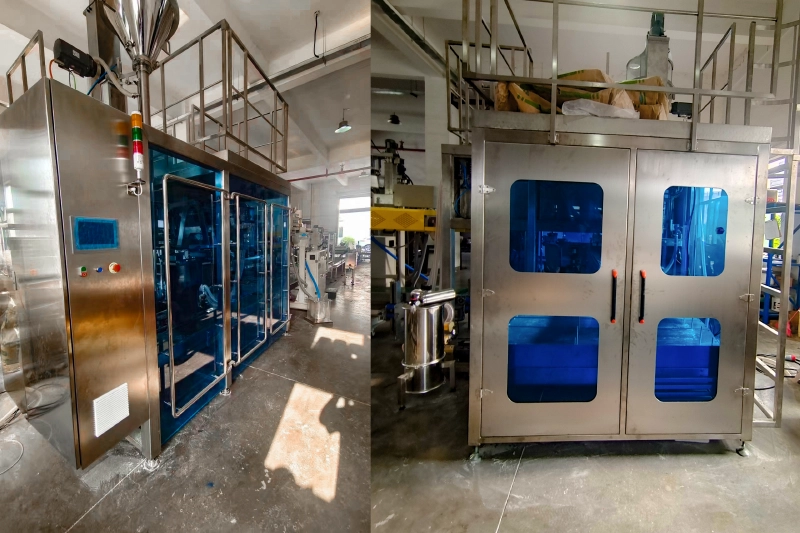
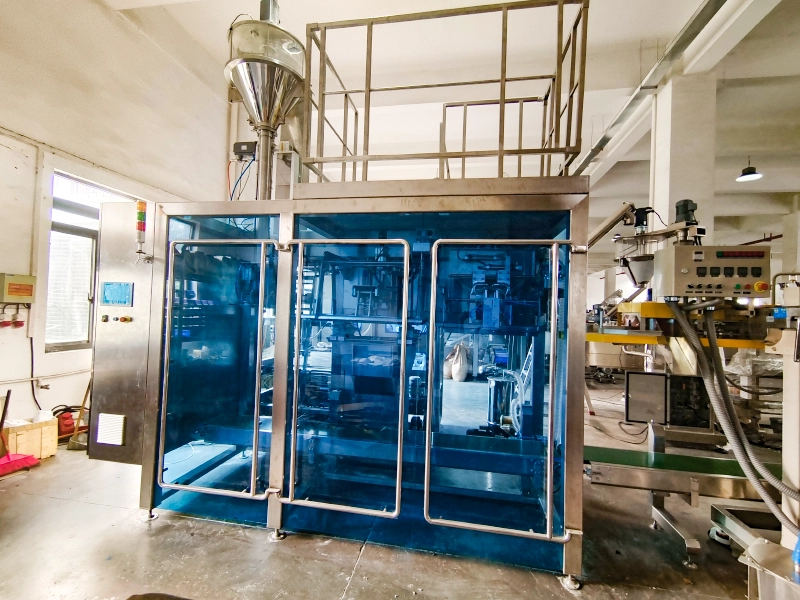
    Enclosed stainless steel powder packaging line with blue viewing windows and top maintenance platform

    Start with the bag and the handoff, not only the filler

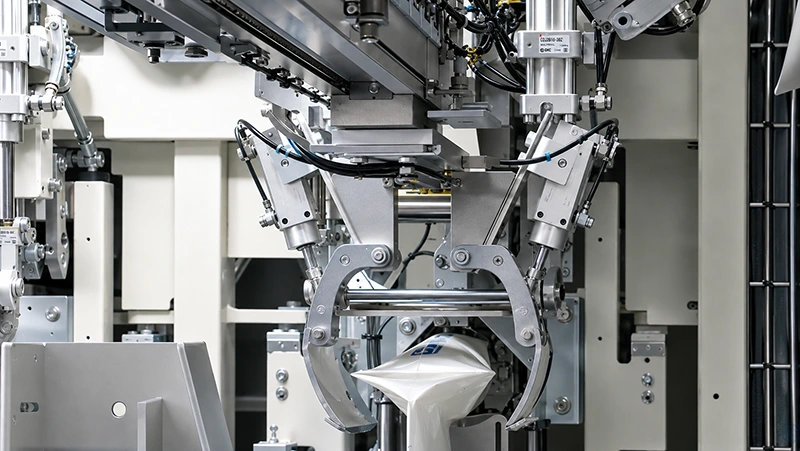
    A plant searching for an automatic powder bagging machine usually has a familiar production problem: the powder can be weighed, but the filled bag still twists, collapses, or arrives crooked at the sewing head. This is common on 25 kg kraft paper, paper-plastic composite, or coated woven bags when the operator has to open the bag, hold the mouth, straighten the body, and push it toward the next station by hand. The line may appear to be running, yet the last metre creates rework and interrupts the closure step.

    The old semi-manual route also exposes the bag mouth to powder. Free-fall filling can leave product around the sealing or sewing area, while a loose conveyor only moves the bag without controlling its posture. Mipline treats the automatic powder bagging machine as a process line: bag magazine supply, pickup, opening, clamping, bottom-up filling, closure, settling, shaping, inspection, reject, and discharge are planned as connected operations. That approach is relevant to a dairy powder bagging line as well as flour or starch packaging when the bag format and powder behaviour are confirmed during project design.
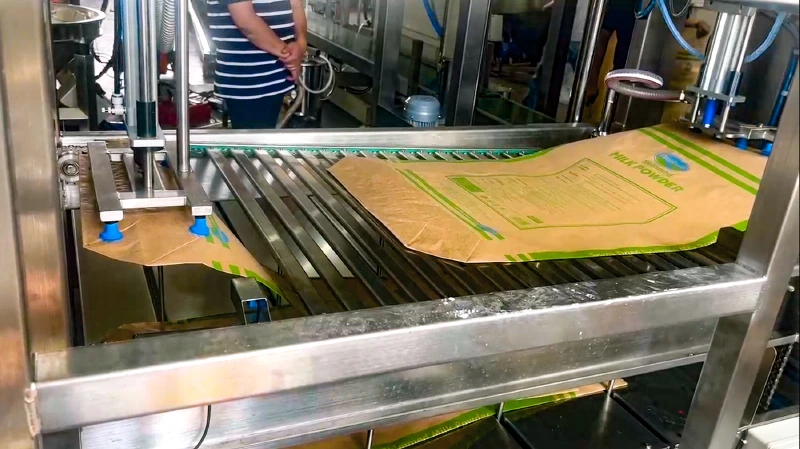
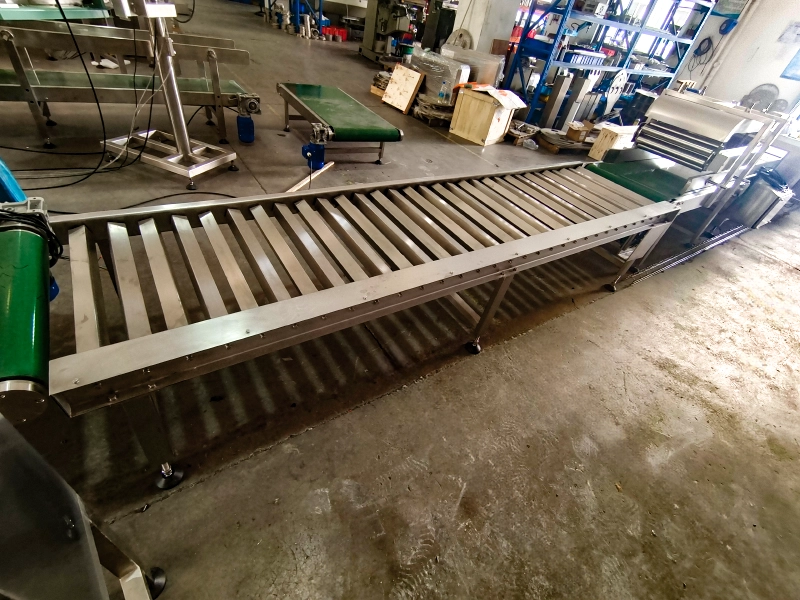
    Powder packaging line roller conveyor with vacuum grippers handling kraft paper bags
    The last metre exposes upstream inconsistency

    If an operator must repeatedly square the bag before sewing, the problem is not solved by adding speed to the filler. The handoff needs support, alignment, and a defined next position.

    Why Mipline fits 25 kg dry-powder lines

    Mipline uses a lifting platform for bottom-up tracked filling, keeping the fill point close to the rising material rather than allowing a long open drop. A vertical screw feeder can be arranged for fast, medium, and slow final dosing, while weighing control manages the target fill. Where the material and bag require it, vacuum extraction or de-aeration can be included before closure. These functions give the automatic powder bagging machine a direct answer to dust around the mouth, trapped air, and unstable bag shape instead of leaving each issue to an operator.

    Bag clamping and guided conveying then carry the filled bag into the next operation. Depending on the approved configuration, closure can combine dust removal, trimming, inner heat sealing, sewing, hot-melt paper tape, and pressing. After closure, settling and shaping help the bag develop a more repeatable profile before metal detection, checkweighing, reject handling, and roller discharge. The goal is not an unsupported claim of one universal speed or accuracy; it is a controlled route that can be matched to bulk density, flowability, moisture, aeration, bag construction, and the required sewing or sealing method.
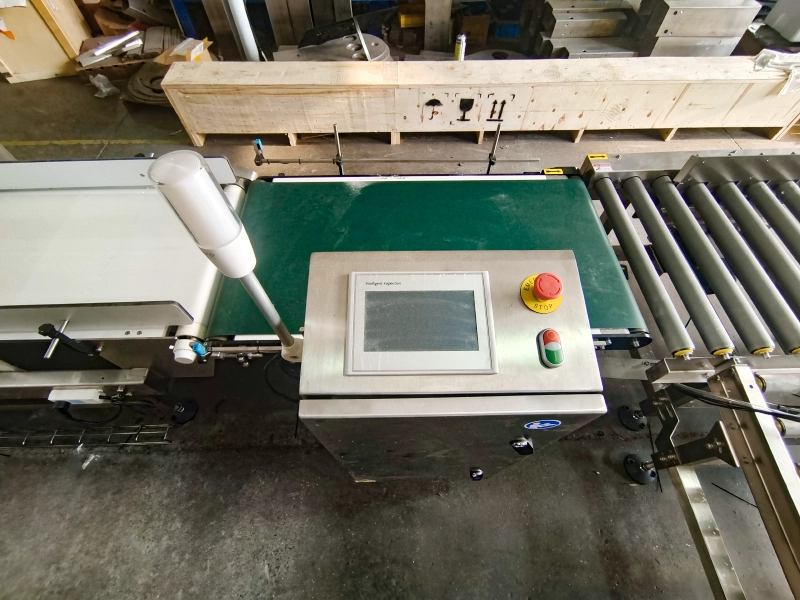
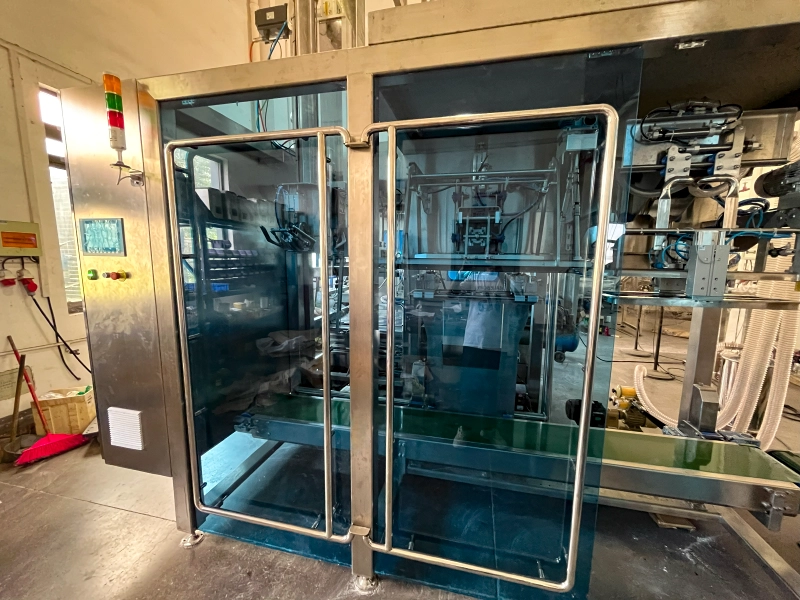
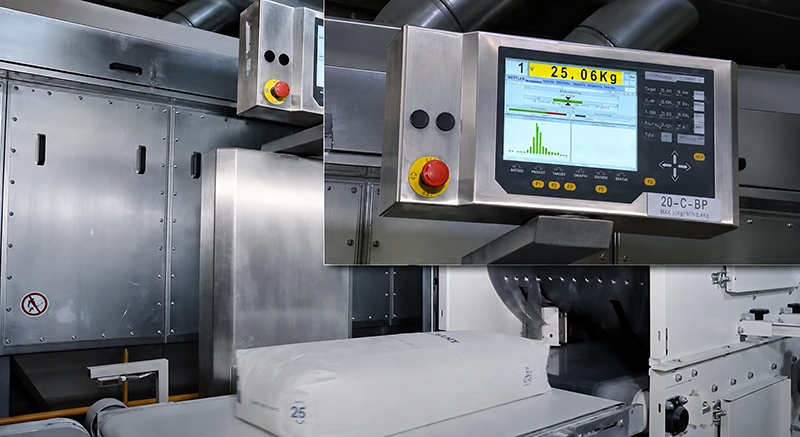
    Powder packaging line conveyor with touch-screen HMI, emergency stop, and roller transfer

    Engineering view: The value of an automatic powder bagging machine is measured at the interface between stations. A clamp, guide, roller section, or settling step matters when it removes a specific correction that used to happen by hand.

    Structure and reference data behind the line

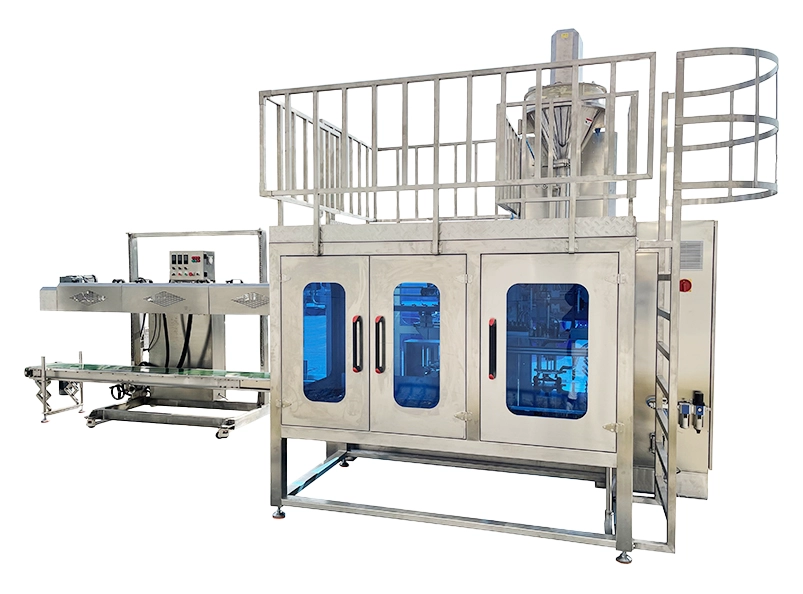
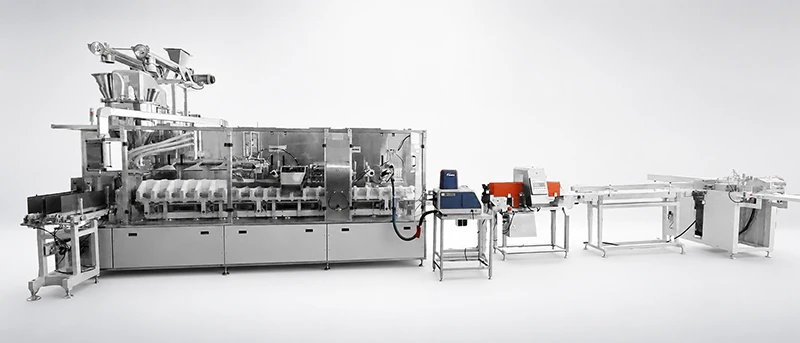
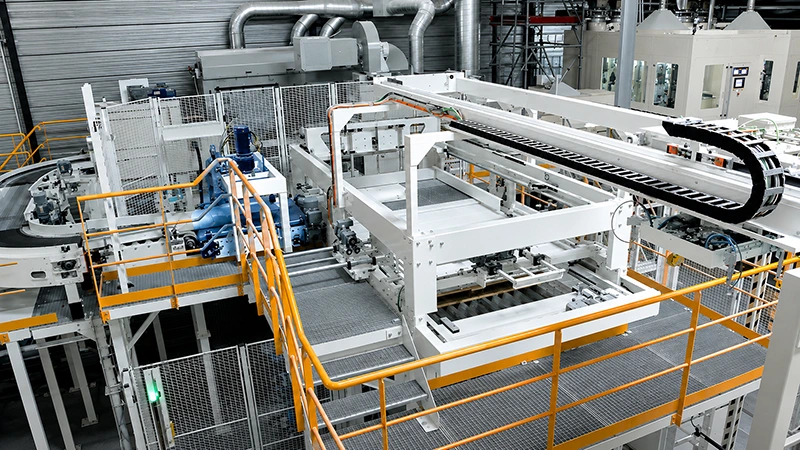
    The factory evidence shows an enclosed stainless-steel machine body, blue inspection windows, guarded access, HMI control, green belts, roller transfers, and a downstream path for finished bags. Those visible structures support the intended workflow, but an image alone does not prove capacity, customer identity, or final performance. The automatic powder bagging machine must be confirmed against a powder sample, bag drawing, target weight, utilities, closure method, and layout.
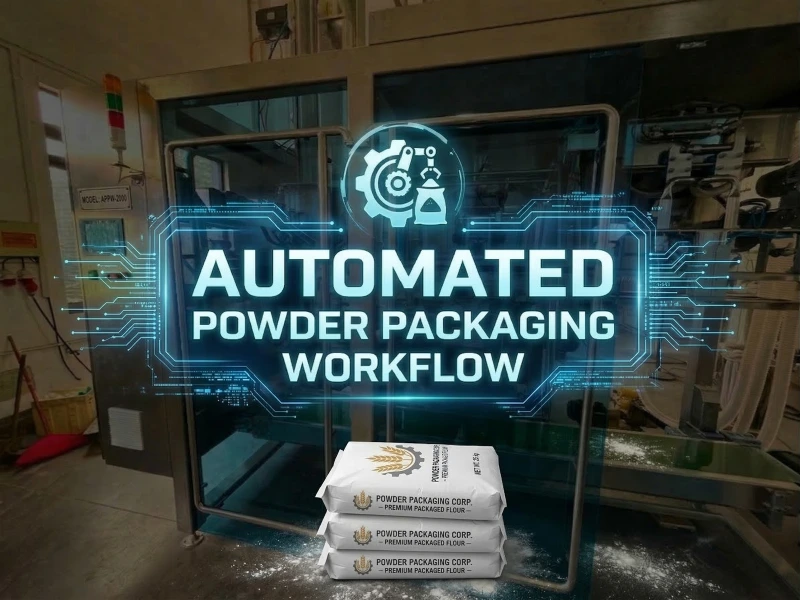
    Automated powder packaging line with safety enclosure, conveyor section, and finished bags
    Line elementReference evidenceProject check
    Bag formatNominal 25 kg industrial powder bagsConfirm dimensions, material, mouth, and filled-bag profile
    Filling sequenceBottom-up lifting fill with three-stage screw feedingMatch screw and control logic to density, flowability, and aeration
    Reference capacity1.5–2 bags/min in one 11889 line listVerify the selected variant, material, and downstream cycle time
    Reference utilitiesSUS304 body, 5 kW main power, 5.5 m³/h air consumptionConfirm the approved electrical and compressed-air specification
    Vacuum option63 m³/h vacuum rate in the referenced configurationConfirm whether de-aeration or residual-oxygen targets apply
    Final quality gateMetal detection, checkweighing, reject, and roller discharge optionsUse the selected detector and checkweigher datasheets

    With these inputs fixed, the result is practical: fewer manual bag-straightening actions, a cleaner and more repeatable handoff before sewing or sealing, and a finished-bag inspection path that is easier for production and quality teams to manage. Review the Mipline powder packaging line overview or send the bag and powder details for a project fit review.

    Confirm your powder bagging line configuration

    Share the powder type, target weight, bag construction, closure method, required output, and available utilities so the automatic powder bagging machine can be configured around the real handoff problem.

    Request a project fit review
  • Milk Powder Packaging Line: Stable 25 kg Bag Transfer

    Milk Powder Packaging Line: Stable 25 kg Bag Transfer

    25 kg dairy powder bagging, filling to sewing handoff

    Milk Powder Packaging Line: Keeping 25 kg Bags Stable Before Sewing

    A milk powder packaging line is judged at the sewing head, not at the filler. On a 25 kg kraft paper or coated woven bag, a few degrees of skew, a puff of powder at the bag mouth, or a bag that still holds air is enough to slow the whole line down and put an operator back at the last metre, straightening bags by hand. Mipline is configured around that handoff: an enclosed stainless steel bagging station, a bag magazine conveyor, clamped bottom-up filling, guided roller and twin-belt transfer, then settling, shaping, checkweighing and discharge before palletizing.

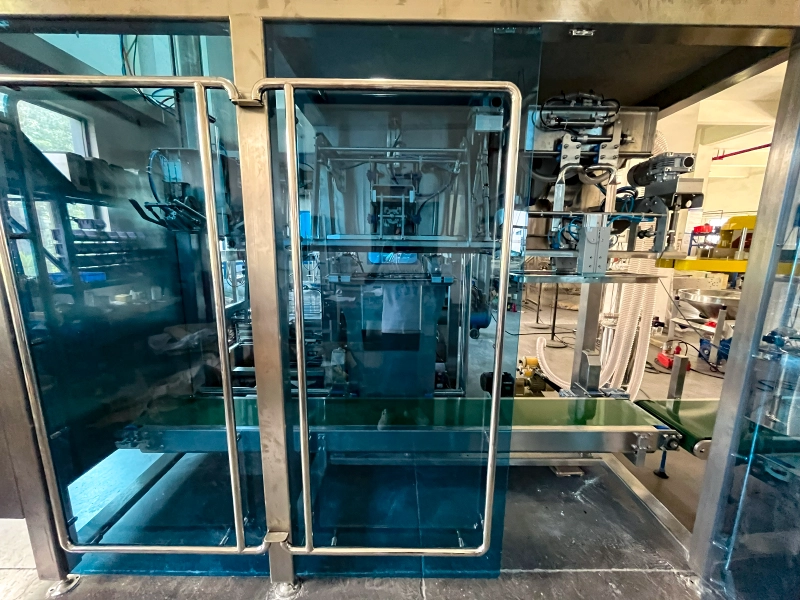
    Enclosed automatic bagging station on a milk powder packaging line with stainless steel guarding and green conveyor belt

    Bag supply and opening: the first failure point

    Most reworked bags are not caused by the weigher. They are caused by how the bag arrives at the fill point. When an operator pulls a bag from a stack, opens it by hand and holds the mouth over the filling spout, the bag angle changes from bag to bag. A bag that starts three degrees out of square is still three degrees out of square when it reaches the sewing head, and by then it is carrying 25 kg of product. On a milk powder packaging line that runs a full shift, correcting that small variation is what the operators are actually doing instead of checking weight or watching the closure.

    Mipline takes the bag out of the operator’s hands earlier. A bag magazine conveyor feeds flat bags to the station, a vacuum pickup lifts and opens one bag at a time against a fixed reference, and the opened bag is positioned and clamped before filling starts. Because the bag is held by the machine rather than by a person, the position of the bag mouth at the fill point stays repeatable from the first bag of the shift to the last. The factory image below shows the infeed and discharge side of that station: bag magazine feed, control cabinet with the vacuum circuit and hose run, and the green transfer belt that carries the opened bag into the filling position.

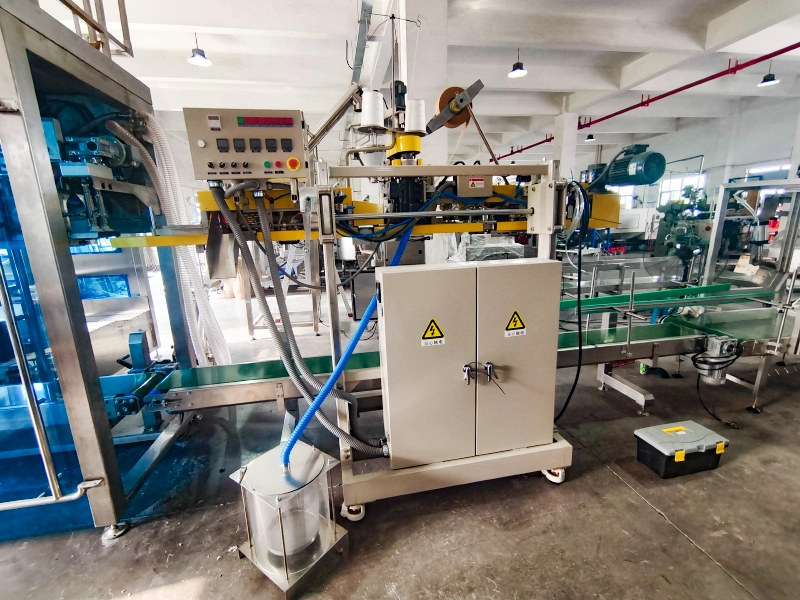
    Mipline automatic bagging station with conveyor, control cabinet, and vacuum hose on a milk powder packaging line
    The last metre is where powder lines lose money

    Free-fall filling throws dust up into the bag mouth. Operators straighten heavy bags by hand. The sewing head then receives a skewed, dusty, air-filled bag and produces a seam that has to be reworked before the bag is fit for a pallet.

    Bottom-up filling on a milk powder packaging line: clean bag mouth, repeatable weight

    On a milk powder packaging line the fill method decides how much cleaning the bag mouth needs. Free-fall filling drops powder from above, so air is displaced upward through the open bag and carries fines onto the sealing surface. Bottom-up filling does the opposite: the bag is clamped and lifted as it fills, so the fill point stays close to the rising product surface and there is far less free fall, far less dust in the air stream and far less build-up around the mouth. A three-stage vertical screw feed then finishes the job in three steps — fast fill, medium fill and a slow final dose — so the last part of the weight is added gently instead of dropped.

    The practical result is a bag mouth that is cleaner when it leaves the fill station and a gross weight that drifts less from bag to bag. On dairy powder this counts twice: powder left on the sealing surface weakens the closure, and powder on the outside of an industrial bag is a hygiene problem on a food-grade floor. Weight verification is still a separate step, and a checkweigher is selected per project, because reference datasheets quote different belt widths, throughputs and accuracies for the same 25 kg duty.

    Field note: Start from the bag, not the machine. Bag construction, gusset, bag height and powder bulk density set the fill geometry; the filling head, settling section and closure method follow from there. Filling accuracy figures quoted for one powder should never be copied onto another without confirmation.

    Stable bag transfer before sewing on a milk powder packaging line

    The transfer between filling and closure is where most 25 kg lines lose their rhythm. A filled bag sitting loose on a plain belt can twist, lean or settle unevenly, and the sewing head becomes unstable because the bag mouth arrives skewed. Mipline uses guided roller conveyor sections and adjustable side guides to keep the bag square through the handoff, with clamping on the bag body instead of relying on an operator to keep pace with the line. Twin-belt transfer sections with adjustable guides carry the same alignment further downstream.

    Downstream the logic continues: turning and settling so the powder levels out, shaping so the bag is flat and stackable, metal detection and checkweighing on the formed bag, a defined reject path, and roller discharge to the palletizer. A milk powder packaging line that treats closure and inspection as one sequence delivers fewer rejects at the pallet than a line that treats sealing as the end of the process. Around all of it sits an enclosed stainless steel frame with blue inspection windows, guarding, an emergency-stop point and a top access platform — so the line can be watched, cleaned and maintained without dismantling the bagging station.

    ParameterReference valueWhat it changes on the line
    Bag weight and format25 kg industrial bags; kraft paper, paper-plastic composite or coated wovenSets fill geometry, clamp size and conveyor loading
    Stated capacity1.5–2 bags/min (referenced configuration)Shift planning only; confirm against your powder and bag
    Stated filling accuracy≤±0.1–0.2%Giveaway control; verify on the actual material
    Feeding systemVertical screw, three-stage dosing with bottom-up lift fillDust at the bag mouth and weight repeatability
    Body and hygieneSUS304 stainless steel enclosure and product-contact partsCleaning access and food-grade finish
    Closure pathDust removal, trimming, sealing, sewing and paper tape where configuredSeam condition after filling and transfer
    Inspection and dischargeMetal detection plus checkweighing on the formed bag, reject path, roller dischargeCatches contamination and weight drift before the pallet

    Planning a milk powder packaging line around your own bag?

    Send the bag drawing, target weight, powder bulk density and the output you need per shift. We will come back with the station layout, the transfer and alignment sections, and the closure and inspection sequence for a milk powder packaging line that matches your product and your floor, not a generic catalogue machine.

    Request a line review
  • Milk Powder Packaging Line: Bottom-Up Filling and Dust Control Before Sealing

    Milk Powder Packaging Line: Bottom-Up Filling and Dust Control Before Sealing

    Mipline · 25 kg Dry Powder Bagging

    Milk Powder Packaging Line: Bottom-Up Filling and Dust Control Before Sealing

    A 25 kg milk powder packaging line built around bottom-up tracked filling, dust extraction at the fill point, and stainless steel enclosed bagging is the cleanest answer to the three problems every dairy powder plant keeps reporting: powder escaping at the bag mouth, bags arriving skewed at the sewing head, and operators straightening bags by hand in the last meter of the line.

    Stainless steel automatic bagging machine with blue inspection windows, bag magazine conveyor, and top access platform on a milk powder packaging line

    Why a Milk Powder Packaging Line Loses Bags at the Sewing Head

    Most 25 kg milk powder packaging lines look clean in the brochure and messy on the floor. Powder hangs in the air above the open bag, the bag mouth gets dusted with fines, and the filled bag leans as it rolls down the conveyor. By the time it reaches the sewing station, an operator is already holding the bag flat and squaring it with a free hand. That is the symptom. The root cause is almost always upstream: free-fall filling, no dust extraction at the fill point, and a conveyor that was never asked to keep a 25 kg bag aligned.

    A milk powder packaging line should not be a screw conveyor pouring powder from 1.5 meters up into an open sack. Free-fall filling generates a dust cloud, splashes fines onto the inner bag wall, and leaves a stable air pocket inside the filled bag. That pocket is what makes the bag skew on the conveyor and arrive crooked at the sewing head. The Mipline milk powder packaging line is built to attack this with bottom-up tracked filling, where the lifting platform rises under the fill nozzle as the bag fills, keeping the drop distance constant and short.

    Stainless steel enclosed industrial machine with blue viewing windows, double doors, and top maintenance platform used on a milk powder packaging line
    The pain on a real milk powder packaging line

    Operators straighten 25 kg bags by hand before sewing because the bag twists in the last meter of conveyor. The sewing head misses stitches when the bag mouth is skewed. Fines settle on the inner bag wall and contaminate the heat-seal area. Air pockets make the bag bulge so it cannot stack square on the pallet. None of this is solved by adding another operator; it is solved by the line design.

    Bottom-Up Tracked Filling on a Milk Powder Packaging Line

    Bottom-up filling is the single biggest reason a milk powder packaging line can keep a bag square from gross weigher to sewing head. On a Mipline milk powder packaging line, the bag is clamped to the filling head, the lifting platform rises under the bag as powder is dosed in, and the screw feed point stays a fixed short distance above the rising powder bed. This holds three things constant that free-fall filling cannot.

    First, the dust path is short. With a small drop distance, fines cannot aerosolize the way they do when powder falls from 1.5 meters. The Mipline milk powder packaging line adds a dust extraction collar at the fill point so the air pulled off the bag is filtered, not vented back into the room. Second, the bag stays symmetric during filling. Because the platform rises with the fill level, the side loads on the bag are balanced and the bag does not bulge to one side. Third, the bag mouth stays clean. Fines do not splash onto the inner wall, so the heat-seal or sewing station gets a clean mouth and a stable bag.

    Engineering note: On a milk powder packaging line, three-stage screw feeding (fast, medium, slow final dose) is what lets the line reach the target weight without overshoot. The fast stage fills 80 percent of the dose in open loop, the medium stage trims toward setpoint, and the slow stage closes to the final gram. Treat any single-stage fill claim as marketing, not engineering.

    How the Bag Gets to the Sewing Head Square

    Filling is half the job. The other half is the conveyor path between the gross weigher and the sewing head. On a Mipline milk powder packaging line, the bag is handed off from the filling clamp to a guided transfer section. The transfer is not a single long belt that lets the bag wander. It is a controlled sequence: clamp release, roller handoff, twin-belt transfer with adjustable side guides, then shaping section before the sewing head. The adjustable guides are what keeps a 25 kg bag from drifting sideways as it loses the support of the clamp.

    For milk powder lines that use a paper-plastic composite bag, the closure is usually a heat seal plus paper-tape wrap, not just sewing. The bag still needs to arrive at the sealer with a square mouth, and the same guided transfer logic applies. The Mipline milk powder packaging line keeps the bag square through the shaping section, which is a 1,500 mm section of belt at 600 mm width and 15 m/min, designed to settle the bag into a stable square before it reaches inspection.

    Factory-installed stainless steel belt conveyor with adjustable guide rails and enclosed transfer tunnel for stable milk powder bag handling

    Settling, Shaping, and Inspection Before the Bag Leaves the Line

    A filled 25 kg milk powder bag is not stable the instant it leaves the clamp. Powder settles, air pockets equalize, and the bag shape can change in the first 30 seconds after fill. A milk powder packaging line that skips settling and shaping will send an unstable bag to the palletizer, and the pallet will lean. The Mipline milk powder packaging line runs a 3,000 mm settling conveyor at 600 mm belt width and 15 m/min, followed by the shaping section, before the bag reaches inspection.

    Inspection on a milk powder packaging line is two checks, not one. A checkweigher reads the gross weight and rejects bags outside the tolerance band, and a metal detector screens the closed bag before discharge. Both run after settling and shaping so the bag is stable when it is weighed. A checkweigher reading a settling bag returns noise, not weight. The reject path drops off-weight or contaminated bags to a separate lane so they do not enter the pallet stream.

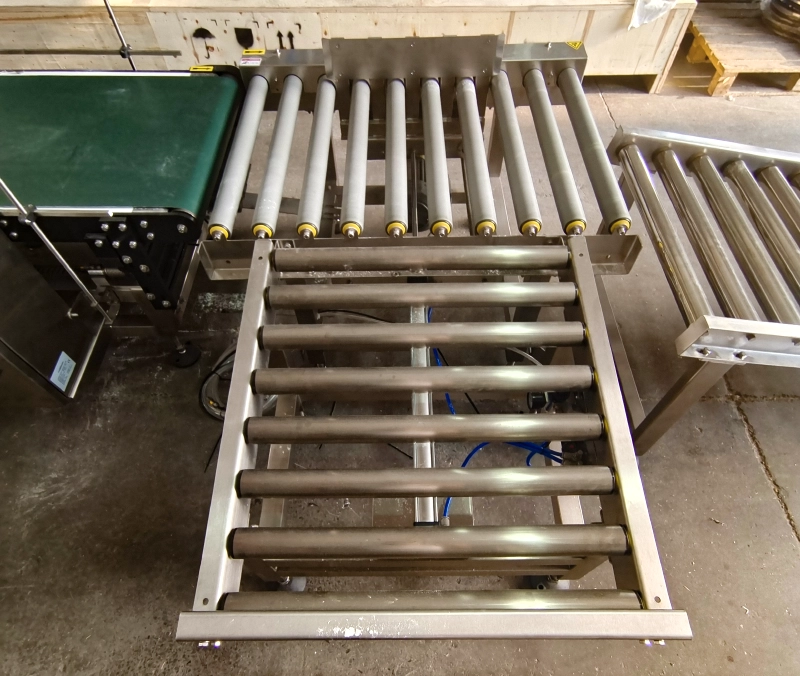
    Stainless steel conveyor weighing platform with adjustable support frame and threaded leveling bolts used on a milk powder packaging line

    What a Buyer Should Verify on a Milk Powder Packaging Line

    Before signing a milk powder packaging line order, a dairy plant should walk the line on paper and confirm five concrete points against the offer, not against a brochure.

    Verification PointWhat to ConfirmMipline Reference
    Fill methodBottom-up tracked filling, three-stage screw dosing, dust extraction at fill pointLifting fill head, fast/medium/slow screw, extraction collar on the milk powder packaging line
    Bag mouth cleanlinessNo operator straightening the bag in the last meter of conveyorGuided roller handoff and twin-belt transfer with adjustable side guides
    Closure stabilityBag arrives square at sewing or heat seal, no skewed mouthShaping section (1,500 mm, 600 mm belt, 15 m/min) before closure station
    Settling before inspectionCheckweigher and metal detector read a settled bag, not a moving one3,000 mm settling conveyor at 600 mm belt width and 15 m/min
    Food-grade constructionStainless steel contact surfaces, enclosed guarding, blue inspection windows for visual check without opening the lineSUS304 body, enclosed stainless steel bagging station, blue viewing windows, top access platform

    A milk powder packaging line that passes these five points is engineered for a dairy powder floor. A line that fails any of them will reproduce the same operator-straightening problem the buyer was trying to leave behind.

    Industrial conveyor line with touch-screen control box, emergency stop, and roller transfer sections on a milk powder packaging line

    Where the Mipline Milk Powder Packaging Line Fits on a Dairy Powder Floor

    The Mipline milk powder packaging line is sized for 25 kg industrial bags, with bag magazine, vacuum pickup, opening, controlled clamping, bottom-up filling, closure, settling, shaping, checkweighing, metal detection, and roller discharge as one continuous sequence. It is built for milk powder, whey powder, dairy powder blends, and other food-grade powders where bag mouth cleanliness and dust control decide the seal quality. It is not a liquid filler, not a sachet machine, and not a standalone weigher without downstream bag handling.

    For a dairy plant that is replacing manual bag opening, manual clamping, and free-fall filling, the milk powder packaging line in this configuration moves the bottleneck from the operators to the line. Output stabilizes around the rated bags per minute for the chosen bag and powder, and the palletizer downstream receives a square, sealed, inspected 25 kg bag instead of a leaning one.

    Real-world automated powder packaging line with safety enclosure, conveyor section, and stacked finished bags at the discharge end of a milk powder packaging line

    Request a Milk Powder Packaging Line Configuration

    Send us your bag size, target weight, powder bulk density, throughput target, and current bottleneck. We will return a milk powder packaging line layout with bag supply, filling, closure, settling, inspection, and discharge mapped to your floor.

    Talk to a Mipline Engineer
  • Automatic Powder Packaging Line: 25 kg Powder Bagging

    Automatic Powder Packaging Line: 25 kg Powder Bagging

    25 KG POWDER BAGGING

    Automatic Powder Packaging Line: 25 kg Powder Bagging

    An automatic powder packaging line replaces manual bag opening, manual clamping, and free-fall filling with a controlled sequence from bag pickup to a sealed 25 kg bag. The result is a cleaner fill point, fewer reworked bags, and a stable handoff before sewing or heat sealing on a dairy powder, flour, or starch line.

    Stainless steel automated packaging line with dual safety doors, conveyor transfer, and control stack light

    Why plants upgrade to an automatic powder packaging line

    For a dairy powder, flour, starch, or food-grade powder plant packing 25 kg kraft or woven bags, the manual work is rarely just at the start of the line. Operators open bags by hand, hold them under the fill head, straighten the bag at the sewing machine, and then lift the finished bag onto a pallet. Each of those steps is where powder escapes, bag mouths skew, and operators slow the line down to a stop. Replacing those manual steps with a controlled machine sequence is the reason most plants move to an automatic powder packaging line in the first place.

    The change is not just about replacing hands with a robot arm. The line is engineered as one continuous flow: bag supply from the magazine, vacuum pickup, bag opening, clamping under the fill head, bottom-up filling, de-aeration, sealing, and guided transfer toward sewing or heat sealing. Once those stations are linked, the bag stops being touched by an operator between the magazine and the discharge conveyor, and that is when rework rates start to fall.

    Stainless steel roller conveyor with green belt infeed and outfeed sections for bag transfer
    Manual correction at the last meter is the most expensive step on a 25 kg powder line

    Bags arrive skewed, the sewing head misses on the first stitch, and operators re-stitch the same bag two or three times. Each re-stitch is lost throughput, lost bag, and lost seal integrity before the bag ever reaches the warehouse.

    What an automatic powder packaging line does at each station

    At the front of the line, a stainless steel bag magazine holds the next 50 to 80 empty bags. A vacuum pickup head takes one bag at a time, opens it with a pair of grippers, and slides it onto the clamp assembly under the filling nozzle. The clamp holds the bag mouth against a dust collar while the fill head lowers into the bag. On a Mipline system this section is fully enclosed in stainless steel with blue inspection windows, so an operator can watch the bag opening and clamp cycle without opening the door.

    Filling happens in three screw stages: a fast feed brings the bag up to about 80% of target weight, a medium feed covers the next 15%, and a slow trim dose lands the bag inside the accuracy window. The bag is lifted by a platform that follows the fill level, so the dust never has the full free-fall distance to escape. This bottom-up filling principle is what separates an automatic powder packaging line from a manual or top-fill setup, and it is the same principle that keeps the bag mouth clean enough for the next station to seal.

    Field note: Bottom-up filling is not a marketing term. It is a mechanical layout choice that keeps the fill point close to the rising powder surface, which is what reduces the visible dust cloud at the bag mouth on most 25 kg powder lines we ship.

    How to specify your line before you buy

    Four project inputs drive almost every layout decision on an automatic powder packaging line: bag type and weight, target throughput, accuracy window, and the closure method. Bag type decides whether the line uses a kraft paper bag with sewing, a paper-plastic composite with heat sealing, or a coated woven bag with hot-melt tape. Each closure method adds or removes stations downstream of the bag clamp, and the settling conveyor length depends on which closure you pick.

    Throughput and accuracy decide the dosing stage and the checkweigher window. Reference configurations for 25 kg powder bags sit between 1.5 and 3 bags per minute, depending on bulk density, screw sizing, and the dust extraction setup. Higher throughput is possible, but it usually means a larger screw, a higher vacuum rate at de-aeration, and a wider settling conveyor after the closure station. Accuracy on a single-pass weigh is usually quoted at ±0.1% to ±0.2%, with a final trim cycle to land the bag inside the checkweigher window before discharge.

    Project inputWhat it changes on the lineTypical range
    Bag typeClosure station, dust collar, magazine geometry25 kg kraft / paper-plastic / coated woven
    Target weightWeighing range, screw sizing, checkweigher window5–25 kg or 25–50 kg
    ThroughputScrew speed, settling conveyor length, reject path1.5–3 bags/min at 25 kg
    Bag opening successVacuum pickup timing, magazine geometry, gripper set99%+ project-verified
    Bottom-up filling liftPlatform stroke, fill head height, dust extraction25 kg bag lift 1,200–1,500 mm
    Closure methodSewing, heat sealing, hot-melt tape, paper-tape wrapSet by bag construction

    Request a project proposal for your 25 kg bagging line

    Send us your powder name, bulk density, bag type, target weight, throughput, and the closure you need. We will return a layout, an indicative price range, and the project inputs we still need to confirm before engineering.

    Request a Project Proposal
  • 25 kg Powder Bagging Line: Hygienic Stainless Steel Design

    25 kg Powder Bagging Line: Hygienic Stainless Steel Design

    Mipline · Hygienic Bagging

    25 kg Powder Bagging Line: Hygienic Stainless Steel Design

    A hygienic 25 kg powder bagging line is the last surface a 25 kg bag of milk powder, flour, starch, or food-grade powder touches before palletizing. Open guarding, dust drift, and unstable transfer are where the line quietly turns a daily audit into a corrective action. Below we show how Mipline’s enclosed stainless steel bagging station, blue inspection windows, and guided transfer earn their cost on a food-grade floor — and what to verify before you sign the PO.

    Stainless steel automatic bagging machine with blue inspection windows, bag magazine conveyor, and top access platform

    Why the Bagging Station Is the Workhorse of the Line

    Most problems on a 25 kg powder bagging line start at the bagging station, not at the filler. That station feeds the empty bag from a magazine, opens the mouth with a vacuum pickup, grips the bag on a clamp, and uses a bottom-up filling head that follows the powder as the bag rises. If any of those four steps slips, the bag mouth arrives skewed at the next station and operators end up straightening it by hand. Mipline builds the bagging station as a single welded stainless steel frame, with a bag magazine conveyor on the infeed side, three blue inspection windows on the operator face, a top access platform with safety railing, and a stainless steel control cabinet on the side. The magazine, pickup, clamp, and filling head sit on one rigid frame so the bag mouth stays aligned from the moment the empty bag is opened to the moment it is released onto the transfer conveyor.

    The reference layout sizes the station so a 25 kg kraft paper bag clears the magazine rails with about 30 mm of slack on each side, and the clamp pad pressure is tuned for 110–140 g/m² paper-plastic composite bags without crushing the seam. That geometry is what lets the line run at 1.5–2 bags per minute on a dairy powder line without the operator touching the bag mouth between the clamp and the transfer conveyor.

    Stainless steel automatic bagging station with blue safety enclosure, top hopper, and control cabinet
    The 1-meter problem on a 25 kg powder bagging line

    On most generic packing lines, the bag mouth leaves the clamp and crosses about one meter of open belt before the next station grabs it. In that meter the bag can twist, lean, or sag — and the operator is the one who straightens it. Mipline closes that meter with a guided roller and twin-belt transfer so the bag arrives at the sewing head square, not skewed.

    Stainless Steel and Food-Grade Compliance

    On a dairy or food powder floor, the bagging station, hoppers, sealing head, and every conveyor in the fill path sit inside the hygiene zone. The Mipline 25 kg powder bagging line uses SUS304 stainless steel on the bagging station frame, control cabinet, and the enclosures around the filler, with a 2B or polished finish on product-contact panels. Side guards are polycarbonate with a blue tint that reduces glare under HMI lighting. The control cabinet, bag magazine rails, clamp arms, filling head nozzle, and the inner surfaces of the discharge chute are all reachable for wipe-down cleaning through the inspection windows and access doors. There is no paint to chip, no carbon steel to rust, and no exposed wiring to trap powder.

    The pneumatic manifold, the vacuum line, and the cable routing all sit on the non-contact side of the frame, and the emergency-stop loop runs through a stainless junction box on each station. That means the line can be hosed down for wet cleaning on a food plant floor without tripping ground faults or coating the room in rust dust.

    Engineering note: Stainless steel is not a finish on this line — it is the structural material. The same welded frame that holds the bag magazine in alignment also carries the inspection windows and the control cabinet, so a 25 kg bag of powder cannot deflect the bag mouth by flexing the frame.

    Stainless steel enclosed industrial machine with blue viewing windows, double doors, and top maintenance platform

    What to Verify Before You Buy a 25 kg Powder Bagging Line

    A food-grade 25 kg powder bagging line is a long-term purchase. The spec sheet can list 1.5–2 bags per minute, 5 kW of main power, 5.5 m³/h of air, and a SUS304 frame — those numbers are easy to match across vendors. The harder questions are about the bagging station itself, the inspection windows, and the discharge transfer. Below is the short list a dairy or food powder engineering team should run through before a 25 kg powder bagging line is approved.

    Verification PointWhat to CheckMipline Reference Answer
    Bagging station material and finishSUS304 frame, 2B or polished contact panels, no paint on product-contact surfacesWelded SUS304 frame, polished product-contact panels, blue polycarbonate guarding
    Bag magazine geometryClearance for 25 kg kraft and paper-plastic bags, clamp pressure tuned to bag weight30 mm magazine clearance, clamp pad pressure tuned for 110–140 g/m² composite bags
    Operator visibilityInspection windows at eye height covering pickup, opening, fill, and releaseThree blue inspection windows on the operator face, plus a top access platform with safety railing
    Transfer between bagging and sealingRoller and twin-belt transfer with side guides, no open belt gaps in the hygiene zoneStainless steel roller conveyor with adjustable guides, then twin-belt transfer with central housing

    A vendor can ship a 25 kg powder bagging line that meets the headline throughput and still fail the audit because the bagging station frame flexed, the inspection windows were too small, or the discharge conveyor left an open belt gap. Confirming the four points above — frame and finish, magazine geometry, operator visibility, and the transfer between bagging and sealing — covers the most common line-level complaints we see on dairy, flour, and starch projects.

    Stainless steel roller conveyor transfer section with angled rollers for industrial bag handling and line integration

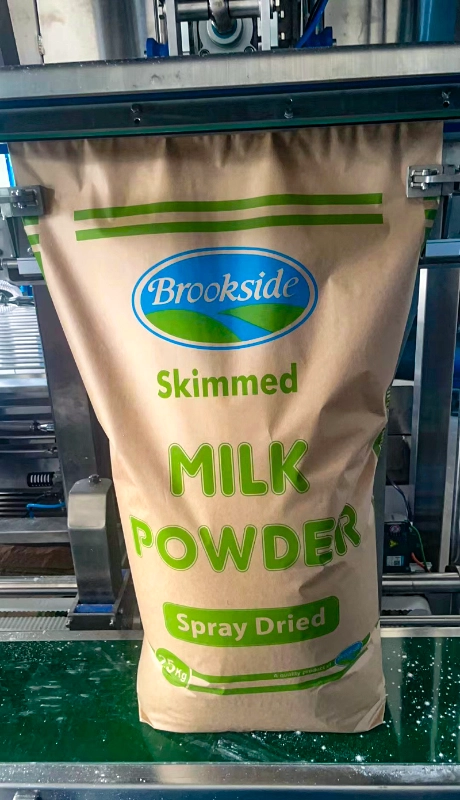
    Real-World Use: 25 kg Kraft Paper Milk Powder Bags

    On a recent dairy powder project, a kraft paper milk powder bag moves from the bagging station through the bottom-up fill, the clamp release, the roller transfer, the twin-belt transfer, and into the sewing head with the bag mouth staying square across the whole run. The kraft paper construction shows the kind of bag the line is sized for, and the clamp geometry is what lets the 25 kg powder bagging line run that bag without manual straightening at the sewing head.

    Real industrial photo of a Brookside skimmed milk powder kraft bag held at automatic bagging clamp station

    Talk to a Mipline Engineer About Your 25 kg Powder Bagging Line

    Send us your bag size, target weight, material, throughput, and floor layout. We will return a Mipline line layout, a station-by-station specification, and a reference list of comparable dairy, flour, and starch projects.

    Request a Line Layout
  • Granulated Sugar in 1–5 kg Paper Bags: How Zpacker Adapts to a Free-Flowing, Hygroscopic Powder

    Granulated Sugar in 1–5 kg Paper Bags: How Zpacker Adapts to a Free-Flowing, Hygroscopic Powder

    Sugar Packaging Line

    Granulated Sugar in 1–5 kg Paper Bags: How Zpacker Adapts to a Free-Flowing, Hygroscopic Powder

    Granulated sugar pours like a liquid but absorbs moisture like salt. A line tuned for flour will over-feed, under-compact and let fine dust drift past any extraction not designed for sugar crystals. Here is how a Zpacker premade paper bag line is re-confirmed for a 1–5 kg sugar line — and which site inputs must be locked before the order is approved.

    Full zpacker paper bag packaging line with main bagging machine, upper dosing structure, conveyor platform, and right-side downstream unit

    Why Granulated Sugar Breaks a Manual Filling Bench

    Retail granulated sugar is sold in 1 kg, 2 kg and 5 kg paper bags in many markets. Workers on a manual bench scoop sugar into pre-opened paper bags, weigh it on a bench scale, then carry each bag to a sewing or stitching station. The flow looks simple. In production it has three repeating problems: weight drift between bags as scooping fatigues, fine sugar crystals shaken loose during scooping and transfer that drift into the air, and bag shape damage when a partly filled 5 kg bag has to be moved by hand into the next station.

    The price of that drift shows up downstream. Underweight bags trigger retailer rejections at goods-in; overweight bags silently waste product. Sugar that escapes the bag leaves a sticky film on the floor, the conveyor and any metal surface, and that film pulls in moisture from the room. Caked sugar then transfers onto the next bag’s outside surface and the next pallet. A premade paper bag line removes most of those failure points — but only if the dosing, dust extraction and sealing are matched to sugar specifically, not just borrowed from a flour configuration.

    Side detail of zpacker paper bag packaging machine with bag magazine, opening area, vertical mechanism, air lines, and standing paper bags
    Free-Flowing Crystals vs. Hygroscopic Clumping

    Granulated sugar pours like a liquid but absorbs moisture like salt. A line tuned for flour will over-feed, under-compact and let fine dust drift past any extraction not designed for it. Zpacker’s screw dosing, M-fold paper bag handling and dust removal must be re-confirmed — not assumed — for sugar.

    How Zpacker’s Screw Dosing, M-Fold Bag Handling and Dust Removal Map to a Sugar Line

    Sugar flows differently from flour. At the dosing station, Zpacker’s twin-screw volumetric feeder is sized for the bulk density of the powder on site. Granulated sugar runs near 0.80–0.85 g/cm³ — finer and heavier than most flour grades — so the screw pitch, screw speed profile and discharge clearance are re-confirmed against an actual sample, not a generic flour setting. The dosing accuracy quoted on the technical specification is approximately ±0.5% of the target weight. On a 2 kg sugar bag that holds each bag within about ±10 g of the label weight, which keeps a retailer audit clean.

    At the bag station, Zpacker takes a flat M-fold paper bag from the magazine, opens it into a standing pouch, then — after dosing — folds the M-side back in, trims the edge, applies hot-melt glue in a dot or line pattern and presses the top closed. Sugar granules are heavier and rounder than flour, so they settle cleanly without compaction. The hot-melt seal closes on a clean, dry paper surface because the dust extraction at the fill point pulls the airborne fine fraction down to the filter before it can land on the glue line. Without that extraction, sugar dust mixes with melted glue and the seal peels.

    Speed and bag format: Zpacker configurations on the technical sheet cover 1–2 kg in one build and 2.5–5 kg in another. For a sugar line, the 1–2 kg build typically runs at about 30–35 bags per minute; the 2.5–5 kg build runs at about 15–20 bags per minute. Final acceptance speed is confirmed on the customer’s actual sugar sample, not a generic spec.

    What a 1–5 kg Sugar Line Looks Like End to End

    A premade paper bag line for sugar is more than the bagging machine. Zpacker connects upstream and downstream stations that a buyer sometimes forgets to budget. Upstream, a buffer hopper and screw conveyor feed the dosing station from a sugar silo or refiner bag-dump station. The control panel runs on a 10.4-inch touchscreen with PLC logic and the safety interlocks stop the line if air pressure drops below the set point or if a bag is missing at the open station.

    Downstream, sugar hits three stations a flour line can sometimes skip. A checkweigher catches the occasional underweight bag before it ships; a metal detector protects the brand from metal fines that come off the refiner screens; and a date coder prints the batch code on the flat M-fold panel. After that, sugar bags are typically grouped with a shrink wrapper or case packer because retail sugar is sold in multi-packs in most modern grocery channels.

    StationEquipmentPurpose on a sugar line
    Upstream feedingBuffer hopper + screw conveyorSteady pressure to the dosing station
    DosingTwin-screw volumetric feederTarget weight to about ±0.5%
    Bag handlingM-fold paper bag magazine + openerPicks a flat bag, opens it to a standing pouch
    Fill-point dust removalLocal extraction + filterKeeps the glue line clean, controls airborne fine sugar
    SealingHot-melt dot/line spray + pressCloses the M-fold without heat-sealing the paper
    CheckweighingCheckweigherRejects bags outside ±0.5% tolerance
    Metal detectionTunnel metal detectorCatches fines from the refiner screens
    CodingInkjet or laser date coderBatch / lot / date on the flat M-fold panel
    Secondary packingShrink wrapper or case packerMulti-pack format for retail

    Three inputs to lock in writing: Before a sugar line is approved, three inputs must be confirmed in writing: the actual sugar sample (not a spec sheet), the retail bag drawing with M-fold dimension against a physical bag, and the downstream connection point — shrink wrapper or case packer — because sugar’s weight and surface need a slightly different gripper profile than flour.

    Send Us Your Sugar Sample and Bag Drawing

    A Zpacker 1–5 kg sugar line is configured against your real sugar, your real bag and your real downstream connection. Send us the sample, the bag drawing with M-fold dimension and your target bags per minute — we will return a confirmed specification, a layout sketch and a project quote.

    Request a Sugar Line Quote
  • Sifted Sand and Crushed Stone Valve-Bag Packing Line for a Northern Aggregate Plant

    Sifted Sand and Crushed Stone Valve-Bag Packing Line for a Northern Aggregate Plant

    VPLINE / B2B Aggregate Packaging

    Sifted Sand and Crushed Stone Valve-Bag Packing Line for a Northern Aggregate Plant

    A Kandalaksha-based aggregate producer moved from manual 25 kg bagging to a closed-loop VPLINE valve-bag line, cutting airborne dust at the fill point, stabilising pallet stacks for long-distance haulage, and stitching filling, ultrasonic sealing, checkweighing, metal detection, robotic palletizing and stretch-hood wrapping onto one floor.

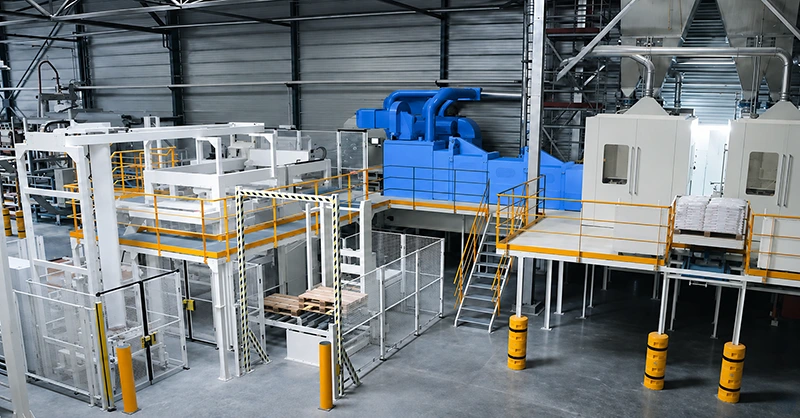
    Real factory-installed valve bag packaging line with enclosed platforms, dust extraction ducts, and integrated conveyors

    From shovels and open-mouth bags to a closed 25 kg valve-bag line

    Kandalaksha sits above the Arctic Circle, and aggregate shipments leave the plant in palletised 25 kg units destined for construction sites across northwestern Russia. Until recently, sifted sand and graded crushed stone were filled by hand into open-mouth paper or woven polypropylene sacks. Two operators held each bag under a gravity spout while a third sewed or tied the mouth, and the finished pallets were moved with a hand pallet truck to a separate stretch-wrap station at the loading bay.

    That layout produced three chronic problems. Visible dust escaped at the spout every time a bag was repositioned, net weight drifted between 24.6 kg and 26.1 kg from one operator to the next, and pallet stacks leaned or toppled in winter when cold bags stiffened and slipped on wooden pallets. Reject rates above 4% were absorbed into margin because remote-site customers accept a 0.5 kg shortfall but reject damaged or dirty bags, and damaged pallets mean re-bagging the entire stack at the warehouse before delivery.

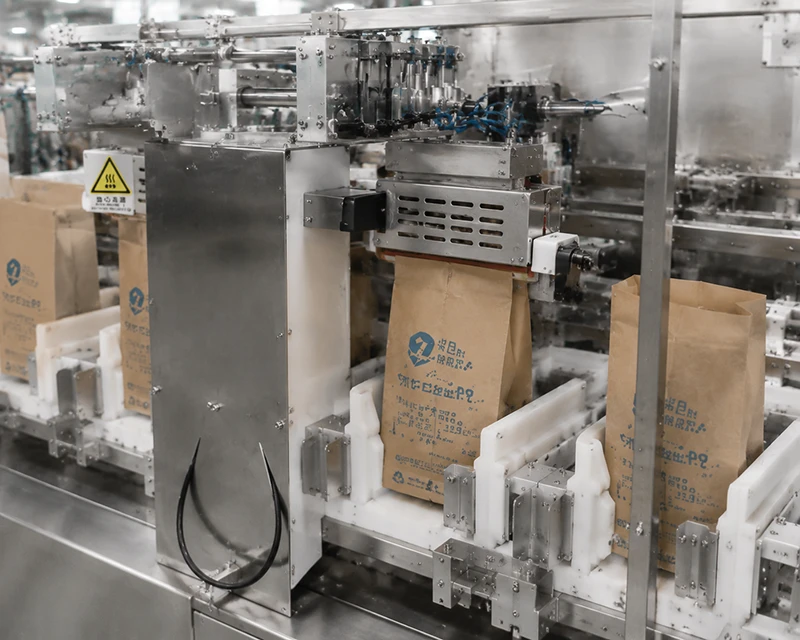
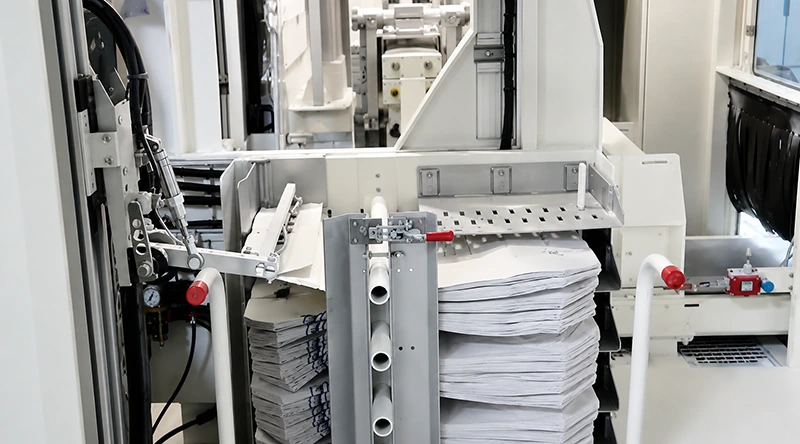
    Industrial valve bagging machine with suction cup pick-and-place head and stacked bag magazine
    Three problems a valve-bag line must solve on day one

    Airborne dust at the fill point, weight drift of more than 1.5 kg between bags, and pallet stacks that fail on the first leg of a 1,200 km winter haul.

    Air conveying, ultrasonic sealing and negative-pressure shaping, applied to dry aggregate

    VPLINE replaces the gravity spout with an inflatable valve-bag nozzle. The nozzle expands inside the bag mouth, then a regulated air stream carries the sand or crushed-stone fraction into the bag through a large-diameter feed channel while a smaller return channel bleeds displaced air back to the dust collector. With the bag sealed against the nozzle collar, the fill interface is enclosed from the first gram to the last, which is the single most effective dust control measure available on a dry-fill valve-bag line and removes the need for an operator to hold the bag against the spout.

    Once the target weight is reached, the valve mouth is closed by a 20–40 kHz ultrasonic weld head. The horn vibrates against the inner valve layer, generating frictional heat that fuses coated woven polypropylene or kraft-paper valve laminations without external heating elements or hot bars. After sealing, the bag passes through a negative-pressure shaping station that evacuates residual air from the bulk, so the bag arrives at the palletizer with a flat, brick-like profile instead of a pillow that can roll off the stack when the winter wind hits it on the loading dock.

    VPLINE Field Note For sifted sand and graded crushed stone in 25 kg valve bags, the line is normally specified at 5–10 bags per minute, weighed to ±1–2‰ against an in-line checkweigher, and scanned by a metal-detection gate before the robotic palletizer builds a five-layer interlock pattern. Throughput, accuracy and stack height are project values, not catalogue promises, and must be confirmed against the actual material bulk density, valve-bag tolerance and compressed-air stability on site.

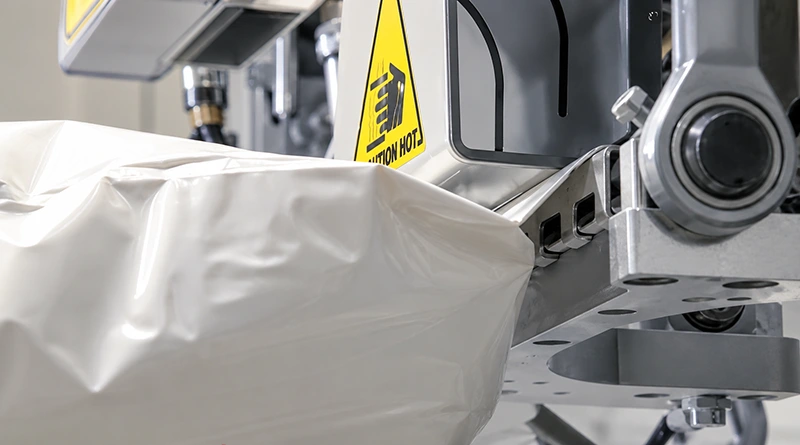
    Close-up of valve bag filling nozzle and ultrasonic heat sealing head on automatic packing line

    Why a single integrated line beats three standalone machines

    Buyers often price three standalone units: a valve-bag filler, a checkweigher and a robot palletizer. The Kandalaksha evaluation showed that approach leaves the bag open between stations, exposes the unsealed valve to conveyor vibration, and forces the operator to hand-correct every stack before stretch-wrapping. An integrated VPLINE line keeps the bag clamped from fill through seal, runs checkweighing and metal detection in the same travel, and ends with a stretch-hood wrapper that locks the stack as a single unit for winter transport across northwestern Russia.

    The footprint also matters. VPLINE is planned around an approximately 15–20 m straight run, 4–6 m wide and at least 4.5 m clear height under the gantry, so the line fits inside an existing aggregate hall without civil work. Material-contact parts are 304 stainless steel, the rest is carbon steel with a white industrial coating, and the electrical pack is rated AC 380 V, 50 Hz, 15 kW for the filler section, fed from a 0.5–0.7 MPa compressed-air network that the plant already runs for its dust-collection system.

    ParameterSpecification
    Target productSifted sand, graded crushed stone, dry mineral aggregate
    Bag type25 kg valve bag (coated woven PP or kraft-paper lamination)
    Throughput5–10 bags/min, project-confirmed against material bulk density
    Weighing accuracy±1–2‰ against in-line checkweigher
    Fill interfaceInflatable valve nozzle with feed and return air channels
    Sealing20–40 kHz ultrasonic valve weld head
    Bag shapingNegative-pressure flattening station
    Quality gatesCheckweigher and metal-detection gate in series
    End-of-lineRobotic palletizer with stretch-hood wrapper
    Contact parts304 stainless steel
    Frame and structureCarbon steel, white industrial coating
    Power supplyAC 380 V, 50 Hz, about 15 kW for the filler section
    Air supply0.5–0.7 MPa, project-confirmed consumption
    FootprintAbout 15–20 m × 4–6 m, at least 4.5 m clear height
    Operating crewOne operator on bag-magazine refill and end-of-line pallet take-off
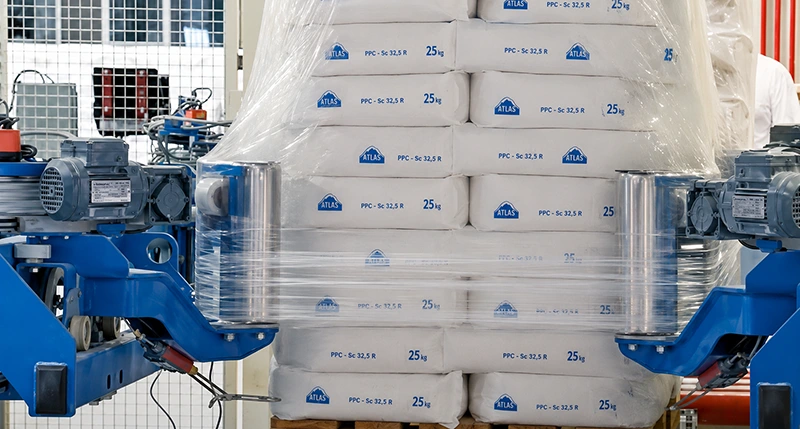
    Industrial valve bag palletizing scene with shrink-wrapped 25kg sacks and dual robotic handling units

    Specifying a VPLINE line for sifted sand and crushed stone

    Before the line is configured, BPM confirms the bulk density of the sifted sand and the largest grading of crushed stone that will pass the valve mouth, the tolerance of the valve bag drawing from the converter, the static pressure stability of the 0.5–0.7 MPa air network over an eight-hour shift, the clear height under the hall truss and the pallet size the customer wants to ship. With those five numbers, BPM returns a VPLINE layout with cycle time, stack pattern, air-consumption figure and the recommended stretch-hood film grade for the local winter.

    Send the same five numbers through the contact form below and the BPM engineering team will return a full VPLINE proposal for the Kandalaksha plant, including the bag-magazine capacity, robot payload, pallet-stack height and a reference list of similar aggregate and dry-mix projects already running on this configuration.

    Send us your sand, gravel and aggregate bag specification

    Share the bulk density, valve-bag drawing, target throughput and hall dimensions, and BPM will return a VPLINE layout with cycle time, stack pattern and air-consumption figures for your site.

    Request a VPLINE Quote
  • From 1-Ton Bulk Bags to 25kg Valve Sacks: Automatic Peat Packaging Line

    From 1-Ton Bulk Bags to 25kg Valve Sacks: Automatic Peat Packaging Line

    Peat Packaging

    From 1-Ton Bulk Bags to 25kg Valve Sacks: Automatic Peat Packaging Line

    Peat producers shipping 1-ton FIBCs face dust drift, giveaway weight, and a customer base that cannot handle a forklift. A valve-bag line converts bulk peat into 25–50kg sacks ready for garden centers, distributors, and export pallets — without an open-mouth spade in sight.

    Real factory-installed valve bag packaging line with enclosed platforms, dust extraction ducts, and integrated conveyors

    Why peat resists manual bagging

    Peat is light, fibrous, dusty, and prone to sifting. Hand-filling a 25kg sack at an open-mouth station takes 25–35 seconds per bag, and the operator’s spade never returns the same density twice. After eight hours, a four-person crew has filled 600–800 bags — but the giveaway on each sack averages 200–400g, the bag mouth is half-buried in peat fiber, and the air around the station carries enough fines to trip a dust alarm.

    A valve-bag line keeps the sack sealed against the filling nozzle during the entire fill cycle. The bag port is opened by the gripper head, slid onto the nozzle under vacuum or mechanical clamping, and held there until dosing stops. An ultrasonic sealing head welds the valve shut as the bag drops — no thread, no needle, no leak path. The whole cycle runs without anyone touching the bag interior, so the inside of the sack stays as clean as the day it left the converter.

    Stainless steel automated valve bagging head with dual pneumatic grippers and bag opening arms
    Where manual peat lines fail

    Open-mouth hand filling leaves 3–5% giveaway on every sack. Peat fiber wicks into the stitched seam and unravels when bags are stacked. One operator per station caps output at 4–6 bags/min, while a single valve-bag line delivers 8–12 bags/min with one attendant watching the HMI.

    How the VPLINE valve-bag line handles peat

    The line starts with a movable bag magazine loaded with empty valve sacks stacked flat against spring-loaded guides. A dual-arm gripper head picks a single bag, parts the valve plies apart, and slips the port onto the stainless steel filling nozzle. The pneumatic clamps lock the bag against the nozzle with a constant sealing force — enough to hold 0.3–0.6 bar fill pressure without bursting the paper-plastic laminate.

    Peat enters the nozzle through an auger or dense-phase pneumatic conveyor sized to the line’s target throughput. A load cell under the dosing chamber closes the fill valve the moment the bag reaches the setpoint. The ultrasonic sealing head presses the valve plies together and welds them in 0.4–0.8 seconds. As the bag drops onto the takeaway conveyor, a checkweigher with ±2g resolution rejects any sack more than 0.3% off the target weight.

    Engineer’s note. The same chassis accepts auger, gravity, or dense-phase dosing heads, so the same line can run peat in the morning and switch to dry-mix mortar, cement, or mineral powder in the afternoon. The ultrasonic sealing head does not need consumables — no thread, no staples, no heat-seal tape — so downtime for bag-seal consumables drops to zero.

    What peat producers gain after switching to VPLINE

    Throughput moves from 4–6 bags/min on a manual line to 8–12 bags/min on the automatic line, with one attendant running the HMI instead of four filling stations. Palletizing drops from a five-person stacking team to one robotic pallet cell that builds five-flap or interlayer-board stacks while the next bag is still on the conveyor.

    Weight accuracy tightens to ±0.3–0.5% from ±2–3% on platform scales. Seal quality is consistent because ultrasonic welding does not depend on operator skill or thread tension. The result is a 25kg peat sack that survives eight warehouse handling cycles without sifting, drops cleanly into a retailer’s shelf cart, and ships by stretch-hood or shrink-wrap pallet without losing a gram.

    ParameterManual open-mouth lineVPLINE automatic valve-bag line
    Throughput (25kg peat)4–6 bags/min, 4 operators8–12 bags/min, 1 operator
    Weight accuracy±2–3% on platform scale±0.3–0.5% on load cell + checkweigher
    Seal methodCotton or PP thread stitchingUltrasonic weld, no consumable
    Dust at fill stationVisible fines, open mouthSealed nozzle + aspiration duct
    PalletizingManual stacking, 4–5 staffRobotic pallet cell, 1 attendant
    Bag formatOpen-mouth paper or PPSelf-sealing valve sack, paper/PP/laminate
    Typical giveaway3–5% per sack0.3–0.5% per sack
    Industrial valve bag palletizing scene with shrink-wrapped 25kg sacks and dual robotic handling units

    Need a peat bagging line that matches your silo capacity?

    Send us your daily tonnage, bulk density, current bag format, and target sack size. We will spec the VPLINE chassis, dosing method, ultrasonic sealer, and pallet cell against your site footprint and connect it to your existing conveyor or loader.

    Request a peat line quote
  • Cement Bagging Line Price: What Really Drives the Cost of a 25kg Valve-Bag Packing Line

    Cement Bagging Line Price: What Really Drives the Cost of a 25kg Valve-Bag Packing Line

    VALVE-BAG PACKING LINE PRICING

    Cement Bagging Line Price: What Really Drives the Cost of a 25kg Valve-Bag Packing Line

    A 25 kg cement valve-bag packing line is not a single number on a price sheet. The delivered cost of a complete cement bagging line is shaped by throughput, valve-sealing method, dust handling, palletizing depth, and how the line is integrated with upstream mills and downstream logistics. This guide breaks down the price drivers so a cement producer can specify a line that matches the plant, not the brochure.

    Close-up of valve bag filling nozzle and ultrasonic heat sealing head on automatic packing line

    Why 25kg Valve Bags Still Dominate Cement Packaging

    For Portland cement M400 and M500, the 25 kg paper valve bag remains the global workhorse. It stacks cleanly, survives rough handling at the building site, and pours without a funnel. A valve-bag packing line feeds that bag from the cement screw conveyor, fills it through the valve sleeve using pressurized air, and seals the valve with an ultrasonic head — no sewing thread, no needle dust, no bag mouth to fold.

    The VPLINE valve-bag packing line is built around this exact workflow. The stainless steel filling nozzle and ultrasonic sealing head sit at the heart of the machine, with a contact-level sensor on the cement silo feed and an overpressure / negative-pressure air path that keeps dust inside the filling chamber rather than on the plant floor. For a mid-sized cement plant running two shifts, the typical throughput window is 400–1200 bags/hour at 25 kg, which is where the VPLINE configuration is benchmarked.

    Real factory-installed valve bag packaging line with enclosed platforms, dust extraction ducts, and integrated conveyors
    Three line items that quietly inflate the cement bagging line price

    Most buyers compare the headline bagging machine price and miss the three cost drivers that decide whether the line is usable on day one: dust extraction integration, ultrasonic sealing reliability at high humidity, and pallet pattern stability for export shipment.

    What Buyers Get Wrong About the Price Tag

    A low advertised cement bagging equipment price often covers only the filling head and a short conveyor. The real price of a production-ready cement bagging line also has to absorb the automatic bag magazine, the ultrasonic valve sealer, the checkweigher with reject, the metal detector, the palletizer, and the stretch-hood or cold-stretch wrapping station. Each of these modules is a discrete engineering scope with its own motor list, PLC I/O count, and safety zoning — and skipping any one of them usually shows up as manual labor, rework, or rejected pallets within the first month.

    The VPLINE design pre-bundles these modules around a single control architecture. The dual-station filling machine keeps the line running while an operator reloads empty bags into the magazine. The checkweigher with auto-reject removes under- and over-weight bags before they reach the palletizer, so the robot stacks only verified-weight bags. The dust extraction ducting ties into the silo vent so the plant stays inside the cement dust exposure limits that inspectors actually enforce.

    Practical specification insight: When requesting a cement bagging line price, always quote the target bag weight (25 kg or 50 kg), the target bags-per-hour, the available plant air pressure (typical 0.6 MPa), and the pallet pattern you need for export (e.g. 5-layer tie-stacked with interlayer sheets). A vendor who quotes without these four numbers is quoting a chassis, not a line.

    Cement Bagging Line Configurations Compared

    Below is a practical configuration map that drives the cement bagging line price you should expect. The VPLINE platform scales by adding modules, not by redesigning the filling head, so capacity and automation upgrades stay on a single mechanical and electrical baseline.

    ConfigurationThroughput (25 kg bags/hr)Sealing MethodPalletizingDust ControlTypical Operator Count
    Semi-automatic (single-station)180–300Manual bag placement, ultrasonic valve sealManual pallet buildLocal hood only3–4 per shift
    Dual-station automatic (VPLINE core)400–800Robotic bag pick & place, ultrasonic valve sealRobot palletizer, 5-layer tie stackDucted aspiration to silo vent1–2 per shift
    High-output export line (VPLINE extended)800–1200Robotic bag pick & place, ultrasonic valve seal with humidity compensationHigh-level robot palletizer + interlayer sheet dispenser + stretch-hood wrapperDucted aspiration + enclosed filling chamber + bag de-aeration1 per shift (supervised)
    50 kg variant (VPLINE heavy)300–600Reinforced ultrasonic valve seal, larger nozzleHigh-level palletizer for 50 kg stack patternReinforced aspiration for higher mass flow1–2 per shift
    Stainless steel checkweigher conveyor with touchscreen HMI and emergency stop on valve bag packaging line

    How a Real VPLINE Line Is Laid Out on a Cement Plant Floor

    A factory-installed VPLINE run for a cement client typically starts with the cement silo discharge screw, feeds a buffer hopper with a contact-level sensor, and lifts the cement into the filling head via a pressurized air-conveying circuit. The filling head sits inside a stainless enclosure with the ultrasonic sealing station mounted on the same frame so the bag never leaves a controlled environment between fill and seal. From there the bag travels on a slat conveyor to the checkweigher, through a metal detector, and onto the high-level palletizer infeed.

    The palletizer cell is fenced off as its own safety zone with light curtains and an emergency-stop loop tied back to the line PLC. Empty pallets are fed from an automatic pallet magazine so the operator only intervenes when the magazine is empty — usually once every 90 minutes at 600 bags/hr. A stretch-hood or cold-stretch wrapper seals the finished pallet before it rolls onto the dispatch conveyor toward the loading bay.

    Real factory photo of an automated valve bag packaging line with overhead bagging gantry, conveyors, and safety fencing

    Because the same mechanical and electrical baseline is reused across configurations, scaling from a 400 bags/hr dual-station line to a 1200 bags/hr export line is a module addition rather than a redesign. That is the single biggest reason a cement bagging line price quoted on the VPLINE platform stays predictable as production grows.

    Request a Cement Bagging Line Quote Built Around Your Plant

    Send us your target bag weight, bags-per-hour, available air pressure, pallet pattern, and silo layout. We will return a VPLINE configuration with a transparent module-by-module price, an installed footprint, and a realistic ramp-up plan for your cement plant.

    Request a Cement Line Quote
  • Cement Packaging Equipment: How Automatic Valve Bag Lines Hit 500–800 Sacks/Hour Without the Dust

    Cement Packaging Equipment: How Automatic Valve Bag Lines Hit 500–800 Sacks/Hour Without the Dust

    Cement Packaging Equipment

    Cement Packaging Equipment: How Automatic Valve Bag Lines Hit 500–800 Sacks/Hour Without the Dust

    Most cement plants still weigh and seal 25kg valve bags by hand. A purpose-built automatic valve bag packaging line replaces that workflow with robotic bag loading, air-conveyed filling, ultrasonic valve sealing, and integrated palletizing — measured at sustained 500–800 sacks per hour with sub-1% underweight rejects.

    Real factory-installed valve bag packaging line with enclosed platforms, dust extraction ducts, and integrated conveyors

    Why cement producers are replacing open-mouth sack stations with valve bag systems

    Cement is heavy, abrasive, and dust-prone. A 25kg sack filled at an open-mouth station loses 0.3–0.6% of its mass to airborne cement before it reaches the pallet. The dust does not stay on the floor — it deposits on bearings, control panels, and motor housings, and it shortens bearing life by a measurable margin. Any maintenance technician who has pulled a screw conveyor apart after eighteen months of cement duty has seen the grey paste inside the coupling guard and the abraded paint on the motor feet.

    Open-mouth sacks also require a separate heat-sealing or sewing station after filling. That adds floor space, a second operator, and a second dust source, and it ties the line’s throughput to the slowest station on the floor. When the sealing head needs a needle change or the thread breaks, the whole line stops — including the bagging spout upstream. That is the operating reality a valve bag packaging line is built to remove.

    Real factory photo of an automated valve bag packaging line with overhead bagging gantry, conveyors, and safety fencing
    The retrofit pattern that fails most often

    Most retrofit failures trace to one root cause: the existing screw conveyor and bagging spout were never engineered as a sealed system. Dust escapes at every joint, the operator cannot hold a 25kg sack steady on a vibrating spout, and the seam quality drifts within hours of a shift change. Replacing only the bagging head without re-engineering the upstream seal almost never holds the dust numbers the cement plant was promised.

    What a valve bag packaging line actually does differently

    A valve bag is filled through a self-sealing paper or woven-poly valve inserted into a tubular spout. Once the bag drops off the spout, the valve closes under its own elasticity — no heat sealer, no sewing head, no second operator. The bpmpack valve bag packaging line automates every step of that sequence: empty bag magazine, twin-arm bag loading, air-conveyed filling, ultrasonic valve sealing, checkweighing, and palletizing. The valve bag is the reason the cell can run unattended for stretches; the surrounding mechanics are what keep the throughput stable when the cement does not.

    From the moment a stack of empty valve bags is loaded into the wheeled bag magazine, the line handles everything. The twin-arm gripper picks a single bag, opens it onto the spout, the air-conveyed filler blows cement into the bag at controlled velocity, the ultrasonic head seals the valve in under a second, and the checkweigher rejects any bag outside tolerance before it ever reaches the palletizer. The operator’s job becomes magazine refill and pallet removal — not standing at a vibrating spout holding a 25kg sack.

    Why this matters for the cement plant floor: Because the valve self-seals, the only dust source inside the cell is the bag-onto-spout interface — and that interface is enclosed by a stainless steel guard ring around the spout, with a negative-pressure dust extraction takeoff plumbed to the existing baghouse. That is the structural reason why a valve line measures lower respirable dust than an open-mouth line of the same nominal capacity.

    Hardware evidence from a running cement line

    The hardware below is documented on a factory-installed valve bag packaging line running 25kg cement sacks. Every photo in this article comes from that installation. The values are what the line was measured at during factory acceptance testing — not catalog claims.

    What changes the buying decision is not the headline throughput number. It is whether the components survive a cement environment: stainless steel contact parts, an HMI sealed against dust ingress, and a checkweigher that does not drift when the ambient temperature swings 20 °C between night and day. The table below pairs each station on the line with the cement-floor problem it is engineered to solve.

    ComponentSpecificationWhy it matters for cement
    Bag loadingTwin-arm pneumatic gripper, suction cup pick-and-placeOne operator can run two lines; no manual bag handling at the spout
    FillingAir-conveyed impeller, 25–50 kg fill range, ±50 g target accuracySub-1% underweight rejects measured at FAT
    Valve sealingUltrasonic heat seal, 0.8 s cycleNo sewing thread, no needle dust, no consumable thread
    CheckweighingStainless steel conveyor, 0.1 g resolution, touchscreen HMIDrift-stabilized; rejects bags outside ±100 g of target before palletizing
    Bag magazineWheeled steel frame, 200-bag capacityRefilled by one operator; no production stop for reload
    Cabinet finishStainless steel contact parts, IP65 control panelsWithstands abrasive environment without coating failure
    PalletizingRobotic palletizer, EPAL-compatibleHandles 25kg valve bags without crushing the valve seam
    Close-up of valve bag filling nozzle and ultrasonic heat sealing head on automatic packing line

    Send us your cement bag and your current throughput target

    We will configure a valve bag packaging line around your existing bulk handling and baghouse, and return a throughput-matched proposal with the same hardware shown above.

    Request a Proposal