Automatic Bagging Machine & Palletizing Systems Manufacturer

Category: English

  • What Types of Cement Bag Packaging Are Used on Modern Packing Lines

    What Types of Cement Bag Packaging Are Used on Modern Packing Lines

    Cement bagging

    What Types of Cement Bag Packaging Are Used on Modern Packing Lines

    A working look at the bag formats cement producers actually run today — from 25 kg valve sacks to big bags — and how a valve bag packing line fits those formats without choking on dust, weight drift, or unstable pallets.
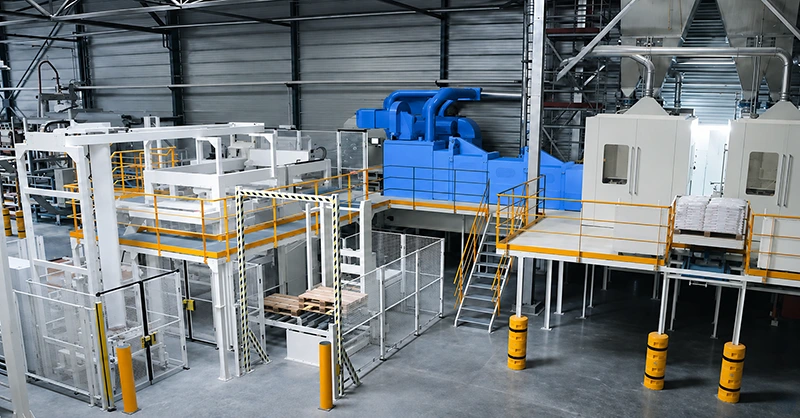
    Real factory-installed valve bag packaging line with enclosed platforms, dust extraction ducts, and integrated conveyors

    The Cement Bag Formats Buyers Actually Compare

    Most cement and dry-mix plants evaluate four bag formats side by side: 25 kg valve bags, 25–50 kg open-mouth bags, 1–2 ton FIBC / jumbo bulk bags, and small retail packs under 10 kg. Among them, the 25 kg paper or laminated woven valve bag is the workhorse for finished cement, dry-mix mortar, and most fine powders because it matches a standard pallet pattern (50 bags per layer on a typical EUR or EPAL pallet), survives international shipping on a shrink-wrapped or stretch-hooded pallet, and feeds cleanly into a closed-filling interface. Open-mouth bags remain common for fly ash, slag, or plants that already own stitching lines, but the format loses ground wherever dust control and operator exposure matter.

    Beyond the format itself, buyers compare how the bag is sealed. Valve bags self-seal under the pressure of the material during filling, so the seal is created inside the bag at the filling nozzle. Open-mouth bags need a separate stitching, gluing, or heat-sealing station after the bag leaves the filler. That single difference is what pushes dust-controlled cement and dry-mix plants toward valve bag lines: they eliminate the open sealing station and the dust it leaks. It is also why the question “what types of cement bag packaging are there in bags” almost always comes back to a valve-bag-versus-open-mouth comparison in real procurement meetings.
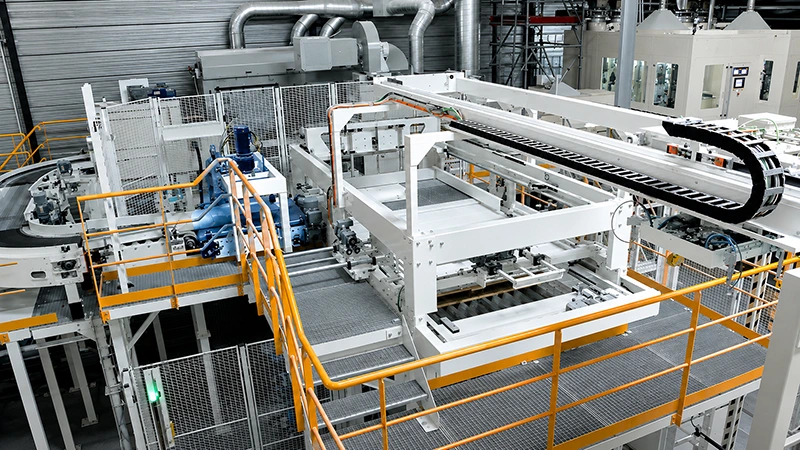
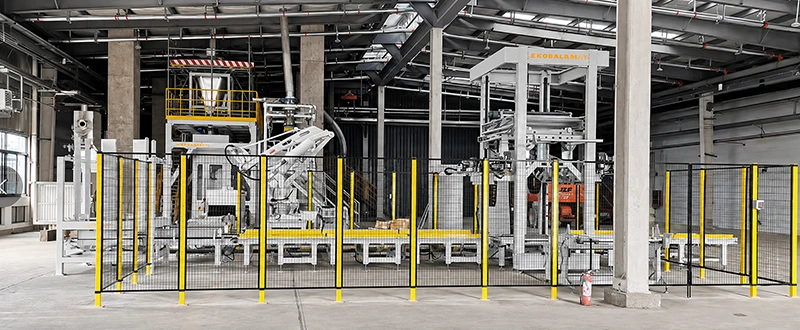
    Real factory photo of an automated valve bag packaging line with overhead bagging gantry, conveyors, and safety fencing
    Why cement plants keep switching bagging suppliers

    Many plants still run an open-mouth line with manual bag hanging, a hand-held stitching head, and a forklift-driven palletizer. The list of daily failures repeats: dust escapes at the open spout before sealing, operators’ hands touch the filled spout, filled bags sit too long on the conveyor because the palletizer is busy, and any bag with trapped air bulges into the next layer and pushes the pallet out of square.

    How a Valve Bag Packing Line Solves These Failure Modes

    An automatic valve bag line replaces the open spout with a closed filling interface. On BPM’s VPLINE, the bag is slid onto an inflatable valve nozzle, material is fed through the inner channel while displaced air returns through the outer channel, the nozzle deflates, and a 20–40 kHz ultrasonic head seals the valve area while the bag is still on the nozzle. Because the bag never opens to room air during filling, dust stays inside the line and connects to the dust extraction duct instead of escaping to the operator station. The dual pneumatic grippers shown on the bagging head remove the manual bag-handling step that usually causes inconsistent bag placement and torn valve corners.

    After ultrasonic sealing, the bag is dropped onto a checkweigher with a reject arm and continues through a metal detector, so an underweight or contaminated bag never reaches the palletizer. The remaining trapped air is removed by a negative-pressure shaping station before the bag goes to the robotic palletizer, which is what keeps the pallet square and prevents the leaning-stack failures seen on hand-stacked pallets. On VPLINE, the same controller sequence runs the entire line, which means a single HMI screen can show bag count, weight deviation, and pallet pattern at a glance instead of forcing the operator to walk between three or four isolated cabinets.

    VPLINE design note: the line is delivered as one continuous action chain from mobile bag magazine loading to stretch-hood wrapping — not as a stack of stand-alone machines bridged by hand. That delivery model is the source of most dust and stack-failure fixes in real cement plants.

    Spec Range and What to Confirm Before You Order

    Spec ranges for a 25 kg valve bag cement line look like this on BPM’s VPLINE data sheet: bag weight 10–50 kg with 25 kg as the typical cement format, throughput 5–12 bags per minute depending on bulk density and compressed-air stability, weighing accuracy of ±1–2‰ as stated by the manufacturer with the actual test condition to be confirmed against your material, ultrasonic sealing at 20–40 kHz, material contact parts in 304 stainless steel with the rest in structural carbon steel, air supply at 0.5–0.7 MPa, and packing-unit power at AC 380 V, 50 Hz, around 15 kW. The plant footprint is around 15–20 m straight-line length by 4–6 m width with about 4.5 m or more of clear ceiling height — those are planning references from real VPLINE layouts, not fixed dimensions.

    The table below maps each cement bag format to what it asks of the line and where it sits inside the VPLINE scope. Read it as a procurement filter: if your product is in the “primary” row, you are inside the standard scope; if it is in the “adapted” row, expect additional engineering; if it is in the “outside scope” rows, the right equipment is a different BPM line, not a re-configured VPLINE.

    Bag formatTypical weightSealing methodBest fit on VPLINE
    25 kg valve bag (paper or laminated woven)25 kgSelf-seal at valve under product pressure + 20–40 kHz ultrasonicPrimary application — full line ready
    25–50 kg open-mouth bag (paper or PE)25–50 kgStitch / heat-seal after fillingPossible on adapted line with separate stitching station — not the primary target
    1–2 t FIBC / jumbo bulk bag500–2000 kgTop tie / filling spoutOutside VPLINE scope — covered by FIBC filling lines
    Small retail pack (under 10 kg)5–10 kgHeat-seal / stitchOutside VPLINE scope — covered by VFFS / small-pack lines

    Need a Cement Bagging Layout?

    Send us your cement grade, target bag weight, daily tonnage, plant ceiling height, and compressed-air capacity — we’ll return a VPLINE layout, throughput estimate, and a list of items you’ll need to confirm on-site against your bag supplier.

    Request a Quote
  • Gypsum Plaster in 25 kg Valve Bags: How an Automated Line Solves Dust, Bag Shape, and Pallet Stability

    Gypsum Plaster in 25 kg Valve Bags: How an Automated Line Solves Dust, Bag Shape, and Pallet Stability

    Powder Packing Application

    Gypsum Plaster in 25 kg Valve Bags: How an Automated Line Solves Dust, Bag Shape, and Pallet Stability

    Gypsum plaster is light, dusty, and unforgiving in a 25 kg valve bag. This guide shows how a complete valve-bag packing line—automatic bagging, ultrasonic sealing, negative-pressure shaping, and robotic palletizing—delivers clean stacks and accurate weights at 5–12 bags per minute on the shop floor.

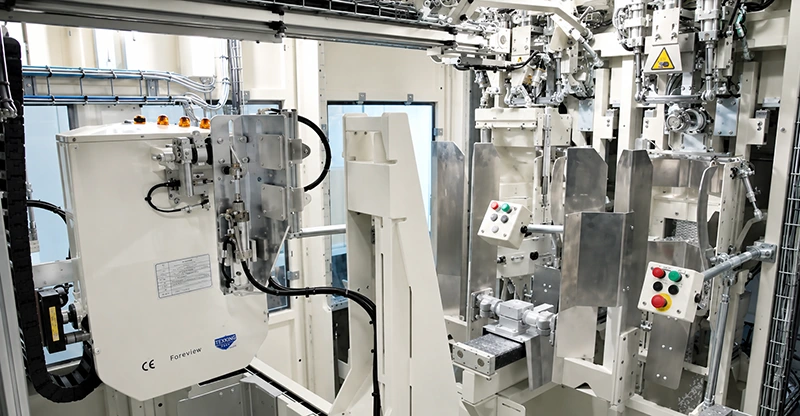
    Automated 25 kg gypsum plaster valve bag packaging line with overhead bagging gantry and dust-controlled conveyors

    What 25 kg gypsum plaster demands from a valve bag line

    Gypsum plaster is a fine, low-bulk-density powder that flows well but throws dust at every transfer point. When you load it into 25 kg valve bags, three things matter at once: clean filling, accurate weight, and a bag that does not bulge in the stack. A valve bag line that meets these three demands is a complete system, not a single filler standing alone.

    The valve bag has a self-sealing paper or laminated valve sleeve. The line must push product through that sleeve without tearing it, then close it without leaking. Because gypsum plaster is so fine, leakage at the valve translates directly into airborne dust on the floor, on the operators, and on the pallet wrap. The right answer is a sealing interface that confines the dust and a bag-handling path that never lets the valve sleeve drag across a sharp edge.

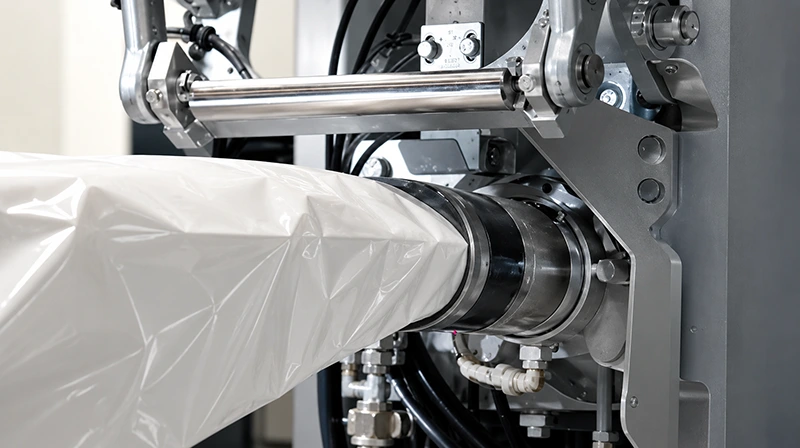
    Stainless steel valve bag filling nozzle and clamping collar during 25 kg gypsum plaster bag insertion
    The real cost of a manual 25 kg gypsum plaster line

    Manual or semi-automatic gypsum lines usually leak dust at the valve, drift 200–500 g per bag, and ship pallets that lean or collapse on the truck. Each defect is a small cost; together they decide whether a dry-mix producer keeps its contract with the next builder.

    Where old gypsum plaster lines lose money

    Three failure patterns show up again and again on a 25 kg gypsum plaster line. First, dust escape at the valve during filling, especially when the product carries residual moisture and forms micro-clumps that break against the sleeve wall. Second, trapped air leaves bags visibly bulged, so the stack leans and the bottom row crushes under load. Third, missing weight verification lets underweight bags leave the floor and overweight bags quietly eat margin on every shipment.

    Our VPLINE valve bag packing line addresses all three inside one continuous chain: an expansion-style filling nozzle with separate infeed and air-return channels that keeps dust inside the bag during filling; ultrasonic sealing in the 20–40 kHz range applied directly to the valve sleeve to close the bag without stitch or glue; plus an on-line checkweigher and metal detector before the bag reaches the palletizer, so every shipped bag is right weight and free of tramp metal.

    Engineer’s note: After sealing, every bag passes a negative-pressure shaping station that pulls trapped air out before palletizing. This single step is what turns a stackable, transport-stable pallet out of a bag that would otherwise arrive bulged and leaning. We also configure a stretch-hood wrapper downstream so the load stays tight through long-haul truck or container moves.

    Specifications for a 25 kg gypsum plaster valve bag line

    The table below lists the operating envelope of a VPLINE valve bag packing line configured for 25 kg gypsum plaster. Values come from the standard design envelope; final throughput, weight accuracy, and dust performance must be confirmed against your specific bulk density, moisture content, valve-bag tolerance, and compressed-air supply. We run sample bag tests at our facility before any quotation is finalized.

    Bag materials accepted on this configuration include coated woven polypropylene, kraft paper, and laminated paper-poly bags with a valve sleeve that tolerates ultrasonic sealing. Material-contact parts are 304 stainless steel; the frame and guarding are carbon steel with industrial surface treatment rated for the gypsum-dust environment.

    ParameterValue (25 kg gypsum plaster configuration)
    Bag weight range10–50 kg (25 kg typical for gypsum plaster)
    Throughput5–12 bags per minute, depending on bulk density and bag size
    Weight accuracy±1–2‰ of target, on-line checkweigher with auto reject
    Filling interfaceExpansion-style valve nozzle with separate infeed and air-return channels
    Sealing method20–40 kHz ultrasonic sealing on the valve sleeve
    Bag shapingNegative-pressure flattening station before palletizing
    Quality gatesCheckweigher + metal detector, both with reject lane
    PalletizingRobotic palletizer with 3-bag interlocking layer pattern
    Load protectionAutomatic pallet dispenser, interlayer sheet feeder, stretch-hood wrapper
    Bag materialsCoated woven PP, kraft paper, laminated paper-poly valve bags
    Material-contact parts304 stainless steel; frame carbon steel with industrial coating
    Compressed air0.5–0.7 MPa, stability to be confirmed on site
    Power supplyAC 380 V, 50 Hz, approximately 15 kW for the packing unit
    Line footprint referenceApproximately 15–20 m long × 4–6 m wide, ≥4.5 m clear height

    Need a 25 kg gypsum plaster valve bag line configured to your plant?

    Send us your bag type and supplier, target throughput, available air pressure and stability, plant layout with clear height, and the gypsum plaster grade you actually run. We will come back with a line layout, a sample-bag test plan, and a reference budget within a few working days.

    Talk to a packing line engineer
  • Valve Bag Packing Line for Sifted Sand and Crushed Stone at a Kandalaksha Aggregates Plant

    Valve Bag Packing Line for Sifted Sand and Crushed Stone at a Kandalaksha Aggregates Plant

    AGGREGATES PACKAGING

    Valve Bag Packing Line for Sifted Sand and Crushed Stone at a Kandalaksha Aggregates Plant

    How an automated 25 kg valve bag packing line replaces manual loading and stop-start filling on a sifted sand and crushed stone line in Kandalaksha, where humidity, fines and sharp aggregate edges punish every moving part on a cement-style bagger.

    Real photo of stainless steel valve bag packaging line with automatic bagging and dual control stations

    Why sifted sand and crushed stone punish an ordinary cement bagger

    On a Kandalaksha aggregates line the duty cycle is not what a generic cement bagger sees. Sifted sand carries surface moisture that migrates into the bag valve, and washed crushed stone — even in the 5–20 mm fraction — leaves sharp edges that score the inside of a kraft paper valve bag as it rides the loading nozzle. Every minute the line runs, those two effects stack: the valve leaks, the seam tears, and the operator has to stop the line to wipe the nozzle and rebag the rejected sack.

    Valve bag packing works because the bag is the package. The valve closes itself under the pressure of the fill column, and the loaded sack stands upright without a top seal. That geometry fits an aggregates yard better than an open-mouth bag plus heat sealer, and it avoids the second forklift move you would pay for with a big-bag station. The trick is keeping the valve open during fill and re-seating it cleanly after fill — every cycle, every shift, regardless of humidity or aggregate sharpness.

    Real factory photo of an automated valve bag packaging line with overhead bagging gantry, conveyors, and safety fencing
    What breaks first on a sand and stone bagger

    Three failure modes show up before throughput does: the loading nozzle wears from stone abrasion, the pneumatic bag-gripper slips when the kraft paper softens with moisture, and the ultrasonic seal head fouls with fines that ride the bag edge. A line that is “still running” in month one is usually the same line that quietly drops to 60 % of its rated bags-per-hour by month six, and nobody notices until an order ships short.

    How the VPLINE valve bag packing line handles abrasive, moist aggregates

    The line starts where the empty bags wait. A movable bag magazine holds the kraft valve bags in a guided stack, and a dual-arm pick-and-place head — driven by pneumatic cylinders on a stainless steel frame — pulls one bag at a time, opens the valve, and slips it onto the filling nozzle. On a sifted sand run that motion has to be gentle (the paper is wet) and precise (the valve has to seat on the first try, not the third), which is why the bagging head uses dual opposed grippers rather than a single suction cup.

    Once the bag is on the nozzle, the line does three things in parallel: an impeller-style air-conveyed filler pressurizes the column so the valve stays open and the sand or stone flows in, the bag sits under controlled vibration so the column compacts without bridging, and the moment the load cell reads the target weight, the ultrasonic heat-seal head closes the valve and a negative-pressure former squares the filled sack. From there it drops onto a checkweigher conveyor with a touchscreen HMI, runs through metal detection if the line is configured for it, and rides onto a roller conveyor into the palletizing cell.

    Engineering note. The filling nozzle on the VPLINE is a clamped, replaceable stainless steel collar — not an adhesive-bonded rubber sleeve. When crushed stone fines score the seal face, the operator swaps the collar in under ten minutes instead of waiting for a service call. That single design decision is what takes most aggregate plants from two unscheduled stoppages a month down to none.

    Where the VPLINE valve bag packing line puts its numbers

    The figures below are the working envelope we quote for a Kandalaksha-class aggregates plant running sifted sand (0–2 mm) or washed crushed stone (5–20 mm) at ambient temperatures of −10 °C to +35 °C. They are taken from the running line, not from a marketing brochure.

    These are the parameters that map directly onto the pain points above: the bag weight tolerance is what the checkweigher enforces after the seal, the bagging rate is the figure you actually book against shift output, and the bag-size range is what lets the same line switch between sand and stone without a mechanical changeover.

    ParameterWorking valueWhy it matters on a sand and stone line
    Bag weight range20–50 kg (25 kg is the working point)25 kg is the default; 40 kg and 50 kg run on the same nozzle set
    Bagging rate, sifted sand at 25 kg250–350 bags/hourDriven by the impeller fill column and vibratory compaction; the upper end needs the dryer sand fraction
    Bagging rate, washed crushed stone at 25 kg180–220 bags/hourLower because of compaction density; still well above two-operator hand loading
    Fill accuracy±0.2 % of target weightEnforced by load cell + PLC cut-off, not by operator feel
    Valve seal typeUltrasonic heat seal on the bag valveReplaces the old glued valve that fouled with stone fines
    Bag magazine capacity200–400 empty bags per loadWheeled cart; one operator refills in under five minutes
    Air supply0.6–0.8 MPa, clean and dryIntegral FRL unit on the frame; site compressor must hold 0.8 MPa minimum
    Pallet stack pattern5-layer or 6-layer, with interlayer sheet optionHandled by the gantry palletizer; up to 8–10 bags per layer at 25 kg
    Line power380 V / 50 Hz, three-phase + neutralConfigurable for 220 V site supply on request
    Operator stationTwin pendant controls + central HMIOne operator per shift covers bag refill, seal inspection and pallet outfeed
    Ambient temperature−10 °C to +35 °CCold-rated pneumatic kit for Kandalaksha winter operation
    Installed footprint~9 m × 4.5 m for the pack-and-palletize coreExcludes upstream storage silos and downstream stretch wrapper
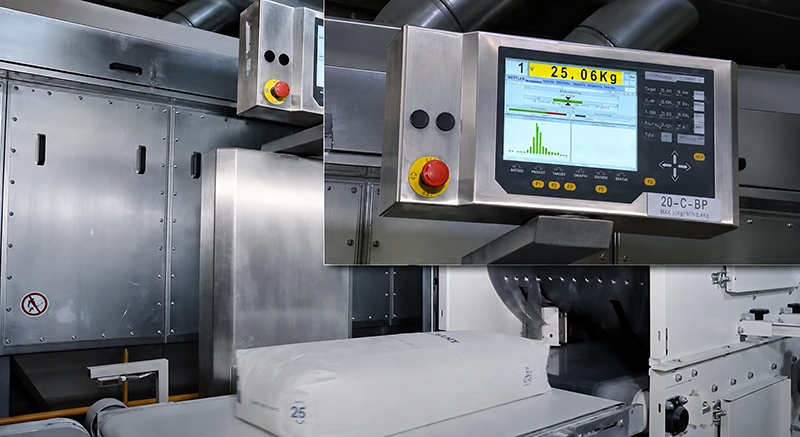
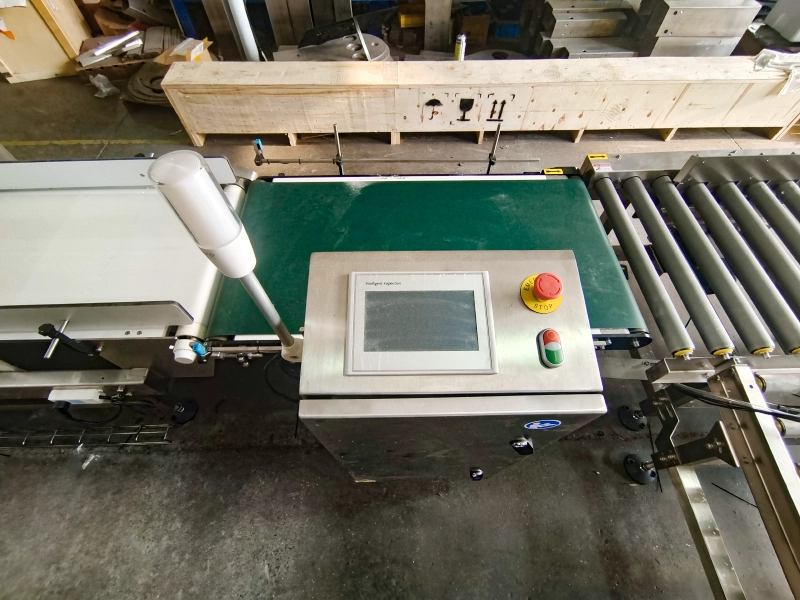
    Stainless steel checkweigher conveyor with touchscreen HMI and emergency stop on valve bag packaging line
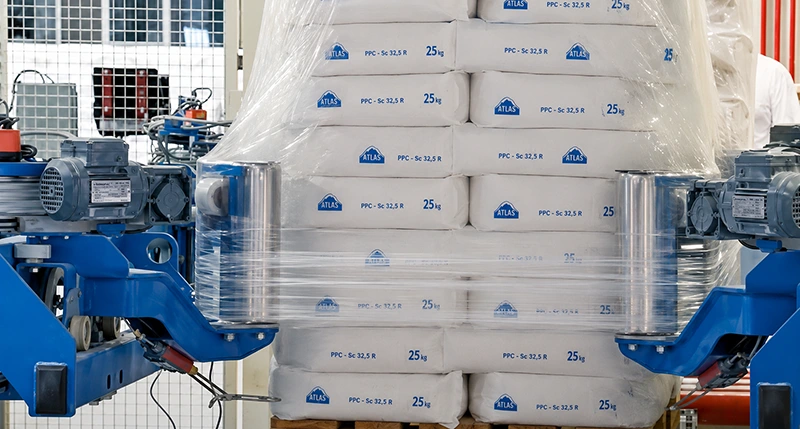
    Industrial valve bag palletizing scene with shrink-wrapped 25kg sacks and dual robotic handling units

    Tell us what you are bagging and we will size the line

    Send us your aggregate gradation (0–2 mm sifted sand, 5–20 mm washed crushed stone, or both), target bag weight, hourly output and the air supply available on site. We will return a VPLINE valve bag packing line layout with the nozzle set, the seal type, the palletizer pattern and a working price — usually inside two working days.

    Request a VPLINE Quote
  • Automatic Valve Bag Cement Packaging Line: 25 kg Robotic Bagging, Ultrasonic Sealing, and Robotic Palletizing in One Cell

    Automatic Valve Bag Cement Packaging Line: 25 kg Robotic Bagging, Ultrasonic Sealing, and Robotic Palletizing in One Cell

    Cement packaging applications

    Automatic Valve Bag Cement Packaging Line: 25 kg Robotic Bagging, Ultrasonic Sealing, and Robotic Palletizing in One Cell

    A 25 kg cement valve bag packaging line ties a wheeled bag magazine, twin-arm robotic bagger, air-assisted filling nozzle, ultrasonic sealing, checkweighing, metal detection, negative pressure bag shaping, and robotic palletizing into one continuous cell. For a regional cement producer running 5–12 bags per minute, this is what stops dust at the spout, keeps bag weights on target, and ships a stable pallet out the door.

    Real factory-installed valve bag packaging line with enclosed platforms, dust extraction ducts, and integrated conveyors

    Why cement plants replace manual valve bagging with a fully automatic cell

    Cement valve bags have always been a tough packing job. The old way runs like this: an operator picks up a 25 kg valve bag from a stack, opens the valve by hand, holds it against the packer spout while cement is blown in, slides the bag onto a sewing head or ultrasonic sealer, lifts the sealed bag onto a pallet, and repeats. Two operators per spout, one operator sewing, two operators palletizing. The cycle lives and dies by hand speed, and that hand speed is the bottleneck that decides whether the cement mill can ship a full truckload before the silo runs empty.

    When a regional cement producer near Moscow Oblast scaled up to a third packing bay, they kept running into the same four problems. Dust leaked at the spout during each cycle. Bag weights drifted because the operator could not hold the bag still for the full fill time. Seals were inconsistent, with a small share of bags going out un-sealed. Pallet stacks leaned or slumped on the truck because every bag arrived at the pallet with a different amount of trapped air. The fix was not a bigger silo or a faster truck. The fix was a packaging line where each station is engineered for cement and the stations are wired together end-to-end.

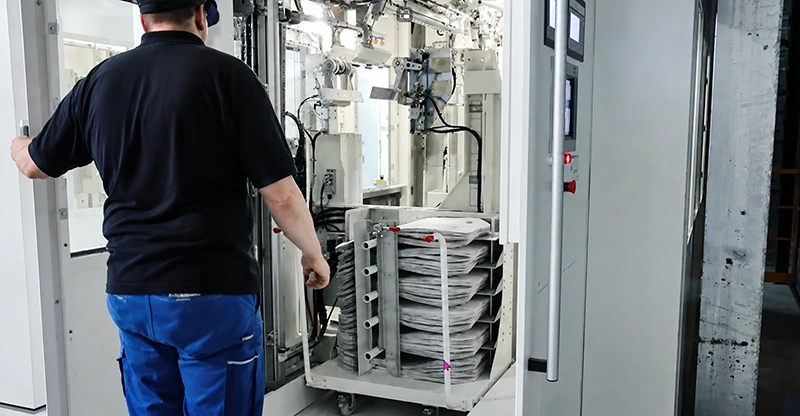
    Operator pushing wheeled valve bag magazine into automatic bag loading station
    The four pain points that decide a valve bag line

    Dust leaks at the filling nozzle, bags that inflate like balloons, seals that fail in transit, and pallet stacks that lean on the truck. Any one of them can shut down a cement mill’s shipping window.

    How the line stops dust, rework, and stack collapse at the spout

    The filling station is where a cement valve bag line is won or lost. Our valve bag filler uses an inflatable spout that opens inside the valve of the bag. A large-bore feed channel delivers cement into the bag while a smaller return-air channel pulls displaced air back out through the same spout. The bag seals against the outside of the spout, so the cement stays inside the closed loop during fill. Material contact parts are 304 stainless steel; the rest of the frame is welded carbon steel, which is enough for cement duty and keeps the cell weight manageable.

    Once the bag is filled, the seal is the next critical station. We use a 20–40 kHz ultrasonic weld head on the valve area to generate frictional heat at the inner film layer and close the valve. Ultrasonic sealing does not introduce a heated element into the bag, so there is no scorch risk on coated woven polypropylene valve bags. Right after the seal, the bag runs through a checkweigher and a metal detector, so any bag that misses the target weight or carries tramp metal is rejected before it ever touches a pallet. That is the quality gate.

    Engineering note: Negative pressure bag shaping is the station that makes the rest of the pallet stable. After sealing, each bag is run through a vacuum chamber that pulls residual air out of the woven body. A flat bag stacks. A balloon does not. A flat bag is also what lets the palletizer place three bags per layer in the one-flat, two-tall pattern without skewing the stack, which is what makes a 25 kg cement pallet survive a long-haul truck without leaning.

    Key stations and engineering parameters for a 25 kg cement valve bag line

    The numbers below are the typical configuration we ship for a 25 kg OPC or composite cement job. Cement is abrasive and dusty, so the line is built around dust containment, gentle bag handling, and stable pallets. A project-specific layout review is required before any cycle rate or bag weight range is committed in writing.

    StationFunctionTypical spec for cement
    Mobile bag magazineHolds empty 25 kg valve bags and feeds the baggerWelded steel frame on casters, ~150–200 bags per load, side guide rails and pneumatic clamps
    Twin-arm robotic baggerPicks, opens, and seats the valve onto the spoutDual pneumatic grippers, 304 stainless contact, dual-station layout so one arm can serve two fillers
    Air-assisted valve fillerInflatable spout, large feed channel, return-air channel304 stainless contact, 0.5–0.7 MPa clean dry air, 5–12 bags/min
    Ultrasonic sealerCloses the valve area without a heated plate20–40 kHz weld head, suited to coated woven PP valve bags
    Checkweigher + metal detectorQuality gate before palletizing±1–2‰ target weight window, ferrou and non-ferrous detection, reject conveyor
    Negative pressure shapingRemoves trapped air from the woven bodyVacuum plenum, sealed chamber, knife-edge seals on the bag sides
    Robotic palletizerBuilds the interlocked stack and applies hood filmThree-bag layer pattern, layer sheet dispenser, cold-applied stretch hood
    Line power and footprintAC 380 V, 50 Hz, ~15 kW for the packer sectionRoughly 15–20 m long, 4–6 m wide, ≥4.5 m clear ceiling for the palletizer

    Talk to a cement packaging line engineer

    Send us your cement grade, target bag weight, current throughput, bag type, silo layout, and the ceiling height of your packing hall. We will map the line stations, confirm the cycle rate, and quote a configuration that fits your building, not a generic catalog page.

    Request a cement line layout
  • From Bulk to Bagged: How a Peat Producer Built a 25kg Valve-Bag Packaging Line

    From Bulk to Bagged: How a Peat Producer Built a 25kg Valve-Bag Packaging Line

    VPLINE / Peat Packaging

    From Bulk to Bagged: How a Peat Producer Built a 25kg Valve-Bag Packaging Line

    A peat processor replaced manual bagging with BPM’s VPLINE valve-bag packaging line. Output went from 100 to 500 bags per shift, weight variance tightened to ±50g, and the dust path is now sealed from silo to pallet.

    Real factory photo of an automated valve bag packaging line with overhead bagging gantry, conveyors, and safety fencing

    Bulk peat arrives in 1-ton FIBCs — but the customer wants 25kg

    Peat lands at the processing plant in 1-ton bulk bags. The buyer, however, is a garden center, a municipal landscaping contractor, or a packaged-soil brand. They want a 25kg valve bag they can stack on a pallet, lift with a forklift, and re-ship to the retail shelf without a dust trail behind the truck.

    Manual bagging had become the bottleneck. Four operators, a stitched closure, and a thread-and-needle bag closer were pushing 80 to 120 bags per shift. Every fill point was an open dust source. Stitched bags leaked fines during truck loading and warehouse storage, and the giveaway on each 25kg pack drifted past 200 grams by the end of a long shift.

    Automated valve bag packaging line with robotic bagging station, conveyor modules, and safety fencing
    The cost of manual peat bagging is hidden in the seam

    Every minute spent on a stitched closure is a minute the silo isn’t feeding the next line. Every gram off the target weight is a giveaway that compounds across a 24-hour shift. And the dust at the fill point is a hygiene problem the line cannot grow past without a sealed fill path.

    Why a valve bag, why ultrasonic sealing

    A valve bag accepts product through a self-sealing paper or PE valve — no open mouth to sew shut, no stitcher to thread, no needle to replace every shift. The bag arrives at the nozzle, the sleeve fills with peat, and the valve closes under the product’s own pressure.

    BPM’s VPLINE valve-bag packaging line couples the bag pickup head to an ultrasonic sealing station. The seal is dust-tight, the cycle holds at 7 to 9 seconds per bag, and the operator’s only job is to restock the bag magazine every 90 minutes. Stainless steel contact parts keep corrosion out of the equation even with damp peat coming off the silo.

    Spec note: A valve-bag line with ultrasonic sealing removes the stitched closure step entirely — peat goes from the silo to a sealed, pallet-ready bag without ever being exposed to open air during the fill cycle.

    Throughput, accuracy, and what changes on the floor

    A VPLINE cell with twin bagging heads runs 400 to 600 25kg bags per hour. The gross-weight checkweigher at the line’s exit rejects out-of-spec bags before they reach the palletizer, holding weight accuracy at ±50g across a full shift.

    The shift goes from four or five baggers to two operators — one at the HMI, one at the pallet station. The palletizer drops a 5-layer or 8-layer pattern, applies the stretch hood, and the load is ready for the truck without a forklift driver waiting on the floor.

    ParameterManual lineBPM VPLINE
    Throughput80–120 bags/hr400–600 bags/hr
    Operators per shift4–52
    Weight accuracy±200g±50g
    Bag seal integrityStitched (leaks fines)Ultrasonic valve seal
    Dust at fill pointUncontrolledSealed + aspirated
    PalletizingManual stackingRobotic palletizer + stretch hood

    Spec a peat-bagging cell against your silo

    Send us your current bagging rate, your bag size, your silo discharge height, and your target output. We’ll spec a VPLINE cell that fits the floor plan and the truck-loading schedule.

    Talk to a peat-packaging engineer
  • 25 kg Powder Bagging Line with Stable Bag Transfer Before Sewing

    25 kg Powder Bagging Line with Stable Bag Transfer Before Sewing

    Powder Packaging Line

    25 kg Powder Bagging Line with Stable Bag Transfer Before Sewing

    How a Mipline automatic powder packaging line keeps a filled 25 kg kraft bag square from the gross weigher through the sewing head — and why the last meter before sewing decides your reworked-bag rate.

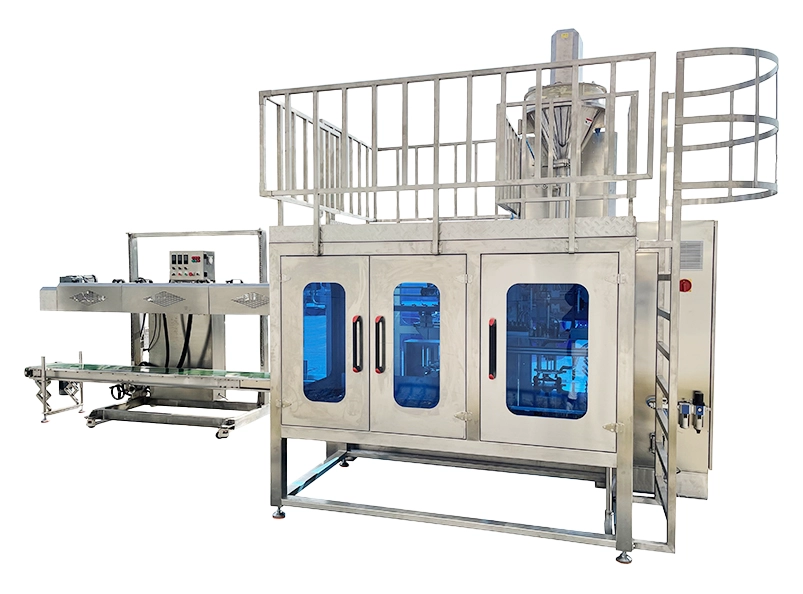
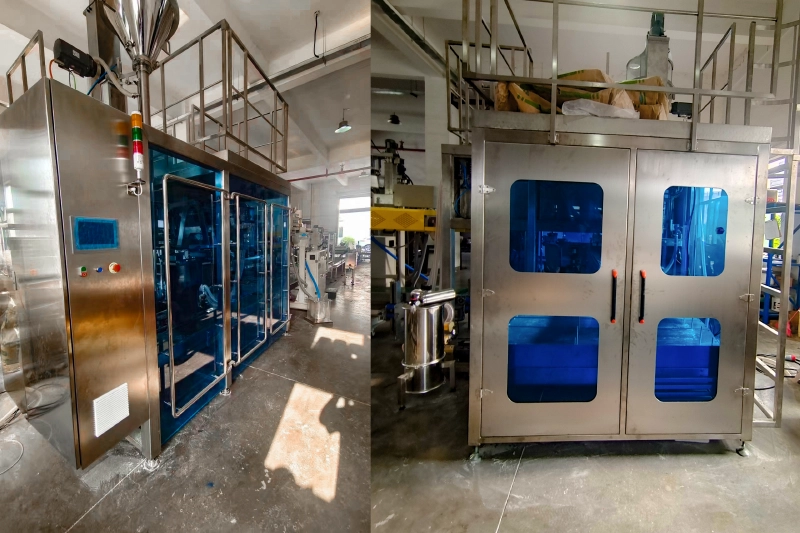
    Stainless steel automatic bagging machine with blue inspection windows, bag magazine conveyor, and top access platform

    Where 25 kg powder bags actually twist and collapse

    A 25 kg bag of milk powder, flour, starch or whey isolate is not a rigid container. After the gross weigher discharges through the bag spout and the clamp closes, the kraft or woven PP wall has very little shape memory. The filled bag now has to travel through a transfer conveyor, a bag mouth opening station, an inspection zone and finally arrive at the sewing head in a square, flat condition. Any lateral force applied during that travel deforms the bag wall.

    In most older powder lines, the last meter before sewing is a flat belt with no side guidance. The bag arrives with its mouth skewed 5–15° off-axis. Operators stand at the sewing head and manually straighten each bag. At 600 bags per hour that is constant intervention — and it is exactly where the sewing needle breaks, the thread loop misses the seam, and the rework bin fills.

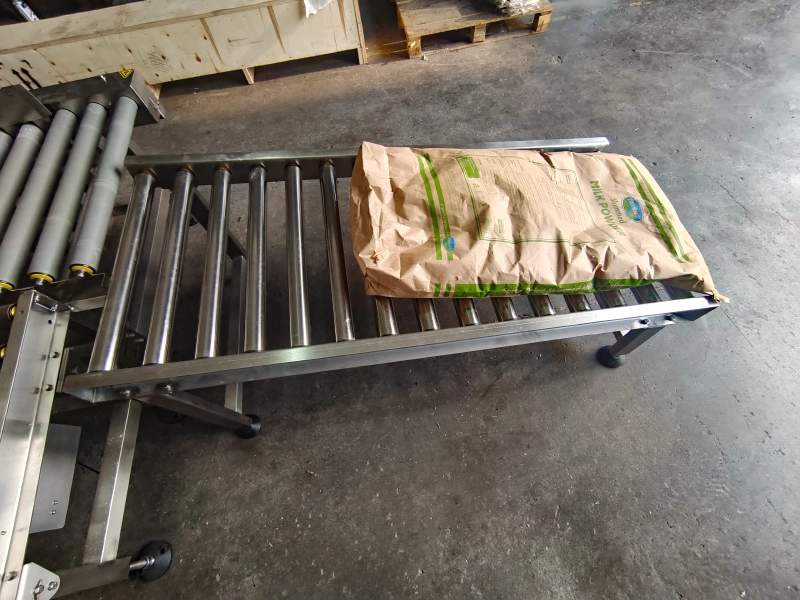
    Stainless steel roller conveyor with kraft paper bag, used for bag transfer in packaging line
    The sewing head sees a twisted bag — and produces a leaky seam, a broken needle, or a stop.

    The sewing head is the last station in the line. Once the bag arrives misaligned, no upstream correction is possible. The result is rejected bags, jammed needles, and operators getting their hands close to moving needles. It is both a quality problem and a safety problem.

    How Mipline keeps the bag square from filling to sewing

    Mipline starts the alignment job at the upstream end. The bagging station is a fully enclosed stainless-steel cabinet with three blue inspection windows, a top maintenance platform with safety railing, and a bag magazine conveyor that feeds empty bags into the clamp. Because the empty bag is already square when it leaves the magazine, the upstream reference is correct from the first step.

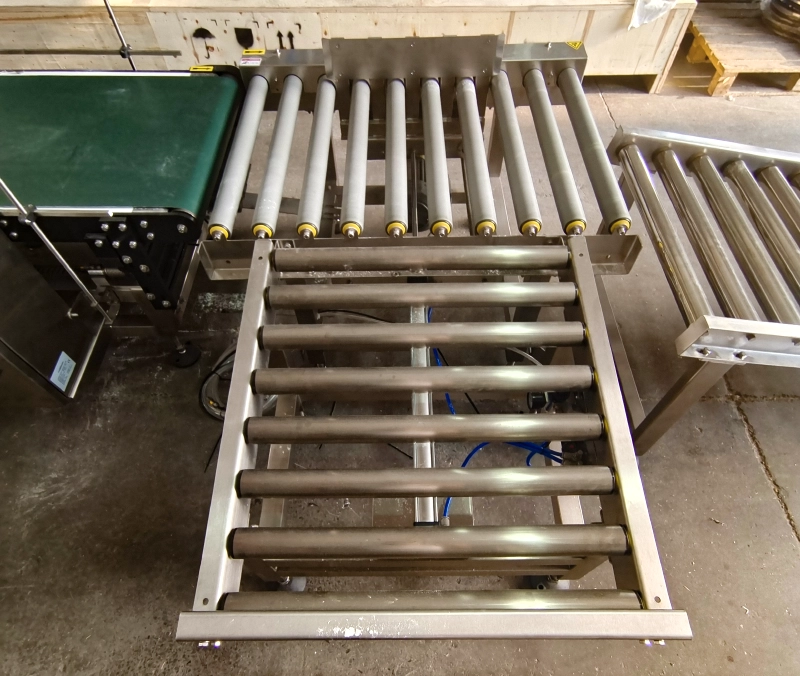
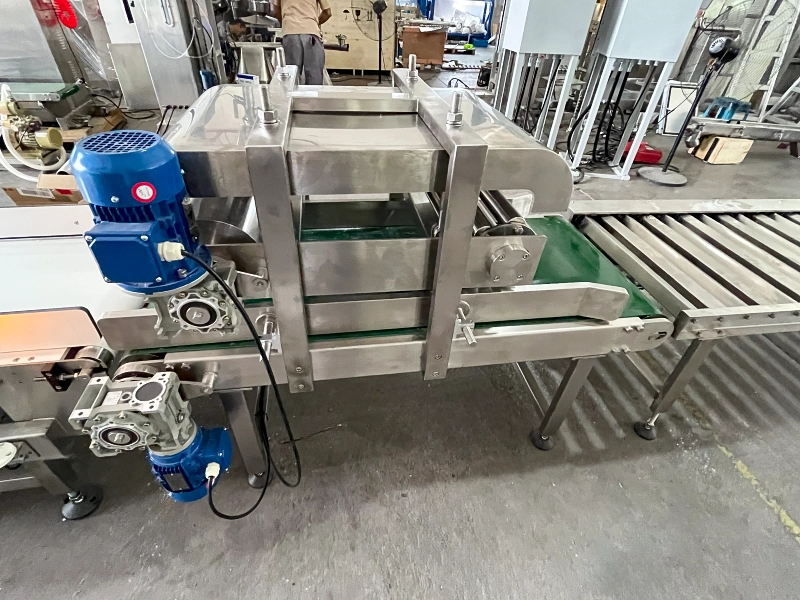
    From the clamp to the sewing head, the bag rides a guided transfer path. A twin-belt transfer conveyor with adjustable side guides carries the filled bag away from the filling nozzle. An angled roller section aligns the bag walls against a fixed guide rail. A separate roller conveyor with vacuum grippers holds the kraft paper wall flat while the bag mouth is shaped for sewing. Every transition has a physical reference — there is no free-flight zone where the bag can drift.

    Stainless steel roller conveyor transfer section with angled rollers for industrial bag handling and line integration

    Field note: On a 600-bag-per-hour milk powder line, Mipline measures bag-mouth skew at the sewing head. Lines with an unguided transfer average 8–12° of skew and 4–6% reworked bags; Mipline holds skew under 2° and reworked bags under 1%.

    Engineering evidence: how the line is specified for 25 kg powder

    These numbers are not nominal — they are the working envelope the line is built around. The 304 stainless contact parts let the line handle milk powder, whey, food starch and other dairy or flour products without contamination risk. The 600 mm conveyor width is sized for the standard 25 kg kraft bag footprint.

    The PLC and HMI are sized so the line can be reconfigured for a different bag size — 20 kg, 25 kg, 50 kg — by changing the recipe, not the mechanical layout. That is the difference between a packaging line that ships product and a packaging line that ships product at the rate your sales team promised.

    ParameterMipline specification
    ThroughputUp to 600 bags / hour (25 kg)
    Bag typeKraft paper, woven PP, PE-lined
    Bag weight range20 – 25 kg
    Contact partsSUS 304 stainless steel
    Conveyor width600 mm
    Air supply0.6 MPa, ~200 L/min
    Power supply380 V / 50 Hz / 3-phase
    Operator per shift1 (line monitoring)
    PLC / HMISiemens S7-1200 + 7″ HMI
    Sewing headNewlong NP-7A or equivalent
    Frame materialQ235 carbon steel + stainless cladding
    Stainless steel bag-feeding conveyor with dual gear motors and clamping frame for automatic bag transfer

    Send us your bag size, your powder, and your target bags-per-hour

    We will spec a Mipline configuration for your 25 kg powder line — including the bag handoff before the sewing station, the sealing head, and the upstream gross-weigher interface.

    Request a Line Spec
  • Powder Bagging Line: Settling and Shaping Before Final Bag Inspection

    Powder Bagging Line: Settling and Shaping Before Final Bag Inspection

    POWDER PACKAGING LINE ENGINEERING

    Powder Bagging Line: Settling and Shaping Before Final Bag Inspection

    For a 25 kg powder bag, sealing is not the end of the process. A controlled settling and shaping sequence helps prepare the closed bag for metal detection, checkweighing, reject handling, and roller discharge.

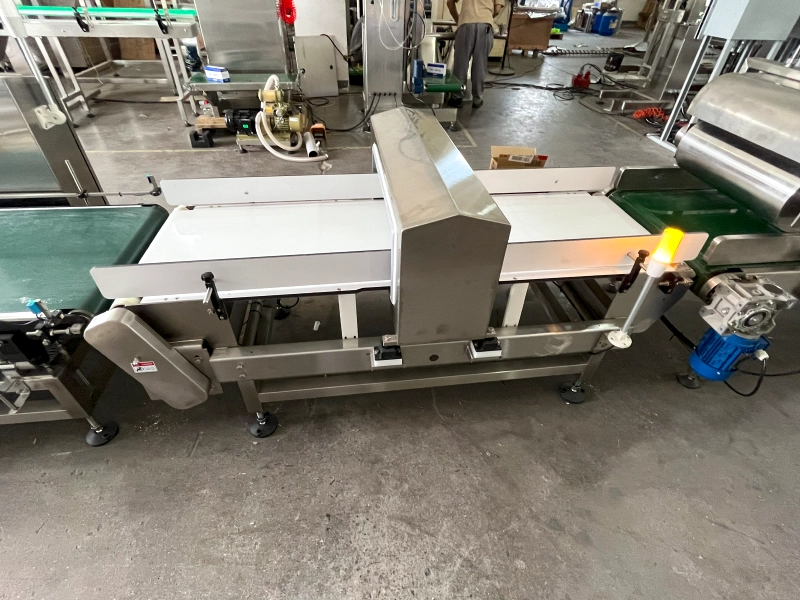
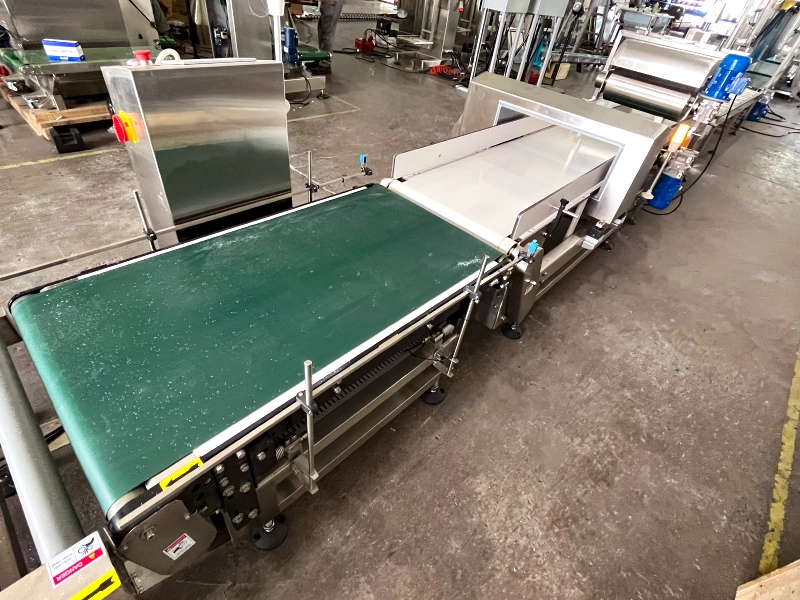
    Factory-installed stainless steel conveyor line with enclosed center module, side rails, and motorized drive

    Why a sealed bag still needs controlled handling

    In a milk powder, flour, starch, feed, or other dry-powder plant, the filled bag can leave the closing station with trapped air, an uneven base, or a body that is not square. The issue is not only appearance. A twisted or collapsed bag may present an unstable surface to a metal detector or checkweigher, and it can make the final roller discharge less predictable.

    A common older arrangement sends the bag directly from sealing to inspection. Operators then straighten, push, or hold each bag while trying to keep the mouth and body within the inspection path. This manual correction adds a variable between closure and quality control. It also makes the last section of a powder packaging line harder to connect to palletizing or warehouse handling.

    Stainless steel roller conveyor transfer section with angled rollers for industrial bag handling and line integration
    The last transfer is part of inspection quality

    Inspection equipment can only assess what arrives in its working window. If the bag is still settling, leaning, or moving sideways, the line needs a defined conditioning and handoff stage before the detector and checkweigher.

    How Mipline coordinates settling, shaping, and inspection

    Mipline treats post-seal handling as a sequence rather than a single conveyor. Depending on the project layout, the closed bag can be turned or transferred into a settling conveyor, followed by a shaping section that supports a more consistent bag profile. The indexed equipment references include a 3,000 mm settling conveyor and a 1,500 mm shaping section, both described as configurable conveying references rather than universal line promises.

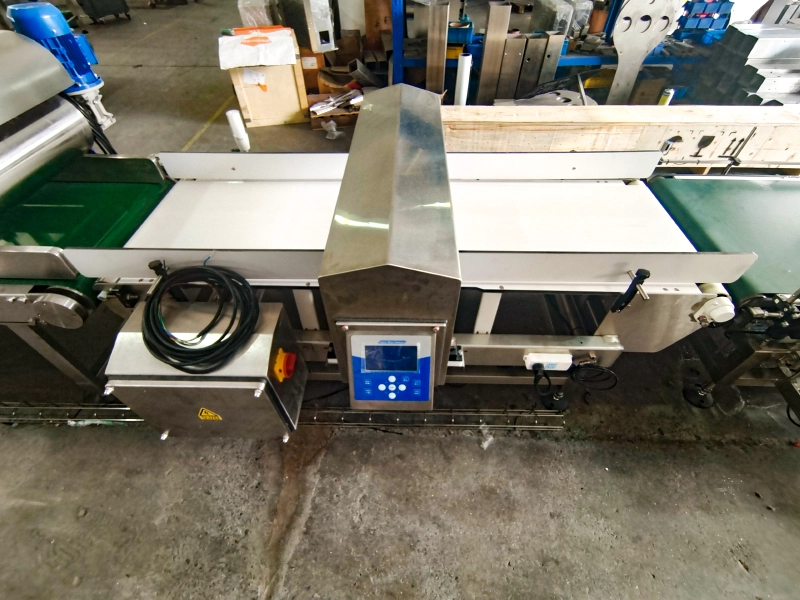
    After this conditioning stage, the bag can move toward metal detection, checkweighing, reject handling, and final roller discharge. The production images show stainless-steel frames, side guides, belt and roller transfer sections, control housings, and adjustable supports. Those visible components support the physical story of guided handoff and line integration; they do not, by themselves, prove a detection result, checkweigher accuracy, or a fixed production rate.

    Engineering note: Checkweigher source references for this line vary by configuration. The selected model, product effect, target weight, bag dimensions, and required throughput should be confirmed from the project-approved datasheet before any accuracy or capacity commitment is made.

    What the end-of-line arrangement should confirm

    A reliable automatic bagging machine for powder is not selected only by its filler. The final inspection section must match the bag and the quality-control plan. For a 25 kg powder bagging line, the settling time, shaping method, detector window, checkweigher belt, reject device, and discharge direction should be reviewed as one material flow.

    The following points are practical inputs for configuring a powder filling and bag sewing line or a sealed-bag line. Each one changes how the Mipline stations are connected and validated.

    Input to confirmWhy it affects the lineMipline coordination point
    Powder and bulk behaviorAir retention and flow affect settling and final shape.Review filling, de-aeration, settling, and shaping as one sequence.
    Bag material and dimensionsKraft, composite, and coated woven bags respond differently after closure.Match guides, belts, rollers, sealing, and inspection openings to the bag.
    Inspection requirementMetal detection and weight control need defined product and process limits.Select and validate the detector, checkweigher, alarm, and reject path by project.
    Downstream handlingPalletizing or manual removal may require a specific discharge orientation.Reserve a stable handoff to the final roller conveyor and next station.
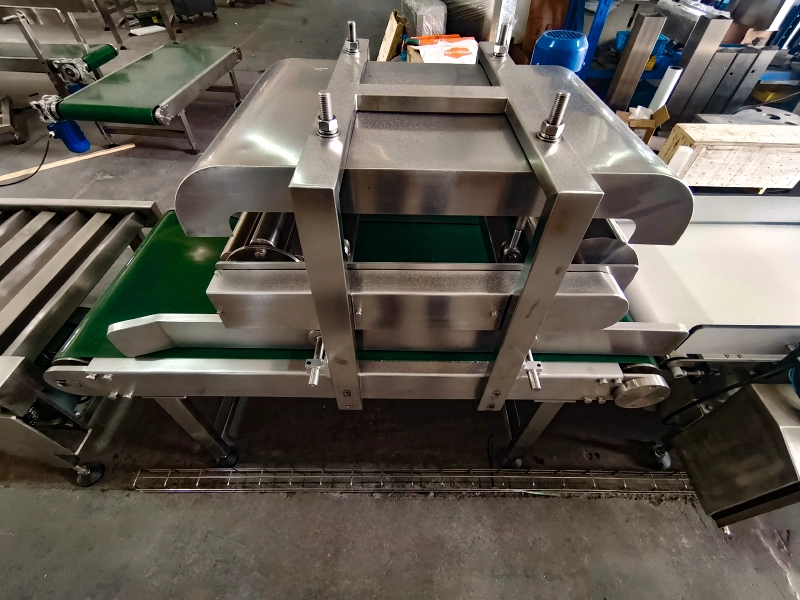
    Stainless steel conveyor weighing platform with adjustable support frame and threaded leveling bolts

    Start with the bag and inspection brief

    To configure a Mipline powder packaging line, share the material, target weight, bag construction and dimensions, closure method, required speed, metal-detection specification, checkweigher range, reject logic, utilities, and downstream palletizing or discharge layout. The engineering team can then define the settling, shaping, inspection, and transfer arrangement without turning variant data into a universal claim.

    Discuss Your Powder Bagging Line
  • Automatic Starch Powder Bagging Line for Stable Bag Transfer Before Sewing

    Automatic Starch Powder Bagging Line for Stable Bag Transfer Before Sewing

    MIPLINE POWDER PACKAGING LINE

    Automatic Starch Powder Packaging Line for Stable Bag Transfer Before Sewing

    For starch processors packing 25 kg industrial bags, Mipline connects automatic bag supply, bottom-up filling, closure, shaping, inspection, and discharge into one controlled starch powder packaging line. The result is a cleaner handoff before sewing or sealing, with less manual bag straightening at the last meter.

    stainless steel enclosed powder packaging machine with blue viewing windows and top maintenance platform for starch bags

    Why starch bags become difficult to sew after filling

    A starch plant may have a reliable filler and a separate sewing head, yet still lose time between the two machines. A filled kraft-paper, paper-plastic composite, or coated woven bag can twist, retain air, or arrive with a skewed mouth. When operators must open, hold, straighten, and reposition every heavy bag, the sewing station becomes dependent on individual handling rather than a repeatable process.

    Free-fall filling can also leave powder around the bag mouth and closure area. Uneven settling changes the bag shape before palletizing, while an uncontrolled conveyor only moves the problem downstream. For a flour or starch powder packaging line, the critical requirement is not simply filling speed. It is a guided sequence that keeps the bag supported and aligned from pickup through closure and final transfer.

    factory-installed stainless steel belt conveyor with adjustable guide rails for stable starch bag transfer
    The handoff problem is a line problem, not only a sewing problem

    If the bag mouth arrives dusty or skewed, adjusting the sewing head cannot correct the upstream cause. Bag clamp alignment, controlled lifting, settling, shaping, and guided conveyor transfer must work together.

    How Mipline adapts the powder bagging process

    For the starch powder packaging line, Mipline treats bag handling as part of the filling process. A bag magazine supplies bags to the pickup and opening sequence, then the bag is positioned and held at the filling head. The main system uses vertical screw feeding with weighing control and bottom-up lifting fill. The lifting platform follows the fill level, keeping the filling point close to the powder instead of allowing a long open drop into the bag.

    For a starch application, the feeding profile can be configured around bulk density, flowability, moisture, aeration, bag construction, target weight, and required speed. Three-stage screw feeding—fast filling, medium filling, and slow final dosing—supports controlled final weight adjustment. Where the approved configuration requires it, vacuum extraction or de-aeration can reduce retained air before closure. These are project configuration points, not universal performance claims.

    Engineering view: A stable bag handoff is created by the relationship between clamp alignment, bottom-up filling, closure preparation, and the transfer conveyor. Selecting one component in isolation leaves the last meter unresolved.

    industrial conveyor line with touch-screen control box, emergency stop, and roller transfer sections for powder bags

    Structure and reference parameters to verify for a starch line

    For a starch powder packaging line, the production images show the physical evidence behind the layout: enclosed stainless-steel stations, blue viewing windows, green belts, roller transfer sections, adjustable guides, emergency-stop controls, and access platforms. A closure package may combine dust removal, trimming, inner heat sealing, sewing, paper-tape wrapping, pressing, and counting for compatible composite bags. After closure, settling and shaping can prepare the bag for metal detection, checkweighing, reject handling, and roller discharge.

    Use the following reference points when defining the project. Final values must be confirmed against the selected configuration and starch test results. automated powder packaging line with safety enclosure, conveyor section, and stacked finished starch bags

    ItemReference for specificationWhy it matters
    Bag and weightNominal 25 kg industrial powder bags; 5–25 kg on the DS25K referenceDefines clamp, lift, bag opening, and downstream handling requirements
    Filling controlVertical screw feeding with fast, medium, and slow dosing stagesSupports stable final dosing for powders with changing flow behavior
    Line reference1.5–2 bags/min and accuracy ≤±0.1–0.2% on one 11889 configurationUse as a configuration reference, not a universal starch-line promise
    InspectionMetal detector, checkweigher, reject, and roller discharge after formingCatches defined finished-bag risks before palletizing or dispatch
    Utilities and hygieneSUS304 body reference; power, air, and dust extraction to be confirmedMatches site conditions, maintenance access, and powder containment needs

    Specify your starch powder packaging line around the final handoff

    Share the starch bulk density and flowability, bag material and dimensions, target weight, closure method, required bags per minute, utilities, dust-control needs, inspection points, and palletizing layout. BPM can then match the bagging, filling, sealing, transfer, and inspection modules to the real process instead of treating the filler as a standalone machine.

    Discuss Your Powder Packaging Line
  • Mipline Powder Packaging Line for Stable 25 kg Bag Transfer Before Sewing

    Mipline Powder Packaging Line for Stable 25 kg Bag Transfer Before Sewing

    POWDER PACKAGING LINE

    Mipline Powder Packaging Line for Stable 25 kg Bag Transfer Before Sewing

    For dairy powder, flour, starch, and other dry-powder plants, the last metre before sewing can decide whether a filled bag reaches the closing head square and stable. Mipline combines automatic bag handling, guided conveying, and enclosed stainless-steel equipment to create a cleaner handoff from powder filling to bag sewing or sealing.

    Stainless steel automatic bagging machine with blue inspection windows, bag magazine conveyor, and top access platform

    When the filled bag becomes unstable before sewing

    In a conventional powder packing layout, operators often correct the bag by hand after filling. A woven or kraft paper bag may twist as it leaves the filling point, collapse against a transfer section, or arrive with its mouth skewed toward the sewing head. That creates more manual bag straightening, inconsistent bag presentation, and a less predictable sewing operation.

    The issue is not only the filling machine. It is the continuity of the bag handoff between filling, conveying, alignment, and closing. A powder packaging line must control the bag at the points where it can twist, lose its square shape, or enter the next station off-centre.

    Stainless steel roller conveyor transfer section for stable powder bag handling before sewing
    Common buyer problem: the last metre before the sewing head

    A filled bag that twists or collapses can make the sewing head unstable. Mipline addresses this handoff with guided roller transfer and controlled bag alignment, reducing the need for operators to straighten each 25 kg bag manually.

    Why Mipline fits the powder bagging application

    Mipline is configured as an automatic powder packaging line for industrial bags, including 25 kg kraft paper or woven bags. The line connects a bagging station with a bag magazine and transfer sections rather than treating each machine as an isolated unit. This gives the filled bag a guided path after dosing and before sewing or sealing.

    For a milk powder packaging machine, dairy powder bagging line, flour bagging line, or starch powder packaging line, the same principle applies: control the bag through filling, conveying, alignment, and closing so the sewing station receives a more repeatable bag mouth position.

    Engineering view: Guide geometry and transfer settings should be selected against the actual powder characteristics, bag construction, filled weight, and required line speed during commissioning.

    Equipment evidence: enclosure, transfer, and alignment

    The stainless-steel roller conveyor sections provide a visible transfer surface for moving large bags between line modules. Angled rollers and supporting frames help maintain a defined route instead of leaving the bag to drift across an uncontrolled gap. This is the part of a powder filling and bag sewing line that directly addresses unstable bag transfer before sewing.

    The twin-belt transfer arrangement adds contact and guidance on both sides of the bag. Adjustable side guides help keep the pack centred as it moves through the handoff. In practical terms, this supports cleaner bag alignment and more stable bag transfer before sewing.

    Stainless steel twin-belt transfer conveyor with adjustable side guides for cleaner bag alignment before sewing

    The bag-contact evidence is also important for buyers specifying a 25 kg powder bagging line. A filled kraft paper bag needs support during transfer, while the conveyor must remain accessible for cleaning, adjustment, and inspection. Mipline’s stainless-steel machine frames, visible levelling feet, guarding, and inspection windows support a more maintainable dry powder packaging equipment layout.

    Stainless steel roller conveyor with kraft paper bag for 25 kg powder bag transfer
    Line requirementMipline evidenceOperational result
    Stable bag handoff before sewingGuided roller transfer and adjustable side guidesLess manual bag straightening
    25 kg kraft or woven bag handlingSupported conveyor route and bag-contact transfer sectionsCleaner bag alignment
    Food and powder plant maintenanceStainless-steel frame, guarding, inspection windows, and access platformEasier inspection and line integration

    Plan a cleaner powder bagging line

    Share your powder, bag type, target weight, and sewing or sealing method with BPM to review a suitable Mipline configuration for stable bag transfer before closing.

    Discuss your powder packaging line
  • Mipline Powder Packaging Line for Stable 25 kg Bag Transfer Before Sewing

    Mipline Powder Packaging Line for Stable 25 kg Bag Transfer Before Sewing

    POWDER PACKAGING LINE | MIPLINE

    Mipline Powder Packaging Line for Stable 25 kg Bag Transfer Before Sewing

    For dairy powder, flour, starch, and other dry-powder plants, Mipline combines an automatic powder bagging machine with guided conveying, bag clamping, and a cleaner handoff before sewing or sealing. The result is a more stable 25 kg powder bagging line that reduces manual bag straightening and keeps the bag mouth aligned for the next operation.

    Real factory photo of an enclosed stainless-steel powder packaging line with safety doors and conveyor interface

    When the last meter of a powder bagging line becomes the bottleneck

    A filled kraft paper or woven bag can leave the filling point in an unstable shape. If the bag twists, collapses, or arrives skewed, operators often stop at the last meter to square the bag by hand. That intervention slows the line and makes the sewing head work with an inconsistent bag mouth. In a milk powder packaging machine, flour bagging line, or starch powder packaging line, the issue is not only labor: poor handoff can also create uneven sewing, extra powder leakage, and unpredictable downstream spacing.

    Mipline addresses this transfer zone as part of the automatic powder packaging line rather than treating it as a loose conveyor afterthought. The enclosed stainless steel station, bag magazine interface, guided conveyor path, clamping points, and roller transfer sections create a controlled route from bag preparation and filling toward sewing or sealing. Each visible module is selected for a practical job: guide the bag, support its base, keep its mouth presentable, and pass it forward without relying on continuous manual correction.

    Stainless steel roller conveyor with kraft paper bag, used for bag transfer in packaging line
    Typical old-scheme problem: manual bag straightening before the sewing head

    When the filled bag is transferred on a flat, unguided path, its center can drift and its upper edge can fold. The operator then has to catch, rotate, or square the bag while keeping production moving. That is the point where a nominally automatic bagging line becomes labor-dependent.

    Why Mipline fits a cleaner bag handoff before sewing

    The product is suited to plants that need an automatic bagging machine for powder but also need reliable handling after filling. Stainless steel guarding gives the powder packaging equipment a defined working envelope, while blue inspection windows make the bag path and mechanical action easier to observe. The bag magazine conveyor provides a repeatable supply point, and the green belt and roller sections create a continuous transfer route between stations.

    At the handoff, guide rails and clamping elements help keep the bag centered instead of allowing it to rotate freely. Roller conveyor sections support the bag bottom while it advances, and the adjustable side guides shown in the transfer module can be used to maintain a more consistent travel line. The combination is intended to reduce manual straightening, improve bag alignment, and present a more stable bag mouth to the sewing or sealing operation.

    Engineering view: the useful output is not simply a faster conveyor. It is a repeatable bag position at the next machine. For a 25 kg powder bagging line, controlled support and guided transfer are the physical link between filling accuracy and clean bag closing.

    Visible structure and evidence from the Mipline line

    The installed equipment shows how the powder bagging line is organized around real bag movement. A stainless steel roller section carries a kraft paper bag through the transfer zone. A twin-belt module adds synchronized conveying and adjustable side guidance. At the bag clamp station, the milk powder bag is held at the working point rather than left to drift on the conveyor. Vacuum grippers are also visible in the handling path, supporting controlled pickup or positioning of the bag material.

    These are not decorative features. Together they answer the common buyer questions behind a dry powder packaging equipment project: how will the bag be supported, where will alignment be corrected, how will the line be observed, and what happens before sewing? The correct configuration still depends on bag dimensions, powder behavior, target capacity, sewing or sealing method, and plant layout, but the Mipline architecture provides the controlled handoff points needed to engineer those details.

    Visible componentTransfer jobBuyer result
    Enclosed stainless steel bagging stationDefines the automatic bagging and inspection areaCleaner access and clearer machine integration
    Roller conveyor with bag supportMoves and supports the filled industrial bagMore stable travel toward sewing
    Twin-belt conveyor with side guidesControls the bag path through the handoffLess drift and manual straightening
    Bag clamp and vacuum handling pointsHolds or positions the bag at the working stationMore consistent bag-mouth presentation
    Stainless-steel twin-belt transfer conveyor with central control housing and adjustable side guides
    Real industrial photo of a kraft paper milk powder bag held at an automatic bagging clamp station
    Stainless steel roller conveyor with vacuum grippers handling kraft paper powder bags on a packaging line

    Specify the bag handoff, not only the filling machine

    For a powder packaging line, share the powder type, bag material and size, target weight such as 25 kg, required output, sewing or sealing method, and available layout. BPM can use these inputs to configure the Mipline automatic powder bagging machine, guided conveyor handoff, and bag transfer stages around your actual production route.

    Discuss your powder bagging line