Automatic Bagging Machine & Palletizing Systems Manufacturer

Category: English

  • How ppline Made Woven-Sack Handoffs Cleaner in a Southern Grain Warehouse

    How ppline Made Woven-Sack Handoffs Cleaner in a Southern Grain Warehouse

    ppline | Bagging line for woven sacks

    How a southern grain warehouse made woven-sack handoffs cleaner before sewing with ppline

    When filled woven sacks leave the bagging point uneven, the sewing station has to fight for alignment. This ppline line was selected for a southern grain warehouse because the handoff path stays controlled: the bag is guided, held, and discharged in a way that makes the next sewing step easier.
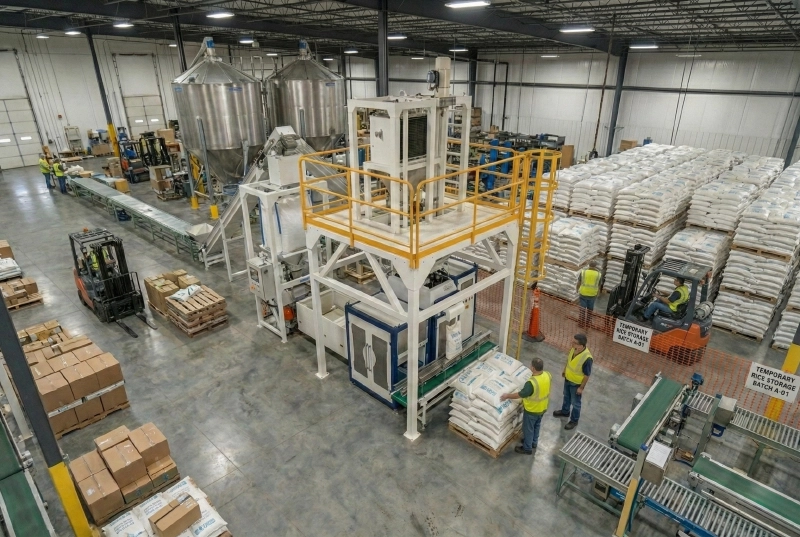
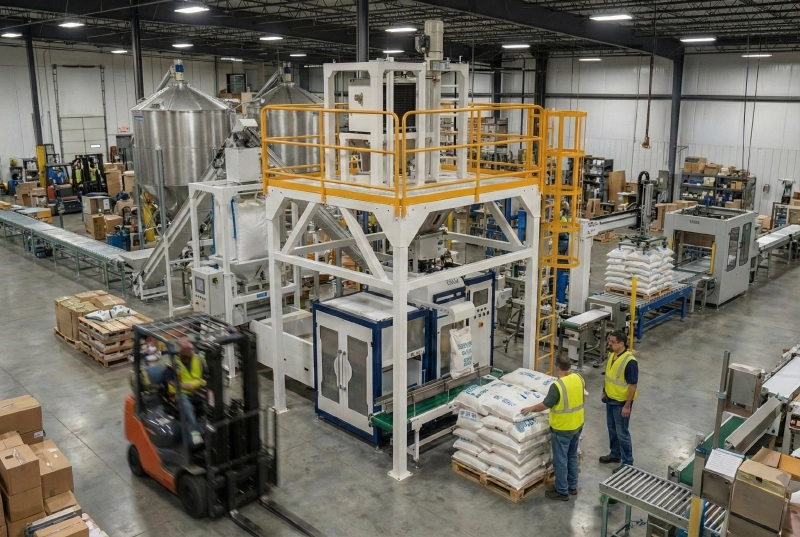
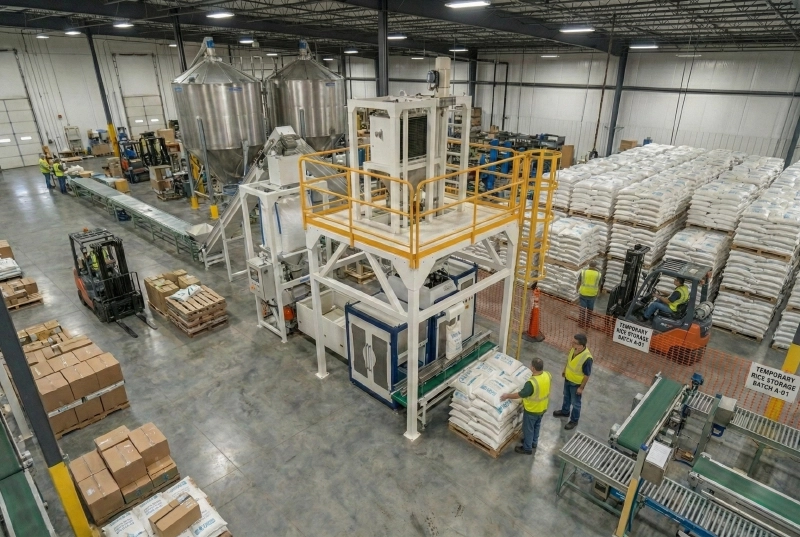
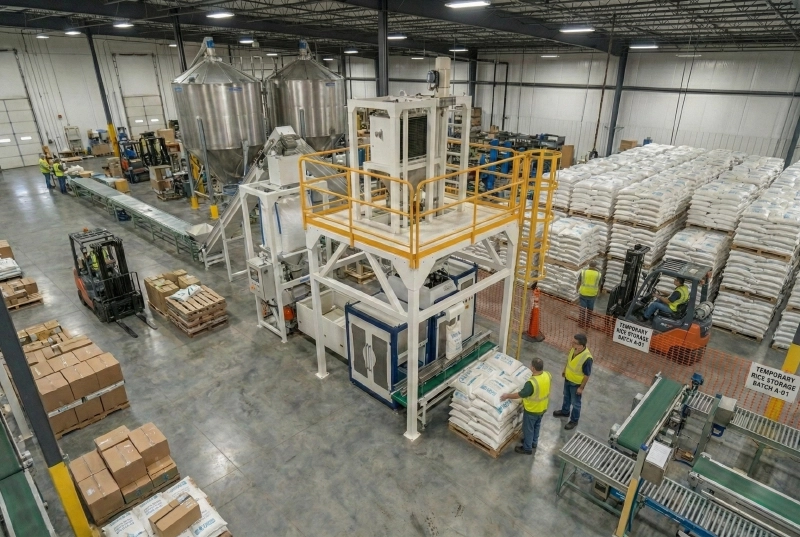
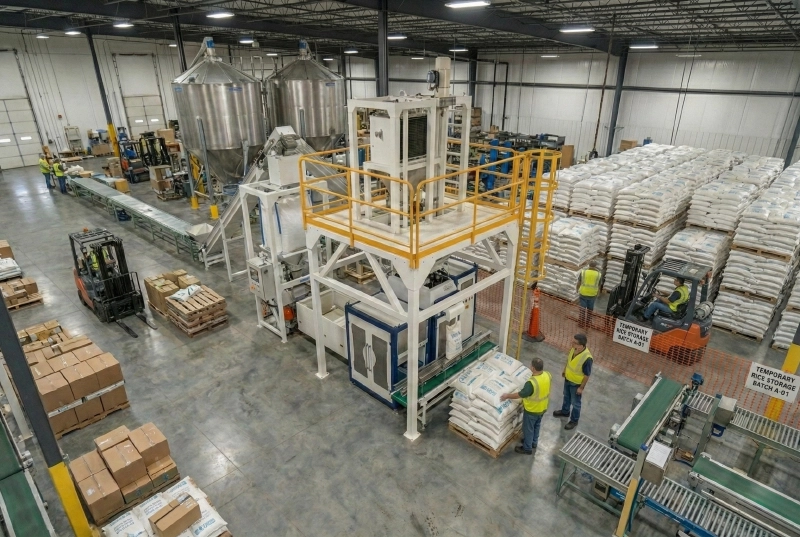
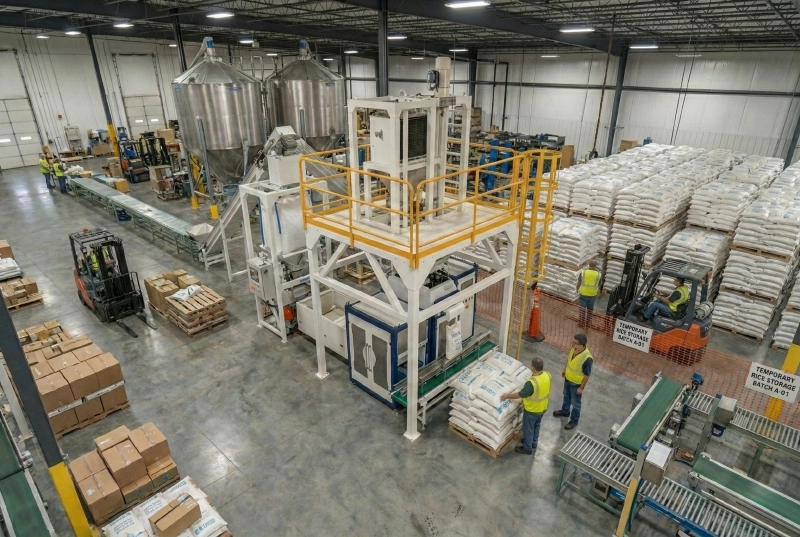
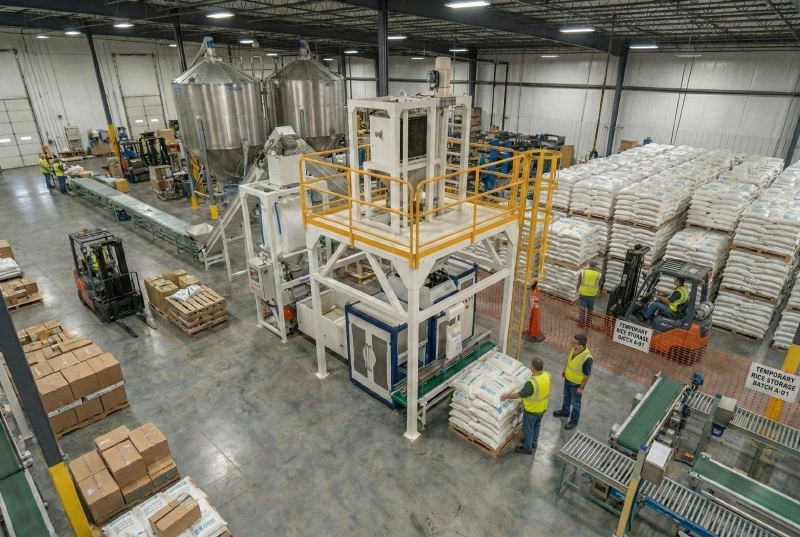
    High-angle operational photo of a QZK-1200 bagging plant with twin stainless steel storage silos, conveyors, and finished sacks ready for sewing

    Why the warehouse needed a steadier bag transfer path

    The customer environment is a grain warehouse with constant bag movement, pallet loading, and a downstream sewing step. In that kind of line, the problem is usually not the fill itself. The real loss happens when a woven sack arrives twisted, off-center, or too loose for the next operator or machine to catch quickly.

    That is where the older setup tends to slow down. If the bag drops too hard or the discharge point is not guided well enough, workers have to straighten it by hand. That adds small delays on every cycle, creates rework at the sewing station, and makes the line feel less stable during peak hours.
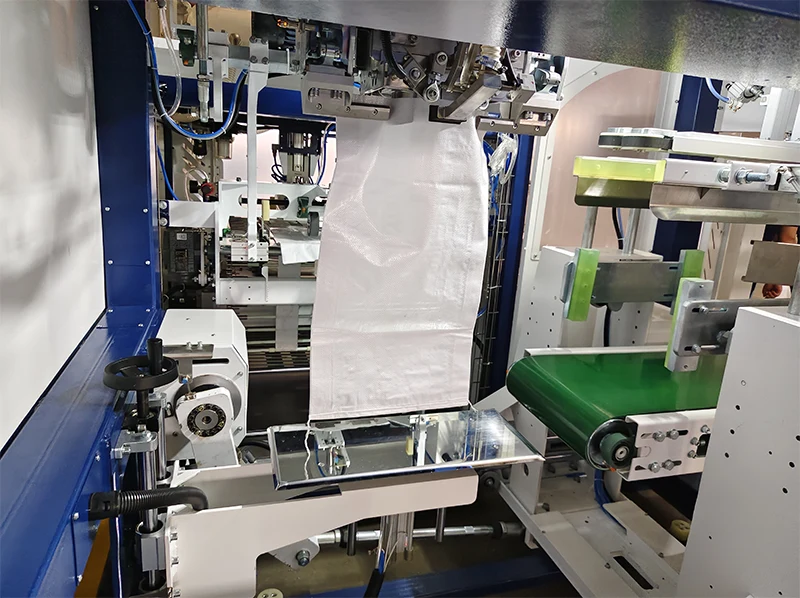
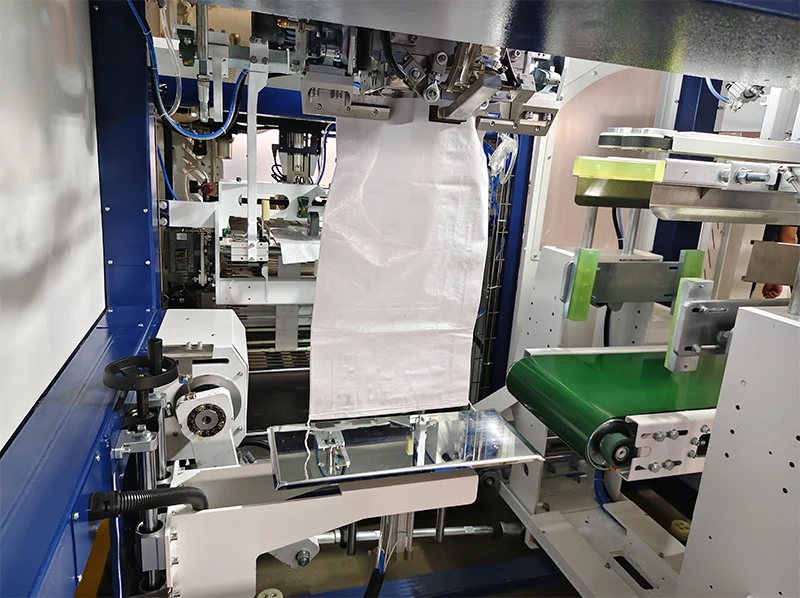
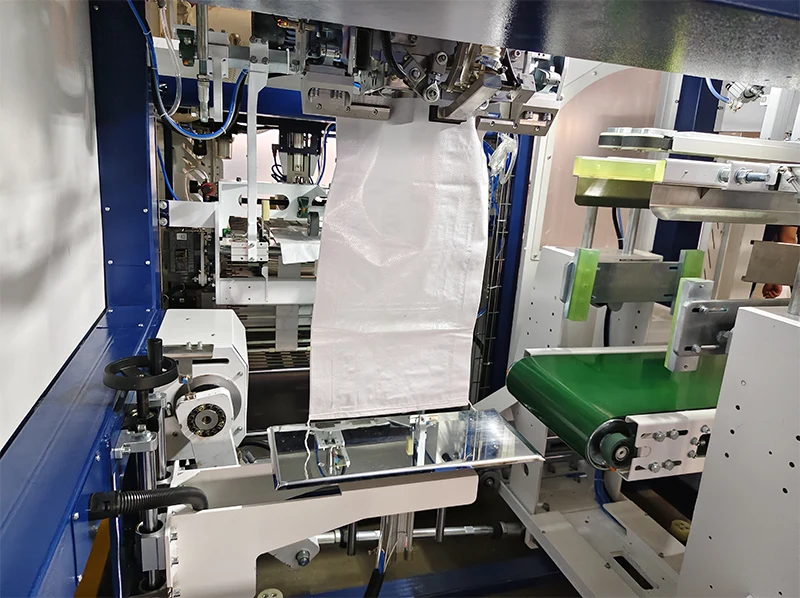
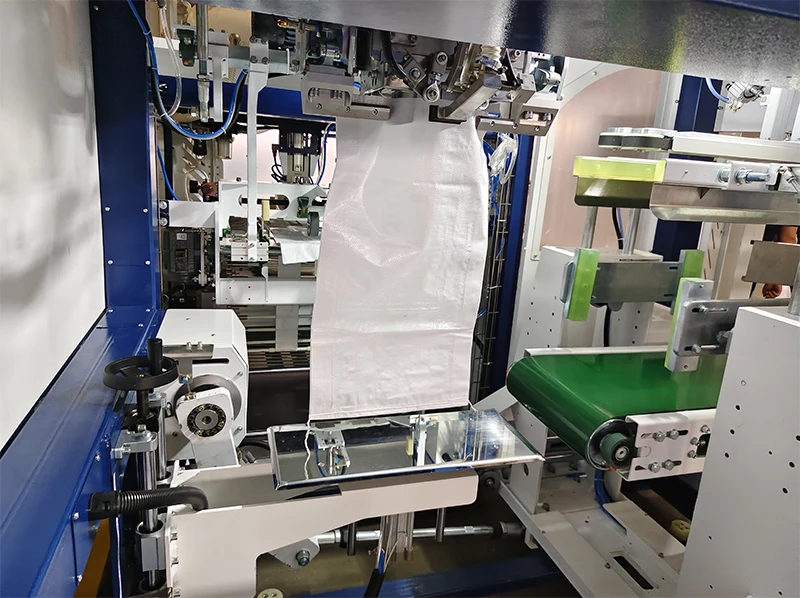
    Close-up internal photo of the bagging unit with vacuum suction cups, pneumatic bag clamp, green conveyor, and white woven sack alignment
    What was hurting the line

    Uneven sack handoff, manual straightening, inconsistent discharge position, and extra effort before sewing were the main pain points. The warehouse needed a layout that kept the bag centered and supported while it moved from filling to transfer.

    Why ppline fit this job

    ppline fits this type of application because the machine is built around a controlled bagging path, not just a fill point. The internal handoff structure visible in the close-up photo shows vacuum suction cups, a pneumatic clamp, and a green conveyor working together to keep the woven sack aligned instead of letting it drift.

    The swing-arm HMI and elevated steel platform also matter in daily use. Operators can reach the controls, monitor the process, and keep the bagging station organized without crowding the transfer area. That helps when the warehouse needs steady work across long shifts rather than short demo runs.

    Why this matters: a better bagging line is not only about output. It is about making the next step easier. If the sack is already positioned cleanly when it leaves the machine, sewing, stacking, and pallet movement all become simpler.

    Structure and image evidence from the line

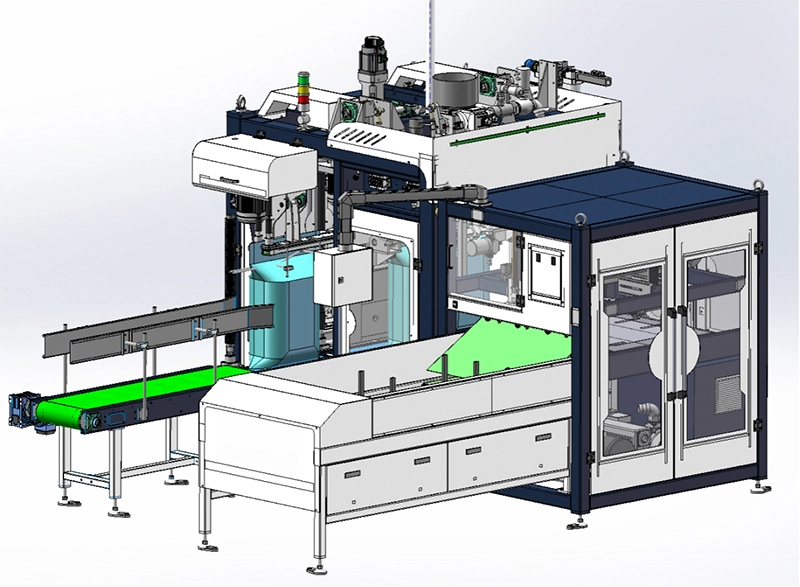
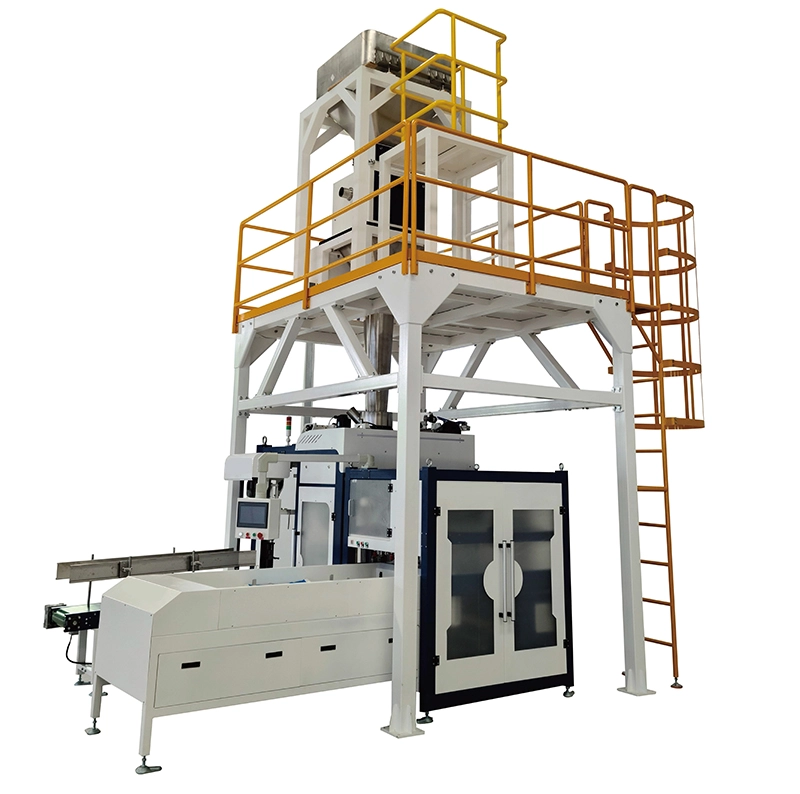
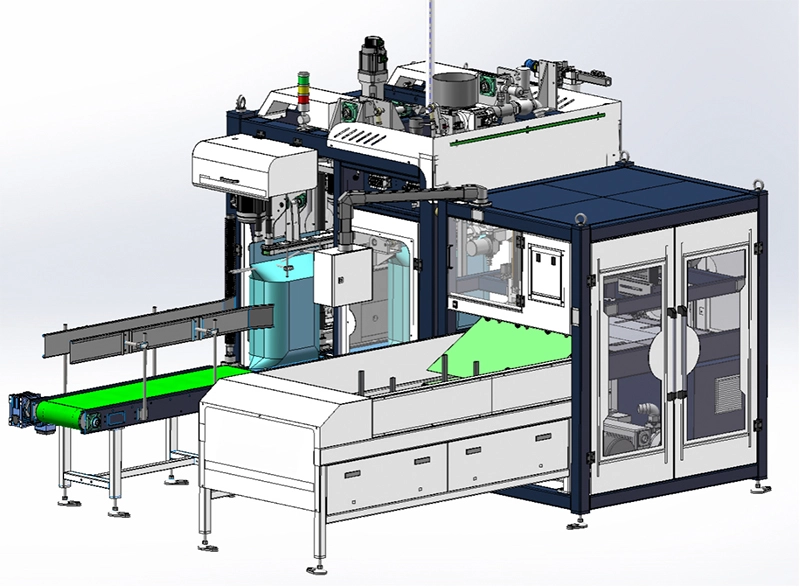
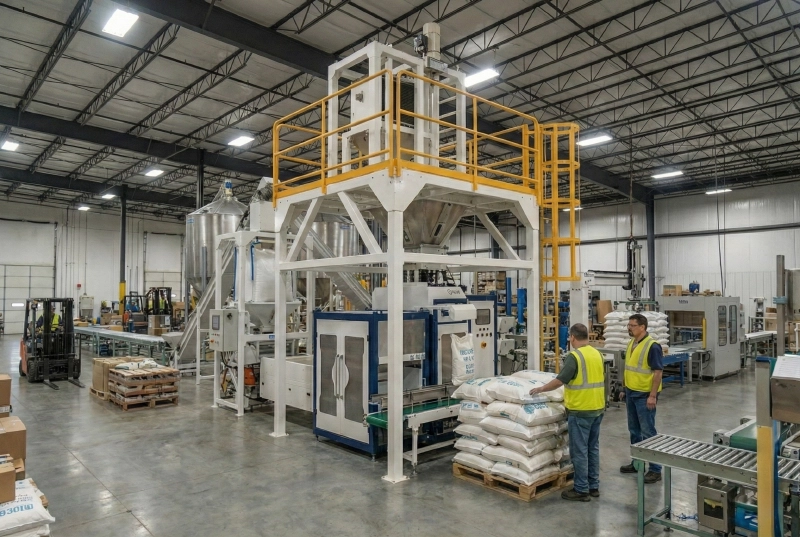
    The visual evidence matches the use case. The high-angle plant photo shows twin stainless steel storage silos, conveyors, and finished sacks moving through the warehouse flow. The internal close-up shows the working bag clamp and alignment zone. The isometric product view shows the operator interface and outfeed belt. Together, these images explain how the machine keeps the path controlled from top to bottom.

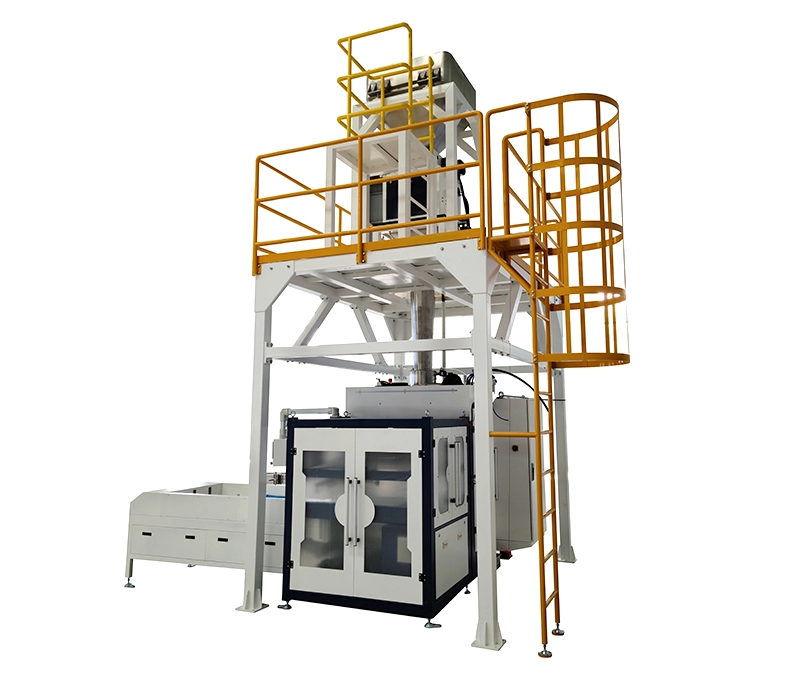
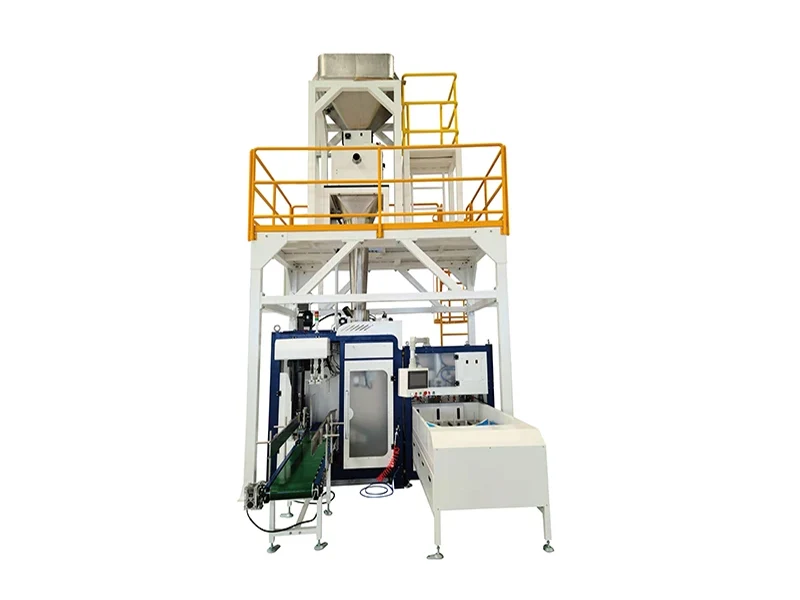
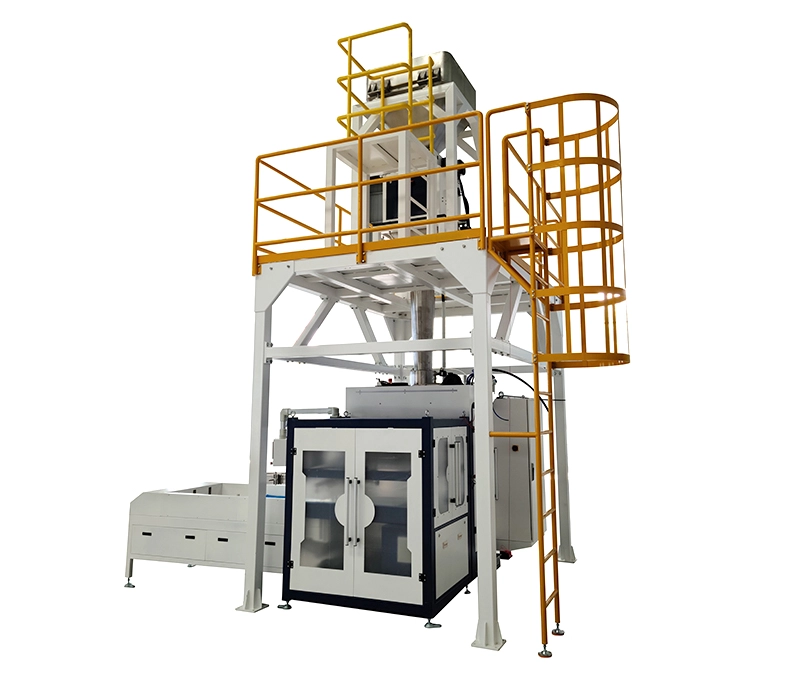
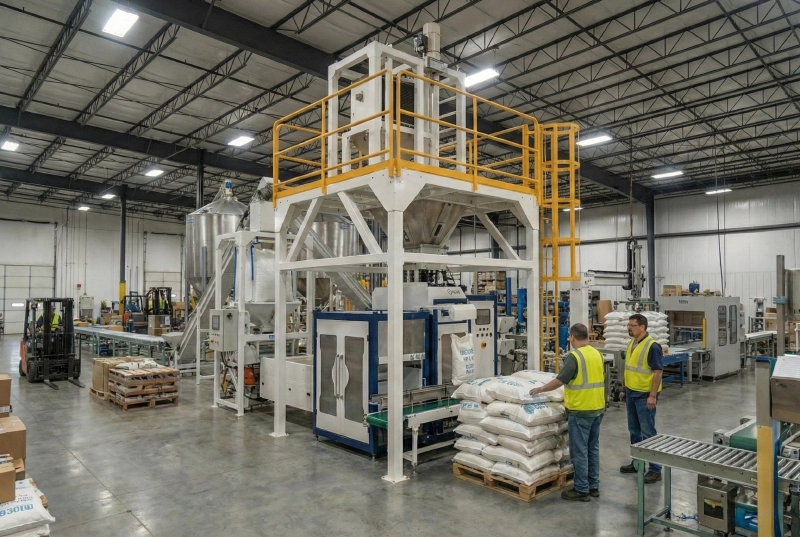
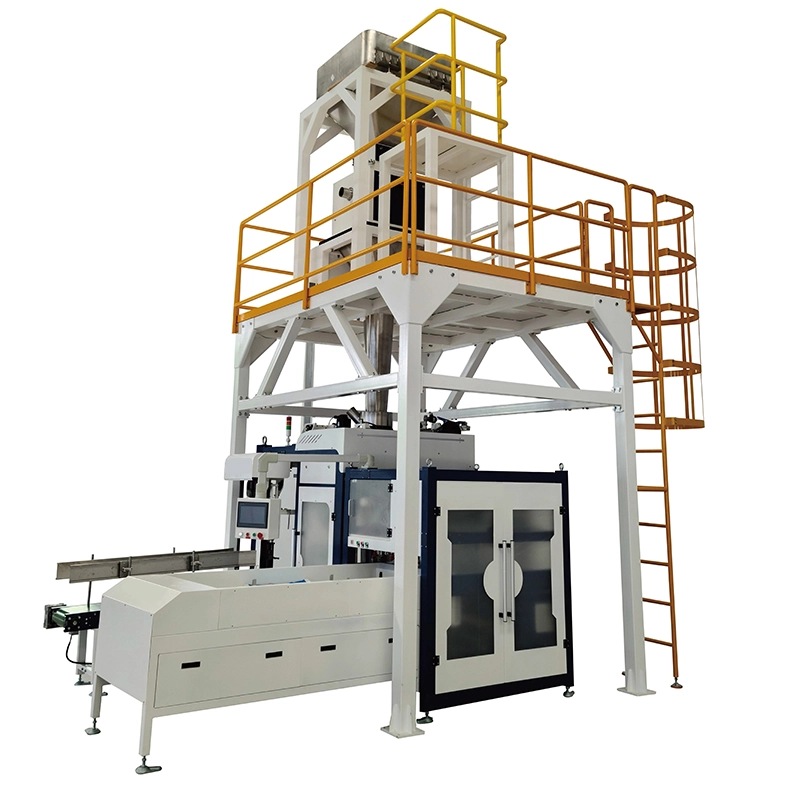
    The white-background product shot adds one more proof point: the elevated steel framework, safety cage ladder, and enclosed cabinet are all arranged as a serious industrial package, not a loose collection of modules. For a warehouse that depends on repeatable handoffs, that matters as much as the fill point itself.
    Isometric product photo of the QZK-1200 bagging machine showing the swing-arm HMI touchscreen, outfeed belt conveyor, and steel platform
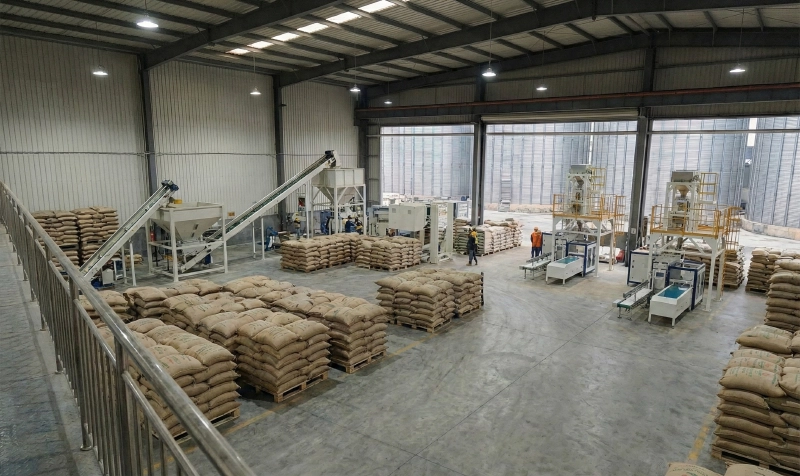
    Wide-angle interior render of a large grain bagging warehouse with dual bagging towers, inclined conveyors, and palletized sacks
    Front view product photo of the QZK-1200 automatic bagging machine with elevated steel framework, safety cage ladder, and enclosed cabinet
    What the warehouse neededWhat ppline provided
    Cleaner transfer into the next sewing stepGuided bag clamp, suction-assisted handoff, and controlled outfeed path
    Less manual straighteningStable alignment zone visible in the internal machine photo
    Safer and more organized operationElevated steel platform, safety cage ladder, and enclosed cabinet
    Better daily consistencyHMI control and a layout designed for repeatable warehouse use

    Need a cleaner woven-sack handoff in your grain line?

    If your current bagging station still needs manual straightening before sewing, ppline can be configured as a more controlled transfer point for warehouse operations that need steadier daily flow.

    Request a bagging line discussion
  • A Cleaner Woven-Sack Handoff Path for a Southern Grain Warehouse

    A Cleaner Woven-Sack Handoff Path for a Southern Grain Warehouse

    ppline in a southern grain warehouse

    A Cleaner Woven-Sack Handoff Path for a Southern Grain Warehouse

    When woven sacks leave filling and move toward sewing, the weak point is not the filler. It is the handoff. A small twist, a loose mouth, or a drifting bag edge can slow the line, pull operators back into manual correction, and create a messy sewing station.

    This project used the ppline bagging station to keep the sack square, keep the transfer steadier, and feed the next sewing step with less rework.

    Close-up internal photo of bagging unit with vacuum suction cups, robotic bag placer, green conveyor, and white woven bag.
    Hero view: the bagging unit keeps the woven sack controlled at the critical transfer point.

    The problem was never just filling

    In this warehouse, the old setup did a reasonable job of moving product into the sack, but the bag arrived at sewing in an inconsistent position. Operators had to re-square the mouth by hand. That meant more touches, more waiting, and more variation from one sack to the next.

    The real pain showed up in three places:

    • Bag mouth drift: the woven sack could lean or wrinkle before the sewing head.
    • Manual correction: staff had to steady each sack before it was safe to stitch.
    • Downstream mismatch: when transfer is unstable, sewing speed drops to the speed of human correction.
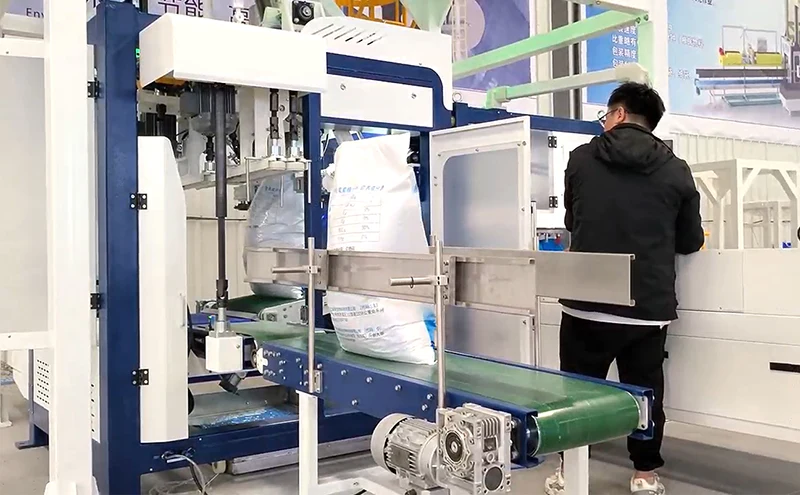
    Industrial bag conveyor transfer machine with steel frame, guide rails, and motorized green belt.
    The transfer conveyor is built to keep the sack guided instead of drifting across the belt.

    Why ppline fit this job

    The ppline system matched the warehouse because it solves the handoff as a mechanical alignment problem, not a labor problem. The close-up bagging module uses vacuum suction cups, a robotic bag placer, and a controlled green conveyor to hold the woven sack in a repeatable position. Instead of relying on a worker to square the mouth after every transfer, the machine keeps the bag seated and guided.

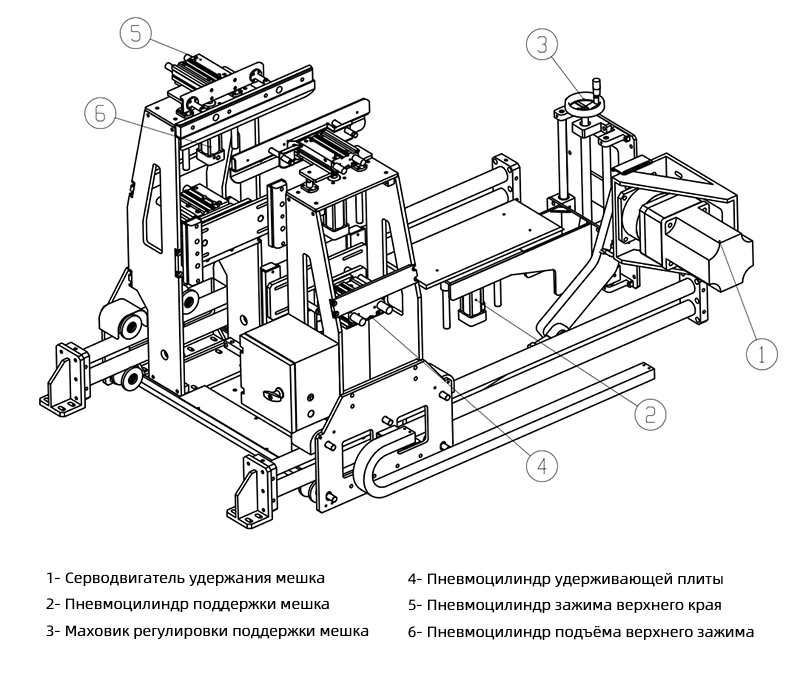
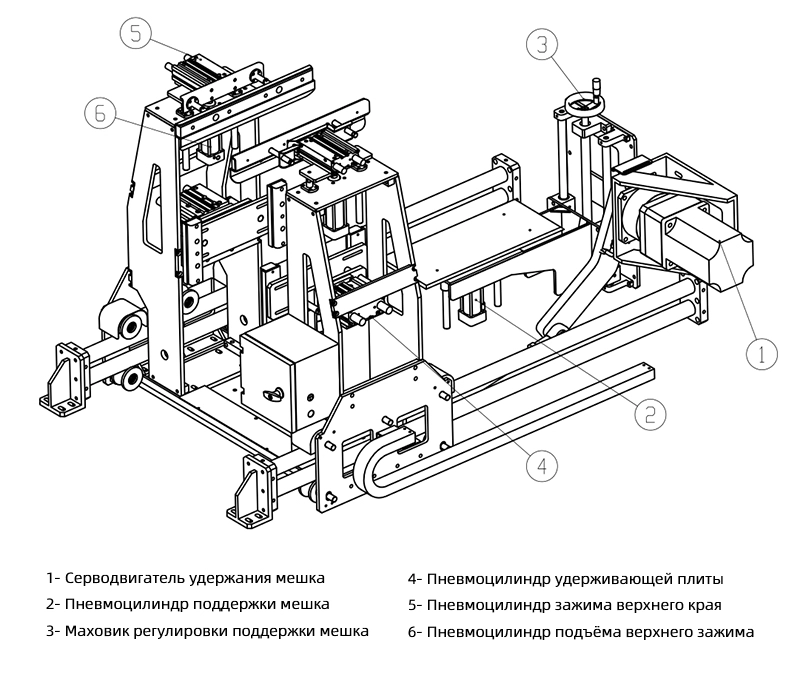
    The line also uses structural details that matter in day-to-day operation: a steel frame for stability, guide rails to reduce side movement, a bag clamp area to hold the mouth, and a bottom support assembly with pneumatic cylinders and servo adjustment to keep the bag aligned during the transition. Those details are visible in the image set, and they are the reason the line performs better than a loose conveyor handoff.

    3D CAD rendering of modular secondary bagging line QZK-1200 with accumulation belt, large bag gripper, and discharge conveyor.
    System view: accumulation belt, bag gripper, and discharge path work as one handoff sequence.
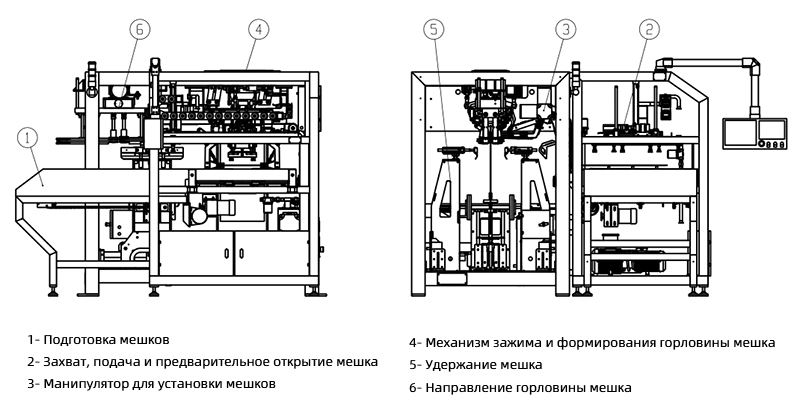
    Technical CAD drawing of bag clamping and bottom support assembly with pneumatic cylinders, servo motor, and Russian annotations.
    Mechanism view: clamping and bottom support keep the sack steady while the mouth is prepared for sewing.

    That is why the warehouse saw a practical improvement. The sewing station no longer had to absorb all the variation coming from upstream. The bag arrived straighter, the mouth was easier to catch, and the line felt less dependent on operator reflexes.

    What changed after the upgrade

    Old situationWhat ppline changedEvidence from the photos
    Bag mouth wandered before sewingVacuum placement and guided transfer held the sack in lineClose-up module with suction cups and green conveyor
    Operators had to re-square every sackClamp, support, and servo positioning reduced manual correctionCAD detail of the clamping and bottom support assembly
    Downstream sewing speed was limited by the handoffStable discharge made the sewing station easier to feedSystem view of accumulation belt, gripper, and discharge conveyor
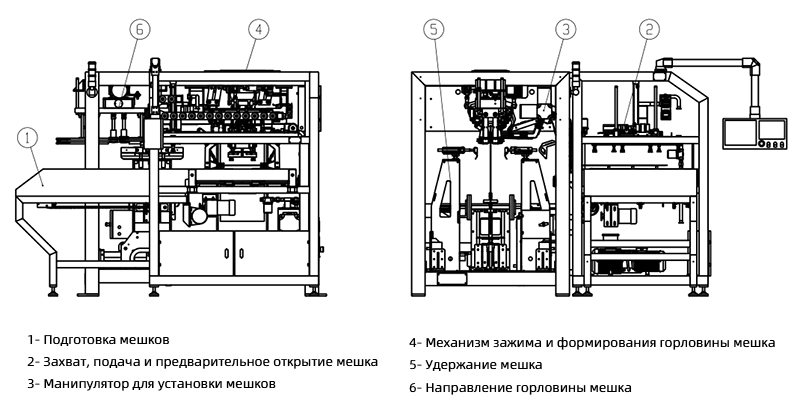
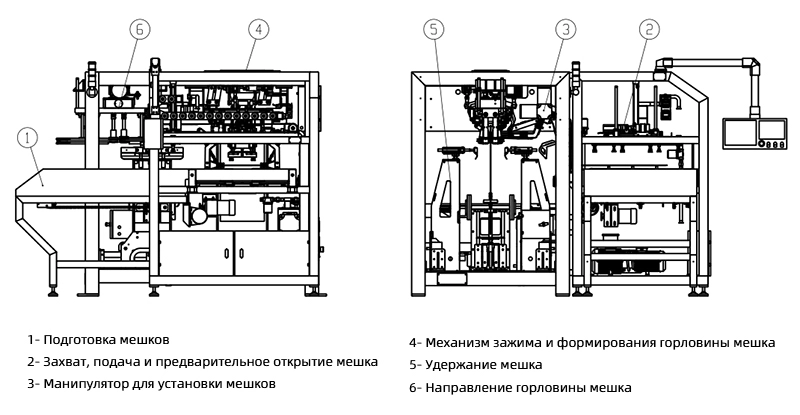
    Dual-view technical CAD blueprint of automatic bagging machine showing bag magazine, robot arm, and Russian component annotations.
    Layout view: bag magazine and robotic placement architecture support a repeatable handoff.

    The result: a steadier path to sewing

    For a grain warehouse, the best packaging change is often the one that removes a small but constant delay. In this case, the ppline line did exactly that. It reduced the need for hand straightening, kept the woven sacks better controlled between filling and sewing, and made the whole transfer feel more predictable.

    That matters because predictable handoff means cleaner flow, less operator fatigue, and fewer minor stoppages that never look dramatic on paper but always cost time on the floor.

    If your line is losing time at the moment a woven sack leaves filling and reaches sewing, the fix is usually not more labor. It is better control of the handoff itself.

    Talk to BPM about a steadier woven-sack handoff line

  • How ppline kept woven-sack handoffs aligned in a southern grain warehouse

    How ppline kept woven-sack handoffs aligned in a southern grain warehouse

    Bulk-products packing line / grain warehouse

    How ppline kept woven-sack handoffs aligned in a southern grain warehouse

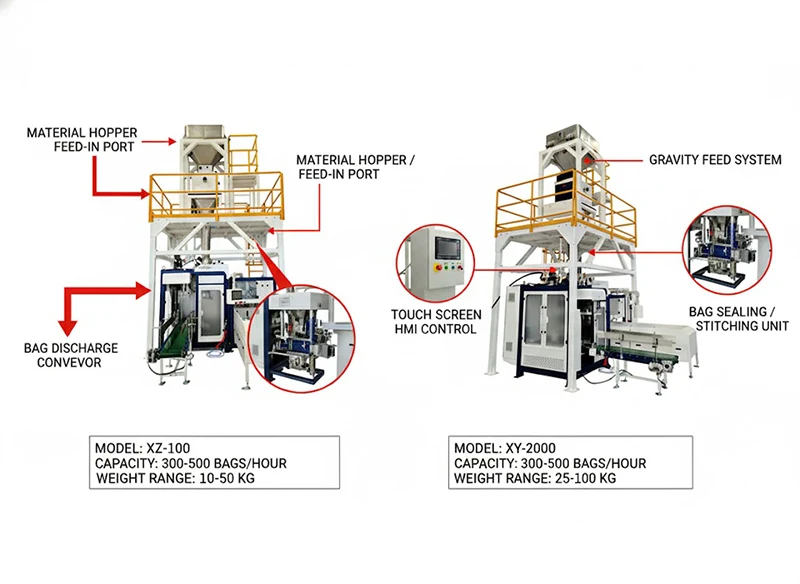
    For a warehouse that needs steady bag flow after filling and before sewing, the problem is rarely one single machine. It is the handoff: bag mouth alignment, transfer stability, dust control, operator rhythm, and whether the line can keep moving when pallets, forklifts, and changeovers all happen at once. This ppline line was matched to that reality with hopper feed, gravity dosing, HMI control, and a bagging-to-conveyor layout that keeps the sacks calmer from the first drop to the final stitch.

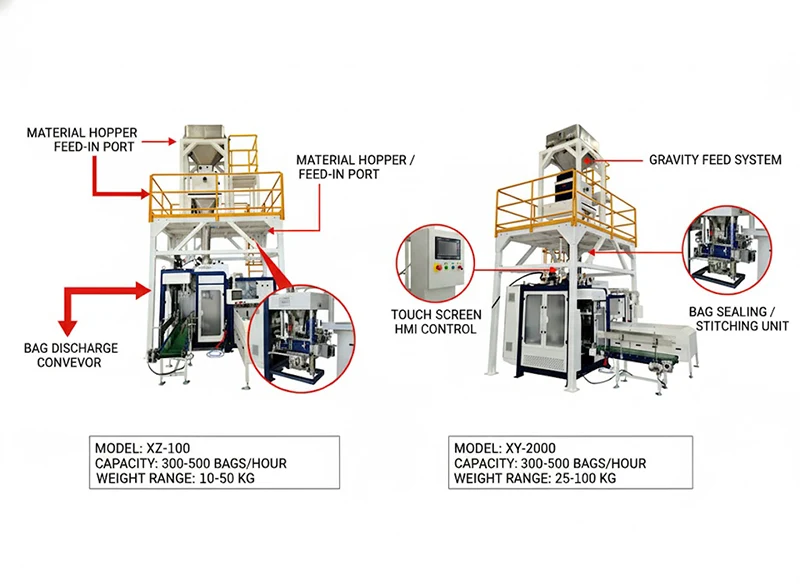
    Automatic bulk bagging machine with hopper feed, gravity dosing, HMI touchscreen, and bag sealing and stitching unit

    Why the old transfer point kept causing trouble

    In bulk-product packing, the warehouse team usually feels the problem first at the seam between filling and sewing. If the bag is not square, the next worker wastes time straightening it. If the discharge point drops the sack too hard, the bag body twists and the seam starts from a poor position. If the conveyor transition is not steady, the line slows down, and the pallet area becomes a waiting zone instead of a staging zone.

    That is why a simple “faster machine” answer is not enough. The customer’s scene needed a line that could hold a consistent bag posture, keep the feed smooth, and give operators a predictable working rhythm. The goal was not only output; it was cleaner handoff, less rework, and fewer interruptions around sewing and palletizing.

    Industrial bagging line with elevated steel platform, hopper, inclined conveyor, and safety railings
    The pain point in one sentence

    The old setup made the warehouse spend labor on bag straightening and transfer control instead of moving finished sacks out of the packing zone.

    Why ppline matched this application

    The fit came from structure, not just labels. The top hopper and gravity dosing help keep product feed stable. The elevated steel platform gives the machine a clear working height and helps the line stay organized. The inclined conveyor supports a smoother transition between stations, so the sack does not have to be “rescued” by hand after every move. The HMI touchscreen gives operators a practical control point for changeovers and daily adjustments, which matters when the warehouse is handling bulk-product variations instead of one fixed bag format.

    The machine family shown in the image set is also built around integration. The enclosed cabinet, platform rails, and linked discharge path are not cosmetic details. They reduce the chaos around the bagging point and make the whole line easier to supervise. For a grain warehouse, that translates into fewer awkward pauses at the sewing point and fewer bags that need to be lifted, turned, or corrected twice.

    Practical insight: when the handoff is stable, the rest of the warehouse stops fighting the packaging line. That is where throughput improves: not in one dramatic jump, but in the small gains from every sack that leaves the machine in the right position.

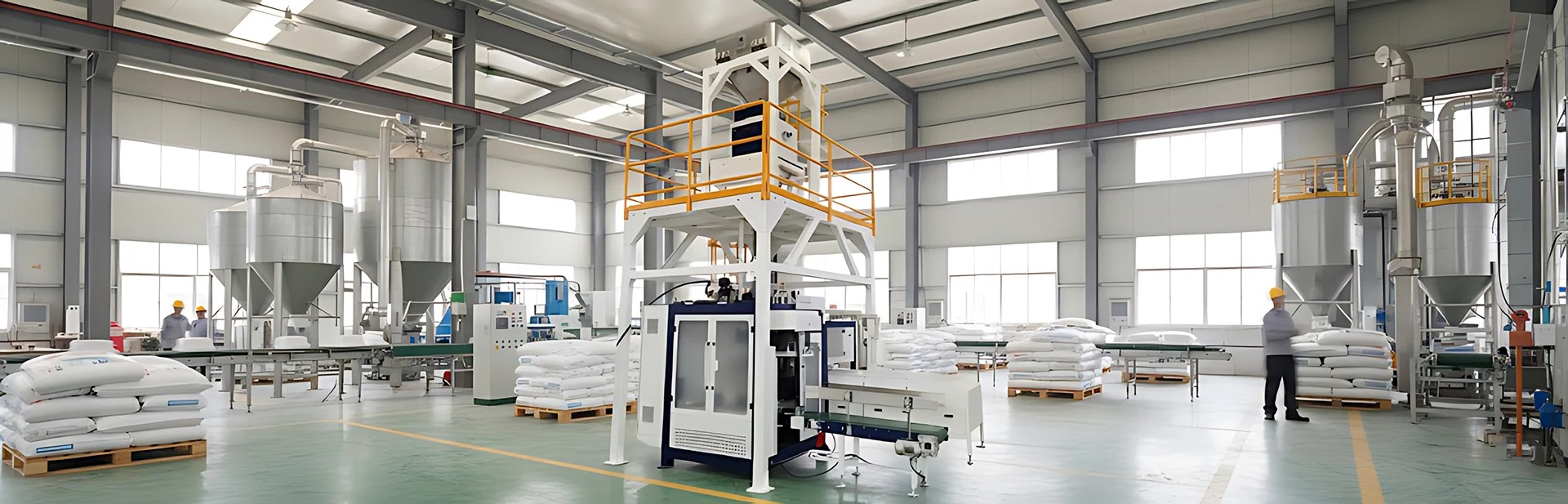
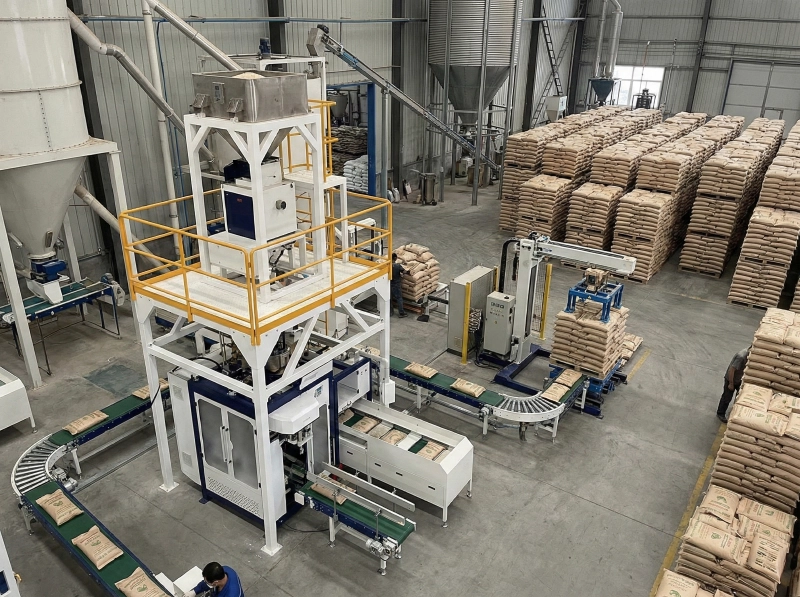
    Industrial powder packaging line with stainless steel silos, elevated platform, conveyors, and bagged product stacks

    What the structure, parameters, and现场 evidence say

    The image set shows three useful evidence layers. First, the machine layout: hopper feed, sealed machine body, platform access, and conveyor connection. Second, the operating context: warehouse-scale installation, bag stacking, and forklift movement around the packaging zone. Third, the product behavior: lines in this family are presented with 300–500 bags per hour capability and coverage for 10–50 kg or 25–100 kg bag ranges, which is the right territory for grain, powder, and other bulk-product handling.

    In other words, ppline is not being used here as a generic packaging buzzword. It is being matched to a site where the packing line must feed, weigh, hold posture, and release sacks in a way that makes sewing and pallet transfer easier, not harder. The final result is a calmer packing zone, less manual correction, and a more predictable warehouse rhythm.

    Warehouse requirementppline responseEvidence from the image set
    Keep woven-sack handoff steadyHopper feed + gravity dosing + controlled discharge pathAutomatic bulk bagging machine and linked conveyor layout
    Reduce bag straightening before sewingRaised platform and aligned transfer geometryElevated steel platform, inclined conveyor, safety railings
    Support warehouse-scale outputLine-level integration with HMI control and bagging range coverageOperational packing line, stacked sacks, forklifts, and plant-floor activity
    High-angle perspective photo of running QZK-1200 packaging line with active forklift logistics and high-visibility operators

    Need a steadier bulk-product packing line?

    If your warehouse is losing time at the seam between filling, sewing, and pallet movement, ppline is built to make that transfer calmer and more controllable. Share the bag size, target output, and product type, and the line can be matched to your packing rhythm instead of forcing your team to work around it.

    Request a packing line proposal
  • How ppline QZK-1200 Kept Woven-Sack Handoffs Steadier Before Sewing in a Grain Warehouse

    How ppline QZK-1200 Kept Woven-Sack Handoffs Steadier Before Sewing in a Grain Warehouse

    Bulk products • warehouse transfer • sewing line stability

    How ppline QZK-1200 Kept Woven-Sack Handoffs Steadier Before Sewing in a Grain Warehouse

    A southern grain warehouse needed cleaner bag transfer, less manual straightening, and a calmer outfeed before sewing. The fix was not a single machine swap; it was a modular ppline layout built around steel framing, controlled discharge, platform access, and a clearer material flow from silo to pallet.

    High-angle operational photo of QZK-1200 bagging plant featuring twin stainless steel storage silos, conveyors, and active forklifts.
    Warehouse-scale layout: twin silos, conveyors, and active forklift flow around the bagging area.

    The old problem: good product, poor handoff

    In bulk-product plants, the trouble rarely starts at the filling point. It shows up a few meters later: a sack leaves the machine slightly skewed, an operator has to square it by hand, the sewing station waits, and the palletizing rhythm loses its pace. That kind of stop-start behavior creates drag in a warehouse that already has to manage forklift traffic, stacked pallets, and limited floor space.

    For a grain warehouse, the real cost is not only labor. Uneven transfer can bruise woven sacks, make the sewing operator chase the bag mouth, and create a messy interface between packaging, inspection, and outbound logistics. The ppline answer is to organize the line so the sack moves in a more predictable path instead of being rescued at every station.

    Why the modular layout fits this kind of site

    The photo set shows a bagging plant built around two stainless steel storage silos, conveyors, and an elevated working zone. That matters because bulk-product lines need gravity, access, and clearance at the same time. When the storage point sits above the process point, the line can feed more steadily; when the access platform is integrated into the frame, operators can inspect, clean, and adjust without breaking the production rhythm.

    On this type of site, the machine is only part of the solution. The steel platform, the enclosed cabinet, and the transfer path are what keep the handoff stable. The ppline layout reduces the chance that a sack leaves the machine off-center and then has to be corrected by hand before sewing.

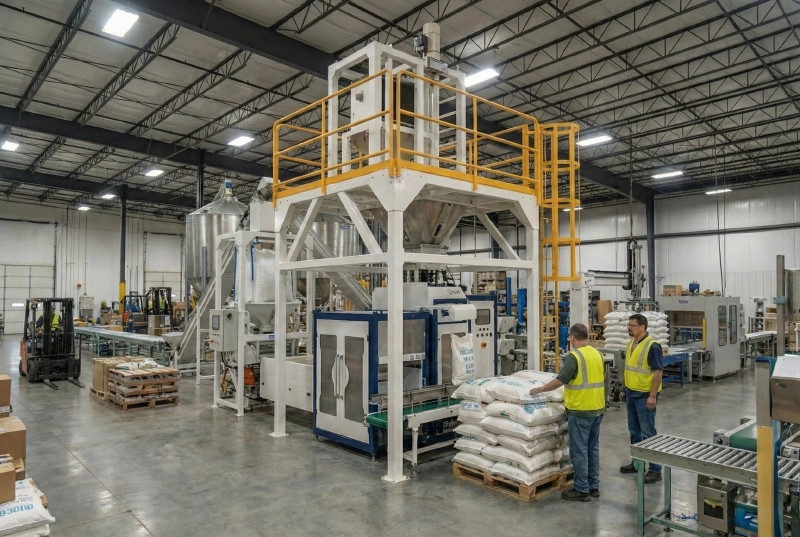
    Eye-level photo of operating QZK-1200 bagging station with steel safety cage ladder, conveyor, and operators stacking sacks.
    Operators stay close to the transfer point while the line keeps moving.

    Structure details that support a steadier bag flow

    Front view product photo of QZK-1200 automatic bagging machine with elevated steel framework, safety cage ladder, and enclosed cabinet.
    Steel framework, safety cage ladder, and enclosed cabinet form the base for stable transfer.

    The front-view machine photo makes the mechanical logic easy to read. The elevated steel framework gives the system a rigid body. The safety cage ladder and platform are not cosmetic; they make maintenance and inspection practical, so the line can stay consistent instead of drifting after repeated manual intervention. The enclosed cabinet also helps keep the working area organized around the process point.

    For a bagging line that has to feed woven sacks toward sewing, that structural rigidity matters more than a flashy specification sheet. A steadier frame means steadier alignment. Steadier alignment means less rework at the sewing station and less handling at the pallet edge.

    Control at the discharge point is where the gain appears

    Isometric product photo of QZK-1200 bagging machine showing swing-arm HMI touchscreen panel, outfeed belt conveyor, and platform.
    The HMI, outfeed conveyor, and platform work together at the handoff point.

    The isometric view shows the swing-arm HMI, the outfeed belt conveyor, and the platform in one frame. That combination is exactly what a warehouse team needs when it wants repeatable bag transfer. The operator can monitor the line without stepping into the flow, and the outfeed conveyor can move the bag toward the next station with less manual correction.

    In practical terms, this is how ppline helps a bulk-products plant. It does not only fill bags; it helps the plant preserve bag shape and direction after filling. That is what keeps the sewing point calmer, especially when the site is busy and forklift traffic is not optional.

    What changed at the warehouse level

    Site pain pointppline responseResult
    Bag leaves the machine slightly skewedRigid steel frame and controlled outfeed pathCleaner approach to the sewing station
    Manual straightening slows the linePlatform access and visible HMI control pointLess interruption between filling and stitching
    Forklift logistics crowd the floorElevated process layout with organized conveyor flowSafer transfer zone and easier pallet movement

    The final result: steadier transfer, less rework

    The biggest improvement was not a dramatic redesign of the warehouse. It was a cleaner sequence: storage, transfer, bagging, discharge, sewing, and palletizing. Once the line was arranged around that sequence, the team spent less time correcting bags and more time moving product.

    The robotic palletizer concept shown in the line render represents the same logic extended downstream. When the discharge side is predictable, automation becomes easier to add later. That is why ppline suits bulk-product sites that want a practical path from manual handling to a more controlled line.

    3D perspective render of QZK-1200 automatic bagging line integrated with a robotic palletizer stacking paper sacks in a factory.
    Downstream automation becomes easier once the bag transfer is already stable.

    For bulk-product plants that need steadier woven-sack handoff before sewing, a modular ppline layout is the faster way to reduce rework and keep the floor moving.

  • Bulk-Products Packing Line for Steadier Sack Handoff Before Sewing

    Bulk-Products Packing Line for Steadier Sack Handoff Before Sewing

    Bulk-products packing line

    How a Bulk-Products Packing Line Reduces Sack Rework Between Filling and Sewing

    For a regional grain warehouse running woven sacks, the issue is rarely the fill itself. The real pain starts after discharge, when a sack leaves the filling point slightly skewed, needs to be straightened by hand, and then still has to arrive at sewing in a clean, stable position. This ppline layout is built to keep that handoff calm, square, and repeatable.

    High-angle operational photo of a bulk-products packing line with twin stainless steel storage silos, conveyors, and palletized woven sacks

    1) What changes when sacks must move from filling to sewing without extra rework

    In a mixed-facility packing room, one loose bag can slow the whole shift. The filling point may be working, but if the sack exits with a twisted mouth, an unstable body, or a poor landing angle, operators spend time pulling it straight before it reaches sewing or stacking. That is where throughput is quietly lost.

    The operational photo above shows the scale of the job: twin stainless steel storage silos, conveyors, and palletized woven sacks all operating in the same space. When bags are moving through that kind of environment, the handoff has to stay controlled. Otherwise the line begins to depend on manual correction instead of machine discipline.

    High-angle operational photo of a bulk-products packing line with twin stainless steel storage silos, conveyors, and palletized woven sacks
    Old-line pain point:

    When the bag mouth does not land squarely, the team must re-grip, re-align, or re-stack before sewing. That adds labor, creates uneven pallet faces, and raises the chance of damaged sacks or inconsistent presentation at dispatch.

    2) Why the ppline layout fits this job

    The transfer module shown in the second image uses a steel frame, guide rails, and a motorized green belt to move sacks in a more disciplined path. That matters because woven sacks do not behave like rigid cartons; they flex, slip, and drift if the support path is not controlled. The guided belt keeps the bag body centered instead of letting it skate across the line.

    The close-up view makes the logic even clearer. Vacuum suction cups, a robotic placing arm, and a green conveyor are doing the work that used to be done by hand. The machine is not just moving material; it is helping the sack stay oriented, which is the real requirement before sewing. Once the bag body is stable, the operator can focus on sealing quality instead of chasing bag position.

    Engineering point: in bulk-products packing, the best improvement is often not a faster fill rate but a steadier transition from fill to take-away. A stable path reduces correction work, and that is what protects the next station.

    3) The structure, parameters, and photo evidence behind the result

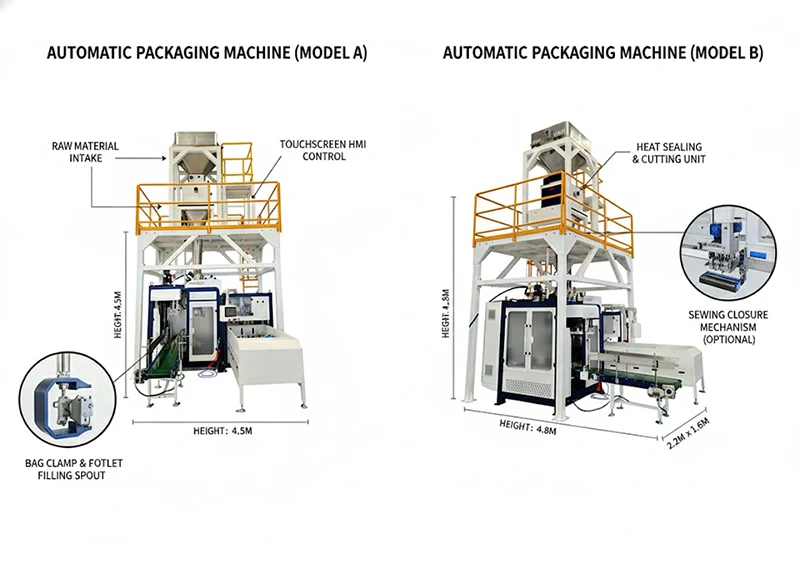
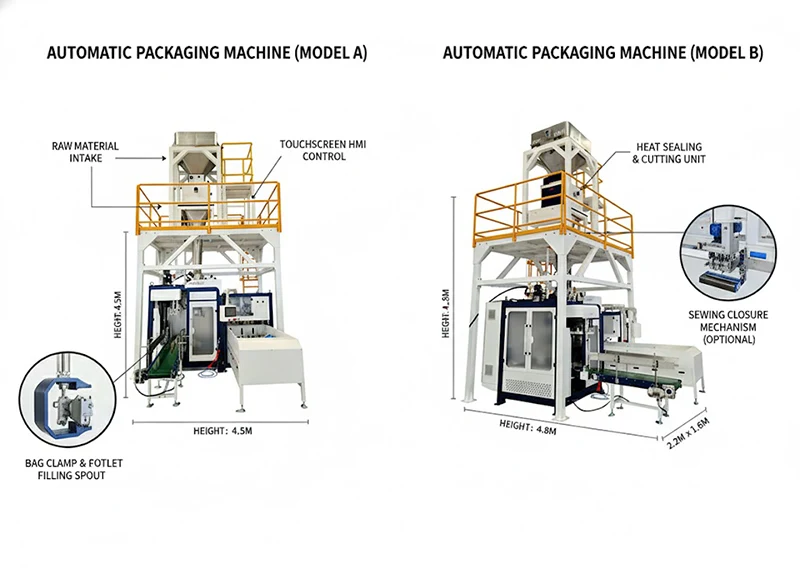
    The third image adds the equipment logic that ties the whole line together. The 3D render of automatic packaging machine models A and B shows HMI control, heat sealing, and an optional sewing closure. That combination is important because the line can be tuned to different bag specs and closure methods without changing the overall layout discipline.

    At a glance, the system is built around a clear chain: storage feed, controlled transfer, stable bag positioning, and closure. The photo set supports that chain from two angles. The high-angle plant shot proves the line can run in a real warehouse environment. The transfer-machine image shows the guided bag movement. The internal close-up shows how the bag is held and guided before it moves on. The 3D model shows the control and closure options that make the layout flexible for different output targets.

    Issue seen on old linesWhat the ppline setup showsResult on the floor
    Bag leaves filling station skewedGuide rails and motorized belt keep the sack centeredLess manual straightening before sewing
    Bag body drifts during transferVacuum suction cups and placing arm hold orientationCleaner handoff into the next station
    Different closure requirements across jobsHMI-controlled model with heat sealing and optional sewing closureOne packing line can cover more sack specs
    3D render of automatic packaging machine models A and B with HMI, heat sealing, and optional sewing closure

    Need a sack line that stays square before sewing?

    Send BPM your bag weight, target output, closure method, and discharge height. We will map the ppline layout around the real handoff problem instead of forcing your warehouse to absorb extra rework.

    Ask BPM for a line layout
  • Bulk Bagging Line for Steadier Woven-Sack Handoffs Before Sewing

    Bulk Bagging Line for Steadier Woven-Sack Handoffs Before Sewing

    dry bulk products packaging line

    Bulk Bagging Line That Kept Woven-Sack Handoffs Steady Before Sewing

    A grain warehouse needed a cleaner way to move filled woven sacks from dosing to sewing and palletizing. The ppline solution focused on stable gravity dosing, a guided bag path, and a discharge conveyor that reduced last-meter bag drift.

    Automatic bulk bagging machine with hopper feed, gravity dosing, HMI touchscreen, and bag sealing and stitching unit for bulk products

    1) The customer problem: bulk sacks were arriving too loose for the sewing station

    The site was handling dry bulk products in woven sacks, and the bottleneck was not filling alone. The trouble started after discharge. Bags were leaving the filling point with slight mouth distortion, uneven top shape, and too much operator correction before sewing. Every correction added time, dust exposure, and avoidable handling.

    That is exactly where a packaging line has to do more than weigh product. It has to keep the sack path predictable from hopper feed to final handoff. For a warehouse working under daily loading pressure, a stable transfer matters as much as the fill itself.

    Dual-view technical CAD blueprint of automatic bagging machine showing bag magazine, robot arm, and bag guide
    Pain point

    Manual bag straightening and an unstable transfer path were slowing down the sewing point, creating rework, and making every shift more dependent on operator skill than on machine repeatability.

    2) Why this ppline fit the job

    The selected machine concept matched the customer’s workflow because it combines hopper feed, gravity dosing, HMI control, and a controlled bag discharge path in one line. The machine family shown in the product images supports 300-500 bags per hour and covers both 10-50 kg and 25-100 kg bag ranges, which makes it practical for different bulk-product SKUs without rebuilding the whole line.

    Just as important, the structure is built for alignment. The bag magazine, bag guide, and gripper area keep the woven sack in a fixed path instead of letting it swing or twist before the next station. That is what makes the line useful for dry bulk packaging jobs where the top seam has to be clean and repeatable.

    What the structure solves: guided bag presentation, steadier top-mouth shape, and less handling between dosing and sewing. In practice, that means the operator spends less time correcting each sack and more time keeping the line moving.

    3) Structure, parameters, and image evidence that support the result

    The line architecture is not decorative. The elevated steel frame creates room for the weighing and filling section, while the side conveyor and discharge section keep the filled bags moving in one direction. The CAD view confirms the modular layout: bag magazine, robotic placing arm, and bag guide are arranged to protect the mouth of the sack during transfer.

    The 3D machine view adds the main industrial details the customer cared about: HMI touchscreen operation, optional sewing closure, and a rigid frame that is easier to integrate into a plant layout. For bulk products, that matters because the packaging machine is not only a filler; it becomes part of the handling system that protects the final package before shipment.

    3D render of automatic packaging machine models A and B with HMI, heat sealing, and optional sewing closure
    3D CAD rendering of modular secondary bagging line with accumulation belt, large bag gripper, and discharge conveyor
    Customer issueLine response
    Bag mouth drift before sewingBag guide, gripper area, and controlled discharge path keep the sack aligned.
    Manual straightening slows the shiftStable transfer reduces corrective handling and frees the sewing station.
    Different SKUs need flexible output300-500 bags per hour and 10-50 kg / 25-100 kg coverage support multiple bulk-product jobs.
    Plant integration must stay clean and modularElevated frame, conveyor discharge, and modular bagging layout simplify installation.

    Final result: a cleaner handoff and a more predictable packing floor

    For this grain operation, the value was simple: less bag rework, steadier sewing preparation, and a packaging line that could keep up without depending on constant manual correction. That is the practical difference between a basic filler and a true packaging line for dry bulk materials.

    Request a bulk-products packing proposal
  • How a Bulk-Products Packing Line Kept Woven-Sack Transfer Steadier Before Sewing

    How a Bulk-Products Packing Line Kept Woven-Sack Transfer Steadier Before Sewing

    Bulk-products packing line / warehouse transfer

    How a Bulk-Products Packing Line Kept Woven-Sack Transfer Steadier Before Sewing

    A Southern grain operator needed a cleaner way to move filled sacks from the bagging station into the next step without constant hand-straightening, edge snags, or uneven bag posture. The answer was a ppline layout built around stable conveying, controlled bag support, and a compact operator-friendly transfer zone.

    High-angle operational photo of QZK-1200 bagging plant featuring twin stainless steel storage silos, conveyors, and active forklifts.

    From a busy warehouse floor to a steadier sack handoff

    The customer’s situation was straightforward: bulk products were already being packed, but the filled woven sacks were not leaving the station in a stable condition. Bags arrived at the next step with a skewed mouth, a soft belly, or a slight twist after discharge. That sounds minor on paper, but in a real warehouse it creates three direct costs: extra manual correction, slower sewing, and a greater chance of scuffed corners or spilled product at the transfer point.

    That is where the ppline approach made sense. Instead of treating packing, transfer, and downstream handling as separate jobs, the line was organized as one controlled flow. The filled sack leaves the bagging unit, settles on the outfeed, and moves through a transfer zone that keeps the sack posture predictable. For an operator, that means less grabbing, less rotating, and less re-positioning by hand.

    Close-up internal photo of bagging unit with vacuum suction cups, robotic placing arm, green conveyor, and white woven bag.
    What was broken in the old setup

    Old transfer layouts usually fail for the same reason: the bag is released, but it is not yet controlled. If the belt speed, support height, or clamp release timing is off, the sack starts moving before it is fully formed. The result is a transfer that looks acceptable from a distance but creates friction for sewing, palletizing, and inspection.

    Why this ppline configuration fit the job

    The line matched the customer’s needs because it solved the weak point at the exact place where the problem appeared. The bagging unit keeps the sack aligned with vacuum-assisted placement and a compact support structure. The conveyor section then carries that sack without forcing a hard drop or an abrupt turn. On a bulk-products line, that matters more than a big headline capacity number, because stable handoff keeps the downstream rhythm intact.

    From the visual evidence, the machine is not just a generic conveyor package. The internal close-up shows a controlled bagging area with vacuum suction cups, a placing arm, and a green belt carrying a woven sack through the transfer path. That structure is exactly what reduces the need for manual straightening and helps the bag mouth stay square before the next operation.

    Practical takeaway: the main improvement is not only packing speed. It is consistency. When each sack leaves the station in a repeatable position, the sewing operator, the pallet stacker, and the forklift team all work with fewer interruptions.

    Structure, proof points, and the end result

    The photo set gives the structure proof. The high-angle plant image shows a full warehouse environment with storage silos, conveyors, and active forklift movement, which is the right background for a bulk-products packing line that must serve real logistics pressure, not just a clean showroom. The close-up machine image shows the transfer mechanics. Together, they support the same conclusion: the system was built to keep the sack path calm from discharge to next-handling step.

    For this customer, the result was a cleaner operation sequence. Operators spent less time correcting sack posture, the sewing step received more consistent bag presentation, and the packing zone became easier to keep orderly during peak throughput. In other words, the line did not merely pack bulk products; it reduced the friction that usually appears between packing and downstream handling.

    Technical CAD drawing of bag clamping and bottom support assembly with pneumatic cylinders, servo motor, and Russian annotations.
    Issue in the old workflowWhat the ppline layout changed
    Bag mouth drift after dischargeVacuum-assisted placement and tighter support keep the sack aligned
    Manual straightening before sewingMore repeatable sack posture reduces hand correction
    Busy transfer zone at peak outputStable belt movement makes the packing-to-handling handoff smoother

    Need a bulk-products packing line that stays steady at the transfer point?

    If your warehouse is losing time to sack straightening, uneven transfer, or awkward downstream handoff, we can map the flow and recommend a ppline layout around your product, bag size, and output target.

    Request a packing-line layout review
  • How a Bulk-Products Packing Line Reduced Sack Rework in a Southern Grain Warehouse

    How a Bulk-Products Packing Line Reduced Sack Rework in a Southern Grain Warehouse

    BULK PRODUCTS / BAGGING LINE

    How a Bulk-Products Packing Line Reduced Sack Rework in a Southern Grain Warehouse

    A southern grain warehouse operator needed a cleaner way to move woven sacks from filling to sewing without crooked bags, handoff delays, or forklift congestion. The ppline setup combines a steel bagging tower, guided outfeed, and enclosed controls to keep the flow steady from the first fill to the final pallet.

    Dual-view technical CAD blueprint of a bulk-products bagging line showing the bag magazine, operator interface, and transfer structure

    What was going wrong on the old line

    The warehouse had a familiar problem: once the bags left the filling point, they were no longer easy to control. Some sacks arrived at sewing slightly twisted, some lost shape during the short transfer, and the team spent time straightening them by hand before the next station could continue. That extra handling slowed the shift and created avoidable wear on the bags.

    Forklift traffic made the issue worse. When filled sacks were moved in batches instead of a stable stream, the aisle around the packing area became crowded, and the crew had to choose between speed and order. The result was not a machine failure; it was a transfer problem between filling, guiding, and stacking.

    High-angle operational photo of a bulk-products bagging plant with storage silos, conveyors, and warehouse forklift movement
    The real pain point

    The bags were not failing at filling. They were failing at handoff. If a line cannot keep sacks square and predictable after discharge, the whole packing area turns into a rework station.

    Why the ppline structure fit this job

    The ppline layout matches this kind of bulk-products workflow because it gives the packing area a rigid frame, a controlled discharge path, and a compact operator side. The bagging tower keeps the machine body stable, the enclosed cabinet protects the electrical side, and the swing-arm control position lets operators monitor the run without crowding the transfer zone.

    Inside the unit, the bagging mechanism uses guided holding and suction-assisted positioning to keep each woven sack aligned before it leaves the station. That is the difference between simply filling a bag and delivering a bag that is still ready for the next process. The photo of the operating station shows the safety cage ladder, conveyor path, and live work area together, which is exactly what a warehouse team needs when continuity matters more than cosmetic appearance.

    Practical takeaway: when the discharge path is stable, the team spends less time correcting bag shape and more time moving finished product.

    Eye-level photo of an operating bulk-products bagging station with safety ladder, conveyor, and operators stacking sacks

    What the structure, parameters, and images prove

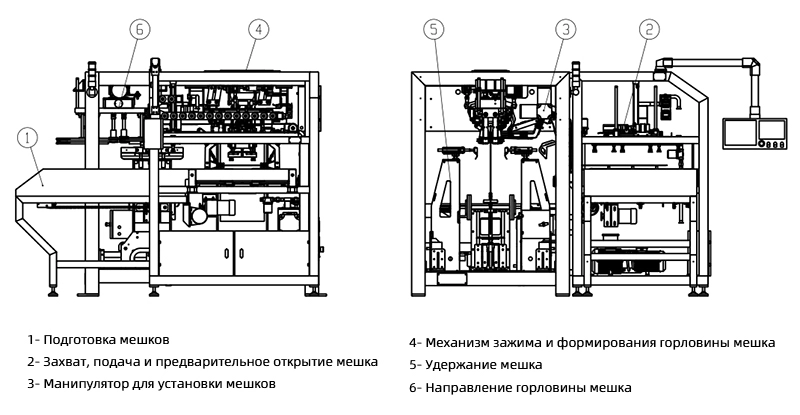
    The design evidence is visible in the drawings and in the field shots. The CAD view shows the bag magazine, the transfer arm, and the discharge arrangement as one controlled assembly. The factory photo confirms that the line is not a concept-only layout; it is built for real warehouse movement, with pallet handling, conveyor routing, and operator access all planned into the same space.

    This matters for bulk products because the packaging area has to do three things at once: keep the bag shape intact, avoid unnecessary manual straightening, and maintain a clean handoff to sewing or palletizing. The close-up internal image shows the suction cups, the positioning arm, and the conveyor relationship in one frame, which is the clearest proof that the system is designed around controlled transfer rather than loose discharge.

    Close-up internal view of a bagging unit with vacuum suction cups, positioning arm, and green conveyor for woven sacks
    Warehouse problemppline responseOperational result
    Crooked sacks before sewingGuided discharge and controlled bag holdingCleaner handoff with less manual straightening
    Congestion around filling and stackingRigid tower layout and planned conveyor flowClearer aisle control and smoother material movement
    Inconsistent transfer qualityVacuum-assisted positioning and enclosed control zoneMore stable process repeatability across shifts

    Need a steadier bulk-products packing line?

    If your warehouse is still correcting woven sacks by hand after filling, the next step is to tighten the transfer structure, not just the filler. A ppline layout can be matched to your product, bag type, and downstream sewing or palletizing flow.

    Request a line review
  • How a Southern Grain Warehouse Stabilized Woven-Sack Handoff Between Filling and Sewing

    How a Southern Grain Warehouse Stabilized Woven-Sack Handoff Between Filling and Sewing

    Dry-bulk bagging in practice

    How a Southern Grain Warehouse Stabilized Woven-Sack Handoff Between Filling and Sewing

    A grain warehouse in southern Russia needed a cleaner way to move filled woven sacks off the bagging station, keep them square for sewing, and hand them over to palletizing without constant rework. The answer was not a single machine upgrade, but a line layout that matched the sack, the conveyor, and the operator’s real workflow.

    High-angle operational photo of QZK-1200 bagging plant featuring twin stainless steel storage silos, conveyors, and active forklifts.

    Why the transfer point was the real bottleneck

    The warehouse did not struggle with filling alone. The hard part started after discharge, when a woven sack still needed to stay flat, align with the next conveyor, and reach the sewing station without twisting. If a bag lands crooked, the operator spends time straightening it. That slows the whole line, increases dust exposure, and makes the pallet stack less predictable.

    The installed bagging line was built around that exact handoff. The elevated steel frame gives the station a stable working height, the outfeed conveyor keeps the bag moving in a controlled direction, and the surrounding safety cage and ladder make maintenance and access predictable instead of improvised. In other words, the layout is not just for show; it removes the small interruptions that usually become daily losses.

    Eye-level photo of operating QZK-1200 bagging station with steel safety cage ladder, conveyor, and operators stacking sacks.
    Common pain point

    A filled sack that is even slightly off-square can turn sewing into a manual correction step. Once that happens, throughput drops and the line becomes operator-dependent.

    What the machine structure solves before the bag reaches the next worker

    The technical drawing matters because it shows where the control points live. The bag magazine, suction placing arm, bag guide, and swing-arm HMI are not separate features; they work together to keep the bag path repeatable. A bag that is picked, opened, filled, and released in a controlled sequence is far less likely to arrive folded or skewed.

    That is the practical value of a QZK-1200-style layout for bulk products. It gives the warehouse a stable transition between filling and sewing, while keeping the operator focused on monitoring instead of fighting bag position. For a site handling dry bulk materials, the biggest gain is usually not a dramatic speed jump on paper. It is the removal of the micro-delays that stack up across a shift.

    Operator insight: when the bag guide and suction placement stay consistent, the sewing station sees fewer corrections, the palletizing side receives a more regular load, and the whole line feels calmer.

    Dual-view technical CAD blueprint of automatic bagging machine showing bag magazine, robot arm, and Russian component annotations.

    The details that protect woven sacks during transfer

    The close-up internal view is where the article becomes more than a layout story. You can see the vacuum suction cups, the green conveyor, the robotic placing arm, and the height-adjustment handwheel working as one mechanical language. Those details matter because woven sacks are forgiving in volume but not forgiving in handling. If the placement point is too high, too low, or too loose, the bag shape changes before it reaches sewing.

    With the right adjustment range and a visible handwheel reference, the line can be tuned to the real sack behavior on site. That helps when material flow changes slightly, when product density varies, or when the bag surface is dusty and less stable in the gripper. The result is a steadier outfeed, fewer manual repositions, and a cleaner bridge to palletizing.

    Pain pointLine featureResult on site
    Crooked bag after fillingBag guide and suction placement sequenceMore square sacks at sewing
    Unstable transfer between stationsControlled outfeed conveyor and elevated frameLess rehandling by operators
    Frequent manual correctionAdjustable HMI-controlled workflowMore repeatable daily throughput

    For bulk product plants, that is the real win: the line does not merely fill sacks. It keeps them usable for the next operation, which protects labor time, improves stack quality, and makes the whole packaging room easier to run.

    Need a cleaner woven-sack handoff for your bulk packing line?

    If your current station is spending too much time straightening sacks before sewing or palletizing, we can help you review the layout, the bag path, and the transfer points around your product and floor plan.

    Talk to BPM
  • Mipline Powder Packaging Line for Stable 25 kg Bag Handoff Before Sewing in a Belarus Dairy Plant

    Mipline Powder Packaging Line for Stable 25 kg Bag Handoff Before Sewing in a Belarus Dairy Plant

    Powder Packaging Line Application

    Automatic Powder Packing Machine for Cleaner 25 kg Bag Handoff Before Sewing in a Belarus Dairy Plant

    For a Belarus dairy powder producer, the key issue was not filling speed alone. The last meters before sewing were creating unstable bag mouths, manual bag straightening, and avoidable variation on 25 kg kraft paper bags. This Mipline powder packaging line uses an enclosed stainless steel automatic bagging machine, guided conveyors, and stable bag transfer logic to keep bags square before sewing and reduce manual correction at the end of the line.

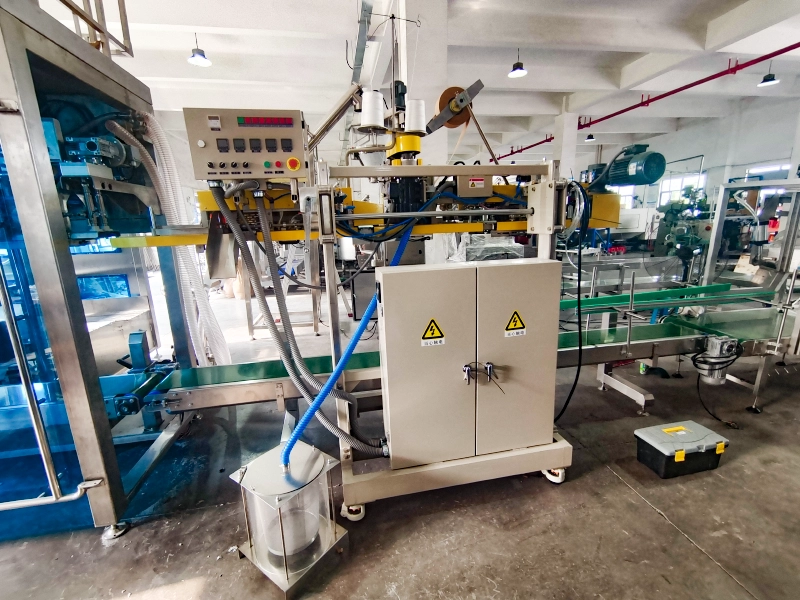
    Real factory shot of a Mipline automatic bagging station with conveyor, control cabinet, and vacuum hose for automatic powder packing machine setup

    Customer scene: dry milk powder packed into 25 kg industrial bags

    The application fit a typical dairy powder bagging line: dry product, repeated 25 kg bag format, and a production team that needed the powder bagging line to stay clean, guarded, and predictable around the filling and sewing handoff. In this kind of plant, operators usually watch the final bag path closely because even a small skew at the bag mouth can affect sewing consistency and downstream handling.

    Instead of relying on open transfer points and operator intervention, Mipline is arranged as an automatic powder packing machine with a stainless steel enclosed bagging station, visible control access, and a connected conveyor path. That matters for food powder packaging because the line must balance automation with cleaner structure, inspection visibility, and easier coordination between bag pickup, filling, conveying, and sewing.

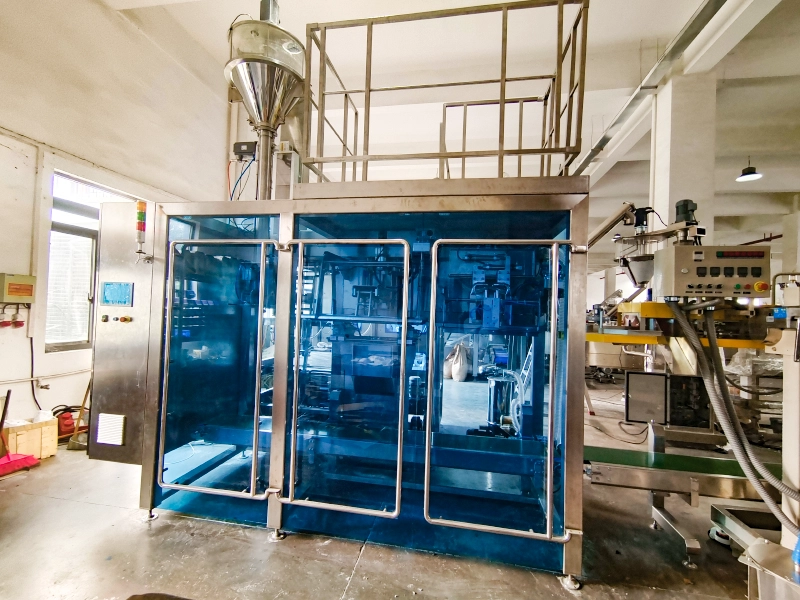
    Stainless steel automatic bagging station with blue safety enclosure, top hopper, and control cabinet for cleaner 25 kg powder bagging line operation
    Old line problem

    On many older powder bagging layouts, the filled bag twists or softens before sewing, so operators manually straighten the last meter, hold the bag mouth, or re-square the bag body before it reaches the sewing head.

    Why the old transfer method caused unstable bag mouths before sewing

    When a 25 kg bag leaves the filling point without enough guidance, the bag body can rotate slightly, collapse at one side, or arrive with an uneven top edge. That creates exactly the buyer problems common in milk powder packaging machine projects: unstable sewing head entry, manual bag straightening, and reduced line calmness at the handoff point. The issue is not only the filler. It is the transition logic between bag holding, release, and conveyor control.

    Mipline addresses that point directly. The product is not presented as a generic conveyor add-on, but as a powder packaging line with guided conveyor handoff and bag clamp alignment built into the process path. The enclosed automatic bagging station supports cleaner operation at the filling area, while the linked transfer path is intended to reduce uncontrolled bag movement before sewing. For dairy powder, flour, or starch powder packaging, that means a straighter bag presentation and less dependence on manual correction.

    Engineering note: In powder filling and bag sewing line layouts, the most expensive small problem is often the unstable last handoff. A steadier bag mouth before sewing improves not just seam appearance, but also line rhythm, operator workload, and reject prevention.

    What made Mipline the right fit: enclosed structure, guided transfer, and visible evidence on the line

    The visible machine evidence supports the selection. The bagging station uses a stainless steel enclosed body with blue inspection windows, integrated conveyor interfaces, and control access suited to food-oriented dry powder packaging equipment. The line layout also shows multiple conveying stages rather than a loose discharge point. That is important because stable bag transfer before sewing depends on how the bag is supported after filling, not only on the bagging head itself.

    On the transfer side, the line uses modular conveyor sections and guided movement to keep 25 kg bags square before sewing. The factory-floor image of connected transfer conveyors shows why this matters in practice: the bag path is controlled, the handoff is calmer, and the operator does not need to keep correcting each bag at the final approach. For a buyer comparing automatic bagging machine for powder options, this is the difference between simple automation and process-ready automation.

    Observed requirementMipline evidence on this projectExpected result
    Cleaner food-powder line layoutStainless steel enclosed bagging station with inspection windows and guarded accessMore controlled powder packaging area and easier visual inspection
    Stable bag transfer before sewingConnected conveyor path with guided handoff between bagging and downstream sectionsReduced bag twisting and cleaner bag alignment before sewing
    Less manual bag straighteningAutomatic bagging machine structure plus conveyor-based bag support after fillingLower operator intervention at the last meter of the line
    25 kg dairy powder bag compatibilityIndustrial bagging layout shown handling kraft paper powder bag applicationsMore repeatable bag presentation for sewing and palletizing
    Factory-floor photo of automated packaging conveyors and steel frames showing guided transfer before sewing on a powder packaging line

    Result: steadier powder bagging with less correction before sewing

    For this Belarus dairy application, the value of the Mipline powder packaging line is clear: the customer gets an automatic powder packing machine designed around cleaner bag handoff before sewing, not just bag filling in isolation. If your project also involves milk powder, flour, starch, or other dry powder packaging in 25 kg bags, BPM can help map the right bagging station, transfer conveyor, and sewing handoff configuration for your line.

    Talk to BPM about your powder bagging line